The bag is packed before the reason is.
You buy the ticket first. You ask questions later.
The flight is at 6 AM. You haven’t slept. You don’t want to.
Something in you already knows that sleep belongs to the life you’re briefly leaving behind.
When we step out of our everyday environments and routines, we undergo a temporary rearrangement of our identities – one that lets us imagine other possibilities for ourselves. This rearrangement is not an escape. It is a revelation. It was always about who you were planning to leave behind when you got there. Not another person. Not a city. A version of yourself that had quietly become a costume – worn so long it had started to feel like skin. The departure gate was always a mirror. The flight was always a question. The landmark was always the backdrop for an interior conversation that had been asking for a stage for years.
1. The Temporary Identity
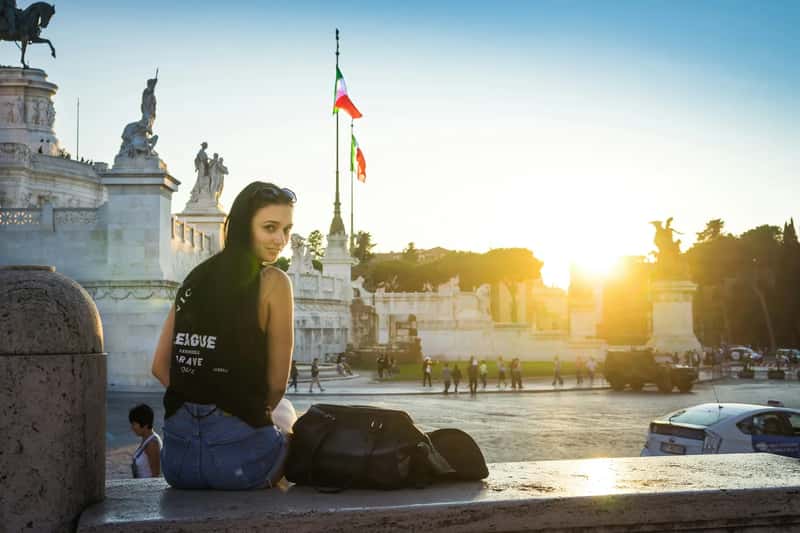
The moment you leave your city, something loosens.
Not your grip on things. Your grip on yourself.
The self you carry in your daily life is not your whole self. It is a highly edited version – shaped by years of feedback from people who needed you to be consistent, reliable, and legible to them. The colleague who expects punctuality. The parent who expects a version of you that stopped being accurate years ago. Travel suspends all of that editing, at least temporarily. You become a rough draft again. Unfinished. Correctable. This is terrifying to some people and deeply attractive to others. The traveler who keeps moving isn’t running from something, necessarily. They may simply be addicted to the relief of being a rough draft in a world that constantly demands a final copy. In many ways, we use travel to experiment with different aspects of our identity. We might try new activities, speak a different language, or find ourselves in a setting where we’re not defined by our usual roles. That is not escapism. That is rehearsal.
2. The Exit Strategy
Nobody leaves home for the reason they say out loud.
“I needed a change of scenery” is the polite version.
The honest version is harder to say at dinner parties.
Away from familiar roles, expectations, and the constant pressure of how you should be, people finally get to meet who they actually are. That is what the exit strategy is really for. Not the Instagram grid. Not the passport stamps. Not the Airbnb with exposed brick and local coffee. The exit strategy is a controlled experiment: what remains of me when everything familiar is removed? Most people are surprised by the answer. Some are devastated. Leaving our home, community, and cultural background and adapting to a new environment can be challenging and lead to feelings of identity confusion and loss. But that confusion is not a malfunction. It is the system working exactly as it should. The confusion is data. Read it carefully.
3. The Dopamine Architecture
Your brain is not neutral about novelty.
It never was.
When we step into unfamiliar territory, something remarkable happens inside our heads – a profound neural awakening that forms the foundation of travel transformation. Your brain loves novelty, and travel delivers it in abundance. That neural hit is real and measurable and deeply seductive. For frequent travelers, the thrill of discovering something new can become addictive. The chemical response can create a feedback loop: the more we travel and experience novelty, the more we seek it. It’s no surprise, then, that many wanderlust-driven individuals feel the need to keep exploring in order to maintain that “high” from fresh experiences. What nobody tells you is that the hit is finite. That the cathedral eventually becomes another cathedral. That the voltage drops. That you start chasing the first time you ever stood somewhere and felt the specific electricity of the new, and you begin to understand that the dopamine architecture of travel is, in the end, a beautiful and honest trap.
4. The Room With No History
The hotel room is the most honest space you will ever occupy.
It was cleaned for a stranger. That stranger is you.
It was cleaned for a stranger. It was designed for no one specifically and therefore offends no one psychologically. You walked in and, for the first time in months, nothing in the room already knew your name. That is not a small thing. That is everything. And yet, for many people, that blankness cracks something open. As a hotel guest, the things we often use to define ourselves – the country, city, home, family and friends, pets, jobs – are no longer immediate. When these things are sucked away like water draining out of a bathtub, we’re left exposed, uncomfortable, vulnerable. This is the grief that lives underneath the joy. This is the sudden, quiet despair of a Tuesday night in a room where the walls hold no memory of you and the art was chosen by committee and you realize, with a clarity that is almost violent, that without your context you are just a body in a bed. The room with no history has always been a mirror. Most people just look away fast enough to avoid seeing what’s in it.
5. The 3 Am Inventory
I know this room.
I have been in this room in a dozen different cities.
Same hum of the HVAC. Same narrow slant of light under the door. The particular silence of a corridor that doesn’t know or care what you’re going through.
I once sat in a hotel room in a city I had genuinely wanted to visit for years and felt nothing. The landmark had been magnificent that afternoon. The food was precisely what I had hoped for. And then I was back inside four walls with no photographs on them, no coffee cup with a ring stain on the counter, no dog asleep at the foot of the bed – and something in me tipped sideways. Not grief, exactly. More like the recognition that I had been running a low-grade fever of dissatisfaction for a long time, and the room had just taken my temperature honestly. The stillness of a hotel room forces us to confront ourselves. At home, a never-ending list of chores and distractions keep us busy and entertained – distracted from our inevitable mortality. That night, I understood the truth of why I had left. It wasn’t the landmark. It was the inventory. The ruthless, inescapable 3 AM inventory of a life in progress.
6. The Stripping of the Road
Travel has a way of removing you from yourself in layers.
First your routine goes. Then your role. Then your name means nothing to anyone.
The road strips away our titles, routines, and labels. In that void, we meet ourselves – not the curated version, but the raw, evolving self. This is the part the travel brochures never feature. The raw self is not always photogenic. The raw self is sometimes frightened. Sometimes it is angry in ways it cannot explain and quiet in ways that feel permanent. Time away from a familiar environment creates space to question culturally inherited ideas of identity. Solo travel across unfamiliar cultural contexts can create the psychological conditions for listening to an inner voice rather than external expectation. That inner voice has been trying to speak for years. Most of us only hear it when the external noise is finally cut. The road cuts it. The empty room amplifies it. And most of the time, what it says is not what we expected to hear.
7. The Reverse Culture Shock
Nobody warns you about coming home.
They warn you about customs lines and jet lag and lost luggage.
Nobody mentions the specific grief of returning to a life that didn’t wait for you to finish changing.
While solo travel can often result in a profound change within the individual traveler, the real challenge may start when you come home from your travels. The certainty, independence, and outlook acquired in life may just not fit in with your daily routines. The feeling of discontent when daily routines are resumed may deepen the feelings of disconnection in your life. It is commonplace to describe this as “reverse culture shock.” You stand in your own kitchen and feel like a tourist. The coffee maker is familiar. The light through the window is the same light it always was. But you have been somewhere. You have briefly been someone with no fixed coordinates, and the re-entry into the fixed coordinates is its own kind of vertigo. Some people have described this feeling as “post-travel depression,” where you miss not a place, but a person you became while travelling. That is, perhaps, the most precise and devastating definition of the cost of movement ever written.
8. The Comfort of Displacement
Some people are more comfortable being displaced than being placed.
This is not a pathology. It is a personality. Possibly a vocation.
Sometimes single, other times in a relationship, the eternal transience suits some travelers at the start. It was fun, for a few years, until suddenly it wasn’t. That “suddenly” is important. It is the moment when the comfort of displacement meets its own ceiling. When the freedom of having no fixed address begins to feel less like liberation and more like loss. Lorraine’s displacement was of a different nature; she grew up out of place, with no deep roots in any of the cultures she was surrounded by. There is a particular kind of person who uses movement as insulation. Who has learned to treat every city as a soft place to land without ever requiring that it become a home. For a while, this works. It works beautifully. Until the question arrives – not dramatically, not in a crisis, but quietly, on a Tuesday – of where, exactly, you would go if you needed to be held by something permanent.
9. The Landmark and the Mirror
You photograph the landmark. You do not photograph your face while looking at it.
But that face is the document.
We all carry internal stories about who we are and what we’re capable of. Travel provides the perfect opportunity to revise these narratives in powerful ways. The landmark – the cliff, the ancient city, the bridge at the hour when the light changes color – is not the point. It is the prompt. It asks you something by its sheer existence. It says: here is something that outlasted everyone who ever stood where you are standing. What will you outlast? Travel creates opportunities to shift your personal narrative by infusing new stories and anecdotes into your life story. These experiences become pivotal chapters in how you understand your own development. The joy of the new landmark is real. But the joy is not about the landmark. It is about the version of yourself that materialized in front of it, briefly unguarded, briefly unedited, briefly capable of being genuinely astonished. That version is worth knowing. Most of us have to travel thousands of miles just to meet them.
10. The Weight of the Return
You come back different.
The door key still works. The neighborhood still smells the same. But the fit is off now. A millimeter. Enough to feel it.
The emptiness of returning from travelling is not a simple feeling of nostalgia and space. The emptiness may also be a sign of just a small expansion of your identity that can’t fully be embraced in your past context. This is the heaviest truth of travel. Not the departure. The return. The expansion that happened quietly in the dark of a foreign city is now too large for the container you left behind. You have to renegotiate everything – what you want, what you tolerate, who you are willing to keep performing for. For many, relocation is where identity stops being theoretical and becomes visceral. You no longer live by default – you begin living by intention. That is the gift hidden inside the grief. The gift is not a postcard version of yourself standing in front of something beautiful. The gift is the brutal clarity that arrives at customs, before you’ve collected your bags, when you look at the arrivals board and understand – with a precision that no landmark ever gave you – exactly which version of your life you are and are not willing to return to.
The question was never really about where you were going.
What travel strips from you, if you let it, is the performance. What it gives back, if you’re willing to sit in the discomfort of the room with no history and not immediately reach for your phone, is something that looks a lot like the truth of your own life – unfiltered, unframed, and quietly, devastatingly yours.
The bag will be packed again soon enough. You already know this. The question is whether next time, you’ll also bring the courage to sit still long enough in the empty room to hear what you went all that way to find out.