Walk through a maternity ward in Seoul or Taipei these days and you might notice something odd: there’s more staff than babies. That’s not an exaggeration so much as a reflection of a demographic shift that’s been building for decades and has now reached a point where entire nations are structurally short on the one resource every economy eventually depends on – young workers, young taxpayers, young parents.
Some of these countries have thrown enormous sums of money at the problem. Others have barely started to grapple with it publicly. What follows is a ranked look at the six nations where the youth shortage is most severe, based on the latest fertility, birth, and aging data available through 2026.
1. South Korea: The world’s most extreme case

No country illustrates the scale of this crisis better than South Korea. In 2023, the birth rate fell for the eighth consecutive year to 0.72, the lowest in the world, from 1.24 in 2015. Since 2018, South Korea has been the only member of the Organisation for Economic Co-operation and Development with a rate below 1. Seoul, the capital, has it even worse than the national figure suggests.
Across the country, the birth rate last year was the lowest in the capital, Seoul, at 0.58. There’s been a modest turnaround lately, though. By 2025 the rate had climbed back to 0.80, up from 0.75 in 2024, marking the first sustained rise in years. Whether that counts as recovery or just a pause in a longer decline is still an open question among demographers.
2. Taiwan: A sudden fall from boom to bust

Taiwan’s story is almost more dramatic than South Korea’s because of how quickly it unfolded. The shift from “aged society” to “super-aged society” status, which took Japan 24 years and Germany 36 years, took Taiwan just seven years. That’s a striking compression of a demographic transition that most countries experience over a generation or more.
The birth numbers tell the same story from a different angle. Only 107,812 babies were born in Taiwan in 2025, extending a tenth consecutive year of birth decline since 2016, when the figure stood at 208,440. By the end of 2025, Taiwan’s population numbered 23,299,132, more than 100,000 fewer than the previous year, marking the second consecutive year of demographic decline. Geography doesn’t help either, since the island’s density leaves little room for young families to spread out cheaply.
3. Japan: Decades ahead of the curve

Japan was the first major economy to hit this wall, and it’s been living with the consequences longer than anyone else on this list. With a median age of 51.1 years, Japan has a youth dependency ratio of 18.8 and an old-age dependency ratio of 51.4 per 100 people of working age. That means for every two working-age adults, there’s roughly one retiree depending on the system.
The population losses are no longer theoretical. Japan has continued a multi-year contraction, with annual drops exceeding 800,000 at points. The share of the young demographic, those aged 0 to 15, sits at just 11.4% of the population. Japan’s experience has become something of a preview for everyone else on this list, which is a sobering thought.
4. Italy: Europe’s oldest nation

Italy holds the distinction of being one of the oldest societies in Europe, and the numbers back that up clearly. Italy is ranked 4th out of 196 countries by median age, from oldest to youngest. The median age in Italy stands at 48.8 years. That places it just behind Japan in the global rankings of societies tilting heavily toward older generations.
Children are becoming a smaller and smaller slice of the population. The share of the young demographic, those aged 0 to 15, in Italy is only 11.9%. The average number of children born to each woman is 1.2 in Italy, the same as in Japan. Rural towns across the south have been especially hard hit, with schools closing for lack of enrollment.
5. Spain: The quiet crisis

Spain doesn’t get the same headlines as South Korea or Japan, but its trajectory is just as steep. South Korea, Taiwan, Japan, Italy, and Spain rank among the most affected countries, with total fertility rates hovering between 0.7 and 1.3 children per woman, levels that lead to each generation being roughly half the size of the previous one when sustained. That’s a fairly blunt way of putting it, but it captures the mechanics well.
Women have gained expanded educational and professional opportunities, while urbanization and higher living costs reshape family decisions in Spain and similar countries. Cultural shifts toward later marriage and smaller households compound the effect further. Spanish cities like Madrid and Barcelona have seen young professionals delay both marriage and children well into their thirties, a pattern that’s become the norm rather than the exception.
6. China: Aging at an unprecedented scale
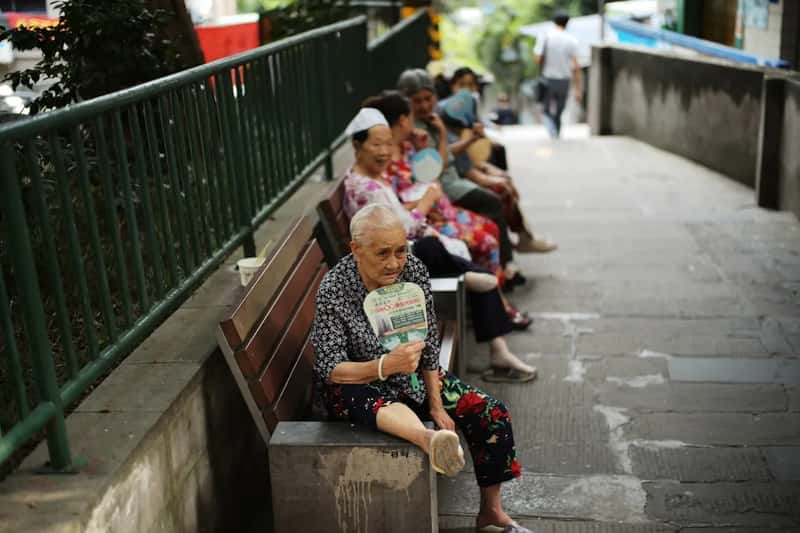
China’s situation is different mainly because of sheer size. What’s happening there isn’t a slow drift but a fast unwinding of decades of population growth. Five of the world’s ten largest countries have fallen below the replacement fertility rate, and China now has one of the lowest fertility rates in the world, at just 1.0 birth per woman as of 2023. That’s a level once considered unthinkable for a country of well over a billion people.
The absolute numbers are staggering even if the rate itself resembles other countries on this list. China alone saw a reduction of roughly 3 million people in a recent year, an absolute loss larger than the entire population of some smaller nations. Recent annual figures indicate net reductions in the millions for China, placing it at the forefront of absolute population losses globally, driven by sustained low fertility and shifts from prior policies. Given the scale involved, China’s demographic shift may end up reshaping global labor markets and supply chains more than any single country’s decline on this list.