Every year, moving companies and researchers publish data on where Americans are packing up their lives and where they are choosing to stay put. While headlines love to focus on the states people are fleeing, a quieter and arguably more interesting story is happening in the states people almost never leave. These are places where affordability, community, safety, and opportunity combine into something that feels less like a place to pass through and more like a place to plant roots.
Using data from the Federal Reserve Bank of Dallas on native-born retention, WalletHub’s happiness and livability rankings, U.S. News & World Report’s Best States report, and United Van Lines’ annual migration study, a clear pattern emerges. The states below consistently show up as places where residents stay for decades, often for life, even when cheaper or sunnier alternatives exist elsewhere.
Texas: The Stickiest State In America

No state holds onto its native population quite like Texas. According to Federal Reserve Bank of Dallas research based on American Community Survey data, about 82 percent of people born in Texas still live there, the highest retention in the nation.[1] That is a staggering number for a state of its size, and it suggests something beyond simple inertia. Researchers point out that the states with the strongest retention share strong job growth, lower tax burdens, multiple big metros to move between, and large size that makes leaving expensive.[1]
Texas checks every one of those boxes. It has no state income tax, a diversified economy spanning energy, tech, and healthcare, and enough distinct metro areas, from Austin to Houston to Dallas-Fort Worth, that a resident can relocate within the state and still feel like they moved somewhere new. That internal variety may be part of why so few native Texans ever look across the border for something better.
Utah: Purpose Over Postcard Views

Utah rarely tops magazine covers the way Hawaii or California do, yet it consistently ranks among the happiest and most livable states in the country. WalletHub’s most recent happiness rankings placed Utah as the second-happiest state in the United States, ranking first for Work Environment and first for Community & Environment.[2] On top of that, Utah residents not only are hard workers and enjoy their work more than residents of any other state, but they also work the fewest hours, and Utah also has the highest volunteer rate, the lowest divorce rate, and is the fourth-safest state.[2]
The economic backdrop reinforces that satisfaction. Utah has repeatedly landed near the top of U.S. News & World Report’s Best States list, and the 2026 list shows Utah, South Dakota and Minnesota in the top three spots, with Utah having held the No. 1 spot for four consecutive years.[3] There are real trade-offs, including rising home prices along the Wasatch Front and air quality concerns in the winter months, but the sense of forward momentum keeps most residents from seriously considering a move.
North Carolina: Steady Growth Without The Chaos

North Carolina has quietly become one of the most reliable retention stories in the country. Dallas Fed data shows the state trailing only Texas, with roughly three out of four native-born residents choosing to stay, and that stability has been matched by years of strong inbound migration from other states. United Van Lines’ most recent movers study confirms the trend is still building, with North Carolina appearing among the top inbound states including North Carolina (58%)[4] in 2025.
What makes North Carolina distinct is how it balances growth with livability. Cities like Charlotte and Raleigh keep adding jobs in banking, tech, and biotech, while smaller metros like Wilmington remain magnets for retirees and remote workers. United Van Lines even singled out Wilmington, NC (83%)[5] as one of the region’s top destination metros, a sign that the appeal extends well beyond the state’s biggest cities.
Georgia: Retention Meets Everyday Satisfaction

Georgia’s numbers tell a similarly compelling story. Dallas Fed research places its native retention rate at 74.2 percent[1], putting it firmly among the top handful of states nationwide. That is not just a statistic about people staying because they have nowhere better to go. Georgia also performs respectably on broader happiness metrics, and in WalletHub’s 2026 happiness rankings, Georgia landed at number 19 overall, a solid mid-pack showing among all fifty states.[6]
Combine those two data points and the picture becomes clearer. Georgia isn’t chasing the flashiest headlines the way Florida or Texas often do, but it offers a dependable mix of affordability, job growth around Atlanta, and enough regional variety, from mountains to coastline, to satisfy people at very different life stages. That steady, unglamorous consistency may be exactly why so many Georgians never seriously entertain leaving.
Hawaii: Paradise That Lives Up To The Name

Hawaii’s reputation as a happy place is not just marketing. WalletHub’s most recent state happiness rankings found that Hawaii is the happiest state, living up to its reputation as an island paradise, with residents reporting the highest levels of life satisfaction in the nation and the second-lowest depression rate.[7] The health numbers back that up too, since Hawaiians also enjoy great physical health, with around 85% of adults reporting that they are in good or better health, and Hawaiians also have the longest life expectancy in the U.S.[7]
The economic side of the story is just as strong. Hawaii has one of the lowest unemployment rates in the nation, at 2.4%, as well as the second-highest share of households with an annual income above $75,000.[7] None of this erases the very real cost-of-living pressures that residents talk about often, including expensive housing and the challenges tied to being an island economy. Still, for many, the daily rhythm of ocean air, strong community bonds, and a climate that never really turns cold outweighs the financial strain enough to make leaving feel unthinkable.
Minnesota: Prosperity That Reaches Further

Minnesota has emerged as one of the country’s most well-rounded states for everyday life, and the data reflects it from multiple angles. WalletHub’s happiness rankings placed Minnesota as the third-happiest state in the U.S., noting it is the third-safest state in the country, has the third-lowest divorce rate, and the second-highest volunteer rate, with residents known for being some of the friendliest and most-inclusive people in the country, despite having some of the most intense winters.[2]
Family-focused rankings echo the same theme. WalletHub ranked Minnesota the third-best state to raise a family in 2024, citing the high median family salary and low levels of separation and divorce, with the state providing excellent early-education opportunities, high K-12 performance, and one of the lowest poverty levels in the country, at just nine percent of residents living at or below the poverty line.[8] Minnesota also broke into United Van Lines’ top inbound states for the first time in 2025, a sign that word about its quality of life is starting to spread beyond its borders.
Idaho: The Quiet Rise To The Top

Few states have climbed the rankings as fast as Idaho. In WalletHub’s most recent Best States to Live In report, Idaho ranked No. 1 overall, followed by New Jersey, Wisconsin, Massachusetts and New Hampshire, with Wyoming ranking sixth overall and Utah coming in seventh.[9] The state’s appeal is rooted in hard numbers rather than vibes alone, since WalletHub ranked all 50 states across 51 measures of livability, and Idaho stood out for its low taxes, strong income growth, short commute times and low crime rates.[10]
Specific figures back up that reputation. Idaho stood out for its low real estate tax rate, high homeownership rate, low overall tax burden and the highest median household income growth in the nation, combined with a strong quality of life and safety record.[11] That combination has translated directly into migration patterns, with Idaho becoming one of the newest entrants on United Van Lines’ top inbound list. For residents who watched Boise grow from a sleepy state capital into a genuine economic hub, the incentive to leave has only shrunk.
Massachusetts: Security Built On Health And Education
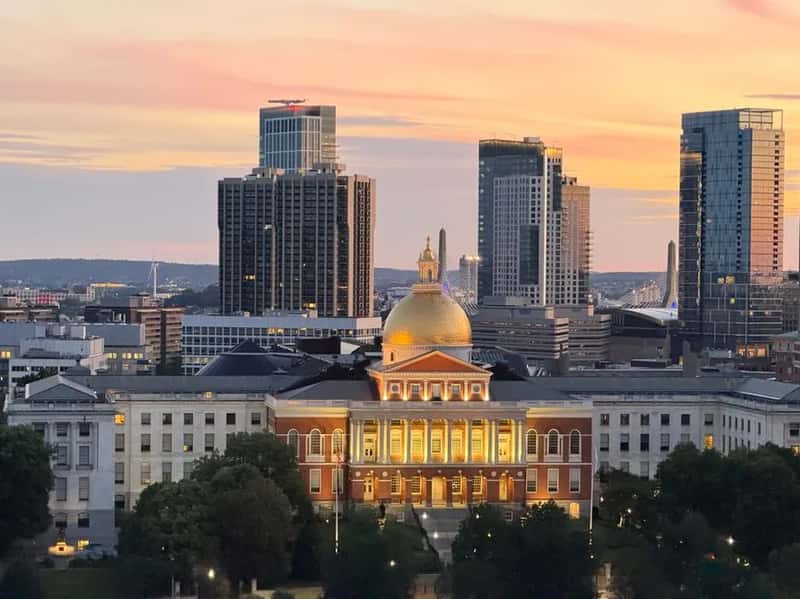
Massachusetts earns its spot on this list largely through the strength of its institutions rather than its climate or cost of living, both of which are notoriously expensive. Massachusetts is the best state to live in, due in large part to its strong healthcare system and high-quality education, with the Bay State having the lowest premature death rate in the country and the fifth-lowest share of adults in fair or poor health, and it also has the highest share of residents with health insurance coverage, at 97.4%.[12]
That security extends into people’s financial lives as well. Good-quality education has helped the state’s residents succeed financially, with the second-highest median household income, at over $101,000, and it also has the fourth-lowest tax rates overall and the highest median household income growth, making it a great place to build and grow wealth.[8] When healthcare, education, and income growth all point in the same direction, the case for staying becomes very difficult to argue against, even in a state where the cost of living is famously high.
California: The Counterintuitive Stayer

California is easily the most surprising name on this list, given years of stories about residents fleeing to Texas, Arizona, or Nevada. Yet the retention data tells a very different story. Dallas Fed research places California’s native retention rate at 73.0 percent[1], putting it firmly among the top five stickiest states in the country, right alongside Texas, North Carolina, Georgia, and Utah.
Part of the explanation lies in policy rather than pure preference. State policies like Prop 13, which strongly limits increases in property tax and assessment values, give even more incentive for those who already own a home to never leave, and for longtime homeowners, the math of leaving simply doesn’t add up, even when the cost of living elsewhere looks tempting on paper.[13] Combine that financial anchor with California’s size, climate diversity, and deep economic base, and it becomes clear why so many lifelong residents stay even as newer arrivals grab the headlines.
What ties these nine states together is not one single ingredient but a mix of them: retention rates that hover well above the national average, strong labor markets, reasonable tax burdens, and a sense that daily life feels manageable rather than exhausting. Some, like Texas and North Carolina, win on sheer economic momentum. Others, like Hawaii and Utah, win on emotional and physical well-being that no paycheck alone can buy. Massachusetts and Minnesota lean on institutions, while Idaho and California show that both fast-rising newcomers and long-established giants can inspire the same kind of loyalty. In the end, the states people rarely leave tend to be the ones that quietly get the fundamentals right, and that, more than any single ranking, is what keeps residents from ever seriously packing their bags.