You land. The wheels hit the tarmac.
You are already hungry – and you haven’t moved an inch.
Not hungry for food. Hungry for proof that you are somewhere else.
Hungry for evidence that this version of you – the one without the commute, without the mortgage, without the beige Tuesday afternoons – is real.
This is the identity gap. The distance between who you are on a Monday and who you become the moment a stranger stamps your passport. In that gap, something ancient and urgent switches on. You start circling the city like a detective at a crime scene, following your nose down side streets, staring at menus in languages you cannot read, pressing your thumb into bread you’ve never seen before. You call it tourism. Psychologists call it something far more precise. It’s called sensory hunger.
1. The Hunger That Has No Name
There are two distinct categories of hunger – and neither one is about your stomach.
A narrative review published in Nutrition Reviews identifies two distinct types of hunger experiences: general hunger, a desire to eat triggered by temporal or interoceptive cues, and specific hunger, which is hunger for specific palatable foods.
But there is a third kind. A traveler’s kind.
It doesn’t arrive from an empty stomach. It arrives the moment you step off a plane into air that smells different. It is the sudden, overwhelming, almost primal need to put the new city inside your body. To ingest it. To metabolize it as identity.
The conscious state of hunger, although driven physiologically, is not exclusively determined by biology – there is an environmental influence that can modulate its intensity and periodicity, and cultural factors that shape how hunger is expressed.
A new city is, neurologically, a new environment. And in a new environment, every sense is recalibrated. The hunger that follows is not caloric. It is existential.
2. Hedonic Hunger Is the Engine
The specific type of hunger driving us to eat our way through a city has a clinical name. It is hedonic hunger. And it is ruthlessly human.
The term “hedonic hunger” was formally introduced in 2007 by Michael R. Lowe and Meghan L. Butryn, describing the drive to consume palatable foods for pleasure in the absence of energy deficits – a distinct dimension of appetite separate from homeostatic hunger.
In precise terms, hedonic hunger is the “drive to eat to obtain pleasure in the absence of an energy deficit.”
In the context of travel, the deficit being filled is not caloric. It is psychological.
It is the deficit of novelty. Of sensation. Of proof that the world is still larger than your calendar allows.
Hedonic hunger describes the drive to eat for the sake of pleasure, a motivation separate from the body’s actual need for energy – it is the desire for a delicious dessert after a full meal, or the craving for a particular snack when not physically hungry. This sensation originates in the brain’s reward centers, the same pathways involved in other pleasurable experiences.
You were never hungry for the taco. You were hungry for what the taco represents.
3. The Brain Wants to “Like” and to “Want” Simultaneously
Here is where the neuroscience gets uncomfortable. Because the thing driving you to the third market stall in two hours is not satisfaction. It is the architecture of desire itself.
In 1996, Kent Berridge introduced the influential “liking” and “wanting” framework, differentiating hedonic “liking” – the sensory pleasure from food taste – from incentive “wanting” – the motivational urge to seek food rewards. This distinction highlighted how brain reward mechanisms could drive eating beyond physiological needs.
The traveler is almost always in “wanting” mode. Not because they are unsatisfied. But because wanting keeps the identity alive.
Wanting keeps the story going. And in a foreign city, with its narrow lanes and fluorescent food stalls and strangers brushing your arm, the story is the only thing that feels certain.
When we encounter highly palatable foods, the brain’s reward centers release dopamine, which generates feelings of enjoyment and reinforces the behavior, encouraging us to seek out these foods again.
In a new city, every dish is a dopamine wager. And we place that bet again and again, not to win, but to feel the stakes.
4. The Palatability of Place
The food doesn’t taste better because the chef is better. It tastes better because you are different.
Research shows we evaluate food on a train as more palatable than the same food in an ordinary restaurant. In one experiment, the same curry and rice was served in a train restaurant car and in a regular restaurant – participants misattributed the contentment of traveling by train to the palatability of the curry.
This is the smoking gun.
It is not the food that changes when you travel. It is the psychological state in which you receive it.
Humans evaluate the palatability of foods and beverages based on their sensory properties – odors, tastes, and textures – using what researchers call bottom-up perception. But humans also evaluate palatability based on brands, origins, and appearance, a strategy called top-down perception. Both operate simultaneously.
When you are traveling, the “origin” of a dish carries the entire weight of a civilization. The taste is almost secondary. You are eating the context.
5. The Anecdote in the Bones of It
I remember a wet Tuesday in Palermo. A market no wider than a hallway. A man frying something unrecognizable in oil that looked older than the street itself. I had no vocabulary for what I was ordering. I pointed. I paid. I stood in the rain and ate something I’ve never been able to name since.
It was the best thing I’d eaten in years. Not because of the ingredients. Because of who I was in that moment – unlocated, unnamed, utterly present.
Back home, I tried to describe it. The words didn’t survive the flight.
This is what eating through a city actually does. It doesn’t feed you. It locates you. It places a pin in the map of who you were on that specific Tuesday, in that specific rain, with oil running down your wrist.
As Marcel Proust described in In Search of Lost Time, the sensory experience of gustatory cues – in his case, a sponge-cake called Madeleine – is powerful enough to trigger a cascade of vivid intrusions associated with a particular set of memories.
We eat cities to make them unforgettable. And it works.
6. Food as Cultural Proof of Presence
Photographs can be staged. Souvenirs can be bought anywhere. But eating something local, in situ, in the heat and noise and chaos of where it was made – that cannot be faked.
Psychologist Paul Rozin, having spent decades studying the interplay between food, identity, and culture, has concluded that hunger isn’t the only reason we head for the kitchen. As he puts it, “Food is not just nutrition that goes in your mouth or even pleasant sensations that go with it. It connects to your whole life, and it’s really a very important part of performing your culture and experiencing your culture.”
Performing culture. That phrase should stop you cold.
Because what travelers are doing in foreign markets is not eating. They are performing a version of themselves that is curious, brave, and alive to the world. The food is the prop. The identity is the production.
Iconic food consists of unique, typical dishes that represent and identify a destination and motivate tourists to visit it. But the motivation is never purely culinary. It is a hunger to absorb identity by proximity.
7. The Sensory Body Wants the Whole City
Taste is never just taste. It is the whole city arriving in your mouth at once.
Our food experience invites all human sensory experiences including gustatory, olfactory, aural, and haptic senses, which ultimately stimulate more memorable and affective experiences.
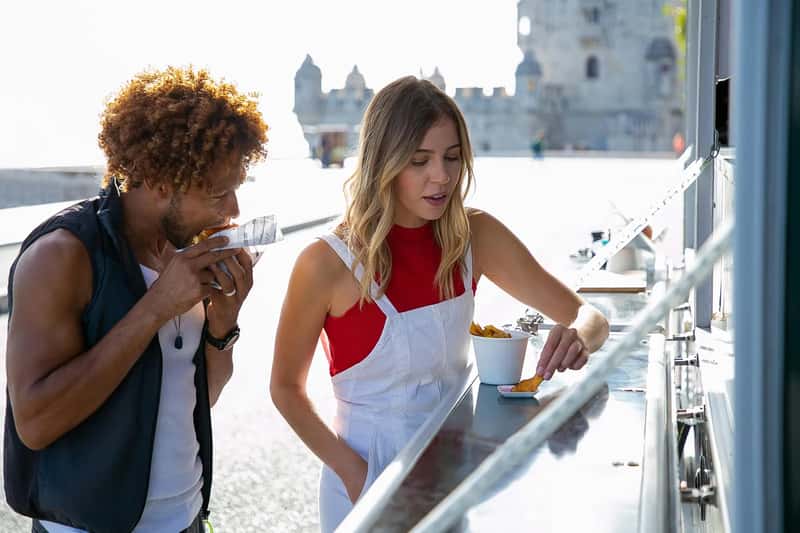
When you eat a bowl of noodles in a hawker stall in George Town, you are not merely tasting broth. You are ingesting the sound of the street, the humidity on your arms, the yellow light above, the plastic stool that wobbles slightly, the vendor’s practiced indifference to your presence.
Visitors form their overall sensory experience perceptions of a destination through participating in activities that help them learn and develop a greater understanding using all five senses – visual, auditory, taste, olfactory, and tactile stimuli. The sensory experience created collectively by these elements influences visitors’ cognitions and subsequently shapes their identification and attachment to a destination.
Attachment. That is the word that matters. The meal is the anchor. The city is what gets attached to you.
8. Memory Is the Real Appetite
You don’t eat through cities to be full. You eat to remember who you were when you weren’t yourself.
People learn to associate specific stimuli – smells, sights, sounds, times, locations – with certain palatable foods. Perceiving these cues reminds an individual of the palatable food it is associated with, triggering the sensation of hunger.
In reverse, the food triggers the place. Years later, a specific spice in an unexpected kitchen will return an entire city to you. Unasked. Unannounced. Suddenly you are twenty-eight again, standing at a street corner in a city that doesn’t know your name.
The food experience is claimed to continue beyond the post-travel stage, where one’s memory is triggered by stimuli and reflection.
The meal ends. The hunger for what that meal represents never fully resolves.
That is the design. And it is, in the most precise psychological sense, the point.
9. The Permission Structure of Travel
At home, most of us eat carefully. Deliberately. With one eye on some internal ledger of restraint.
Travel burns the ledger.
A culture of consumerism frames food not just as sustenance, but as an accessible form of entertainment, comfort, and personal identity. Travel amplifies this dynamic to its extreme. In a foreign city, the rules of your regular self do not apply. The temporary nature of your presence is its own permission slip.
More recent theorists suggest that hunger is not solely a biological experience but is deeply intertwined with cultural and psychological factors – including not only the physical need for food but also psychological and social components, such as emotional fulfillment and societal norms around eating.
Travel creates a temporary societal norm where gluttony is reframed as adventure. Where eating a second lunch is a narrative choice, not a failure of discipline.
The traveler who “eats their way through a city” is not being indulgent. They are being strategically human. They are feeding every sense at once, in the only way the body knows how.
10. The City Where You Ate Is the Only One You’ll Remember
Of all the cities in all the years of wandering, the ones that stay are the ones you tasted.
Not the museums. Not the monuments. The bowl of something on a plastic table with a fan overhead and nowhere to be until tomorrow.
Activities and experiences that define the individual and emphasize one’s identity are considered a strong psychological predictor that improves visitors’ sense of well-being, both subjectively and objectively, and increases life satisfaction.
Research indicates that memory and destination attachment mediate the relationship between sensory appeal and behavioral intention. Put simply: the cities you ate are the cities you return to – in body, and in mind, for the rest of your life.
Research confirms the relevance of sensorial elements over intellectual ones in gastronomy tourism experiences, with both being determining factors in quality of life and emotional arousal.
You were never eating the food. You were eating the feeling of being someone who eats food like that. Someone loose enough to follow a smell down an unmarked street. Someone present enough to sit with strangers and ask for the thing on the menu with no translation.
You were eating the identity you only get to wear in cities that don’t know your last name.
There is a particular silence that comes after a great meal in a foreign city. Different from the silence of satiation. It is the silence of a person who has briefly, perfectly, inhabited themselves.
Hedonic hunger – that ancient, reward-driven, dopamine-lit craving that lives beyond the body’s actual need – is what propels us down the night market, into the dim sum hall, past the bakery for the third time in one afternoon. It is not weakness or indulgence. It is the psyche’s most honest way of asking to be somewhere real. To be present. To be made, temporarily, of the place you are moving through.
The city gets into you through your mouth. And long after the trip is over – long after the tan fades and the jet lag resolves and the currency gets converted back – you will still carry that bowl of broth, that wedge of cheese, that thing you ate in the rain in a city whose name you now say with a specific weight. Some hungers are never really about food at all. They are about finding, in the texture of an unfamiliar meal, a version of yourself you were afraid you’d left behind.