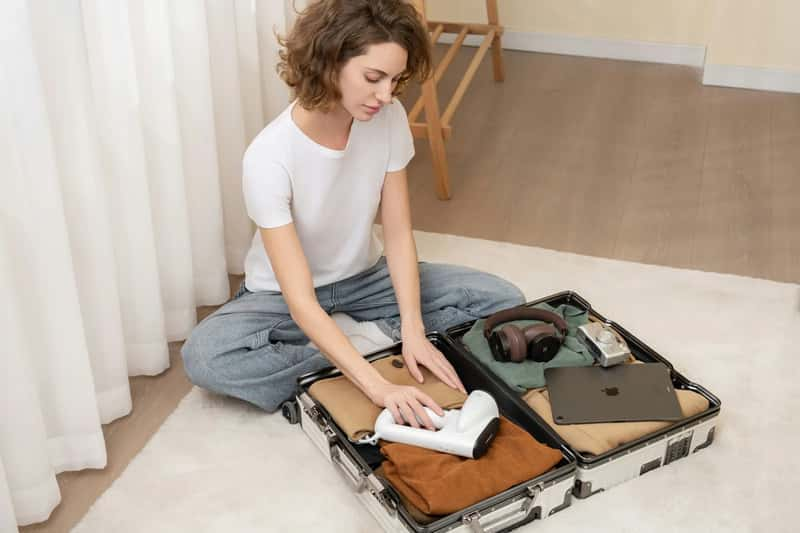
The bag is by the door.
It has been since Tuesday.
You don’t leave until Sunday.
You tell yourself it’s efficiency. Organization. Practicality. You tell yourself a lot of things at 11 PM when the zipper is already pulled and your shoes are already lined up like small soldiers awaiting orders.
But here is what nobody says out loud: the bag isn’t packed for the trip. The bag is packed for the escape. It’s packed for the version of you who learned, very early, that things can change without warning. That comfort is provisional. That staying was never something you could count on.
1. The Inconsistent Caregiver
Some mornings, breakfast was warm and the house was full of light.
Other mornings, the air had a different texture entirely.
Early inconsistent caregiving leaves individuals prone to hyperactivating strategies – a relentless internal amplification of distress signals designed to elicit care from an unpredictable source. The child becomes a meteorologist. Not of weather, but of mood. Every footstep down the hallway is data. Every silence is a threat assessment.
This is where the packed bag begins – not in a suitcase, but in the body. Early experiences, such as caregivers inconsistently responding to a child’s needs, shape that child’s expectations of all future relationships, fostering anxiety and a chronic hypervigilance to maintain connection.
The child learns: nothing lasts. Anxious-ambivalent children fear abandonment but cannot trust their caregiver to be consistent. So they stay ready. They keep one hand on the door. They grow up and they keep packing early, not because they are organized, but because being unprepared once cost them something they are still quietly grieving.
The bag is a hedge against that grief. It is a physical promise to the child still living inside the adult body: This time, we’ll be ready.
2. The House That Changed Addresses
You never wrote your address in pencil on your school forms.
You just left that line blank and waited to be told.
When children move frequently, especially during formative years, it disrupts the continuity needed for stable identity formation – forcing them to repeatedly adapt to new environments, schools, and social circles. Each move is a small death of a version of yourself. You learn not to name things. Not to get attached to the bedroom, the neighbor’s dog, the shortcut through the park.
The more times people moved as children, the more likely they were to report lower life satisfaction and psychological well-being in adulthood. But the data doesn’t capture what the body remembers. It doesn’t capture the way you still do a quiet inventory of exits when you enter a new space. The way a half-packed bag on a bedroom floor feels like safety, not chaos.
Each move requires readjusting routines, relationships, and identity. Over time, this can lead to restlessness or detachment. You carry both. You wear them as a kind of armor that looks, from the outside, like wanderlust. On the inside, it is the echo of a child who never got to say a proper goodbye to anything.
3. The Hypervigilant Body
Your body learned to read rooms before you could read words.
It still does.
Hypervigilance is what happens when our natural fight-or-flight instinct goes into overdrive. People who are hypervigilant exist in a constant state of anxiety. It is not dramatic. It is quiet and exhausting and utterly invisible to everyone but you. It looks like being the first to notice a shift in someone’s tone. It looks like scanning a restaurant for the best seat facing the door. It looks like a bag packed four days early.
Abusive or unstable childhood conditions the child to be hyper-vigilant about danger for all their life. The nervous system doesn’t distinguish between then and now. It only knows what it was trained to expect.
People often develop hypervigilance in childhood to cope with an unstable family or environment. The tragedy is not the vigilance itself – vigilance kept you safe once. The tragedy is that it never got the memo that the danger has passed. It is the body’s way of keeping itself safe, but it can become a prison when the danger has long since passed.
4. The Divorce Script
You learned early that adults could stop loving each other.
Which meant, logically, they could stop loving you.
The stress of parental divorce, combined with the upheaval of moving, can create a double burden on a child’s emotional well-being. Children who experience both parental divorce and frequent moves are at an even higher risk for developing mental health issues, including depression and anxiety, in adulthood.
But here is what the studies don’t mention: the suitcase. The one that appeared in the hallway one Tuesday afternoon. The one that told you, without a single word, that the world you knew was renegotiating its terms. This is abandonment trauma – a childhood experience where caregivers leave or become emotionally unavailable. For example, experiencing the divorce of parents can mean that a fear of being left becomes deeply embedded in adult behavior.
So you pack early. You control the one variable that feels controllable. The departure. The exit. Because arrivals were always uncertain, but leaving – leaving you could manage on your own terms, with dignity, with shoes already by the door.
5. The Parentified Child
I remember being nine years old and knowing what it felt like to be the heaviest person in the room.
Not in weight. In responsibility.
I knew which drawer held the overdue bills. I knew which facial expression meant tonight would be difficult. I knew how to make dinner go quiet and smooth before anyone had to ask.
Parentification occurs when parents look to their children for emotional and/or practical support, rather than providing it. The child becomes the caregiver, forced to assume adult responsibilities and behaviors before they are ready to do so.
As adults, the need to compulsively plan, rely on fearful mental scenarios for motivation, and work compulsively are all fallout from parentification and emotional neglect. The packed bag is a direct descendant of this. It is compulsive preparedness. It is the adult expression of a child who was always, always on.
Children who are parentified often develop obsessive-compulsive tendencies as a way to maintain control over their environment. The need to regulate family chaos and take on adult responsibilities can lead to a heightened need for structure and certainty. Your suitcase is structure. It is certainty. It is the only room in your life where you are always in charge of what stays and what gets left behind.
6. The Unpredictable Mood Weather System
You knew before anyone else when the atmosphere changed.
You could feel it in the walls.
A child immersed in an unpredictable environment – where a parent is sometimes in a good mood and then, out of the blue, becomes enraged or violent – develops a finely tuned radar that never switches off. That radar doesn’t care that you are now thirty-four and living alone. It is still pinging.
What you learned as a child doesn’t work as well in the adult world, and you don’t turn it off. You still feel those little-kid feelings, still look for worst-case scenarios, and are still over-sensitive to other people’s reactions.
The packed bag is the physical manifestation of that radar. It says: I am ready for the atmosphere to change. It says: I have done the math and departure is always an option. This inconsistency in early life makes it difficult for the child to predict what a caregiver’s behavior will be at any given time, resulting in elevated insecurity and anxiety that follows them, quietly, into adulthood – into every hotel room, every guest bed, every place that is almost but never quite home.
7. The Identity of Impermanence
You never fully unpacked.
Not even in the place you have lived for six years.
There is a box in the corner of the bedroom. You know the one. Early attachment and childhood environments marked by unpredictability, parentification, or instability can create long-term patterns around safety, self-worth, and belonging. These patterns don’t announce themselves. They live in boxes half-unpacked. In leases signed with a quiet awareness of the exit clause.
Frequent relocations during childhood can disrupt the development of a stable identity, strain social connections, and increase the risk of depression in later life. What that means, translated into the language of the body, is this: you became someone for whom permanence feels like a trap. Impermanence feels like intelligence.
The temporary is familiar. The settled is suspicious. Emotional baggage is what happens when certain experiences aren’t fully integrated, and they keep shaping your present – when your system still reacts as if the old situation is happening now. Your bag is packed because part of you still believes, in the oldest and most cellular part of yourself, that this, too, will not last.
8. The Exit Strategy as Love Language
You care deeply.
Which is why you always know where the door is.
Avoidant individuals may inhibit and control their emotions by avoiding closeness. In contrast, adults with an anxious attachment style may become obsessive and hypervigilant to potential loss, and may be viewed by others as demanding and clinging. Both are the same root fear wearing different coats. Both are the architecture of a childhood that made love feel conditional.
When early relationships are unstable or unpredictable, children learn that they cannot rely on others to help them. So they develop alternatives. Self-sufficiency. Contingency plans. A packed bag that says: I don’t need anyone to rescue me. I already rescued myself.
The exit strategy is not a failure of intimacy. It is the most honest thing about you. It is the scar of having needed a way out and not having had one. Now you always have one. The zipper is pulled. The passport is in the front pocket. This fear results in a hypersensitive nervous system, an overactivation of emotions, and hypervigilance for something going wrong – especially in relationships. Especially in rooms that feel permanent. Especially on nights before you leave.
9. The Body That Never Got to Rest
You are tired in a way that sleep doesn’t fix.
You have always been tired in this particular way.
Children exposed to addiction in the home, chronic fear, neglect, or instability often grow up with nervous systems that remain locked in survival mode. Survival mode is not a phase. It is a renovation. It rebuilds the architecture of the self around the assumption of threat. From a trauma-informed perspective, emotional baggage often lives in the nervous system. It shows up in the body. It influences how safe or unsafe you feel, how you interpret other people, and how easily you can return to calm after stress.
The bag packed the night before is not anxiety. It is a ritual of self-soothing. It is your nervous system doing the only thing it knows how to do when the future feels uncertain: prepare. Control one small, tangible thing in a world that trained you to expect the uncontrollable.
The brain is wired to always look ahead, to always look around corners, to think about and brace for the worst. This can be exhausting. It can keep you from living in and appreciating the present moment because your head is always twenty steps ahead. The bag is those twenty steps, folded and zipped. It is the future, made portable, made manageable, made yours.
And this – this tenth, unnamed, heaviest point – is the one nobody writes about. Because it isn’t dramatic. It isn’t a diagnosis. It is simply this: you grew up in a house where the future was not something to look forward to. It was something to brace for. And so you learned to meet it halfway. You learned to pack early, speak last, and watch the room. You learned that the space between leaving and staying was the only place that felt, paradoxically, like safety.
That space is transit. That space is the departure hall and the hotel room and the seat that faces the door. You did not choose to live there. You were trained to. By inconsistency, by impermanence, by the sound of a suitcase being dragged down a hallway in the dark when you were supposed to be asleep.
The bag by the door is not neurosis. It is loyalty. Loyalty to a version of yourself who needed to be ready and was not always allowed to be. Who learned that the only truly safe thing was to always, quietly, be one step ahead of whatever was coming next.
Put the bag down when you’re ready. Not before. The door will still be there.