You’re in Bangkok. Or Lisbon. Or some city whose name you still mispronounce.
The menu in front of you is a revelation. Strange, beautiful, wildly unfamiliar.
And yet.
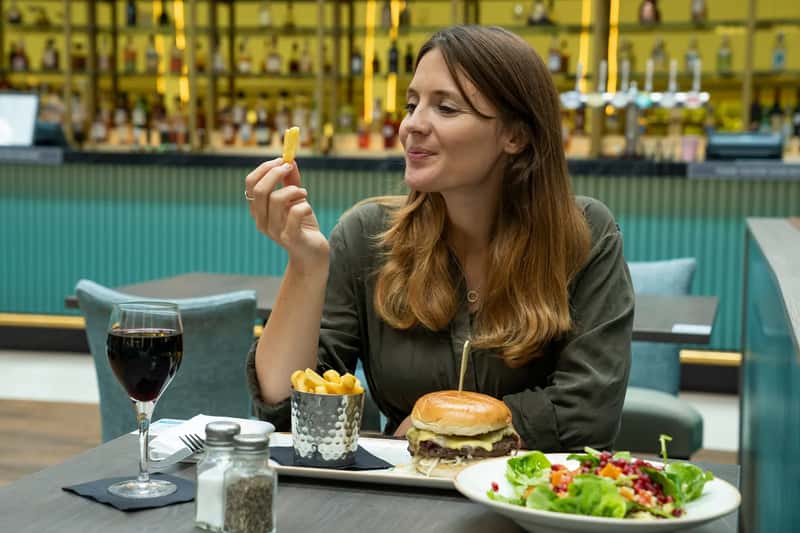
You order the pasta. Or the burger. Or something – anything – that sounds like home.
You tell yourself it’s just what you were in the mood for. That’s the lie we travel with, tucked between the sunscreen and the passport. The truth sits deeper, wired into the part of your brain that hasn’t changed since the Pleistocene – the part that still scans every room for threat, still measures every unfamiliar space against the internal blueprint of safe.
When we move abroad, our sense of identity changes. Leaving our home, community, and cultural background and adapting to a new environment can be challenging and lead to feelings of identity confusion and loss. That confusion isn’t weakness. It’s just the architecture of a self suddenly missing its scaffolding. The traveler who orders the comfort food isn’t failing at being adventurous. They are surviving the gap between two selves – the person they were and the person the new place is asking them to become.
1. The Cortisol Ambush
Travel is beautiful. Travel is also a low-grade emergency for your nervous system.
New airport. New smells. New currency, new faces, new rules you can’t quite read.
When we’re under a lot of stress, our bodies release a hormone called cortisol. This hormone can make us feel hungrier and crave high-fat, sugary comfort foods. This isn’t a personality flaw. It’s ancient biochemistry.
The exotic menu in front of you is, to your hypothalamus, just another unknown. Regardless of the type of stressor, if our brain perceives it to be threatening, the critical hub of the brain’s stress response – the hypothalamus – will be activated. The hypothalamus is responsible for orchestrating the appropriate physical responses at the time, whether fight, flight, or feed, because the hypothalamus is also responsible for hunger.
You’re not craving pasta. You’re craving a ceasefire.
The pasta is the white flag your nervous system waves at the chaos of arrival. One familiar choice in a sea of unknowns. A single controllable outcome in a day that has offered almost none.
2. The Brain’s Demand for Predictability
Your brain has a very specific, deeply inconvenient preference: it loves knowing what comes next.
New cities violate that preference approximately every thirty seconds.
During stress, the body looks for fast, reliable sources of relief. Familiar foods require less mental effort, less decision-making, and less uncertainty. Predictability itself is comforting, and known flavors provide that predictability.
This is not about adventurousness. It is about cognitive load.
In an unfamiliar setting, our cognitive shortcuts and social cues become irrelevant. This forces the brain into a state of heightened awareness, compelling us to pay close attention to our surroundings.
By the time you sit down at dinner, your brain has already spent ten hours in a state of heightened processing. It has navigated train stations, deciphered menus, tried to read social cues in a language it doesn’t speak. It has earned its rest. The familiar food on the menu isn’t a defeat. It is the single decision the brain gets to make on autopilot. And the brain, exhausted and vigilant, takes it gratefully.
3. The Reward Circuit Override
There’s a chemical argument happening inside you every time you sit down to eat abroad.
One side: dopamine-fueled curiosity, pulling you toward the unknown, the exotic, the story you’ll tell later.
The other side: a far older system, running a far simpler command.
When you eat something familiar and satisfying, it activates reward centers in the brain, calming stress signals from the nervous system.
At a biological level, comfort food influences the brain’s reward system. Foods high in carbohydrates, fat, or warmth trigger the release of dopamine and serotonin, neurotransmitters associated with pleasure and calm. These chemical responses help reduce stress hormones and create a sense of temporary relief.
The exotic dish is a gamble. The familiar one is a guarantee.
When the nervous system is already running hot, it doesn’t want a gamble. It wants the guaranteed transaction: input familiarity, receive calm. Every time. No surprises. That is not cowardice. That is the body doing its job.
4. The Olfactory Time Machine
You smell something. Garlic in butter. Warm bread. Coffee from a chain you recognize.
And for one disorienting second, you are somewhere else entirely.
Our olfactory system connects directly to the brain’s emotional and memory centers. Unlike other senses that first pass through the thalamus for processing, smell travels immediately to the amygdala and hippocampus. This direct pathway explains why scents trigger emotional responses before conscious thought even registers.
The olfactory system is closely linked to the amygdala and hippocampus – areas of the brain that process emotions and store memories. This is why certain scents can instantly evoke vivid recollections and emotional responses. When these memories are positive or comforting, they can counteract stress by signaling safety and familiarity to the brain.
The familiar food is not just a meal. It is a smell-triggered anchor dropped into the chaos of the unfamiliar. When everything around you is new and unreadable, a recognizable aroma is the nervous system’s fastest route home. The food arrives. You exhale. You didn’t realize you’d been holding your breath.
5. The Identity Evacuation
I remember sitting in a small restaurant in Marrakech, the call to prayer threading through the warm evening air, a menu in front of me that I couldn’t fully parse, the city vibrating with a kind of sensory intensity I hadn’t been prepared for. The waiter watched me. I looked at the menu. I looked at the waiter again.
I ordered the tagine.
But I remember the split-second temptation to point to the words “club sandwich” at the bottom of the menu. I remember noticing that temptation. And I remember being slightly embarrassed by it.
Later, I understood it wasn’t embarrassing at all. Stripped of your usual context, your brain must generate a sense of self from within. This period of solitude and self-referential processing allows for a re-evaluation of your personal narrative. You are no longer defined by your relationships or responsibilities, but by your immediate actions and choices.
The familiar food is, in that moment, one of the few available choices that carries a known self inside it. The self who orders that dish is a self you already know. In a room where everything else is foreign, that is no small thing.
6. The Attachment System in Disguise
Attachment theory was built around children and caregivers. But the nervous system doesn’t retire its attachment behaviors just because you’ve bought a round-trip ticket.
Perhaps the term “security food” is more fitting than comfort food. Food and feelings align with the Circle of Security – a child’s need to have a secure base from which to go out and explore the world and a safe haven to return to for physical and emotional nourishment.
Comfort food is a familiar safe haven, which restores our sense of felt security. Accordingly, research found that securely attached participants experienced less loneliness after writing about their comfort food, but not after writing about a new food.
You’ve been exploring all day. Your nervous system needs its safe haven. It can’t always be a person. Sometimes it has to be a bowl of something warm and known. The meal becomes a surrogate for the presence you can’t access from twelve time zones away. It is not weakness. It is the attachment system, quietly and competently doing exactly what it was designed to do.
7. The Cultural Memory Anchor
Food is not just food. It never has been.
No matter where you’re from, there’s likely a dish – full of familiar ingredients, flavors, and aromas – that instantly makes you feel warm inside. These meals go beyond just cooking or baking; they’re woven into our memories, family traditions, and even our sense of identity.
Food is deeply connected to identity and belonging. Cultural dishes and shared meals create a sense of connection. Craving those foods can reflect a desire for closeness or familiarity. Eating them feels like participating in something larger than the moment. The psychological comfort extends beyond flavor into social meaning.
When you order that familiar dish in a foreign country, you are not eating a meal. You are eating a memory. You are eating a table you once sat at. A person who once cooked for you. A version of yourself who was smaller and safer and not yet responsible for navigating a continent alone.
The food carries all of that. Across borders, through customs, past every unfamiliar street sign. It arrives intact.
8. The Cognitive Consolidation Break
Your brain is not built for endless novelty. This is the truth that the travel industry, and the identity of the “good traveler,” would prefer you not examine too closely.
Studies on prefrontal cortex activity suggest that when the brain encounters familiar material, cognitive load drops measurably. The regions responsible for threat assessment and decision-making ease off. The nervous system, which in most modern adults spends the day in a state of low-grade overactivation, receives something it almost never gets from new content: a signal that nothing requires evaluation. The brain, in effect, stands down.
Alternating between expansion and integration is exactly how the nervous system learns best. Push into the new. Then consolidate. The familiar meal is not the enemy of adventure. It is its necessary counterpart. The night you order the comfort food is the night your brain finally begins to absorb the city you have been moving through all day. The familiar dish clears the cache. Tomorrow, the unknown can flood back in.
9. The Quiet Language of Belonging
There is a particular loneliness that lives inside travel. The guidebooks don’t mention it. The Instagram grid doesn’t capture it.
It is the loneliness of being surrounded by life you cannot fully enter. A language that flows around you but not through you. A city that does not know your name and is not curious about it.
At the core, comfort food is about emotional safety. Choosing a meal that’s tied to positive experiences can make us feel secure, cared for, and less vulnerable. In moments of stress, that warm, familiar flavor can be more than dinner – it can be a reminder that we’ve made it through hard times before, and we can do it again.
When we are upset or stressed, we sometimes choose foods that are familiar or remind us of our childhood. They may remind us of a parent or caregiver’s love, and that memory is strongly tied to a shared food experience from childhood.
The familiar food whispers something that the foreign city cannot: You belong somewhere. You are from somewhere. Someone, once, made something warm for you and set it in front of you with care. That belonging doesn’t dissolve just because you’ve crossed a border. It lives inside the food. And the food, if you let it, carries you back to it – even here, even now, even in this beautiful, disorienting, impossible city that doesn’t know your name.
The real pilgrimage of travel has never been outward. The miles, the stamps, the layovers – those are just the visible surface of something much quieter and much more necessary.
Every traveler, at some point, lands in a restaurant in a country that is not their own, and faces a menu that could take them somewhere genuinely new. And something in them – ancient, honest, bone-deep – reaches for the familiar instead. Not because they failed to be adventurous. But because the nervous system knows what the ego refuses to admit: that identity is not a fixed monument but a fragile, portable thing we carry with us, and occasionally, desperately, need to set down somewhere and rest.
The comfort food in the exotic country is not the end of the story. It is the breath between chapters. It is the body saying, in the only language older than words: I was here before this. I will be here after.
And maybe that is enough to order dessert and look out the window at the city you don’t yet belong to – and feel, very quietly, like you might.