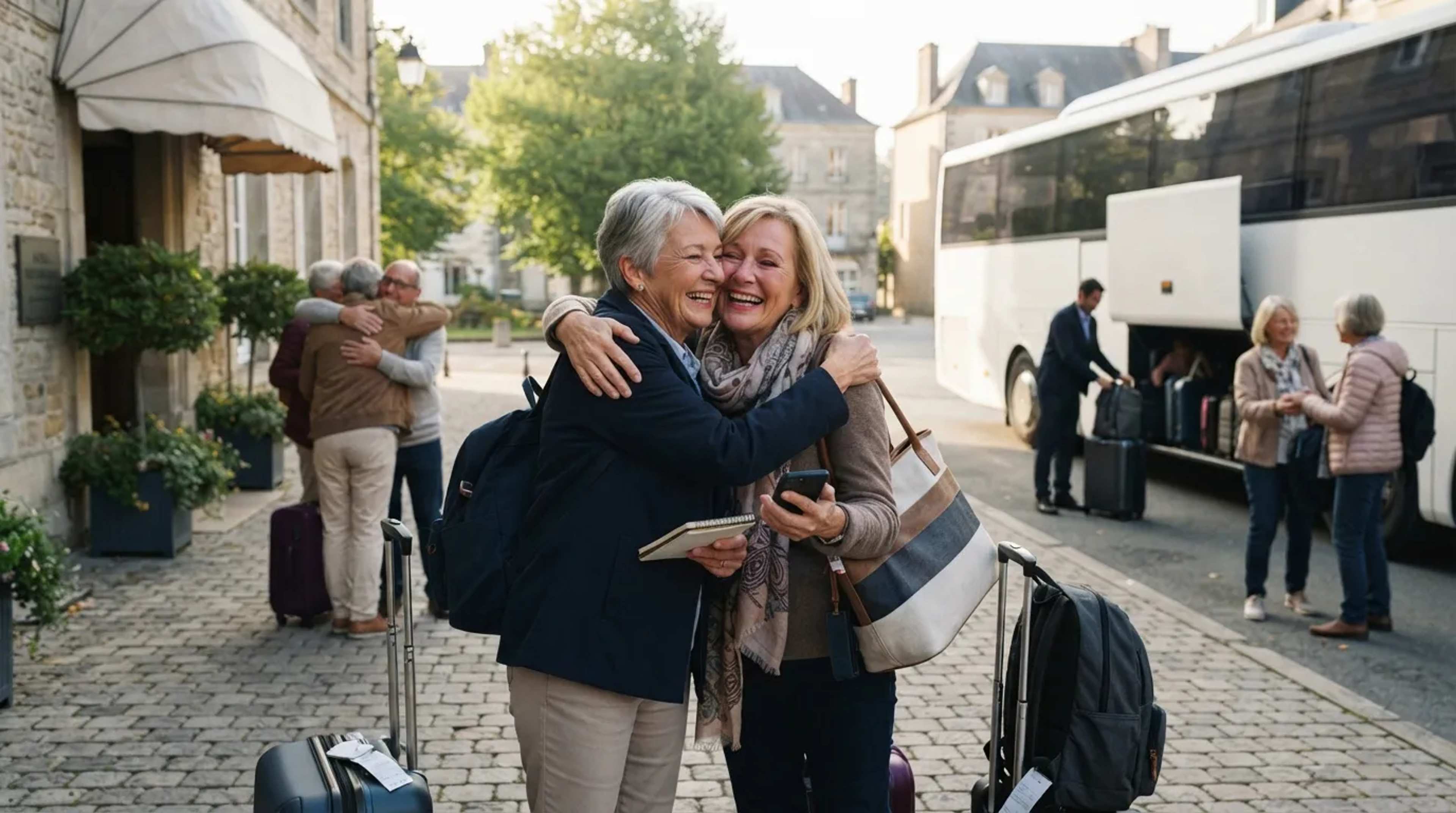
The stranger smiles too wide.
You take a half-step back.
Your jaw tightens before your brain explains why.
You are a thousand miles from home, surrounded by beauty you paid good money to see, and yet something in you is already calculating the exit. The local offering directions, a recommendation, a warm “welcome, friend” – they have done nothing wrong. And still, the alarm rings.
This is the Identity Gap. The space between who you perform yourself to be at home – competent, trusting, open – and who you actually become the moment a stranger is too generous, too helpful, too present in a place where you wanted, desperately, to be invisible. Travel is the only arena where we willingly strip ourselves of our social armor. That stripped-down state – what psychologists call the “Anonymity Advantage” – lets you experiment with identity. You realize that much of your behavior at home is just a habit performed for others. Without those witnesses, you can find out who you are at your core.
1. The Amygdala on Patrol

Here is what is happening in your skull at that exact moment.
The smile comes in. Your amygdala intercepts it before your prefrontal cortex even gets a memo.
The cognitive side of threat detection is driven by the amygdala, a small structure deep in the brain that acts as your threat-detection center. The amygdala evaluates incoming sensory information, decides whether something is dangerous, and sends alarm signals to other brain regions that coordinate your response.
It doesn’t ask questions. It doesn’t weigh probability. It reacts.
And because you are in unfamiliar territory – a different city, a different culture, a street with signs you cannot fully read – your brain is in a state of sustained, heightened alertness, scanning for danger even when no real threat exists. It goes beyond normal caution. Where healthy vigilance lets you notice a car running a red light and step back, hypervigilance keeps that same level of alarm running constantly.
The too-friendly local isn’t the threat. The unfamiliarity is. They just walked into the crossfire.
2. The Reciprocity Trap
Kindness isn’t free. Your nervous system has always known this.
The Reciprocity Norm is a fundamental social rule that compels us to repay, in kind, what another person has provided for us. It is the deep-seated belief that we should return favors, pay back debts, and treat others as they treat us. While this instinct is the glue that holds human society together, it is also a “weapon of influence.”
A stranger helps you. A debt is born.
The feeling of indebtedness triggered by a small, uninvited favour is often not a conscious, rational calculation but a deeply ingrained behavioural response. The fact that this feeling can overpower a person’s liking for an individual demonstrates its potency.
When a local is “too friendly,” your brain doesn’t just register warmth. It registers obligation. It starts computing what this will cost you. Time. Energy. A purchase. A commitment you cannot honor. The smile becomes a contract you never signed.
The panic is not about the kindness. It is about the invoice hiding behind it.
3. The Evolutionary Stranger Danger Protocol
You inherited this.
You did not build this fear. Your ancestors handed it to you, loaded and ready.
Some theories suggest that the wariness of outsiders has evolutionary roots, as a mechanism to protect one’s community or resources from strangers. And in some cases, fear of outsiders could have been a protective mechanism against invasion or sickness. Mistrust of a person from a different tribe, even if misplaced, could have its roots in the desire to protect one’s home against a foreign threat.
You are not in a tribe anymore. You are in a café in Lisbon, or a market in Chiang Mai, or a cobbled square in Krakow.
But the software hasn’t updated.
Anxiety is viewed as an evolutionary system biased toward false positives of threat. This means that anxiety might be a form of fear that occurs when a harmless eliciting event is present. It is adaptive in the sense that it is better to experience unwarranted fear than to not experience fear in the face of a dangerous stimulus.
Your body would rather be wrong and safe than right and dead. The too-friendly local triggers the protocol. Protocol does not ask for evidence.
4. The Attention Scanner
You think you are taking in the cathedral. You are not.
Part of your brain is always running a different program. Hypervigilance operates in the presence and absence of threat and involves monitoring for potential dangers via attentional broadening or excessive scanning of the environment with numerous eye movements, leading to improved threat detection.
Travel amplifies this to a roar.
At home, you have pre-mapped every face on your street. You know which neighbors wave and which ones don’t. You have calibrated the baseline. Abroad, every face is new data. Every smile is unverified input. Walking down the street, you mentally map which storefronts you could duck into, which alleys to avoid, which strangers seem unpredictable. None of this is conscious planning. Your brain does it automatically, constantly, whether you want it to or not.
When someone approaches with warmth that exceeds the local norm, your scanner flags it immediately. Because too much positivity, in the algorithm’s logic, reads as statistical anomaly. And anomalies are threats.
5. The Anonymity You Came Here to Protect
I remember the first time I truly understood the shape of this feeling. A small fishing village, southern Portugal. A man outside a restaurant gestured at me warmly, pulled out a chair, spoke rapidly in a voice that carried nothing but enthusiasm. I smiled. I kept walking. I went back to my room and sat with it for an hour.
It wasn’t rudeness. It was self-preservation.
Because the anonymity was the whole point of being there. It is not necessarily about vanishing. It is about reducing the amount of self that a person has to perform while away. And there is a gap between who we are inside our routines and who we become the moment we step outside them. When we step out of our everyday environments and routines, we undergo a temporary rearrangement of our identities – one that lets us imagine other possibilities for ourselves.
The friendly local punctures that rearrangement. He makes you real again. Visible. Socially located. And that, underneath the travel brochure fantasy, is the thing you were running from.
6. The Social Debt Alarm
There is a specific terror in owing something to someone you will never see again.
It sits differently than normal debt. It has no ledger. No timeline. No way to close the account.
The positive norm of reciprocity creates “embedded obligations by exchanges of benefits or favours among individuals. The recipient feels indebted to the favour or benefit giver until he/she repays.” But what happens when repayment is structurally impossible? When you leave tomorrow? When the geography swallows the debt whole?
While the norm of reciprocity promotes positive interactions by encouraging cooperation and mutual support, it can also lead to negative outcomes. Individuals may feel pressured to return favors even when they cannot or do not wish to do so, leading to feelings of resentment or obligation.
The panic is the sound of an open tab in a bar you’re already leaving. The too-friendly local is the bartender walking toward you with one more round you didn’t order.
7. The Outgroup Calibration System
You know them. They do not know you.
That asymmetry is where the anxiety lives.
Socially anxious individuals are thought to attend to social threats so as to detect signs of possible negative evaluation; in this way they can then adjust their behaviors to be more acceptable. Until they receive information signaling social exclusion, they may be hypervigilant for social threat cues.
As a traveler, you are always the outgroup. You carry a different passport, a different accent, different shoes. You are, by every social definition, the outsider. In modern times, people may feel more comfortable around those who look, speak, or act like themselves, and more suspicious of those who do not.
When a local is too friendly, it breaks the script. Outgroups are supposed to receive polite indifference. Warmth, especially excessive warmth, doesn’t compute. The hostility to foreigners is not activated until there are “strangers” that come too close and pose a “threat” to the identity. The reverse holds true too. When a local comes too close to you, your own identity threat system fires. You are not equipped to decode what they want.
8. The Safety Lag
You are safe. Your body has not gotten the message yet.
This is not a metaphor. This is neuroscience.
This disconnect has a name: the safety lag. It’s the gap between what your thinking brain understands and what your nervous system believes. Your brain can calculate that a cheerful local offering restaurant advice poses zero statistical danger. Your nervous system has already tightened your chest and shortened your breath before that calculation finishes.
In brains affected by chronic stress, a type of neuron responsible for calming neural activity shows reduced communication. Without that braking mechanism, the brain becomes hyperexcitable, which can drive the overreactive fight-or-flight response characteristic of hypervigilance.
Frequent travelers often live in a low-grade version of this state. The constant recalibration of new environments, new social norms, new faces – perhaps the most challenging aspect of hypervigilance is the profound exhaustion it creates. Your nervous system isn’t designed to maintain high alert indefinitely. The constant physical tension, racing thoughts, and emotional stress drain your energy reserves.
The too-friendly local catches you in mid-recalibration. Still rebooting. Defense up.
9. The Catastrophic Projection Engine
He offers to walk you to the museum. Your mind skips twelve steps ahead.
This is the engine running beneath the panic. Intrusive thoughts about worst-case scenarios can pop up without warning. Catastrophic thinking, where your mind jumps to the most dangerous possible outcome, becomes a default setting rather than an occasional worry.
You are not thinking about the museum. You are running simulations. What does he want? Where does this end? What happens if I say yes? What happens if I say no? Mentally, hypervigilance shows up as racing thoughts focused on potential problems or threats. You might catch yourself constantly asking “what if” questions and imagining worst-case scenarios.
The man is standing on a cobblestone with a tourist map. The man in your head is something else entirely.
Travel sharpens this engine because the variables are multiplied. You don’t know the local customs around refusal. You don’t know if “no thank you” translates cleanly. You don’t know the social stakes. So the engine runs every scenario simultaneously, burning fuel you didn’t know you were carrying.
10. The Temporary Self That Cannot Afford Witnesses
This is the heaviest one. Sit with it.
You travel, in part, to become someone slightly different. Solo travel strips away the roles we play in ordinary life. At home, you are a business owner, a colleague, a neighbor, a person with a reputation and a history. For many, travel is a form of identity maintenance, a way of returning to ourselves after long stretches of being what other people needed us to be.
That temporary self is fragile. Deliberately so.
Every trip hands you a blank name tag. No backstory. No reputation. No history of the version of you that failed, hesitated, or disappointed. The too-friendly local is the first witness. They see you. Not the person you are building in the silence of unfamiliar streets. You. The original. The accountable one.
And the panic is not fear of the local. It is fear of being seen before you are ready. Of being pulled back into a social architecture that requires you to perform, explain, reciprocate, and remain. When you use anonymity to hide rather than to explore, the temporary identity becomes a permanent prison. But even those of us who know this – even those of us who have read the theory and nodded along at the insight – still feel the constriction in the chest when someone is just a little too warm, too present, too insistently kind.
Because the defensive systems are older than the insight. They were there long before we had language for them.
There is a particular kind of loneliness that only travelers know. Not the loneliness of being without people – there are people everywhere – but the loneliness of having constructed a self that can only breathe in anonymity. The version of you that moves through foreign cities with a quiet confidence, unbothered, untethered, unaccountable. That version is real. But it is also a negotiation. It requires the world to agree not to look too closely.
When a local breaks that agreement with nothing more than warmth, all ten of your defensive systems fire at once. The amygdala catalogs the threat. The reciprocity system opens an invoice. The catastrophic projection engine lights up every worst-case corridor. And underneath all of it, the temporary self grips the edge of the thing it has built – that beautiful, paper-thin version of itself – and braces for collapse. All because someone smiled too genuinely in the afternoon light of a city you will leave in three days.
The kindness was real. So was the panic. Both can be true at once. And somewhere in the gap between those two truths, if you are willing to stay in the discomfort long enough, is something that looks very much like the person you came all this way to find.