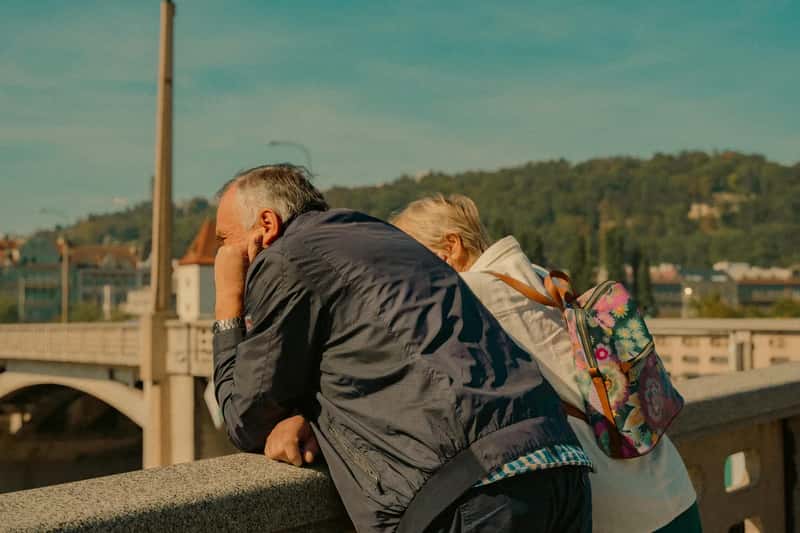
You see them from across the square.
You are holding a coffee you don’t taste.
Something moves through your chest. Cold. Quiet. Precise.
You call it beautiful. You mean it. But underneath the beautiful is something older and heavier and much more personal than a picturesque moment in a foreign city.
The modern traveler has mastered the art of arrival. Visas, layovers, hostel check-ins, the practiced nonchalance of someone who has navigated fourteen airports and knows which terminal has the best Wi-Fi. But master the art of arrival long enough, and you start to notice: you have no equal mastery of staying. You have confused motion with meaning. Movement with maturity. And somewhere along the cobblestones of someone else’s hometown, the truth catches up with you. Not dramatically. Just as a cold thing in your chest when you see two people who clearly never needed to run.
1. The Provisional Self
Every new city offers you a new character to play. In Lisbon, you are contemplative. In Tokyo, you are disciplined. In Buenos Aires, you are passionate in a way you never quite manage back home.
This is the seduction. This is also the trap.
The traveler’s identity is, by design, provisional. It is a costume rotated by latitude. It fits everywhere and belongs nowhere. You wear it well. People compliment your adaptability. They don’t know that adaptability is sometimes just a polite word for the inability to settle.
The provisional self is not a bad thing. It is agile, curious, open. But it carries a hidden cost. Every character you play in a foreign city is a character that does not accumulate. It does not age gracefully into something recognizable. It does not, after sixty years, sit in a square with another person who has memorized every version of it.
The provisional self never becomes a permanent one.
And that is what the couple in the square has, without even trying.
2. The Seduction of Anywhere
At some point, often after the initial honeymoon phase, we realize that what used to be a matter of certainty no longer is. This is the seduction of travel. You can be anyone. The problem is that “anyone” includes no one in particular.
That is worth sitting with.
No one in particular. A ghost with a well-curated Instagram. A silhouette in someone else’s hometown. You move through these cities like a benevolent haunting – present, charming, but ultimately untethered from the place and from yourself.
The seduction of anywhere is that it feels like freedom. And it is. For a while. But freedom without an anchor is just drift with better lighting. You board the next plane and you feel the familiar relief of departure. What you don’t feel – what you haven’t felt in years, perhaps – is the particular and underrated comfort of having nowhere left to run to.
That comfort is what the couple in the square radiates like heat from sun-warmed stone.
You feel it from twenty meters away.
3. The Architecture of Commitment
The old couple in the square did not get to be anyone. They had to be themselves – the same selves, stubbornly, repeatedly, for decades. And somewhere in that stubborn sameness grew something that looks, from across a cobblestone plaza, like peace.
Peace. Not as a destination. As an outcome of repetition.
This is the architecture of commitment. You don’t build it by visiting it. You build it by staying inside it, even when the roof leaks. Even when the walls feel too close. Even when some other city, some other version of yourself, is calling from the departure board.
You are watching what commitment to a single self looks like from the outside. It looks like held hands.
Two hands. Decades of friction and tenderness worn smooth into something indistinguishable from grace. You see it and feel something nameless move through you. What you are witnessing is not romance. It is architecture. The kind you can’t construct from the outside of your own life.
4. The Departure as Defense
The chronic traveler often has a departure date booked before they’ve fully arrived. It is a psychological hedge. A pre-emptive goodbye. If you leave before a place can disappoint you, the place never gets the chance.
Read that again slowly.
The departure date is not logistics. It is armor. It is the emotional equivalent of walking out of a film before the ending, so you can pretend, forever, that it might have gone differently. You have learned that people and places disappoint. You have learned this early, probably at home, long before you booked your first flight. And so you move. You stay moving. Because a moving target is harder to hurt.
But the couple in the square stayed. They stayed through all the disappointment. They let the place get to them. And what grew inside that vulnerability is the exact thing you are grieving across the cobblestones.
You didn’t run from them. You ran toward the exit before they got the chance to run from you.
5. The Blueprint You Never Received
I want to tell you something personal here. Something that might be yours too, if you look at it honestly.
I know what it is to sit in a foreign square and feel the grief arrive before the thought does. To look at two old people moving slowly through a plaza – one with a cane, one in a red coat – and feel something collapse quietly inside the ribcage. Not jealousy. Not even sadness, exactly. Something more structural. Like recognizing a building you were never taught how to build.
What you are grieving is the blueprint you never received.
Nostalgia often taps into a yearning for a sense of safety, security, and comfort that may have been lacking during our formative years. Trauma can disrupt the development of secure attachment bonds and distort perceptions of trust and safety. As a result, nostalgic feelings may be imbued with a deep longing to recapture moments of warmth or connection that were scarce in the individual’s past.
The foreign square is just the room where you finally stop moving long enough to feel it.
6. The Geography of Longing
Nostalgia often involves a sense of yearning for what once was or what could have been. For trauma survivors, this yearning may be compounded by a profound sense of loss for the opportunities, relationships, or experiences that were stolen or disrupted by trauma. Whether it’s the loss of a carefree childhood, a sense of safety and security, or the chance to form healthy attachments, nostalgia can serve as a poignant reminder of what was taken away.
This is the geography of longing. It has no fixed coordinates. It finds you in Porto, in Oaxaca, in a square in Ljubljana at four in the afternoon when the light goes gold and everyone around you seems to belong somewhere.
You carry this longing across every border. You stamp it in every passport. You dress it in the language of adventure. But underneath the adventure, underneath the hashtags and the hostel check-ins and the practiced ease of someone who knows how to pack light, there is a person who is very tired of packing light.
Who has, if they are honest, always wanted to be one of those people who unpacks completely.
Who leaves things in drawers.
Who doesn’t scan for exits when they walk into a room.
7. The Anxious Mover and the Avoidant Stayer
A person’s attachment type is a crucial factor in the generation of nostalgia, as it influences whether or not a person would seek the support of interpersonal bonds in the face of distress. There are three proposed attachment types, namely secure attachment, anxious attachment, and avoidant attachment.
The anxious traveler and the avoidant traveler move differently but arrive at the same square.
The anxious traveler keeps moving because they are convinced that the next place will finally be the one where they feel at home. Both of them end up in the same foreign square. Both of them see the same couple. Both of them feel the same cold thing move through their chest.
Same cold thing. Different reasons for the cold.
The anxious mover chases connection and never quite trusts it when it arrives. The avoidant one creates distance before distance can be created for them. But both are moving. Both are choosing geography over intimacy. Both are standing in a foreign square, watching two people who chose the harder thing – who chose each other, repeatedly, without the option of a next departure.
The square does not judge either of them.
Neither do I.
8. The Identity Gap
There is a version of you that exists in every city you’ve visited. A leftover. A residue. The version who laughed a certain way in a bar in Seville. The version who cried at a train window somewhere between Prague and Vienna without fully knowing why.
When individuals reflect on cherished memories, they often find a sense of continuity and purpose in their lives. This retrospective contemplation helps integrate past experiences with the present, fostering a coherent life narrative that supports a stable identity.
But what if you never stopped long enough to integrate them?
What if the versions you left in all those cities never caught up with the version currently drinking coffee in this square? What if you have been moving so efficiently that your identity is not a coherent narrative but a scattered archive – fragments in thirty cities, none of them complete?
Research suggests that nostalgia becomes more prominent during periods of rapid social, cultural, or technological change. Scholars argue that accelerated change can produce feelings of uncertainty and dislocation, leading individuals and groups to engage nostalgically with the past as a way of restoring a sense of continuity and stability.
You are not nostalgic for a place. You are nostalgic for a version of yourself that was allowed to stay in one.
9. What the Square Gives Back
On the one hand, nostalgia can be positive, imbued with a rosy glow of familiarity and belongingness. On the other hand, it can be negative, accompanied by longing, loss, and frustrated desire. Nostalgia often melds both positive and negative experiences.
The square, then, is doing something generous. Even in its cruelty.
It is giving you information. Clean, unambiguous, written across the posture of two people who have been navigating each other’s rhythms long enough to move as a single slow organism through afternoon light.
Looking at two people holding hands in a foreign square can extract meaning too, if you are willing to sit with the discomfort long enough to hear what it is actually saying. It is saying: you know what you were missing. You have always known. That knowledge did not come from the square. The square just gave it a face.
That is not a small thing.
Most people live their whole lives without their longing ever finding a face. You are standing in a foreign square in the middle of a Tuesday and yours just found one.
Sit with it. Don’t book the next flight yet.
10. The Heaviest Thing You Carry Has No Weight
You have carried this through every country you’ve moved through. It has no weight. It takes no space in your carry-on. It never shows up on the X-ray machine. But it is the heaviest thing you own.
It is the grief for a life you were never shown how to build. Not the life of the couple in the square – theirs is theirs, built from materials you do not know. But a life with continuity. A life where the self is not always provisional. A life where you leave things in drawers and come back to them.
The loss of a familiar environment can be as distressing as the loss of a person, leading to homesickness, nostalgia, and a profound sense of diminished belonging.
And yet you keep choosing it. The movement. The departure. Because the grief of the square is painful but bearable. Because the grief of staying – of risking the full weight of a place, a person, a life – feels unsurvivable.
It isn’t. But you have not yet had the evidence for that.
The couple in the square is the evidence.
And somewhere beneath the cold thing in your chest, some part of you already knows it.
The square will empty. The couple will disappear into one of those side streets where nothing in particular happens and everything continues. The afternoon light will shift. Someone nearby will laugh at something you did not hear, and the spell will break, and you will be a traveler again, alone in a foreign city, excellent at departure.
But something will have been different about this particular stillness. Not dramatically. Not in a way you could explain to someone at the next hostel bar over a shared bottle of wine and the rehearsed shorthand of the perpetual mover. Something smaller than that. A quiet millimeter of honesty about what it is you are actually looking for out here, city after city, square after square, coffee after untasted coffee.
You were not looking for the world. The world was just the long way around to the thing you actually want – which is the feeling, just once, of having arrived somewhere and knowing, without checking the departure board, that you do not have to leave.