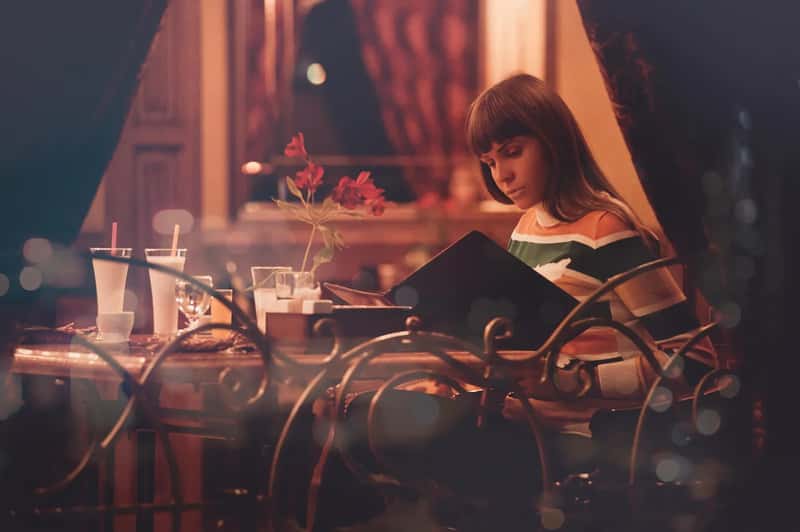
It’s 10 PM in Seville.
The restaurant is full. Children are laughing at the next table. Nobody is checking their phone for the time.
You ordered something you can’t pronounce. You feel, inexplicably, more like yourself than you have in months.
Back home, dinner happens at 6:30. Sharp. Between the end of the commute and the beginning of the guilt about not sleeping early enough. You eat fast. You clean up. You perform the ritual. The clock is always watching.
Here, the clock doesn’t exist. And the person who normally lives inside it – the one who is perpetually late, perpetually rushed, perpetually failing to optimize – has vanished. Someone else sat down at this candlelit table. Someone quieter. Someone who belongs.
1. The Clock Is Not Neutral
You’ve been told your whole life that structure is freedom. That time management is self-respect.
Nobody told you the clock could be a cage.
Modern society often puts us under stressful psychological situations for months and years – in competition for social and professional recognition – which adds an additional level of stress-related wear and tear on the nervous system. The 9-to-5 was not designed around your biology. It was designed around factory output. And somewhere in that confusion, you internalized the factory whistle as your own heartbeat.
The clock never seems to stop. Every day, it seems, we’re fighting it: rushing to get to work, getting errands done, catching whatever sleep we can. There’s never enough time to do what we need or want to do.
That exhaustion is not laziness. It is the cost of living in a time zone that was never yours to begin with.
Southern Europe doesn’t fix this. But for a few weeks in summer, it suspends it. And in that suspension, something in you exhales.
2. Social Jetlag Is Already Eating You Alive
There is a clinical term for what you feel every Monday morning.
It is called social jetlag.
Social schedules – school and work – interfere considerably with individual sleep preferences in the majority of the population. Late chronotypes show the largest differences in sleep timing between work and free days, leading to considerable sleep debt on work days. The discrepancy between work and free days, between social and biological time, can be described as “social jetlag.”
You are chronically out of phase with your own life. Not metaphorically. Biologically.
When you arrive in Lisbon or Barcelona and find yourself wide awake at 10 PM, hungry, alive, curious – that is not the vacation talking. That is your actual circadian signature, finally free to express itself without a Monday morning meeting standing on its chest.
The late dinner isn’t indulgent. It’s corrective.
3. The Identity You Leave at the Airport
Every traveler carries two bags. The one the airline loses. And the one they’re quietly relieved to misplace.
The second bag contains your title. Your deadline. Your carefully maintained reputation as someone who has it together.
Unlike the daily identity, which operates within familiar social and commercial settings, tourist identity involves a temporary sense of freedom from everyday routines and social expectations. This is not an accident. This is your nervous system making a rational trade: I will exchange certainty for permission.
Permission to be slow. Permission to be confused. Permission to sit at a table for three hours and order another carafe of wine because nobody is watching and nobody, mercifully, cares.
“Travel and vacations are a means to reshift and reorganize identities,” according to Karen Stein, a sociologist studying culture and travel.
You don’t go to Southern Europe to find yourself. You go to remember which parts of yourself you buried.
4. The Architecture of the Spanish Day Is a Quiet Revolution
To understand why 10 PM dinner feels like relief, you have to understand the full scaffold.
Spaniards follow a structured daily meal schedule including early breakfast, second breakfast, late lunch around 2–4 PM, merienda at 5–6:30 PM, and dinner after 9 PM. This is not chaos. This is an alternative operating system. One built around human rhythm rather than economic efficiency.
In 1940, under Franco’s regime, Spain moved its clocks one hour forward to align with Germany, a change that was never reversed. This time difference means that when the clock shows 10:00 PM, the sun is still relatively high and the daily rhythm of Spaniards continues well after sunset. This historical adjustment shaped the entire pace of Spanish life, pushing meals and social activities to later hours.
So in a very literal sense, when you eat at 10 PM in Spain, you are eating in a timezone that was politically imposed but culturally absorbed. You are living inside a historical accident that became a philosophy of life. And that philosophy – eat when the sun goes down, not when the spreadsheet says – is the exact opposite of everything your alarm clock has been demanding of you since adolescence.
5. The Table That Waited for You
I remember the first time I understood it.
It was a Thursday in Valencia. I had walked for hours and found a restaurant near the old market that didn’t open until 9 PM. I sat outside. The chairs were still being unstacked. A cat regarded me without judgment. I had nowhere to be. No meeting to prepare for. No morning version of myself waiting like a creditor to be paid.
When the food came, I ate slowly. Not mindfully – that word belongs to a productivity podcast. Slowly. Like it was allowed. Like hunger was not a problem to be solved but a signal to be honored.
Perhaps the most beautiful part of Spain’s late dinners is their emotional symbolism. Eating late reflects a broader philosophy about how Spaniards approach life: food takes time. Conversation takes time. Relationships take time. Meals are meant to be lived slowly and absorbed fully.
That night, I realized the meal wasn’t late. I had been early my entire life.
6. Dinner as a Social Technology
Northern European and American dinner culture treats the evening meal as a transaction. Fuel plus family plus obligation. Done in thirty minutes. Dishes in the sink. Screens on by 7:30.
Southern European dinner culture treats the evening meal as infrastructure.
For Spaniards, dinner is not a private moment. It’s not a rushed “let’s eat quickly and move on.” It’s a communal activity – a time to connect with others after the demands of the day.
Professor Robin Dunbar of Oxford’s Experimental Psychology department has noted that “social eating has an important role in the facilitation of social bonding, and that communal eating may have even evolved as a mechanism for humans to do just that.”
When you sit down at 10 PM in a plaza that smells of jasmine and grilled fish, you are not being reckless with your bedtime. You are participating in something your nervous system has been craving since the first time someone put a fluorescent-lit lunch break in your calendar and called it nutrition.
Researchers found that people who eat socially are more likely to feel better about themselves and have a wider social network capable of providing social and emotional support. The late table is not a luxury. It is a repair mechanism.
7. The Temporary Self Is the Honest Self
Here is the uncomfortable truth about who you are on vacation.
That person – the one who orders dessert, stays for another hour, and laughs without calculating how tired they’ll be tomorrow – that is not your lesser self. That is not the irresponsible one.
That is the one you have been suppressing with alarming consistency since you were old enough to have a Google Calendar.
Travel involves navigating what sociologists call a “liminal state” – a transitional phase between fixed social identities. In this state, individuals are temporarily outside the normal constraints of their home culture, allowing them to experiment with new behaviors and self-definitions.
The person eating slowly at 10 PM isn’t performing freedom. They are remembering what it felt like before freedom required a permission slip.
In many ways, we use travel to experiment with different aspects of our identity. We might try new activities, speak a different language, or find ourselves in a setting where we’re not defined by our usual roles.
You are not your job title. You are not your inbox. In Seville, the waiter has never heard of either.
8. What the Clock Does to Your Body
The damage is not just psychological. It runs deeper than mood.
Biological clocks drive or alter our sleep patterns, alertness, mood, physical strength, blood pressure and every other aspect of our physiology and behaviour. When those clocks are systematically overridden by external scheduling pressures – when the alarm is always earlier than your body wants and dinner is always earlier than your hunger – something chronic begins to accumulate.
Sleep and circadian rhythm disruption is far more than feeling sleepy at an inappropriate time. It promotes multiple illnesses ranging across abnormal metabolism, heart disease, reduced immunity, increased stress and abnormal cognition and mood states.
The exhaustion you bring to the airport is not in your luggage. It is in your cells.
Southern Europe’s rhythm – the long lunch, the slow afternoon, the late communal dinner – is not a failure to be productive. It is a different theory of what a human body is for. And for a few weeks every year, your body remembers it agreed.
9. The Permission Structure of Someone Else’s Culture
Here is why you can do in Seville what you cannot do at home.
At home, eating at 10 PM is a choice. Choices require justification. Justification invites guilt. And guilt is the native language of the clock-regulated life.
In Spain, eating at 10 PM is simply correct. In a world that feels increasingly unpredictable, these mealtimes offer a rare, unshakeable certainty. At 2 PM every day, you will sit, you will eat, and you will connect. These meals don’t just nourish the body – they nourish the soul.
When behavior is culturally sanctioned, the ego stops arguing. The self-monitoring goes quiet. Activating a tourist identity allows individuals to act more freely and expressively in ways consistent with that identity.
You are not being irresponsible. You are being local. And in that borrowed permission, something in you stops defending itself.
That relief – that specific, bone-deep loosening – is not the wine. It is the absence of judgment. Including your own.
10. You Are Not Going Back the Same
Something happened at that table. You may not be able to name it yet.
It happened when the bread came without being requested. When nobody apologized for taking up space. When the conversation moved like water – no agenda, no endpoint, no one checking their watch to see if the topic was still efficient enough to justify the time.
Historically, social constraints have determined the daily number of eating occasions, and culture has dictated when eating is, or is not, appropriate. What you experienced in that plaza was a culture that made a different decision. A culture that decided the evening belonged to people, not to calendars.
Understanding why Spain eats dinner so late means stepping into a culture that prioritizes conversation over convenience, connection over efficiency, and living well over living fast.
And somewhere between the second course and the complimentary digestif, you absorbed that decision into your body like a slow heat. Not as information. As permission. As memory. As a small, furious note to yourself that you have been living slightly wrong – not in a catastrophic way, but in the way of a plant that has been watered on someone else’s schedule, at someone else’s convenience, and quietly turning yellow at the edges for years.
The version of you that existed before the flight home – the one with unlaced shoes and olive oil on the tablecloth and no opinion about what time it was – that version is not lost. It does not require a return ticket to access. It is simply waiting for you to stop apologizing for its hunger.
The clock will be there when you land. It always is.
The question is whether, this time, you’ll remember that you were the one who agreed to obey it.