The train moves.
You don’t have to.
Your inbox is still full. Your landlord still wants a reply. Your mother still expects a call.
But right now, at 11:47 PM, in a window seat with the world blurred to oil-black streaks, none of that can reach you. Not here. Not in this car. Not while the tracks keep their rhythm beneath your feet like a secondhand heartbeat.
There is a version of you that exists only in transit. The one who doesn’t answer emails. The one who stares at nothing and calls it thinking. The one who isn’t a title, a role, a debt, or a deadline. That version lives in the gap between departure and arrival – and the late-night train is its only address.
The Identity Gap is this: the distance between who you perform to be and who quietly surfaces when the performance has nowhere to go. When the theater is dark. When the audience has gone home.
1. The Threshold Effect
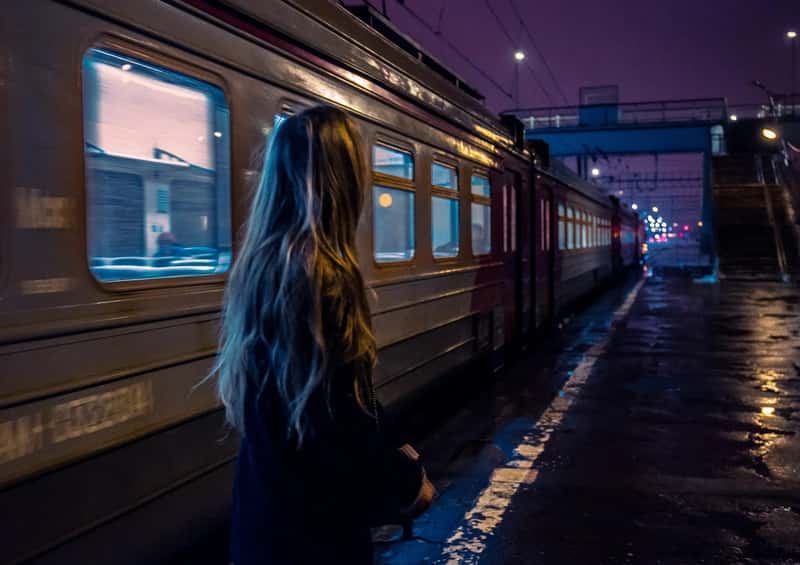
Every train ride is a threshold.
Not a destination. Not a departure. A threshold.
A liminal space is a place or state of transition – an in-between zone that exists on the threshold between what came before and what has not yet arrived. The late-night train is this made physical. Made steel and glass and fluorescent hum.
You are between your obligations and your escape.
Between the person your calendar insists you are and the person your nervous system actually wants to be.
The liminal period is the time when those in transition are no longer who they had been and have not yet become who they would be – occupying an intermediate state, suspended between identities, between social roles, between one chapter of life and the next.
On the late-night train, you are nobody’s anything. You are between chapters.
And that feels, inexplicably, like relief.
2. The Darkness as Permission
Night changes the physics of accountability.
During daylight hours, the world can see you. It can locate you. It can want things from you.
But at night, the windows go dark. The world outside becomes a smear of amber and shadow. There is a unique sensation of being completely alone, even when surrounded by sleeping passengers. The world outside blurs into streaks of light and shadow, creating a dreamlike atmosphere where anything seems possible.
This is not metaphor. This is neurology.
The brain responds to darkness with a loosening. The performance instinct quiets. The vigilance softens. The part of you that monitors how you appear to others – that relentless internal auditor – finally clocks out.
The darkness outside the window is not emptiness. It is permission.
Permission to sit with your own thoughts without narrating them for an audience.
Permission to feel whatever you actually feel.
Permission to simply be in transit, rather than in performance.
3. The Temporary Identity
You are allowed to be nobody on a train.
No one on car seven knows your job title. No one knows your credit score, your relational status, your unfinished projects, your recurring failures. You are a silhouette in seat 14C, and that anonymity is startlingly close to freedom.
Detachment from identity and roles is one of the common psychological effects of liminal space. When you encounter these “in-betweens,” you often get detached from your usual identity and roles – giving you an opportunity to explore more aspects of your personality without the restrictions of your typical identity.
The temporary identity is lighter than the permanent one.
It doesn’t carry the weight of expectation. It doesn’t come loaded with history. It is just a person on a train, watching the dark world pass, and for once not needing to explain themselves to anyone.
The frightening thing is how good it feels.
The more frightening thing is what that reveals about the identity you go home to.
4. The Rhythm as Sedative
The train has a sound that your apartment doesn’t.
It is the sound of forward motion that requires nothing from you. Clack-clack. Clack-clack. A percussion section for the exhausted. There is a timelessness of travelling on a train in the dark – the whirring hum, the fluorescent lights, and the gentle swaying.
That rhythm is a sedative for the overclocked mind.
It is predictable. Reliable. It asks nothing of your executive function. While your waking life demands constant micro-decisions – emails to triage, conversations to manage, moods to regulate – the train simply moves. And in moving, it gives your brain the rarest of gifts: something to follow without effort.
The rocking. The hum. The soft percussion of track after track.
These aren’t just sounds. They are the architecture of release. The body hears the rhythm and begins to believe, however briefly, that someone else is driving. That for once, you can stop steering.
And it lets go.
5. The Night You Couldn’t Go Home
I took a late train once with no intention of arriving anywhere in particular.
I had paid for a ticket. I had a seat. But the destination felt less real than the journey. I sat with a coffee going cold in my hand and watched the city dissolve into countryside, and then into darkness, and I didn’t feel lost. I felt located – in the only place I had ever fully belonged to myself.
Nobody called. Nobody texted. The wi-fi was patchy and I let it stay that way.
What I remember most is the silence of my own mind. Not empty – but quiet in the way a room is quiet after the last guest leaves. The furniture of my thoughts rearranged itself without my interference.
It’s a space where memories surface, and hopes for the future take shape. The night train becomes a vessel for personal reflection, a mobile sanctuary from the demands of the everyday world.
I wasn’t escaping. I was returning. To the self that doesn’t perform. To the one that just breathes and stares and, for a few hours, doesn’t owe anyone anything.
6. The Exit Strategy
Most of us carry a quiet fantasy.
Not a dramatic one. Not a running-away fantasy. A smaller, more specific one: the fantasy of a few hours in which the demands of your life simply cannot physically reach you.
Vacation is perhaps the most pleasurable form of dissociation, where we literally leave our lives and go somewhere else. But vacation requires planning, money, and the tacit acknowledgment that you are, in fact, running. A train ticket at 10 PM requires nothing but a platform and a departure time.
It is the exit strategy available to anyone.
The late-night train is not an escape. It is a pause. A grammatical comma in the run-on sentence of modern obligation. Dissociating isn’t always negative – detaching from reality can be positive, such as in a flow state, or neutral, such as when daydreaming or spacing out during a walk.
And so the train becomes a scheduled, socially acceptable form of voluntary disappearance.
A way to leave without leaving.
A way to rest without admitting you were exhausted.
7. The Social Contract, Suspended
On the train, the social contract goes quiet.
You do not have to make eye contact with your neighbors. You do not have to perform wellness. You do not have to appear productive, engaged, or spiritually fulfilled. The shared understanding on a late-night train is profound in its simplicity: we are all here to go somewhere, and we are all, by unspoken agreement, leaving each other alone.
Victor Turner saw liminality as a condition with its own character – a space where social structure loosened, where normal rules were temporarily suspended, and where something new could emerge.
The social rules of your waking life – the ones demanding productivity, responsiveness, emotional availability – do not board with you.
They wait on the platform. They will be there when you arrive. But for now, the car is a room with no social obligation. No performance required. No role to inhabit.
You are just a body in motion. And that is enough.
8. The Window as Mirror
Look at your reflection in the dark window.
You won’t see the version of yourself that your calendar knows. You won’t see the version your boss has opinions about or your family worries over. You’ll see the outline. The silhouette. The bare shape of a person in motion.
There is something worth thinking about with reference to travelling, and that is the impact travel has on the identity of the traveller itself. Travelling is a challenge to your sense of personal identity because there is little space, and little time, to establish a sense of self while in motion and with limited opportunity to express identity.
The window doesn’t reflect your role. It reflects your form.
And in that strip of dark glass, suspended between the fluorescent interior and the black exterior, you see something honest. Something unedited. The face you wear when you think no one is watching.
The face, perhaps, that has been waiting all day just to rest.
9. The Non-Place That Feels Like Home
The paradox of transit is this: a place designed to be moved through somehow feels more like home than the place you’re going.
The reason that these moments often exist as liminal is because time seems to be stagnant, and reality becomes subjective.
Stagnant time. That is exactly it.
The clock on your phone still moves, but it means nothing here. Your 7 AM alarm is an abstraction. Your Monday morning meeting is a rumor. The train has its own time zone – one governed not by obligation but by motion.
The spaces within which travelling takes place – airports, planes, trains – are often very odd spaces that seem to belong nowhere and seem owned by nobody.
And belonging to nobody, they somehow belong to everyone equally.
On the late-night train, there are no class distinctions enforced by context. No one cares about your job title. No one is comparing your life to theirs. The non-place makes everyone the same kind of temporary.
And in that equality of impermanence, something like peace becomes possible.
10. The Weight You Only Feel When You Put It Down
This is the heaviest truth.
You don’t know how much you are carrying until the train pulls away from the station and, for the first time in weeks, your shoulders drop.
Not deliberately. Without your permission. The body knows things the mind refuses to admit.
Another psychological effect of liminal space is contemplation and introspection. These unfamiliarities give rise to deep thought, leading to a greater understanding of past, present, and future. Introspection acts as a tool in individual personal growth and development – and it can make people understand their beliefs, values, purpose, and emotions.
The late-night train does this without asking. It creates the conditions for your mind to finally exhale.
It gives you the darkness and the rhythm and the anonymity and the motion.
It gives you back your own silence.
And in that silence, you begin to feel the exact shape of the weight you’ve been carrying. What takes place in the dark phase of liminality is a process of breaking down in the interest of “making whole” one’s meaning, purpose, and sense of relatedness once more.
You carry the performance of being yourself. You carry the maintenance of being needed. You carry the low hum of anxiety that modern life treats as background noise but which is, in fact, relentless. You carry the exhaustion of being reachable, always reachable, every hour of every day.
The train, for a few dark and moving hours, makes you unreachable. Not missing. Not absent. Simply in transit – which is to say, temporarily outside the jurisdiction of everything that wants something from you.
The platform will come. The doors will open. The city will be waiting with all its demands stacked neatly like unanswered messages, like unpaid bills, like relationships that require maintenance and days that require navigation.
You will step back into it. You always do. But for the duration of the ride – for every clack of the track and every blur of streetlight and every reflected version of yourself watching you from the dark glass – you existed somewhere outside the jurisdiction of your own life. That is not nothing. That is, in fact, everything.
The most honest version of yourself lives in motion, between addresses, between arrivals, between the person you are required to be and the one you actually are at 11:47 PM with a cold coffee and a window seat and nobody asking anything of you at all.
The train is already moving. Look out the window. Stay a little longer in the dark.