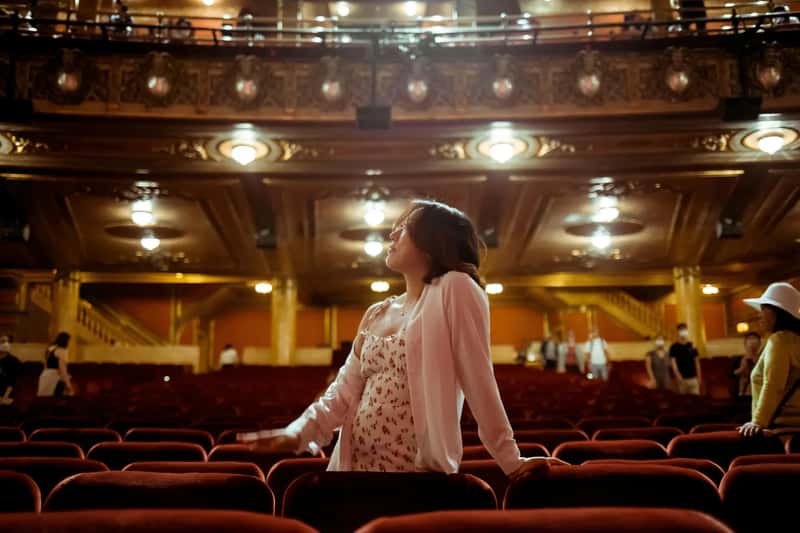
The lights dim in the theater.
You don’t watch the screen.
You watch the door.
The red glow of the exit sign is the first thing you found when you walked in. Not the seats. Not the stage. The door out.
Nobody taught you to do that. Nobody had to.
There’s a version of you that was supposed to arrive here – in this strange city, in this foreign theater, unbothered by the geometry of the room – and simply watch the film. But that version of you never quite materialized. Instead, there’s this one. The one who calculates escape routes in unfamiliar rooms the way other people calculate tips. Automatically. Without drama. Without even noticing it’s happening.
1. The Survival Cartographer
Before you were a traveler, you were a mapper.
Not of cities. Of rooms.
Hypervigilance is a pattern of adaptation, developed as a way of keeping oneself safe in an environment that is threatening to our safety and survival. In a high-conflict home, the child does not have the luxury of simply existing in a room. Every room had weather. Every hallway had a forecast. You learned to read it.
You mapped the kitchen at 7 AM differently than you mapped it at 11 PM. You knew which floorboards announced your weight. You knew which silences were safe and which ones were the held breath before the storm.
Children who have experienced trauma will display signs of hypervigilance. They may avoid perceived threats, jump or flinch at sudden movements or noises, and take precautions to prepare for threats – such as sitting near an exit in case they need to escape.
This is the original cartography. Every foreign theater you enter now is just another room you learned to read before you learned to read words.
The map never stopped being drawn. You just changed the territory.
2. The Alarm That Never Clocked Out
Most people walk into a room and see the room.
You walk into a room and see the room’s vulnerabilities.
Whether the cause was childhood trauma or a career in emergency services, the result is the same: your brain is stuck in “scan” mode. When you live in this state, your brain treats every sound as a potential danger.
There’s no switch. That’s the part nobody tells you about growing up in a high-conflict home. You don’t get a deactivation code. Your brain learned to stay alert to survive. Now it won’t turn off.
The foreign theater – dark, unfamiliar, full of strangers speaking a language your body doesn’t fully trust – is, to your nervous system, structurally identical to the living room at age nine.
Unpredictable. Enclosed. Unknown exits.
Hypervigilance refers to a state of constant, heightened alertness – always watching, always waiting for danger – even when the environment is safe. In the context of PTSD, it is one of the core symptoms that keeps the “alarm system” running, long after the traumatic threat has passed.
You are not paranoid. Your alarm just never clocked out.
3. The Architecture of Dread
In a high-conflict home, architecture becomes psychological.
The hallway is not just a hallway. It is the corridor between safety and exposure. The bedroom door is not just a door. It is a negotiation between privacy and intrusion.
Adverse experiences during childhood leave a lasting imprint on the developing brain and nervous system. When a child grows up in an unsafe environment, their brain adapts to prioritize survival, often at the expense of long-term well-being. This process can lead to hypervigilance – a state of being constantly on guard for potential threats.
So when you enter the foreign theater and your eyes sweep immediately to the green exit sign above the side door, you are not being dramatic. You are being architectural. You are overlaying the floor plan of every room you have ever had to navigate under duress onto this new, unfamiliar space.
The theater’s emergency exit is not an emergency exit to you. It is a door in a room where the weather might turn. It is an option. A guarantee. A quiet, non-negotiable promise you make to yourself the moment you walk in.
You are not afraid of this theater. You are simply refusing to be trapped in it.
4. The Translated Threat
Your nervous system does not speak Portuguese or Mandarin or Finnish.
But it speaks threat fluently in every language.
Hypervigilance is what happens when our natural fight-or-flight instinct goes into overdrive. People who are hypervigilant are in a constant state of anxiety. But here is what the clinical language softens: that anxiety is not abstract. It is sensory. It is the specific, physical sensation of being in a room where the rules are foreign, and your body – trained on a decade of domestic unpredictability – cannot distinguish between “unfamiliar” and “unsafe.”
Complexly traumatized youth frequently suffer from body dysregulation, meaning they over-respond or under-respond to sensory stimuli. They may be hypersensitive to sounds, smells, touch, or light.
The smell of a foreign theater – popcorn oil, unfamiliar cleaning products, the specific warmth of a crowd you cannot read – registers in your body before it registers in your mind.
Your nervous system is not being irrational. It is translating. Badly, but faithfully. Every unfamiliar smell is “uncharted.” Every uncharted space is “potentially hostile.” The exit sign is the only thing in the room it recognizes as a reliable word.
5. The Body That Remembers What the Mind Edited Out
Here is where I have to stop and be honest with you.
I have been in a theater in Lisbon – beautiful city, warm October, the kind of evening that should have been uncomplicated – and I spent the first eleven minutes of a film I had wanted to see for months calculating whether the side exit or the main entrance would be faster to reach if something went wrong. Something did not go wrong. Nothing ever goes wrong. But my body did not know that. My body was running an old program on new hardware.
If the long-term impact of trauma could be summed up into one phrase, it would be nervous system dysfunction. Whether we’re referring to the physical changes in the brain, the resulting fight or flight activation, or the long-term harmful coping mechanisms, it all comes back to feeling dysregulated and imbalanced in the nervous system.
The body keeps the score in foreign currency. It doesn’t care that you’re in Lisbon now. It cares that, once, a room felt exactly like this – enclosed, unfamiliar, full of sounds you couldn’t predict – and something happened.
Trauma doesn’t typically resolve on its own. While the event may be over, the impacts of a traumatic experience can live on in your body for decades.
The theater in Lisbon was gorgeous. The exit sign was green. I knew where it was before the previews ended.
6. The Invisible Inheritance
Nobody handed you a document when you left.
There was no formal transfer. No itemized list of what you were taking with you when you finally got out of that house, that city, that chapter.
But you took everything.
When trauma occurs during childhood, hypervigilance often becomes woven into your developing sense of self and relationships. It does not stay in the childhood home. It packs itself into your carry-on. It knows your passport number. It has memorized your travel itinerary.
If your home environment was unpredictable, chaotic, or emotionally unsafe, your nervous system may stay on high alert to protect you from possible danger. That high alert does not recognize borders. It does not soften because the architecture is beautiful or the food is extraordinary or the light falls differently at this latitude.
The invisible inheritance travels first class, always. It arrives before you do. It has already scanned the theater, noted the exits, categorized the strangers by proximity and potential threat level – all before you’ve found your seat.
You didn’t choose this inheritance. But here it is, pressed into your hands like a heirloom nobody asked for and nobody quite knows how to put down.
7. The Performance of Ease
You are very good at looking relaxed.
This is also part of what you learned.
In a high-conflict home, performing calm in the presence of chaos is a survival skill of the highest order. You learned to make your face say “everything is fine” while every receptor in your body was running threat assessments in real time. The child is constantly scanning the environment for perceived danger. They become acutely aware of subtle changes in how the abuser is acting – a change in tone of voice, or a hand gesture.
You carried this performance forward into adulthood. Into travel. Into foreign theaters.
You look like you’re watching the film. You look relaxed. One leg crossed over the other. Maybe even a small smile.
Hypervigilant people may struggle with clinginess, people-pleasing, and emotional regulation problems. They often neglect their own needs – or even suppress elements of their identity – to avoid conflict.
The performance of ease is its own exhaustion. Nobody sees the part where you’re running calculations. Nobody sees the seven-second assessment you did when you walked through the door. The performance is seamless.
That seamlessness cost you something. It costs you something every time.
8. The Comfort of Controlled Escape
Here is the dark irony at the center of all of this.
You travel to feel free. But the hypervigilance that came from a home where freedom was conditional means that even in freedom, you are engineering escape routes.
This might look like automatically cataloging exits when entering any building, positioning yourself with your back to the wall in restaurants, or feeling intense discomfort in crowded spaces where you can’t see everyone around you.
You book aisle seats. You sit near doors. You know which way is out before you know where the bathroom is. This is not anxiety about this theater. This is the residue of a time when knowing the way out was the most important information in any room.
Chronic exposure to stress causes the fight-or-flight system to remain active, creating a chronic stress response. For children exposed to ongoing trauma, this heightened state of alertness becomes their baseline, leading to heightened alertness even in safe environments.
The controlled escape is a love language you speak to yourself. It says: I will not be caught off guard again. It says: I know the way out. It says: I am ready.
Whether or not there is anything to be ready for is a separate conversation your nervous system refuses to have.
9. The Question You Haven’t Stopped Running From
You have been in thirty-one cities.
Or eleven. Or four.
The number doesn’t matter. What matters is that in every single one, there was a moment – in a theater, or a restaurant, or a crowded market – where your body ran the old calculation before your mind could intervene.
While hypervigilance may once have felt protective, over time, it becomes exhausting, intrusive, and disruptive to daily life. Sleep becomes restless, concentration frays, relationships feel strained, and just relaxing feels impossible.
The question underneath all of this travel – underneath the foreign theaters and the exit-sign-finding and the aisle seats and the maps of rooms you haven’t entered yet – is not “where should I go next?”
It is: when does the room start feeling safe without me having to make it safe?
One goal in working with clients is to help them realize that their hypervigilance is a normal response to trauma. It helped them survive the trauma – but it’s not working now. Not in the foreign theater. Not in the beautiful city with the warm October light and the film you wanted to see for months.
The exit is still there. You still know where it is. But the heaviest work – the work that has nothing to do with cities or tickets or itineraries – is learning to sit in the dark for a little while without immediately calculating the distance to the door.
There is a version of healing that does not look like healing from the outside. It looks like choosing the middle seat. It looks like staying in the theater for the whole film. It looks like noticing the exit sign and then, deliberately, looking away from it – not because you are no longer afraid, but because you are practicing the radical act of deciding that this room, right now, does not require your full tactical attention.
That practice is quiet. It is unglamorous. It does not photograph well against the backdrop of a foreign city. Nobody writes captions about it. But it is perhaps the most courageous thing a traveler who grew up in a high-conflict home can do – to be somewhere beautiful, and to choose, however briefly, to simply be there.
The theater is dark. The film has started. The exit sign is still glowing, soft and red, in your peripheral vision – and for once, you let it stay there, peripheral, where it belongs, while you turn your eyes toward the screen and allow yourself, for just this hour, to be somewhere without a plan for leaving it.