You slide onto the stool.
You don’t look around.
You already know what you want.
Not from the menu. From the geometry of this particular arrangement of the world – the bartender in front, the bottles behind, and everyone else just slightly out of frame.
There is a version of you that exists only in full social exposure. At the dinner table, center stage. Four walls of eye contact. Every bite a performance. Every pause a verdict. That version is exhausting. That version is not the real one. The real one found a bar stool, ordered the special, and quietly exhaled for the first time all day.
The Geometry of Disappearing
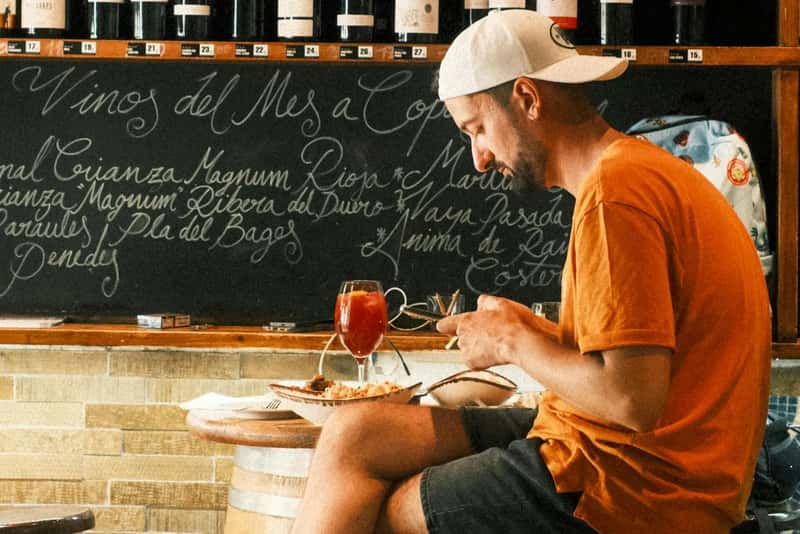
The bar is engineered for peripheral existence.
Think about what it actually offers you, architecturally: a fixed forward gaze. Your eyes go to the bottles, the taps, the television, the bartender’s hands moving like a slow metronome. You face outward, not inward. Nobody is sitting across from you, waiting.
Participating in a meal can feel excruciating for those who experience social anxiety. We are confined to a spot with no easy escape, and the pressure to belong and make conversation can feel overwhelming. But the bar neutralizes that trap. You are present. You are housed within the living hum of the room. And yet you are not required to perform for anyone directly in front of you.
That is not a small thing. That is everything.
The bar is a one-directional stage. The audience is the room. But the room isn’t watching you back.
The Spotlight That Doesn’t Exist
You think people notice you more than they do. That is not philosophy – that is neuroscience.
Psychologists describe the spotlight effect as the tendency to overestimate how much others notice you. You sit down at a table alone and feel the weight of a thousand invisible eyes. You sit at the bar and somehow – somehow – the weight lifts. The stool tells your nervous system: this is where single people sit. This is the designated zone of solitude-in-public.
Most people believe they’re being noticed and judged far more than they actually are. Truth? No one in the café is crafting a documentary about you eating a sandwich alone. They’re probably wondering if they have spinach in their teeth.
The bar removes the spotlight without removing you from the room.
You get to exist. You just don’t have to explain yourself while doing it.
The Third Place and the First Self
Sociology has a name for this kind of space. It has always had a name.
In the 1980s, American sociologist Ray Oldenburg developed the notion of a “third place”: a space for informal, free social interaction, essential to democracy. Not home. Not work. Somewhere in between, governed by different rules. Rules that don’t require you to be anyone in particular.
Oldenburg showed that bars, coffee shops, and general stores are central to local democracy and community vitality. But there is something he understood quietly, beneath the civic theory: these places let you be nobody. Or more precisely, they let you be the version of yourself that exists before the social contract kicks in.
A third place is a powerful antidote to isolation and exclusion. It restores connection, gives us an identity, supports us, and allows us to be our genuine self.
The bar stool is your third place seat. Not assigned. Not earned. Just claimed.
The Permission Structure of Bar Seating
A table for one announces itself. It cannot help it.
Many restaurants simply aren’t set up for solo diners. Tiny two-person tables or a sea of four-tops filled with couples can make even the most confident among us feel like we’re crashing a party we weren’t invited to.
But the bar does not operate under that social contract. The bar, by its very design, is intended for single occupancy. You are not an anomaly at the bar. You are the intended user.
Counter seating and bar spots are built for singles and make it easy to chat with staff if you want a friendly exchange. The key word is “if.” The bar does not demand exchange. It merely makes it available. That optionality is the psychological reprieve you didn’t know you were looking for.
You can talk. You can stay silent. Both are acceptable. Neither requires justification.
The bar is the only room in the restaurant where not being in conversation is a perfectly valid state of being.
The Real Reason (A Confession)
I need to tell you something from the inside.
I have eaten alone in thirty cities. Tables, counters, park benches, airport gates. But the bar – the bar is the only place where I stopped feeling like I owed the room an explanation. The first time I ordered a meal at a bar and kept my eyes forward, watching the bartender slice limes, watching the ice tumble into a glass, I felt something release in my chest that I hadn’t known was clenched.
I wasn’t lonely. I wasn’t hiding.
I was, for the first time in a long time, just there.
A table for one is one of the few remaining places in adult life where you can sit in public without being needed, without performing, without managing someone else’s experience of you.
The bar doubles that gift. Because the bar removes the possibility of sustained eye contact. And with it, the possibility of sustained expectation.
The Performance We Can’t Stop Giving
Social life is performance. That is not cynicism – that is Erving Goffman, that is basic sociology.
Every time we sit across from another person, a stage activates. We manage our expressions, our timing, the angle of our interest. We project. We receive. We recalibrate. It is exhausting in a way we rarely acknowledge, because acknowledging it would feel antisocial, which would itself require more performance.
Solo diners eat alone because they’ve found something at that table that’s hard to find anywhere else. A version of themselves that doesn’t need to perform, manage, anchor, or explain.
The bar amplifies this. Because at the bar, even the functional social exchange – with the bartender – is transactional, brief, and forward-facing. No one is waiting for you to make their experience of the night complete.
You are just a person. Eating food. Watching ice melt.
It is, quietly, profound.
The Anatomy of Eye Contact Avoidance
Eye contact is the hinge of social obligation.
When you make sustained eye contact with someone, you open a door. You signal availability. You invite reciprocity. The brain, wired for threat detection and tribal belonging, reads eye contact as the initiation of a social contract. And sometimes – many times – you don’t want to sign that contract.
Some people can’t seem to continue their train of thought unless you make direct eye contact and nod all the time. Do you really want to spend an hour quickly eating between replies?
At the bar, the architecture pre-empts the question. The person next to you is also facing forward. The social default is parallel existence, not confrontational engagement. You can speak – but speaking is initiated by choice, not by default proximity.
The bar is a room where eyes travel sideways, not forward. And in that sideways glance, you find the most extraordinary thing: rest.
The Anonymous Communion
Here is the paradox the bar solves.
You want to be near people. You also want to be left alone. These things feel contradictory. They are not.
Solo dining extends previous portrayals as a bundle of aloneness and togetherness, exploring such interplay in the context of the aestheticization of eating. There is a version of togetherness that requires no direct address. The background clatter of conversations. The clink of glassware. The bartender sliding a coaster across the bar without being asked. These are social signals without social demands.
The primary driver of the solo diner is the conversion of a public meal into a private ritual of emotional maintenance. Consumers are using restaurants to escape the “mental load” of domestic or professional life.
The bar is where that escape is most structurally complete. You are surrounded by the living world. You are untouched by its claims.
What the Stool Actually Holds
The bar stool is a psychological object. Don’t be fooled by its simplicity.
It is elevated. Slightly above eye level of the room. You can see without being seen as directly. You have a surface in front of you – drink, plate, phone – that gives your hands somewhere to be. Hands with something to do are a nervous system signal of safety.
Eating solo can be a great mindfulness tool. Without conversation or external distractions, you’re more likely to notice the textures and flavors of your meal. You may also become more aware of your body’s hunger and fullness cues.
At the bar, sensory engagement deepens. You watch the kitchen line if the bar faces it. You watch the street if it faces the window. Your senses find occupation without your brain needing to manage a relationship simultaneously.
The stool holds you slightly outside the main narrative of the room. Close enough to feel the warmth. Far enough to breathe freely.
The Identity You Get to Set Down
This is the heaviest truth. The one that takes the longest to arrive.
Every room you walk into has a version of you already waiting there. Friend. Colleague. Partner. Child. The version with the specific laugh, the specific opinions, the specific emotional labor that particular relationship requires. You carry these identities the way a coat accumulates weight through a long winter – without noticing, until you try to take it off.
Solo dining has evolved from a social fallback into an intentional tool for personal autonomy and emotional regulation. Consumers increasingly prioritize “stolen time” and self-care over traditional communal expectations.
The bar is where identity gets to dissolve. Not permanently. Not dangerously. Just temporarily – for the length of a meal. You are not anyone’s anything. At a restaurant bar, you’re anonymous. You have no role. The server doesn’t need you to be interesting or kind or helpful. The couple at the next table doesn’t need you to fill their silence.
That anonymity is not loneliness. It is the opposite of loneliness. It is the rare permission to exist as an unassigned person. To take up space without owing the space anything in return.
There is something almost sacred about that. The way a confessional is sacred, except with better lighting and a decent Syrah.
We have built a world that runs on mutual witness. To be seen is to be real. To be known is to belong. The mythology of connection demands constant reciprocity – eye meeting eye, story answering story, need calling out to need. And most of the time, that mythology sustains us. It is the architecture of love and friendship and everything that makes a life feel inhabited.
But the mythology has a cost nobody advertises. The cost is that you are never entirely off. Never entirely released from the requirement to be legible to another person. And the accumulated weight of that legibility – of always being someone’s something – can become, quietly, over years, a kind of disappearance. You perform yourself so consistently that you begin to lose the thread of who performs when no one is watching.
The bar stool is where you go to find that thread again. Not through grand introspection. Not through therapy or meditation or a long walk through a redwood forest. Just through the small, quiet, radical act of sitting down, facing forward, ordering something warm, and letting the room move around you without requiring you to move with it. The glass condensates. The kitchen sounds carry. Somewhere behind you, someone laughs at something you’ll never know about. And for a while – for exactly this long, delicious while – you are in the world, and the world is asking nothing of you at all.
Maybe that’s all belonging ever needed to be.