The train moves at 11:47 PM.
You don’t.
Or rather – the version of you that owes emails, carries deadlines, maintains personas – that version stays on the platform.
Something strange happens between stations at night. The window goes black. The carriage hums. The world outside dissolves into a smear of dark and the occasional amber streak of a distant highway. And for a few hours, you become nobody in particular. Not in a tragic way. In the best way possible.
1. The Liminal Contract
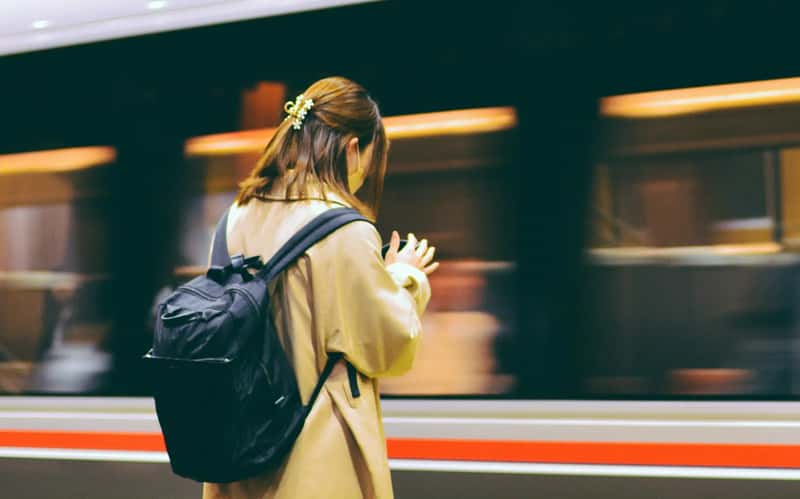
There is a clinical word for what happens the moment those doors close: liminality.
In psychology, liminal space is defined as a threshold state – a pause, a transition, a space that can feel uncertain, uncomfortable, and even disorienting.
But here’s what they don’t tell you in the textbooks.
Sometimes the disorientation is the point.
Sometimes the uncertainty is a relief.
When you’re in a liminal space, you’re neither here nor there, neither this nor that. At the same time, you’re both here and there. Both this and that. The late-night train is this exact architecture – dressed in steel and fluorescent light, rattling through geography that belongs to no one.
You signed a contract when you bought the ticket. It reads: for the duration of this journey, you are temporarily excused from being yourself.
Most people sign without reading it.
The ones who prefer the late train? They read every word.
2. The Clock Stops Here
Something peculiar happens to time on a moving train at night.
The urgency drains out of it.
Nearly a century and a half after railroads standardized time zones, many long-distance train passengers still feel that time shifts when they step aboard a train.
Think about that. The very institution that invented modern time loses its grip on you inside its own machine.
A subtle alteration in the perception of time occurs aboard a long-distance train. Everything seems to run more slowly, including emotional and intellectual metabolism. Without the pressure of the clock, one feels more relaxed, patient, and confident.
This is not metaphor. This is neurochemistry.
When your brain is no longer calculating the time until the next obligation, the prefrontal cortex – that relentless scheduler – loosens its grip. The body exhales. The self, briefly, stops performing.
At 11:47 PM, you are not late for anything. You are, for once, exactly where you are supposed to be.
3. The Permission Slip
Nobody told you that you needed permission to stop being productive.
But your nervous system has been waiting for someone to issue it.
Long before the smartphone kept us tethered to our responsibilities, one train traveler described the journey as having “no telephone calls, no mail, no TV, no traffic, no supervisors… no appointments, no social entanglements, no family responsibilities, no community obligations, no promises, no identity save what I create out of whole cloth during this passage.”
Read that again. No identity save what I create.
This is the underground confession of every person who books the late departure over the sensible morning option. It is not about the schedule. It is not about the cheaper fare. It is about the few hours in which the architecture of your obligations physically cannot reach you.
The late-night train is the permission slip your Monday morning would never sign.
4. The Identity Offload
You carry a lot of selves through your day.
The professional self. The parental self. The responsible-enough self. The self that replies to messages within a reasonable window. The self that remembers to ask how someone’s mother is doing.
By 11 PM, these selves are exhausted.
Escaping the constraints of your usual self-concept when you’re between roles or life phases allows you to experiment with aspects of your identity that might have remained dormant in more stable times.
The late-night train is a role-free zone. Nobody knows your job title in Carriage C. Nobody requires anything from you. The darkness outside the window is not indifferent – it is merciful. It asks nothing.
For a few hours, you are just a body in motion, watching the country blur past, remembering that you existed before the inbox did.
This is not escapism. This is maintenance.
5. The Confession I Keep Making to Moving Windows
I will tell you something I have never typed into a work document.
I once booked a late-night train from Edinburgh to London not because it was the most practical option, but because I needed four hours during which no one could reasonably expect anything from me. My inbox was catastrophic. My phone was vibrating in the way that meant I had ignored it too long. I was, in the clinical language of the modern age, overwhelmed.
I sat in the dark carriage with my forehead almost touching the cold glass and watched the Scottish lowlands dissolve into English flatlands. Nobody asked me anything. A woman two rows ahead was asleep under a coat. A man at the far end was doing a crossword in pencil. The conductor came and went with the quiet efficiency of someone who respects silence.
For exactly three hours and forty minutes, I was not required to be anyone in particular.
I have chased that feeling ever since. Psychology research describes what happens in these transit spaces as something researchers call “identity play” and “mind-wandering with purpose.” I just called it breathing.
6. The Stranger Effect
There is a social paradox that lives specifically on trains at night.
You are surrounded by people. And you are utterly alone.
On trains, everyone is “between places,” suspended in time. This creates a sense of solidarity. A quiet communion. You are not friends with the woman asleep under the coat. But you share something – this temporary statelessness, this mutual agreement to be nowhere for a while.
Psychologists have long been fascinated by the stranger-on-a-train phenomenon – the curious, fleeting intimacy we sometimes feel when chatting with people we’ll likely never see again. Far from being just small talk, these interactions reveal profound truths about social psychology, loneliness, and human well-being.
The night train makes these interactions feel sacred precisely because they are temporary. There is no follow-up. No LinkedIn connection. No awkward next encounter. Just a brief fluorescent moment of two people existing without pretense, and then the station arrives and everything disappears.
7. The Neuroplastic Window
Here is what is actually happening in your brain during those hours.
When the usual patterns are suspended, the brain becomes more plastic – more open to new connections, insights, and meanings. The loss of “normal” makes space for something more honest.
The late-night train strips away the scaffolding of routine. Without the familiar architecture of your day – the commute, the desk, the meetings, the domestic choreography – your mind begins to wander in ways it is rarely permitted to.
This is not unproductive wandering. Many find that traveling on a long-distance train is ideal for internal exploration, or daydreaming. The kind of thinking that happens at 1 AM in Carriage B is the kind of thinking that quietly rearranges things. Old problems look different through a dark window. Old decisions soften. New ones arrive without being summoned.
Your brain was waiting for a gap in the noise. The late-night train gave it one.
8. The Anonymity Architecture
There is a specific kind of freedom in being unknown.
The city street offers it fleetingly. The supermarket does not. The office absolutely does not.
But the late-night train? It is engineered – accidentally, architecturally – for anonymity.
Psychological anonymity in a crowd paradoxically encourages openness. This is the same principle behind confessions to bartenders, hairstylists, or even taxi drivers. They’re strangers, yet trusted confidants in the moment.
On a night train, you can be whoever the journey requires you to be. You can be the person who reads poetry. The person who cries quietly into a phone screen. The person who stares at the ceiling and lets the vibration of the tracks think for them. Nobody is keeping score. Nobody is updating their assessment of you.
This is the anonymity architecture. And it costs less than therapy.
9. The Responsibility Horizon
Here is the hard truth about why your responsibilities feel so suffocating on land.
They have no natural limit. They expand to fill every available space – every room, every screen, every silence. They are ambient. They are everywhere.
The late-night train installs a horizon.
In anthropology, liminality is the quality of ambiguity or disorientation that occurs in the middle stage of a rite of passage, when participants no longer hold their pre-ritual status but have not yet begun the transition. During a rite’s liminal stage, participants “stand at the threshold” between their previous way of structuring their identity, time, or community, and a new way.
The train installs exactly this threshold. On one side: everything you owe the world. On the other: where you’re going. And between them? A corridor of dark countryside and rattling metal where neither version of you has full jurisdiction.
You are in transit, which legally – psychologically – means you are in no-man’s land.
And no-man’s land is, perversely, the most restful place many of us ever get to stand.
10. The Heaviest Truth About Coming Home
Here is what nobody says at the end of the journey.
The dread isn’t about the destination. It is about the resumption.
As the train slows into the final station, something contracts in the chest. The lights of the platform appear – cold, specific, demanding. The world outside the window resolves back into detail. Streets become legible. Signs become directives. People on the platform have faces that expect things from you.
During a person’s time in liminal space, their previous identity will try to bring them back while their new identity pushes them forward. The arriving train does this with brutal efficiency. In the span of one deceleration, you are required to reassemble yourself. To remember which self gets off at this stop.
But something has shifted. Something always shifts.
Research suggests that while liminality can be unsettling, it also offers opportunities for growth and transformation. Embracing these periods of transition can lead to new perspectives and personal evolution. The late-night train does not change your life. But it changes the angle at which you re-enter it. Problems you boarded with feel slightly differently weighted. Decisions that felt sealed now feel provisional. You are, incrementally, different from the person who stood on the other platform three hours ago.
—
The question nobody asks is why the late train specifically. Why not the 9 AM with its commuters and coffee cups and the performative busyness of people who need to be seen being productive?
Because the 9 AM is still the world. It is still operating at the frequency of obligation. The seats are full of people who have somewhere important to be. The energy is forward-thrust, purposive, watched. But the late train – the 11:47, the midnight sleeper, the 1:15 with its four scattered passengers and its half-lit carriage – this runs at a different frequency altogether. It runs at the frequency of the self without an audience. It is slow in a way that has nothing to do with the timetable.
There is something to be examined in the specific ache of preferring transit to arrival. It is not a pathology. It is a form of honesty. A confession that the life waiting at the destination sometimes requires more courage to return to than we are willing to admit in daylight. The train does not judge this. It simply moves through the dark, carriage after carriage, delivering its quiet passengers back to their lives at a speed that feels, for once, like something chosen.
You will reach the station eventually. You always do. But for now, the window is dark, the tracks are speaking their low monotonous language beneath your feet, and nobody – not a single person in the world – knows exactly where you are.