The cold hits you at the gate.
Not metaphorically. Literally. The glass doors slide open and the wind finds the exact gap between your collar and your jaw.
You don’t flinch.
Everyone around you does. They curse. They pull scarves tighter. They look around for someone to confirm that this is, in fact, unreasonable. You just walk.
There is something happening in that moment that has nothing to do with weather tolerance. It has everything to do with identity. We curate our travel destinations the way we curate our wardrobes – not for pure function, but for the story they tell about who we are. And the story most winter travelers are quietly telling themselves is this: I can take it.
1. The Weather Does What Your Feelings Can’t
You’ve spent years managing your interior climate.
Softening your tone in difficult meetings. Holding your face neutral at the dinner table. Performing calm in situations that deserved panic.
The cold doesn’t ask you to manage it. It simply is. Harsh, indifferent, and honest.
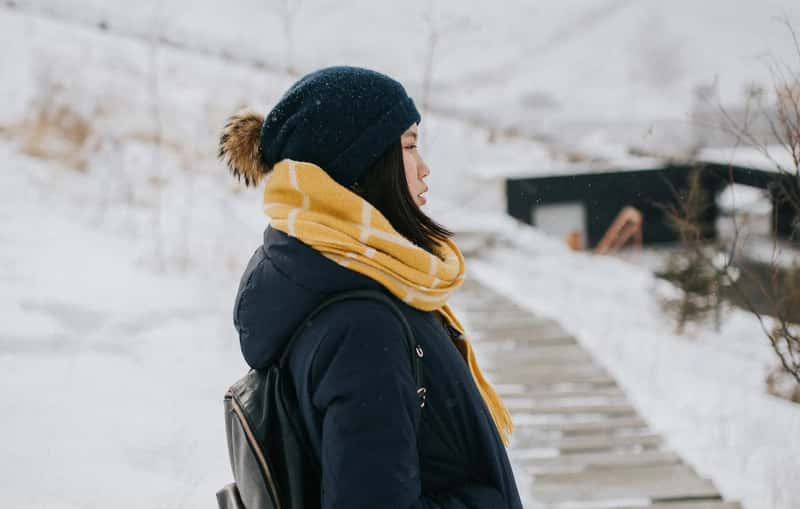
There is a quiet relief in that. Facing the cold and stepping outside can be an act of resilience. Winter, with its stark landscapes and challenging conditions, often mirrors life’s hardest difficulties. That mirroring is the point. When the outside world finally matches the inside world, the tension between them disappears – if only for a long weekend in Reykjavik.
You don’t travel to winter destinations despite the weather.
You travel because of it. Because for once, the environment is being honest about how hard things actually are.
The cold is not the obstacle. The cold is the validation.
2. The Solitude Speaks Your Language
Summer beaches are full of people performing happiness.
Everyone is loud. Everyone is present. Everyone requires something from you – eye contact, laughter, a version of yourself that’s available.
Winter destinations ask for none of that.
People who love cold weather often find a sense of peace and comfort in solitude. This doesn’t necessarily mean they’re introverted or antisocial, but rather they appreciate the tranquility that comes with a frosty landscape.
That tranquility is not emptiness. It is space.
Space to exist without narrating yourself to others. Space to stop performing. Space to be the version of you that developed in private, in the hard years – the one who got good at being alone, at sitting with discomfort, at finding something to admire in a bare, ice-stripped tree against a colorless sky.
The solitude of winter travel doesn’t feel like loneliness. It feels like recognition.
3. The Destination Personality Matches Your Own
We choose places the way we choose companions.
Unconsciously. By feel. By the sense that something out there understands what’s in here.
Research risks overlooking the emotional and symbolic meanings that tourists ascribe to their experiences. Most travel writing does exactly that – it lists activities and skips the psychological architecture underneath them.
But winter destinations have a personality. They are stern. Spare. Beautiful in a way that requires something from you before it reveals itself.
You have to earn the view. You have to walk into the wind to get to it. You have to stand there, eyes watering, and decide that yes – this is worth it.
That is not a casual tourist’s itinerary. That is the interior logic of someone who has learned that most good things are hard to reach.
The destination is not separate from you. It is a projection of the self you’ve built.
4. The Cold Makes the Body Honest
In warm climates, the body can lie.
It can be soft. Relaxed. Uncommitted to the moment. Heat makes you slow and vague and pleasantly dissociated from the present.
Cold does the opposite.
Cold weather can sharpen the senses, making outdoor experiences more vivid and grounding. The crunch of snow underfoot, the crispness of the air, and the stark beauty of bare branches against a pale sky all demand attention.
That demand is the thing. You cannot drift when you are cold. You cannot be elsewhere. Every nerve ending insists on right now.
For someone who has spent years learning to be present through difficulty – who built resilience not in therapy rooms but in impossible situations – that forced attention feels like home. The body under cold is the body at its most awake. Most honest. Most yourself.
Warmth lets you forget yourself. Cold insists you remember.
5. The Internal Anecdote: Oslo, January, 4 PM Dark
I stood on a bridge in Oslo in early January. The light had gone by four in the afternoon.
Not dusk. Gone. Completely and without apology.
The river below was the color of old pewter. The city was quiet in that particular way that Nordic cities get quiet – not abandoned, just unhurried, as though everyone had agreed to stop pretending movement equals progress.
I remember thinking: This is what I feel like inside most of the time.
Not depressed. Not defeated. Just – real. Stripped of the decorative layers. The calmness of snow-filled streets helped create a sense of peace absent in busier, warmer destinations. For those who feel emotionally drained, the stillness of cold places can be rejuvenating.
I hadn’t booked Oslo to have fun. I had booked it to feel recognized.
The darkness didn’t frighten me. It confirmed something I already knew about myself – that I had learned to function in the absence of light. That I had, in fact, built my entire interior life in exactly that condition.
6. The Discomfort Is the Point, Not the Price
Most people describe travel discomfort as something to be minimized.
They pack thermal layers to avoid the cold. They research heated restaurants to escape the wind. They treat the weather as a logistical obstacle between them and the experience.
But for a specific kind of traveler, the discomfort is not the price of the experience.
It is the experience.
Embracing these challenges by choosing to engage with the outdoors can foster a sense of accomplishment and self-efficacy. Each decision to venture out despite the cold becomes a small victory, reinforcing mental toughness and adaptability.
That reinforcement is not accidental. It is a recalibration. Every moment you walk into the wind and stay upright, you are reminding yourself – quietly, privately, without an audience – that you are still the person who can do hard things. That the years that made you hard were not wasted. That the internal toughness you developed has a use.
Winter travel is the practice round for the rest of your life.
7. The Quiet Is Not Empty – It’s Evidence
You notice things in winter that disappear in summer noise.
The way snow absorbs sound and leaves a silence so complete it has texture. The way frost on a window is more intricate than anything a designer ever made. The way the last light of a Scandinavian afternoon turns the snow the exact color of something you cannot name.
Cold-weather lovers have a knack for finding beauty in places others overlook. When the world is cloaked in snow and ice, they stop to marvel at the intricate patterns of frost on a window, or the way early morning light sparkles off a freshly fallen snowdrift. They find joy in the hush that descends on a city after a snowfall.
This attention is not romantic affectation. It is a survival skill repurposed.
When you’ve had to learn to find meaning in difficult circumstances – in quiet rooms, in long stretches of solitude, in seasons that didn’t offer much – you develop an eye for it. The beauty in hard places. The evidence of something worth staying for.
Winter travel hands you that same assignment. And you already know how to do it.
8. The Travel Preference Is a Mood Report
Where you go says what you feel.
Not consciously. Not deliberately. But with the quiet accuracy of the unconscious mind, which is always filing toward truth while the conscious mind is busy making itineraries.
Travel preferences are shaped by emotional state. When emotionally overwhelmed or burnt out, the craving is for quiet, cold destinations.
That craving is worth examining. Not to pathologize it. But to honor it as information.
When you choose Tromsø over Tulum, your nervous system is telling you something about what it needs. Not warmth and stimulation and social carnival. Stillness. Monochrome skies. A landscape that has already done the hard work of becoming stark and beautiful and honest without you.
Once you start seeing climate as a psychological mirror, everyday scenes look different. The friend who moves countries to “escape the cold,” the partner who sleeps with the window open in March – they’re not just being quirky. They’re revealing how they relate to comfort, risk, and other people.
Your winter travel is a mood report you write with boarding passes.
9. The Scandinavia Paradox – Cold Countries, Resilient People
There is a data point that keeps surfacing when researchers look at cold-climate cultures.
The people are, by many measures, doing remarkably well.
In Scandinavia, where the winters are among the coldest and darkest on earth, many people look forward to winter as a time of coziness, beauty, and rest. Psychologist Kari Leibowitz studies the power of mindsets to improve health and well-being in these extreme conditions.
That is not a coincidence of geography. It is a lesson in identity alignment.
When your environment is hard and you have decided to find it beautiful anyway – not in spite of the hardness, but through it – something shifts. The external difficulty stops being a threat and starts being a texture. Something that gives the life its definition, the way shadows give a photograph its depth.
Cold-weather lovers have a special way of seeing the world and living in it. Their ability to find joy and comfort in chilly conditions not only defines their preferences but also enhances their sense of resilience and mindfulness.
You weren’t drawn to the cold. You were drawn to evidence that surviving it is possible.
10. The Heaviest Truth: You Aren’t Running From the Warmth – You’re Running Toward the Mirror
Here is what no travel influencer will tell you, standing in their perfectly lit thermal layers against a backdrop of frozen fjords.
You are not here for the aesthetics.
You are here because this landscape looks like something that happened inside you a long time ago.
Instead of seeing winter as something to endure, we can begin to see it as a season of life – one that offers its own rhythms, textures, and opportunities for reflection. But for some of us, that reframe isn’t necessary. We already see winter clearly. We aren’t afraid of it. We were made in it.
The internal hardness you developed was not a flaw in your character. It was an adaptation. A calibration. The psychic equivalent of learning to walk in ice without falling – a skill that looks effortless from the outside and cost everything on the inside.
If you’ve felt an unexplained connection to a cold destination, you’re not imagining it: your brain and body are responding to the environment in ways that influence emotions and mental health.
What you found in that cold place wasn’t escape. It was echo.
There is a particular kind of grief in realizing that you became tough not because you wanted to, but because softness was not an option available to you at the time. That you built the interior landscape of a winter country not as a creative project but as a survival requirement. The cold outside didn’t teach you anything. You were already fluent in its language before you ever boarded the plane.
What winter travel gives you – quietly, without ceremony – is permission to exist as you actually are. Not the warmed-up, sunlit, sociable version you maintain for other people. The real one. The one that knows how to stand in a gray place and find it genuinely, privately, sufficiently beautiful. The one that doesn’t need the weather to be kind in order to feel okay. That version of you is not damaged. That version of you is extraordinarily capable of being present in conditions that send everyone else inside.
The next time you find yourself booking a ticket to somewhere cold and dark and far away while everyone around you is searching for all-inclusive resorts in the sun – don’t explain yourself. Just go. Stand in it. Let the wind find the gap between your collar and your jaw. And notice, without judgment, that you already know exactly what to do.