You booked the flight at midnight.
You didn’t tell anyone until it was confirmed.
The destination was high. Deliberately, instinctively, inexplicably high.
There is a version of you that performs contentment beautifully. The right job title on the LinkedIn profile. The apartment that photographs well. The social calendar that looks full from the outside and feels hollow from the inside.
That version of you moves through the world on autopilot – nodding in meetings, smiling at brunches, existing inside a life that technically fits but never quite does. And then one day, something cracks. Not dramatically. Quietly. You find yourself searching for mountains.
1. The Altitude Instinct
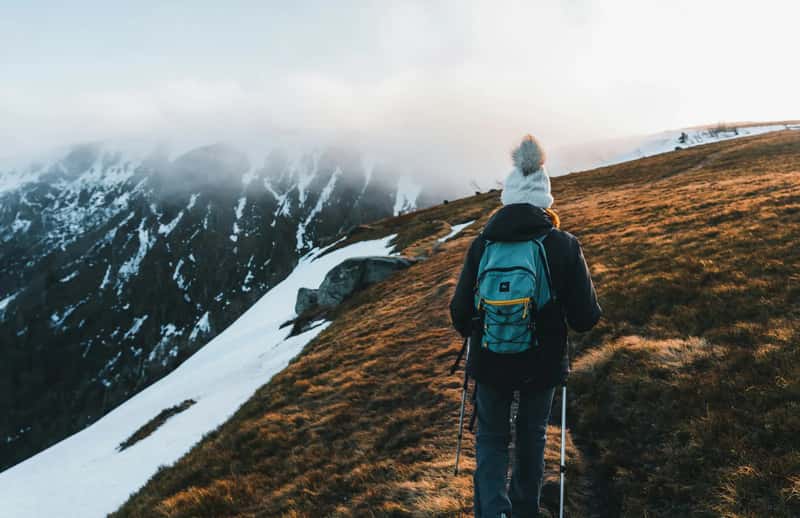
You don’t choose high altitudes randomly.
There is something deliberate in it – even when it masquerades as impulse.
The grandeur of mountains offers spectacular views, providing ample opportunities to experience the emotion of awe, which quiets negative self-talk by quieting the part of the brain responsible for self-perception. That is the first thing altitude does to you. It silences the inner critic. Not through distraction – through scale.
When the ridge opens up and you see a thousand miles of nothing but sky and stone, your problems don’t disappear. They simply find their actual size.
The life that felt so heavy at sea level – the overdue email, the relationship that has gone grey, the career that is moving sideways – suddenly looks like what it always was: small print on a very large page.
You didn’t go up the mountain to escape. You went up to finally see.
2. The Diminished Self-Effect
Here is what the science says about standing at altitude and looking out.
Studies have shown that awe is often accompanied by feelings of self-diminishment and increased connectedness with other people. Experiencing awe often puts people in a self-transcendent state where they focus less on themselves and feel more a part of a larger whole.
The self you carry down in the valley – the one constructed from performance reviews and old arguments and other people’s expectations – shrinks.
Not in a damaging way. In a clarifying way.
Awe has been found to activate a sense of small-self, through which people feel humbler in the grand scheme of things – what researchers call self-diminishment – and more connected to the greater whole.
What you’ve been unconsciously searching for on every high ridge and every thin-aired summit is not an escape from yourself. It is a recalibration of yourself. The mountain gives you the correct proportions back.
3. The Identity Gap
There is a version of you that only exists at altitude.
Unscheduled. Unencumbered. Breathing hard not from anxiety but from effort.
The real cost of habitual life is the growing incompatibility between the you that exists in motion and the you that is expected to stand still. This is the identity gap. The space between who you actually are and who the world has decided you should be.
At 4,000 meters, the gap narrows. Nobody up there knows your professional failures. Nobody knows the version of you that said yes when you meant no. Nobody has a file on you.
You are just a person breathing thin air, watching clouds form below your feet.
That anonymity is not emptiness. It is relief.
4. The Escape Theory
Let’s be precise about the word “escape.”
It is not the dirty word we’ve made it.
The human desire to escape is perennial; sometimes we escape through mental fantasies, while other times we escape to physical places that we’ve fantasised about. ‘Escape’ doesn’t have to carry negative connotations, especially since nomadism characterised 99% of human history, with genetic variants still predisposing some people to nomadic lifestyles today.
When you book a flight toward the mountains, you are not running away. You are running toward the only version of your life that still feels real.
Escape theory assumes a ‘negative’ driver: people sometimes travel at least partly because they want to be away from a given place – and they might prefer not to be able to quickly travel back to daily life, nor to be easily accessible by others.
The distance is the point. And the altitude doubles the distance. Not just in miles. In altitude of mind.
5. The Autonomy Hunger
I remember standing at a trailhead in the thin morning air of somewhere high and cold, pack on, no signal, no itinerary beyond “up.”
The freedom wasn’t about the mountain. It was about the decision. Mine alone. No approval required. No calendar to check. The sheer unmediated quality of choosing a direction and walking toward it – that was the drug.
Self-Determination Theory suggests that humans have three innate psychological needs: autonomy, competence, and relatedness. Travel, particularly independent travel, can be a powerful way to satisfy these needs, leading to enhanced well-being and personal growth.
Part of the thrill of adventure travel is the need for autonomy and the fulfilment one attains from challenging oneself and overpowering trials along the way.
A life that feels small is almost always a life in which autonomy has been quietly surrendered – to institutions, to obligations, to the slow erosion of doing what you’re supposed to do. The mountain gives it back, one steep step at a time.
6. The Perspective Architecture
Perspective is not a feeling. It is a structural need.
When your life feels small – when the walls of routine have moved closer and the ceiling has lowered – perspective is what allows you to see that the walls are not, in fact, the whole world.
Mountains promote perspective on life’s problems via the diminutive effect – the feeling of being small in the presence of something significant.
The irony is exquisite. You go to the highest place you can find to feel small. Because feeling appropriately small in the presence of something vast is the only cure for feeling wrongly small inside a life that has become too narrow.
A key theme to emerge from research on high-altitude expeditions was the altered perspectives of many participants, which they experienced following their involvement. The key factors for this change in outlook were identified as emerging via mental and physical challenge, cultural exposure, and learning about other people’s recovery journey.
You don’t climb to find answers. You climb to find the right questions.
7. The Liminal Space
There is a specific psychological territory that altitude creates.
It is not here and it is not there. It is the in-between.
Liminality refers to a transitional state of being “betwixt and between” established social roles and identities. When we travel, we enter a liminal space, temporarily shedding our everyday identities and the social expectations that come with them. This suspension of our normal roles creates a psychological space for experimentation and self-exploration.
At altitude, that liminal space is amplified. The physical difficulty of the ascent makes it impossible to carry your usual psychological luggage. You are too busy breathing to maintain your performance of yourself.
And in that exhausted, open, oxygen-thin state – something real surfaces. Something that the noise of ordinary life had been drowning out for months, or years.
The mountain doesn’t tell you who to be. It just strips away who you’ve been pretending to be long enough for the real thing to emerge.
8. The Resilience Power
There is a particular kind of confidence that belongs only to altitude.
It cannot be purchased in a workshop. It cannot be intellectualized in a therapy session. It must be earned, one difficult step at a time, with burning lungs and unreliable footing.
Because mountains, by their very nature, offer more physically demanding terrain, hikers in this environment experience a sense of accomplishment, boosting self-esteem. Hikers may adopt an internalized sense of being someone who can accomplish challenges – a mental shift that can raise their sense of personal empowerment.
Recent approaches to adventure and psychological well-being emphasize the ability to handle emotions better, resilience, and self-confidence. Such benefits may not only be experienced when participating in the adventure activity but may also transfer to circumstances one may experience daily.
You go up the mountain feeling small. You come down knowing you are not. That knowledge is not arrogance. It is the quiet, unshakeable kind of confidence that only comes from surviving something difficult on your own terms.
9. The Return Problem
Here is the thing nobody warns you about.
Coming down is harder than going up.
Not physically. Psychologically.
Without actively integrating a revised model of self, one might experience existential conflict and confusion, left with two models of self: a new one momentarily realized and the familiar, habitual one that reappears when back home.
The emptiness of returning from traveling is not a simple feeling of nostalgia – it may also be a sign of a small expansion of your identity that can’t fully be embraced in your past context.
The city waits. The inbox waits. The version of you that everyone has a fixed image of – that waits too. And you return with altitude still in your lungs, trying to breathe mountain air in a place that only offers recycled office air and the particular deadness of obligations resumed.
The gap opens again. Wider now, because you’ve seen what’s on the other side.
10. The Real Summit
The mountain was never the destination.
It was the question, delivered in the only language large enough to make you stop and actually listen. The summit – that cold, windswept, exhilarating place above the clouds – is not where you find yourself. It is where you lose the false self long enough to glimpse the real one.
The emotion of awe awakens self-transcendence – reaching beyond one’s self-boundary – which in turn invigorates pursuit of the authentic self, defined as alignment with one’s true self.
In the end, our craving for adventure is a reflection of our deepest psychological needs – for freedom, connection, discovery, and renewal. When we step into nature, we’re not escaping life; we’re returning to it.
The need you brought to the mountain was never really about altitude. It was about authenticity. About reclaiming the parts of yourself that got lost somewhere between who you were and who you became. The high places just happen to be where the signal is clearest. Where the noise of an over-scheduled, under-examined life finally drops away and you can hear the frequency you’ve been trying to tune into for years.
This is why you go back. Not for the views, though the views are extraordinary. Not for the physical challenge, though that matters too. You go back because the mountain is the only place where the gap between who you are and who you pretend to be finally, mercifully, closes.
Being outside is a powerful natural antidote to the stress of modern culture and the lack of engagement and fulfilment many of us feel in our daily lives. But it is more than antidote. It is diagnosis and prescription simultaneously.
The mountain tells you, in the language of cold wind and thin air and a horizon that won’t stop, that your life as you’ve been living it has been too small for the person you actually are.
The question that lingers when you return – the one that altitude plants in you like a seed in frozen ground – is not “where should I go next?” It is simpler, quieter, and far more demanding than any summit: What would it look like to live at that altitude every day?