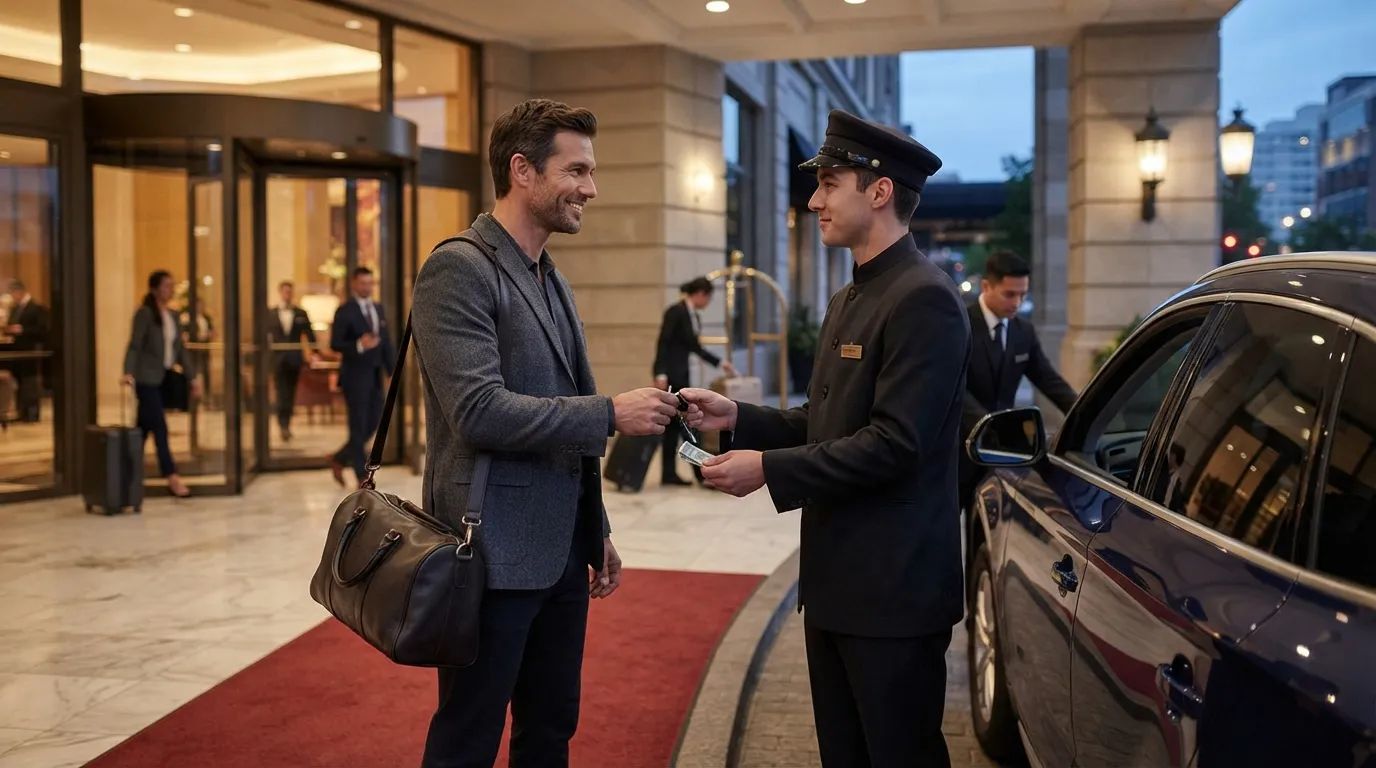
Most people assume valets are just parking attendants focused entirely on your car. They’re not – and the moment you pull up, they’re already reading you.
In the time it takes to hand over your keys, they’ve clocked your body language, your luggage, your eye contact, and even your tip. What happens next depends entirely on what they saw – and most guests never find out.
#16 – Whether You’re a First-Timer or a Regular
Experienced valets can spot a luxury newcomer almost instantly – and it changes everything about how they approach you.
Guests unfamiliar with high-end hotel service often hesitate before letting go of their keys, a brief pause rooted in unfamiliarity rather than distrust. Regulars show none of that hesitation, releasing keys automatically mid-conversation.
That tiny pause tells a valet exactly how much extra explanation to offer at handoff. Regulars get assumed competence; newcomers get a quiet assist.
That’s just the warm-up. Wait until you hear what your tires are quietly saying about you…
#15 – The Condition of Your Tires
This one surprises almost every guest, because nobody thinks about their tires while checking into a hotel.
Valet attendants are trained to notice tires that look underinflated or unevenly worn. Uneven tread can hint at alignment or suspension trouble long before the owner notices it.
They’re not mechanics, but they’re reading your tire condition the second they take the keys. A tire that looks noticeably low may just need air – or it could be a slow leak about to become a real problem.
Valets are trained problem-solvers, often the first to flag something off with a vehicle before anyone else does. A conscientious valet who spots a dangerously flat tire can genuinely prevent a roadside emergency – a service guests rarely know they received.
Fast Facts
- Most U.S. states require at least 2/32 of an inch of tread depth to be considered road-legal.
- Tire pressure should ideally be checked monthly, since it naturally drops with temperature changes.
- Underinflated tires raise blowout risk significantly at highway speeds.
- Uneven wear caught early often means a cheap alignment fix instead of a costly tire replacement.
It’s a quiet safety net most drivers never thank them for. Your tires are just the beginning – wait until you hear what they think of your backseat…
#14 – How Clean (or Filthy) Your Interior Is
Valets slide into dozens of cars per shift. They notice everything inside – and rarely say a word.
The state you leave your car in gets noticed instantly, from coffee cups in the console to a spotless dashboard. There’s nothing wrong with a little clutter, but it’s worth clearing the obvious trash before you travel.
Valets rarely say this to your face, but a car packed with fast-food wrappers is one of their quiet pet peeves. Nobody expects a showroom interior – just proof it’s been vacuumed sometime this decade.
Most guests have no idea they’re being quietly judged the moment a valet opens their car door. The mess up front is nothing, though, compared to what your trunk gives away…
#13 – What the Trunk Reveals About Your Trip
The trunk isn’t just storage. To a trained valet, it’s a quick biography of your entire trip.
Popping it open instantly versus guarding it like a secret reveals what kind of traveler you are. Business travelers tend to grab their own bags fast, almost reflexively.
Leisure guests linger, often unsure what to bring in and what to leave behind. Guests arriving for medical appointments, family visits, or funerals often carry a heavier energy that valets notice – and quietly respond to with extra care.
Hotel valets aren’t limited to parking cars; they help with local tips, hotel services, and all kinds of requests. A valet who spots golf clubs, a stroller, or medical equipment instantly adapts their approach – long before you’ve said a word.
It’s not your luggage valets remember most, though. It’s what happens next, at eye level…
#12 – Whether You Make Eye Contact
This is the one valets consistently bring up – and most guests have no idea it’s happening.
Guests who make direct eye contact before handing over the keys tend to be the friendliest ones inside the hotel too. It’s a small habit that signals someone who sees service staff as people, not furniture.
Valets say this single moment often predicts tipping behavior later on. Guests who stare at their phone through the whole handoff usually aren’t rude – just nervous first-timers unfamiliar with the etiquette.
A two-second moment of eye contact can quietly unlock better service for your entire stay. Eye contact is just half of it, though – the way you physically hand over your keys says even more…
#11 – How You Handle the Key Handoff
There’s an art to handing over your keys – and valets read every version of it.
Guests who pause mid-conversation and hand keys over while still talking signal comfort and experience. Guests who stand stiffly and present the key with two hands are almost always first-timers, and valets adjust their language accordingly.
Etiquette expert Elaine Swann has a simple tip for instant rapport at handoff.
“If they’re wearing name tags use their first name so that way you have a connection with them.”
Elaine Swann, Etiquette Expert
That connection works both ways – valets who feel acknowledged during the handoff are naturally more attentive throughout the stay.
The 10-second key exchange is actually a two-way interview. The valet is sizing you up just as much as you’re sizing up the property.
Nothing shapes your treatment faster, though, than one small move most guests skip completely…
#10 – Whether You Tip at Drop-Off – Not Just Pickup
Most guests tip when they collect their car. Valets notice – and remember – the ones who tip going in.
When someone tips at drop-off, attendants remember it, which can mean faster retrieval or a better spot once that guest calls down for their car. The unwritten two-touch rule covers most valet encounters: tip on drop-off, tip again on pickup.
Fast Facts
- Standard valet tips run $2 to $5 at drop-off and again at pickup, for a total of roughly $4 to $10 per stay.
- Upscale hotels and fine-dining venues tend to see tips land at the higher end of that range.
- Extra help – like carrying bags or offering local recommendations – is generally a signal to tip a bit more.
- Cash still works best; many valets can’t process a card tip on the spot.
Guests who tip only at pickup are, technically, only completing half the etiquette equation – and valets know it, even if they never say so. The upfront tip isn’t really about the money; it’s respect for the job before it’s even done.
Tipping opens doors. But actual conversation opens something even better…
#9 – How You Talk to Them (Or Don’t)
Valets interact with hundreds of guests a week. The ones who actually speak to them stand out immediately.
Many valets know the local area well and will offer restaurant picks, driving shortcuts, or tourist tips – and that generosity flows more naturally toward guests who’ve already shown a little warmth. It’s not that they withhold help; rapport just makes them chattier.
For travelers unfamiliar with a new city, that casual knowledge can beat a concierge desk. The guests who chat for 30 seconds at arrival often walk away with better dining tips than those who spent an hour interrogating the concierge.
Some guests give themselves away without saying a word, though…
#8 – Whether You Keep Glancing Back at Your Car
Some guests can’t help themselves – and valets know exactly what it means.
They walk toward the entrance but keep glancing back at their car, sometimes two or three times before disappearing inside. Valets say this habit is almost always tied to a genuinely valuable vehicle – or something precious left inside.
A valet who sees it will typically give that vehicle extra care and a more protected spot – not out of policy, but instinct. They understand the anxiety, and they respond to it.
For guests with high-end or sentimental cars, that look-back isn’t embarrassing. It’s useful information – and it’s not the only thing shaping how carefully your car gets handled…
#7 – The Make, Model, and Condition of Your Car
Valets formally document your car’s condition the moment you hand it over – but they’re reading it long before they write anything down. They’re required to inspect for existing damage and note it immediately.
Many luxury sports cars – Ferrari, McLaren, Aston Martin – sit dangerously low to the ground. Speed bumps and steep ramp transitions that a normal car clears without issue can wreck a lowered car’s front splitter in an instant.
Attendants have to know every inch of the parking route and which paths to avoid for low-clearance cars. The vehicle you arrive in is basically a briefing document that determines exactly how it gets driven and parked.
A battered compact and a new Porsche get handled through entirely different mental checklists. What you say – or don’t say – about your car’s quirks matters just as much…
#6 – Whether You Mention a Quirk (or Hide One)
Every valet has a story about a car that surprised them mid-drive. The polite guests warn them first.
Driving an unfamiliar car for the first time is already a challenge. If your window sticks, your brakes feel soft, or something else affects how it handles, telling the valet upfront helps them drive it safely.
Guests who volunteer that information calmly, without being asked, register immediately as considerate and self-aware. Valets quietly rank guests by how forthcoming they are, and that rank has real consequences for how carefully your car gets handled.
The guests who say nothing and then complain about a scratch later? Those are the ones valets remember longest – and not fondly.
But cars aren’t the only thing valets are reading. Sometimes, it’s you…
#5 – Your Energy and Emotional State
Valets aren’t therapists – but they’re perceptive in ways most hotel staff aren’t trained to be.
Valets say guests arriving for funerals, medical stays, or emotional family visits carry a different energy. Experienced attendants pick up on it within seconds – a slumped posture, a forced smile, luggage packed in a hurry – and respond by dialing down the small talk.
Valets also pay closer attention to older guests who move slowly or hesitate near curbs and steps. That attention might mean walking a few extra steps alongside someone, or timing the car’s arrival so nobody has to stand around waiting.
This instinctive emotional calibration is one of the least-discussed skills in the entire hospitality industry. Emotion is one signal they read – pace is another, and it changes everything about your welcome…
#4 – How Much of a Rush You Appear to Be In
Guests radiate urgency – and valets read it to prioritize their whole workflow.
The moment a valet spots your car approaching, they often signal the luggage team – and sometimes the front desk – to get your room ready before you’ve even parked.
A guest who jumps out before the car fully stops, grabs their own bags, and power-walks inside is sending a clear signal. Valets at high-end properties relay that read straight to the front desk, sometimes triggering a faster check-in.
Meanwhile, the guest who chats and takes their time gets the relaxed, leisurely welcome instead. Both are fine – the experience you get is partly shaped by the pace you arrive with.
Speed changes your welcome. But almost nobody knows about the rule that kicks in the moment you’ve already walked away…
#3 – Whether You Know the Seat Reset Rule
Here’s one almost nobody outside the industry knows – and it separates experienced valet operators from careless ones.
At quality establishments, the rule is simple: never adjust a guest’s seat, mirrors, or steering wheel unless it’s absolutely necessary for safety. If an adjustment is unavoidable, the valet notes the original settings and resets everything before retrieval.
Valets move dozens of cars a day, constantly adjusting seats and mirrors to fit their own driving position. Careful attendants make a habit of resetting everything before you get back in.
Worth Knowing
- Many newer vehicles store multiple driver memory profiles, which can make resets nearly instant.
- A missed seat or mirror reset is one of the most common post-valet complaints at luxury properties.
- A quick phone photo of your seat and mirror position before handing over the keys makes any mix-up easy to spot.
- Simply asking “could you reset the seat when you bring it back?” almost always guarantees it happens.
Guests who thank a valet for resetting their seat signal real hospitality fluency – and valets remember those guests by name. Most guests never even notice.
Most guests never think to look back at their car, either. The ones who do get something the rest don’t…
#2 – Whether You’re Actually Watching Your Car Drive Away
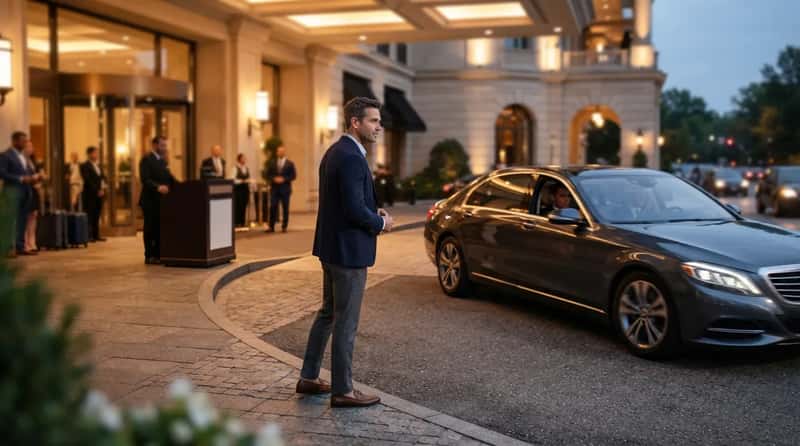
Most guests turn and walk straight inside. A small percentage watch until the car disappears from sight – and valets absolutely notice the difference.
Before every shift, the valet supervisor briefs the team on expected high-value vehicles and known regulars, so nobody is caught off guard by handling requirements.
Guests who stand and watch their car leave are sending a clear signal: I’m paying attention. That watchfulness – even from thirty feet away – is one of the fastest ways to guarantee careful handling, because every valet knows there’s an engaged owner on the other end.
The guests who vanish instantly are trusting the system blindly. That’s usually fine – but not always. And that brings us to the #1 thing valets notice, which most guests would never guess…
#1 – The Final Glance Back Before Walking Inside

Every other observation on this list is something you can consciously control. This one? Almost nobody does.
Right before stepping inside, many guests take one last glance back at the driveway – sometimes at the car, sometimes just at the world they’re leaving behind. Valets say this final look is almost universal, cutting across every type of guest.
It’s a small, unconscious habit that marks the shift from “traveling” to “arrived.” Noticing it, several valets say, has made them more aware of how much weight a short walk to the lobby doors can carry for someone who’s tired, excited, or nervous.
This is the detail valets describe most vividly – not the car, not the tip, not the luggage. It’s that single, unguarded moment that says: Okay. I’m here now.
Experienced valets call it the most honest thing they see all day – and quietly, the reason many of them love the job.
The Bottom Line
Valets aren’t just parking your car – they’re running a rapid-fire read on who you are, how you travel, and what kind of guest experience to prepare for.
From your tire condition to your emotional state, from your eye contact to that final unconscious glance before the lobby door closes – it’s all being read, logged, and quietly acted upon. Guests who understand this get faster service, warmer interactions, and far better local intel.
The guests who treat valets as invisible are leaving a lot of value sitting on the curb. Next time you pull up, try eye contact, an upfront tip, and mentioning that sticky parking brake – you might be surprised how different the whole stay feels.