Between Ho Chi Minh City and Hanoi, Vietnam stretches like a slender spine, traced by its main road and railway line running parallel to the coast, forming a gentle arc between the country’s two major cities. Mui Ne, to the south, immediately breaks away from this orderly route to define its own dimension: a beach town that borrows from the Sahara a landscape of sand dunes in two distinct shades—golden yellow and vivid red.
I arrived in Mui Ne without high expectations, driven more by geographical curiosity than by any real craving for desert scenery. Instead, I found myself enjoying two distinct yet complementary sandy landscapes: the red dunes, intimate and easily accessible, and the yellow dunes, vast and spectacular, with the horizon opening above them like an overexposed photograph. For anyone traveling through Vietnam, I recommend the detour: it’s worth it (and the sea is beautiful too).
Why the Dunes
From a geological perspective, Mui Ne’s dunes are neither an accident nor a local oddity. The area rests on ancient deposits of marine and river sand, rich in iron oxides, which are responsible for the red, orange, and ocher tones that dominate the landscape. Constant winds blowing in from the sea—especially during the dry season—have done the rest, shaping the sand into light, shifting dunes more reminiscent of a coastal desert than a classic tropical setting.
In this context, even the so-called Fairy Stream (Suối Tiên)—which, to my great regret, I wasn’t able to visit—is no exception: it’s the same sandy, friable soil, carved by water, that creates those sculpted walls and intense colors that look almost hand-painted. Sand, wind, and iron in the soil are the common thread running through the entire area—dunes, canyons, and hills alike—and explain why nearly everything in Mui Ne seems to lean toward red, as if the landscape had been filtered through a coherent, deliberate color palette.
The Red Dunes: a Miniature Desert
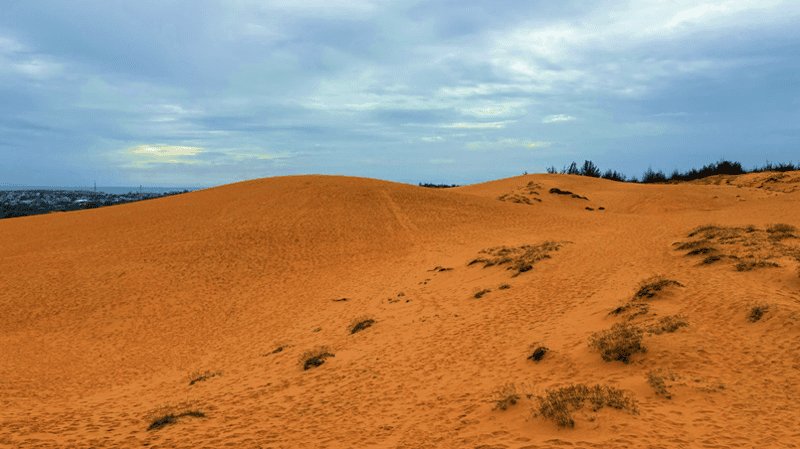
In the Mui Ne area, there are two main places where you can fully experience the dunes, walking across them and—if you wish—taking part in various activities directly on the sand. The Red Sand Dunes are located just north of Mui Ne’s town center. No elaborate planning is required: a scooter, a taxi, or a Grab ride is enough. The sand has a warm tone, somewhere between brick and copper, that becomes almost theatrical at sunset. Here the main activity is the simplest—and perhaps the most fun: sliding down the dunes either with nothing under you or on pieces of cardboard or thin plastic sleds (which locals rent out for a few dollars). The system works surprisingly well for carefree fun on the sand, even though, for me, the most rewarding activity is the more contemplative one: walking up to the highest dune on foot, under the sun or the moon.
Because they’re right in town, the red dunes are also the best place to observe how tourism and local life overlap with very little mediation. Between groups of sweaty backpackers and Vietnamese families on day trips, the line between attraction and everyday space remains deliberately blurred.
The White Dunes: Wind, Silence and Turbines
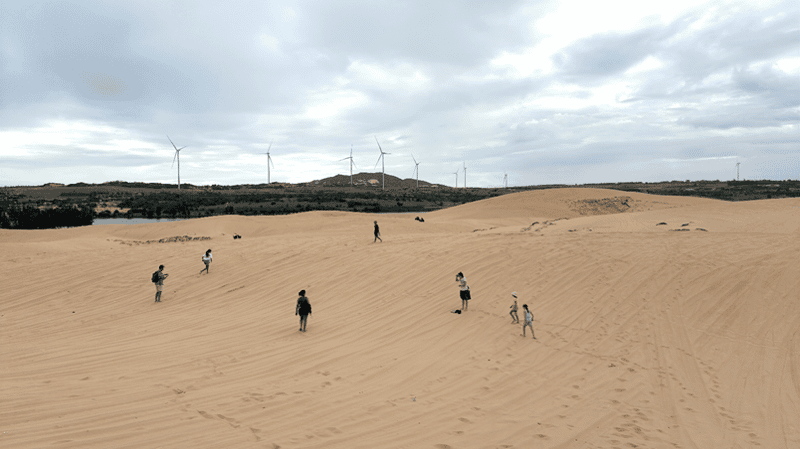
About 15 miles north of Mui Ne lie the White Sand Dunes, often referred to as the Yellow Sand Dunes. Here, the change in scale is immediate. The dunes are taller, wider, and more isolated. Getting there requires a bit more organization: a Grab or taxi will take you to the starting point of the visit, where you can book more demanding activities such as the very popular sunrise jeep tour.
The best time is early morning, when the sand is still cool and the low light casts sharp shadows. The landscape feels almost abstract: rolling dunes upon dunes, with wind turbines in the background—slightly out of context, yet not entirely jarring.
Here, the range of activities available to travelers increases—and not all of them are equally convincing.
What to Do (and What to Avoid) on the Dunes

Sandboarding is the most successful option: simple, physical, and immediate. Don’t expect professional boards; the roughness is part of the appeal. It’s a low-tech form of fun that feels appropriate to the place. Then there are the ATVs. Loud, aggressive, and often driven with little care, they race across the dunes, disturbing wildlife (and people) and leaving tracks that may fade quickly but disrupt the visual and acoustic balance of the landscape. They work if you’re looking for quick adrenaline, but they clash with the delicacy of the setting (I personally hate them, but to each their own).
More surreal is the camel ride. The camels, imported purely for tourist appeal, feel as out of place as artificial palm trees in a shopping mall. It’s a brief experience, more photographic than meaningful, that says a lot about how tourism reshapes places—not always convincingly. For me, walking is far better. Slowly climbing the most remote dune, feeling the sand give way under your feet, stopping at the top, and doing nothing at all. While the dune area isn’t especially vast, it does allow you to find pockets where—truly, and as in a real desert—there’s no one else around. My advice: seek those out and let yourself be immersed in the dense, compact silence of sand.
Dunes Everywhere
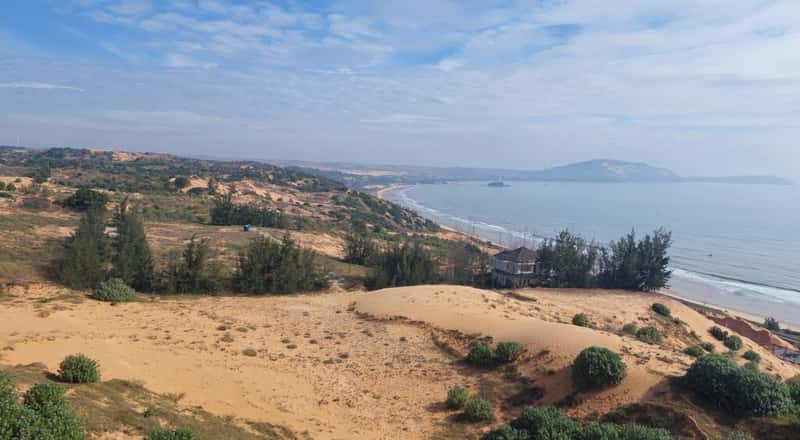
It’s also true that in Mui Ne, dunes aren’t necessarily confined to a clearly defined perimeter: they’re a distributed phenomenon, often infiltrating greener landscapes. You find them in dense, spectacular clusters in the well-known areas, but also in subtler, more everyday forms—along the road, behind rows of houses, at the edges of resorts. Around my hotel, located in the northern part of town, the dunes—more yellow than red in tone—flanked the building and gently slid down toward the sea, a truly sublime sight.
Practical Information on Getting There
Mui Ne is easily reached from Ho Chi Minh City in about 4–5 hours by bus or train to Phan Thiet, followed by a short taxi or Grab ride. It’s a natural stop along the coast, ideal for breaking up the journey toward Hanoi.
Once there, scooters and taxis are the most flexible options. The red dunes are accessible even without a guide; for the yellow dunes, a sunrise tour can simplify logistics, especially if time is limited.
A Detour that Works
Mui Ne isn’t a desert in the classic sense, nor is it a monumental destination. It’s a geographical aside, a visual anomaly along one of Southeast Asia’s most traveled routes. That’s precisely why it works: it interrupts the rhythm, shifts the palette, and forces you to recalibrate your gaze. Between Ho Chi Minh City and Hanoi, a bit of sand under your feet is more than a distraction—it’s a useful change in perspective.