Most people assume that leftover buffet food gets carefully boxed up and handed to someone in need. The truth is messier, colder, and far more wasteful than almost anyone expects.
Buffets generate more food waste than any other restaurant format in America, and what happens after closing time involves landfills, pig farms, legal loopholes, and a few genuinely hopeful fixes most diners never hear about. Here’s what actually happens to all that untouched food.
#9 – Almost Half of Every Buffet Never Gets Eaten
The scale of buffet waste is staggering, and most people have no idea how bad it really is.
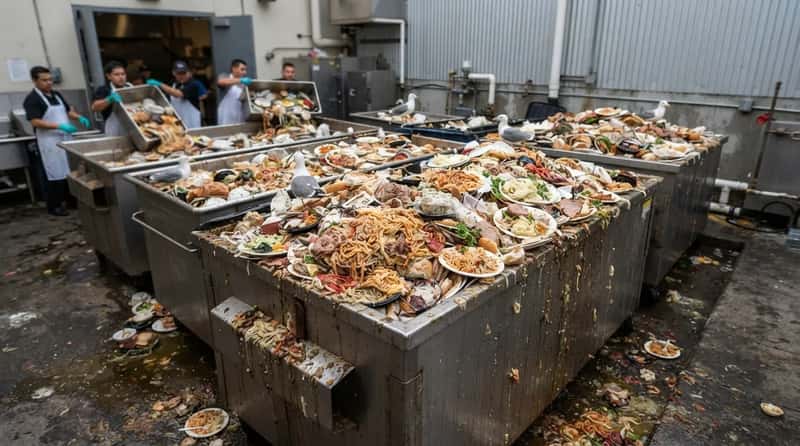
Researchers at the University of California, Berkeley found that most buffet providers waste nearly half of what they put out for customers. The majority of it ends up in a landfill.
All-you-can-eat buffets generate more food waste than any other restaurant format, pulling in $8 billion a year in the U.S. Over 70% of that waste is plate waste – food diners scooped onto their own plates and never finished.
It’s basically baked into the business model. Restaurants would rather oversupply than undersupply, because an empty chafing dish makes unhappy customers, and unhappy customers don’t come back.
Fast Facts
- Nearly half of the food at buffets is wasted before it ever reaches a landfill count.
- All-you-can-eat buffets generate more food waste than any other restaurant format and bring in $8 billion annually in the U.S.
- Over 70% of this waste is plate waste – food diners serve themselves but leave uneaten.
- Restaurants would rather oversupply than undersupply, since it is better to oversupply than undersupply, as the latter would lead to exasperated customers.
That’s the norm, not the exception. But it’s nothing compared to what happens the moment that food gets pulled off the line.
#8 – Food on the Buffet Line Is Legally “Contaminated” the Moment You Touch It
Here’s a fact that surprises almost everyone: the food sitting in those chafing dishes isn’t just “leftover.” Legally, it’s treated as unsafe.
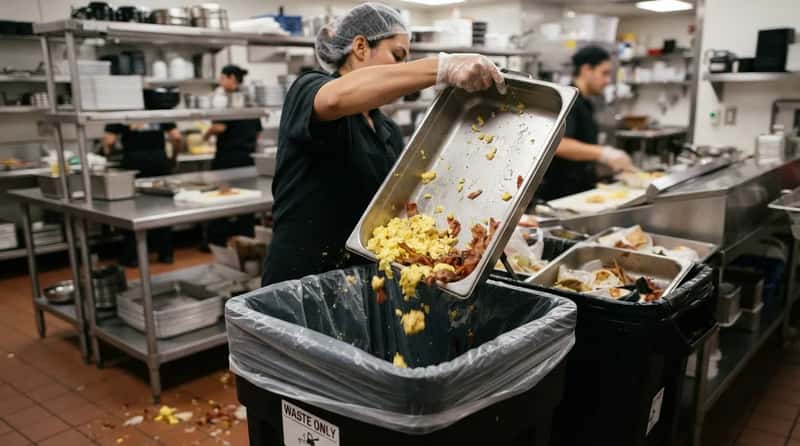
Once food no longer meets food safety guidelines, restaurants have to pull it from the line. Anything that was exposed to the public is considered contaminated, and it goes straight into a trash bin or a compost bin – no exceptions.
Full, untouched pans that never left the kitchen warmers are a different story. Those are considered pre-consumer, which means they can potentially be donated or turned into a staff meal.
The dividing line isn’t freshness. It’s whether the public ever had access to it – and that single detail decides whether food gets saved or thrown away.
That’s already unsettling. But the real numbers behind all this are almost impossible to picture.
#7 – The Landfill Numbers Are Almost Impossible to Comprehend
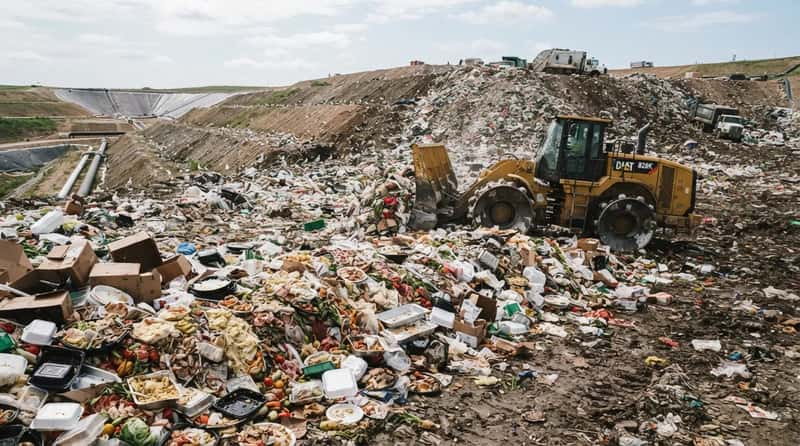
Once you see the scale in real numbers, the abstract waste turns into something very concrete.
That near-50% buffet waste rate feeds into a staggering national total: 108 billion pounds of food wasted every year in the United States. That’s roughly 130 billion meals, worth more than $408 billion, thrown away annually.
The environmental cost is just as brutal. Every kilogram of food tossed out generates almost two kilograms of carbon dioxide equivalent and burns through nearly three tons of natural resources to produce.
Hotels are one of the biggest offenders. A case study of a single hotel lunch buffet found that 46% of the food produced was never eaten – almost identical to the industry-wide average.
A separate assessment of hotel buffet operations reached a similarly stunning conclusion: their initial finding – that guests ate just a little more than half of the food put out – surprised almost everyone.
“The scope of the problem was an eye-opener beyond belief.”
Eells
That’s the environmental toll. But what happens to the small fraction that doesn’t hit the landfill is where things get more personal.
#6 – Staff Sometimes Get the Scraps – But Only the Lucky Ones
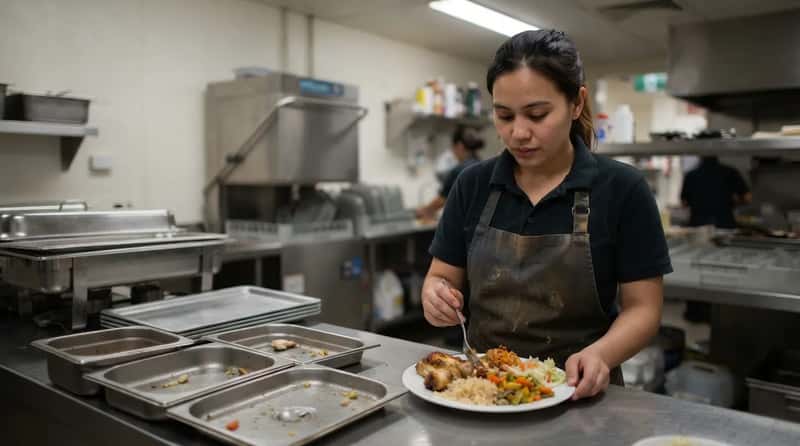
One of the more human outcomes of buffet leftovers is that employees occasionally eat what the public didn’t. But the rules here are murky, uneven, and mostly out of workers’ control.
While most leftover buffet food goes to landfills, some of it gets sold at a discount through surplus food apps, handed off as scraps to farmers, or eaten by staff. Whether that last option even exists depends entirely on individual management, not policy.
If a tray was kept at a safe temperature and never went out on the buffet, it can sometimes be repurposed or saved for the next day. But it has to stay out of what food safety experts call the Danger Zone the entire time.
The harsh reality: most front-line buffet workers have no guaranteed right to take home or eat surplus food. It varies by owner, and plenty of places just bin it all – staff included.
That inconsistency is frustrating enough. But some of this food ends up somewhere almost nobody expects.
#5 – Las Vegas Buffets Have Been Feeding Pig Farms for Years
This one surprises almost everyone: a real chunk of buffet waste in the U.S. never touches a landfill at all. It goes to livestock.
Large pig farms can accept food scraps from buffets, as long as the scraps are cleaned and pasteurized first. This has been common practice in Las Vegas for years, so common that the recent decline of casino buffets is now hurting at least one local farm that depended on it.
Some buffet restaurants also donate the food they pull off the line directly to nearby pig farmers, which helps keep it out of the waste stream entirely.
It’s unglamorous, but it works. The catch is that pasteurization and transport logistics only make sense at scale, so smaller buffets rarely have this option – for them, it’s still just the bin.
That’s a rare bright spot. But the legal reality around donating this food is far more tangled than most people assume.
#4 – A Federal Law Protects Restaurants That Donate – But Most Still Don’t
You’d think fear of lawsuits is what stops restaurants from donating surplus food. Congress actually solved that problem decades ago – and buffets still barely use the fix.
The Bill Emerson Good Samaritan Food Donation Act, passed in 1996, protects donors from civil and criminal liability when food is given in good faith to a nonprofit, even if it later causes harm. The only requirement is that the food was safe to eat at the time it was donated.
In its 2022 Food Code, the FDA went further, clarifying that donations from food retailers are acceptable as long as proper safety practices are followed.
Worth Knowing
- The Bill Emerson Act became federal law in 1996 and still stands today.
- It protects good-faith donors from liability even if the donated food later causes harm.
- The FDA’s 2022 Food Code confirmed retailers can donate surplus food when safety practices are followed.
- Even so, this concern was raised by 25% of retail/wholesale respondents and 39% of restaurant respondents worried about liability risks tied to self-serve buffets.
And yet only 32% of hotels have a donation program to manage their excess food. That means roughly two-thirds of hotel buffets have zero donation system in place, despite having both the legal cover and the surplus to make it work.
The protection exists. The surplus exists. What’s still missing is a look at the tech that could quietly fix most of this.
#3 – Technology Could Fix Most of This Waste – Few Buffets Are Using It
The buffet industry isn’t blind to the problem. A wave of tech-driven fixes already exists – they’re just not widely adopted yet.
Some buffets now run on inventory management systems that forecast how much food to prepare based on historical data, the season, and upcoming events. That alone can meaningfully cut down on the amount of excess food hitting the line in the first place.
Industry research points to a whole toolkit beyond forecasting: central kitchens, vetted suppliers, smarter buffet table layouts, redesigned service methods, ongoing waste tracking, and better communication with customers about portions.
The tools exist. The financial incentive exists. The real obstacle is cultural – an industry built on the promise of endless abundance struggling to admit that abundance is now a liability.
That’s the fix hiding in plain sight. But there’s a quieter shift already happening, one app download at a time.
#2 – Surplus Food Apps Are Quietly Redirecting What Would Have Been Thrown Out
A growing, underreported solution is the rise of surplus food marketplaces – apps that let buffets sell leftover food at steep discounts instead of pitching it in a bin.
Some leftover buffet food gets sold this way, letting budget-conscious customers grab a discount on food that would otherwise be tossed, while the restaurant turns a would-be loss into a small win. It’s a new customer base that never would have paid full buffet price to begin with.
The model sidesteps the legal tangle of donation entirely, since selling food is simpler than giving it away. It creates a modest revenue stream out of what used to be a dead loss.
Quick Compare
- Donation: needs a nonprofit partner, safety paperwork, and legal cover under the Good Samaritan Act.
- Surplus apps: skip the legal tangle entirely because selling food is simpler than donating it.
- Donation: the restaurant sees no direct revenue, just less waste.
- Surplus apps: turn a would-be loss into a small win, plus a brand-new discount-seeking customer.
Some operators are also attacking the problem earlier, refilling trays in smaller batches more often instead of keeping every dish stacked high all night. It’s a low-tech fix, but operators increasingly swear by it.
That’s progress. But after all these fixes, the single most common fate for buffet food is still the most brutal one.
#1 – Most of It Still Just Gets Thrown in a Bin – Untouched
After all the apps, pig farms, and policy innovations, the dominant outcome for uneaten buffet food is still brutally simple. It goes straight in the trash.
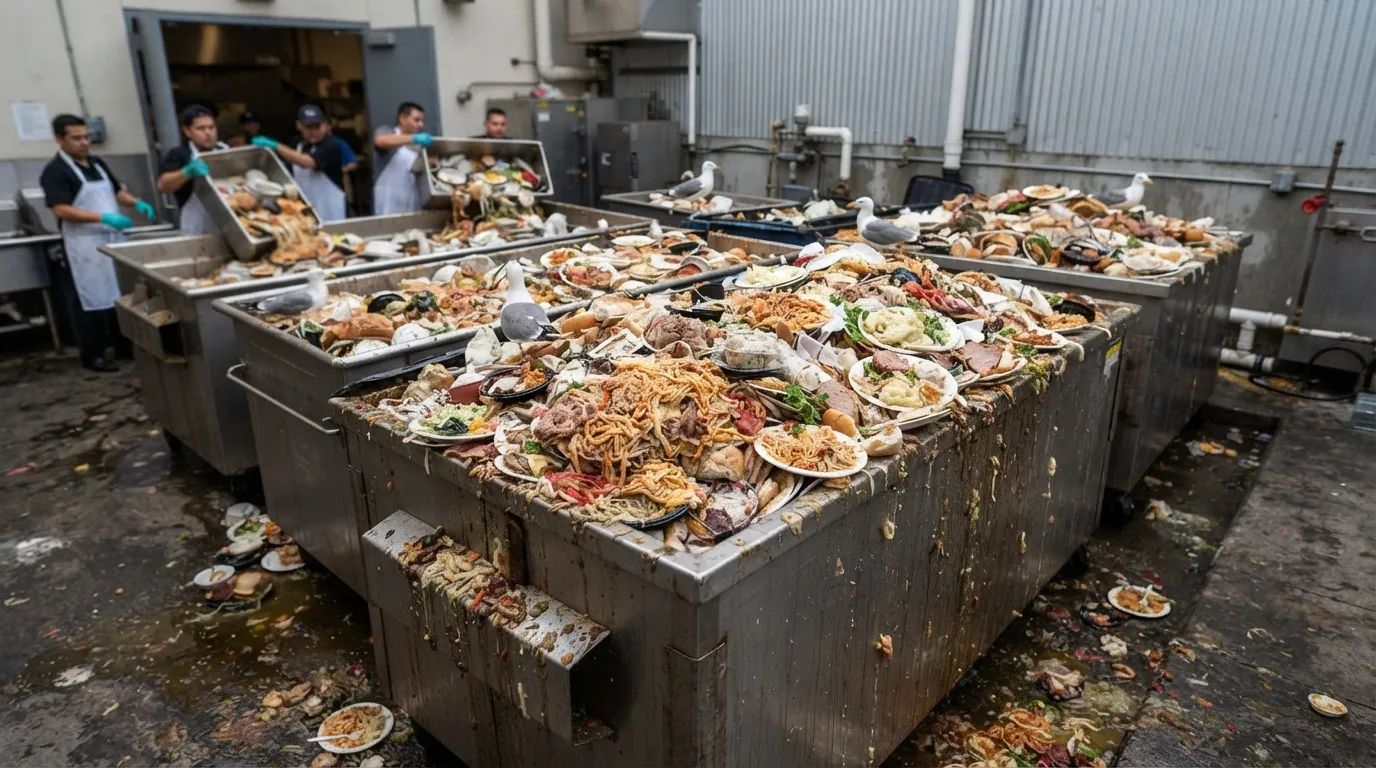
Health regulations at many establishments require everything not eaten by customers to be thrown out – a standard practice in the U.S. and abroad. A reporter visiting a Melia Hotels property in Europe watched staff wheel in giant outdoor bins at closing time and shovel food directly into them, most of it untouched and presumably still fresh.
In some jurisdictions, any food that was displayed has to be discarded once service ends, whether or not a single person touched it. No workaround, no donation, no staff meal – just the bin.
The food was cooked, heated, plated, and never eaten. It ends its journey generating methane in a landfill, wasting every drop of water and land that went into producing it, and costing the restaurant real money with zero return.
This is the default outcome. Everything else in this list – the farms, the apps, the donation programs – is still the exception, not the rule.
The Bottom Line
Most buffet providers waste almost half of what they put out, and the majority of it lands in a landfill. Once food touches the public serving line, it’s legally treated as contaminated, which rules out donation in most cases.
The alternatives – pig farms, surplus apps, staff meals, charity partnerships – are real, but they’re still rare. Only 32% of hotels even bother with a donation program.
The next time you walk past a buffet at closing time, that untouched tray is almost certainly heading for the bin. Has your local buffet done anything differently – or have you seen the other side of this firsthand? Drop it in the comments.