Most travelers picture a locked back room somewhere, full of sad suitcases nobody ever comes back for. The truth is stranger: lost luggage feeds a secretive, multi-million-dollar industry, and what’s actually inside those bags will surprise you.
Airlines move billions of bags every year, and even a tiny failure rate turns into hundreds of thousands of orphaned suitcases annually. Here’s what really happens once your bag disappears for good – and why the ending isn’t what you’d expect.
#7: The Scale of the Problem Is Bigger Than Airlines Admit
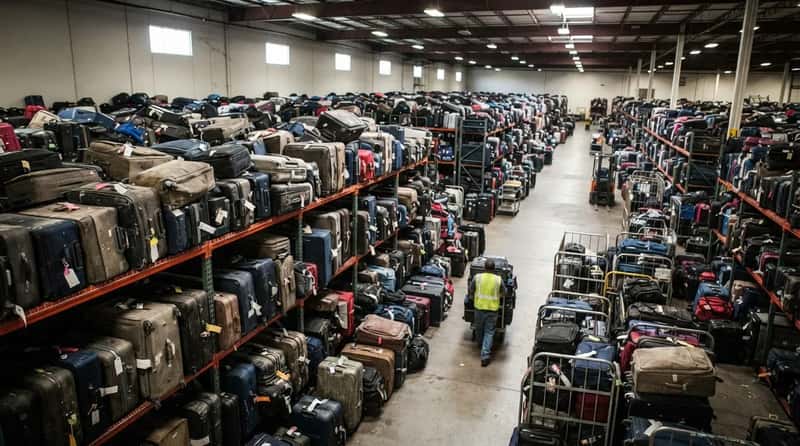
Most travelers think losing a bag is a rare fluke. The numbers say otherwise.
In 2022 alone, airlines mishandled roughly 26 million bags worldwide – delayed, damaged, or outright lost. That’s about 7.6 bags for every 1,000 passengers who checked one.
Most of those bags eventually come home. But roughly 7% – close to 1.8 million bags a year – vanish completely, thanks to torn tags, glitchy scanners, or an agent typing in the wrong airport code.
Fast Facts
- 2022 mishandling rate: 7.6 bags per 1,000 passengers
- 2023 rate dropped to 6.9 per 1,000 passengers
- 2024 rate fell further to 6.3 per 1,000, even as passenger traffic hit record highs
- Most 2024 mishandled bags were resolved within 48 hours
Airlines reportedly spend 12% of their entire customer service budget just chasing missing suitcases. That’s not a rounding error – that’s a full department built around bags that went the wrong way.
There’s good news: tracking tech is improving. Mishandling rates fell 23% in recent years, according to SITA’s industry research, even as airlines still lost track of roughly 24 million bags in 2025.
Still, millions fall through every year. And once they do, a very specific clock starts ticking – one almost no passenger has ever heard of.
#6: The 90-Day Clock Nobody Tells You About
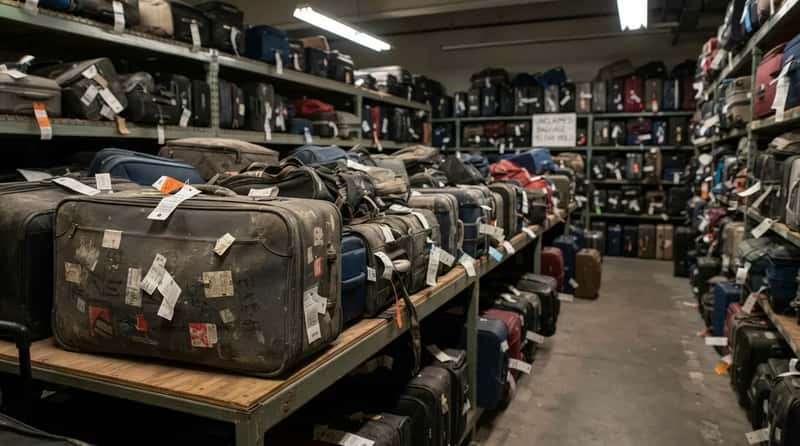
Here’s what no airline announces over the PA system.
In the U.S., some airports hold unclaimed bags for as little as 30 days. The UK holds onto lost items for three months – but charges you to get your own stuff back.
Airlines actually chase owners for up to 90 days, using barcode tracking, phone calls, and international forwarding systems. Every checked bag carries a code baked into its tag – your name, flight number, airport, and departure time.
But about 8% of unclaimed bags are what insiders call “John Does” – no name, no tag, no way to trace them at all. Those bags sit in storage for roughly three months before they’re officially declared orphaned.
Fewer than 0.03% of all checked bags ever reach that fate. It sounds tiny – until you remember how many billions of bags fly every single year.
Once a bag earns that label, it stops being lost property and starts an entirely new life. That new life has an address – and it’s nowhere near an airport.
#5: They All End Up in One Small Alabama Town
There’s exactly one place in America built entirely around this problem: Scottsboro, Alabama.
Unclaimed Baggage has operated there since 1970, and it’s still the only store of its kind in the country. Founder Doyle Owens started it with a pickup truck and $300 worth of bags bought off a bus company in Washington, D.C.
At a Glance
- Founded: 1970, in Scottsboro, Alabama
- Store size: roughly 50,000 square feet, plus a multi-story annex
- New inventory: about 7,000 items added every day
- Annual visitors: more than 1 million shoppers
United Airlines sends unclaimed suitcases here after 90 days of searching; Southwest waits 120. Most shoppers have no idea the entire country’s lost luggage funnels into this one small town.
What they find inside those bags is where the story stops being about logistics – and starts getting genuinely bizarre.
#4: What’s Actually Inside Those Bags
Open enough abandoned suitcases and you start finding things that sound made up.
Staff have logged a $39,000 diamond ring, a $20,000 Rolex, a full suit of armor, and a complete parachute. There’s also a reported rattlesnake preserved in whiskey – right next to a toilet seat and a set of butt pads someone packed and never came back for.
“If these bags could talk, what a story they’d have to tell.”
Bryan Owens, Unclaimed Baggage owner
The strangest find might be an actual guidance system for an F-16 fighter jet, pulled from a civilian checked bag. How it got there – and who was supposed to be waiting for it – has never been explained.
The single most valuable item on record is a 40.95-carat natural emerald, now nicknamed the “Unclaimed Emerald.” Rare instruments, movie props, and designer clothing show up constantly, all sold for a fraction of what they’re actually worth.
But before any of it reaches a shelf, it goes through a process most shoppers never think to ask about.
#3: The Processing Operation Behind the Curtain
Buying a stranger’s suitcase sight unseen is one thing. Selling the contents responsibly is another.
The store buys each bag as-is, with zero idea what’s inside until it’s opened in the warehouse. Everything gets sorted, cleaned, and inspected before it ever reaches a shelf.
Used undergarments never go on sale – only unworn ones still carrying tags. Every electronic device gets wiped of personal data and tested to make sure it actually works.
This isn’t a thrift store operation – it runs closer to a small manufacturing line. About 60% of what arrives is clothing, and most items sell at a 20–80% discount once they clear inspection.
More than half of everything that comes through the door gets donated or thrown out because it simply isn’t sellable. What survives becomes someone else’s find – but Scottsboro isn’t the only place a lost bag can end up.
#2: The Other Fates – Charity, Auction, and the Bin
Depending on the airline and the country, an unclaimed bag can take several very different paths.
Quick Compare
- Sold to shoppers: roughly one-third of inventory, discounted 20-80%
- Donated to charity: another one-third
- Discarded as unsellable: the remaining one-third
In the U.S., bags are either destroyed, donated to charity, or bundled onto pallets and sold off to third parties. United Way Greater Toronto once received a haul of unclaimed Air Canada luggage – mostly clothes and souvenirs – and sent it straight to local shelters.
Around 25% of unclaimed luggage gets auctioned off, generating roughly $2 million a year for airports. Another 15% is never claimed at all and simply becomes airport property.
The uncomfortable part: a real chunk of unclaimed luggage still just gets thrown away. Mass incineration isn’t standard practice anymore, but for items with no resale value, destruction is still sometimes the ending.
Unclaimed Baggage’s own charitable arm, Reclaimed for Good, has funneled millions of dollars in donated goods to relief efforts. The system isn’t perfect – but it’s come a long way from simply dumping everything.
#1: The One Thing That Decides Your Bag’s Fate
Here’s the detail airlines will never put in bold on their homepage.
About 92% of mishandled bags come back within a day or two. The ones that don’t almost always share exactly one thing in common: no reliable way to identify who they belonged to.
An outside tag can rip off in seconds – it happens constantly. The one thing that almost always survives is something placed inside the bag, which most travelers never bother to pack.
That fraction sounds tiny – until you multiply it by the billions of bags flying every year. As one Unclaimed Baggage retail executive summed it up: “They’re successful 99.5% of the time in reuniting you with your suitcase, but when millions of people travel every day, that fraction of one percent really adds up.”
The system is remarkably good at finding bags. It just needs something to work with.
A card inside your suitcase with your name, phone number, and email costs nothing. It’s the difference between your bag finding its way home – and ending up on a shelf in Alabama.
The Bottom Line
Unclaimed luggage isn’t just an airport inconvenience – it’s a genuine, globe-spanning industry. In 2022 alone, the number of mishandled bags hit 26 million worldwide.
Most come home within a day or two. The stubborn few that don’t follow a surprisingly organized pipeline: a 90-day search, a pallet sale, a truck bound for Alabama, a warehouse sort, and finally, a price tag.
The strangest find on record is probably that F-16 guidance system. The most valuable is almost certainly the 40-carat emerald.
The easiest way to avoid becoming part of that inventory is almost embarrassingly simple: put your contact details inside your bag, not just on the outside. Ever had a bag disappear and never come back? Tell your story in the comments.
Bonus: How to Actually Get Paid If Your Bag Never Comes Back
Most travelers never file the paperwork that actually triggers compensation – they just complain at the counter and go home. Here’s the move that gets airlines to pay out instead of shrug.
- File a Property Irregularity Report (PIR) before you leave the airport, even if you’re sure the bag will show up tomorrow – this is the document that legally starts your claim.
- Know your real ceiling. On U.S. domestic flights, federal rules require airlines to cover up to $4,700 per passenger for a lost or damaged bag; on international flights, the Montreal Convention caps it at 1,519 SDR (roughly $2,000).
- Keep every receipt for anything you buy while waiting – toiletries, a change of clothes, chargers – because airlines are required to reimburse reasonable essential purchases up to that same limit.
- Put your claim in writing, not just a phone call. For international delays, you have 21 days from delivery to file a written claim; a paper trail is what actually gets paid, a phone complaint often isn’t.
One more habit worth building before you even fly: snap a quick photo of anything valuable packed inside your checked bag. It turns a “maybe” claim into a documented one the airline can’t easily dispute.