Miami Vice premiered on September 16, 1984, and its film crew was 95 percent local to the Miami area, so the show left a long trail of real addresses behind. A surprising number of them are still standing, and you can walk up to every one on this list.
But the Vice City in your memory, all neon and speedboats, is not quite what you will find. One stop is a quiet park under an interstate, another is a gas station with no gas, and the best-known address on the list hides a date that changes how you see the entire show.
#12 – A Small Park Beneath the Interstate
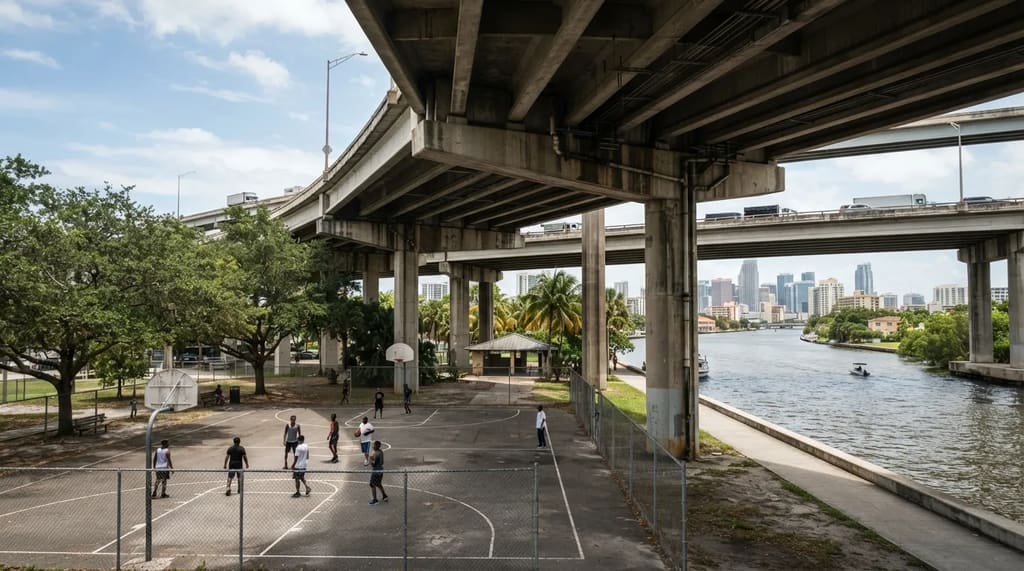
Jose Marti Park sits at 351 SW Fourth Avenue, tucked right below I-95 on the banks of the Miami River, and it is small enough that most drivers overhead never notice it. It is about as far from the glossy postcard version of Miami Vice as a landmark can get, which is exactly why it makes a good first stop.
The Miami New Times includes it among the Miami Vice locations you can still see today, and the park made several episode appearances.1 It is a public park with free access, so a few minutes under the rumbling interstate is all it asks.
Its history is heavier than its looks suggest, because the park served as a camp for thousands of Cuban refugees after the Mariel boatlift. That gives the stop a weight no television scene could add, and it ties the show’s Miami to the real city of the early 1980s.
Fast Facts
- Address: 351 SW Fourth Avenue, right below I-95
- Setting: the banks of the Miami River
- Access: public park, free to visit
- Backstory: a camp for thousands of Cuban refugees after the Mariel boatlift
Farther west in Little Havana, a former gas station on Flagler Street kept its Art Deco shape long after its pumps and tire shop vanished. One six-minute scene is the reason anyone still remembers it.
#11 – The Art Deco Gas Station Without Pumps
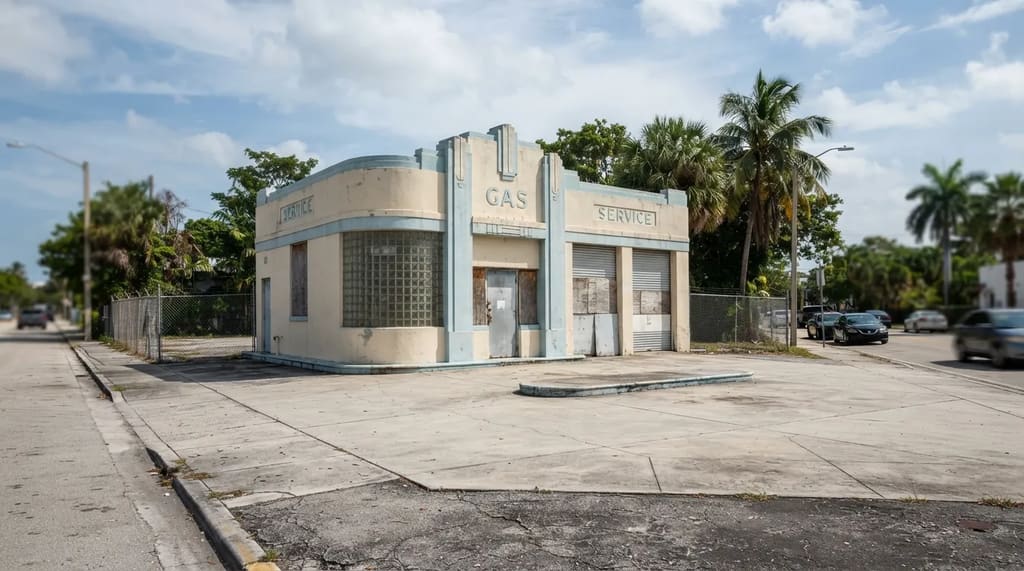
One of Miami Vice’s most intense moments, a six-minute conversation between Crockett and Tubbs in Season 1’s “Evan,” was filmed at an Art Deco gas station at 1240 W. Flagler St. in Little Havana on March 12, 1985. Six minutes is an eternity on television, which is why this humble corner is remembered at all.
Today there are no more gas pumps, and the tire shop that once occupied the building is also gone. What remains is a small Art Deco structure with the proportions you would recognize from the scene, and very little else to look at.
Honestly, an empty former gas station cannot compete with the buildings on this list that are still in use. Paired with the park on the river, though, it makes a reasonable half hour in Little Havana for anyone who remembers the episode and wants to stand where two actors carried a long scene on talk alone.
Flagler Street runs east into downtown, where the Miami-Dade County Courthouse stands at number 73. It is the easiest stop on the list to find.
#10 – Flagler Street’s County Courthouse
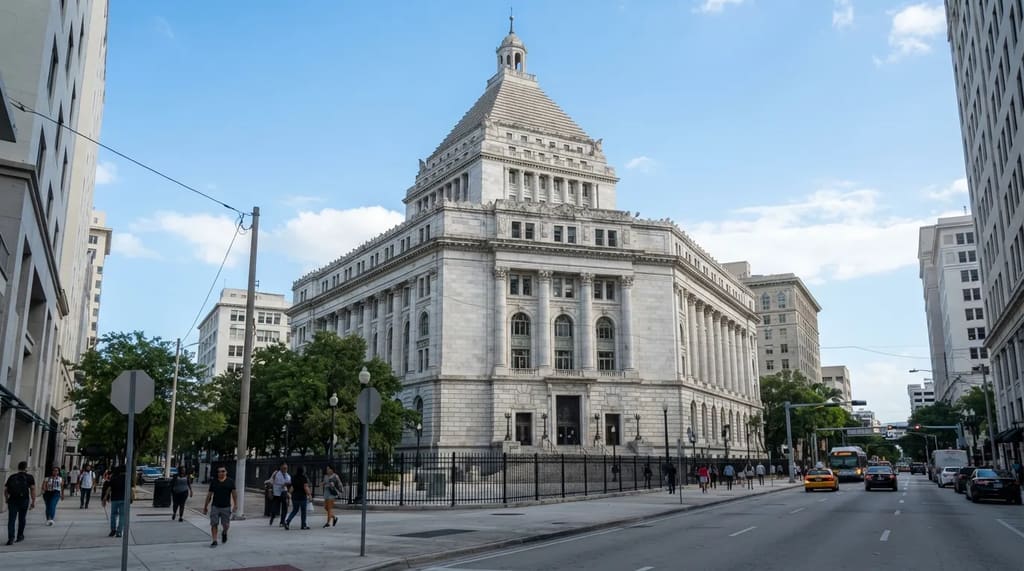
The Miami-Dade County Courthouse, at 73 W Flagler Street, appears on several published location lists for the series, alongside a long run of downtown addresses.2 It is a tall, neoclassical building from the 1920s, and for decades it was among the most recognizable structures on the downtown skyline.
That makes it a natural fit for a show that kept returning to crime, arrests and the people who processed them. It is also the easiest stop on this list to reach, since it sits on a main downtown street and needs no detour.
You see it from the sidewalk, because it is a working government building and nothing about it has been arranged for visitors who come for the show. A few minutes with a camera is plenty, and the surrounding blocks of Flagler Street are the better reason to linger.
Next, the list drives south to a house that was brand new when the location scouts found it. It was built for a family, not for a camera.
#9 – A Pinecrest Compound Built in 1987
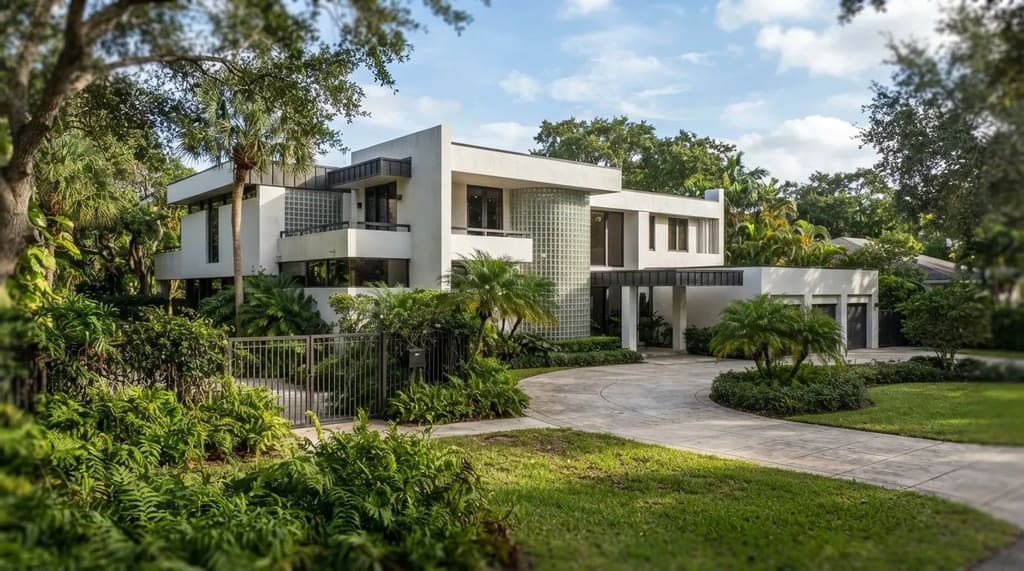
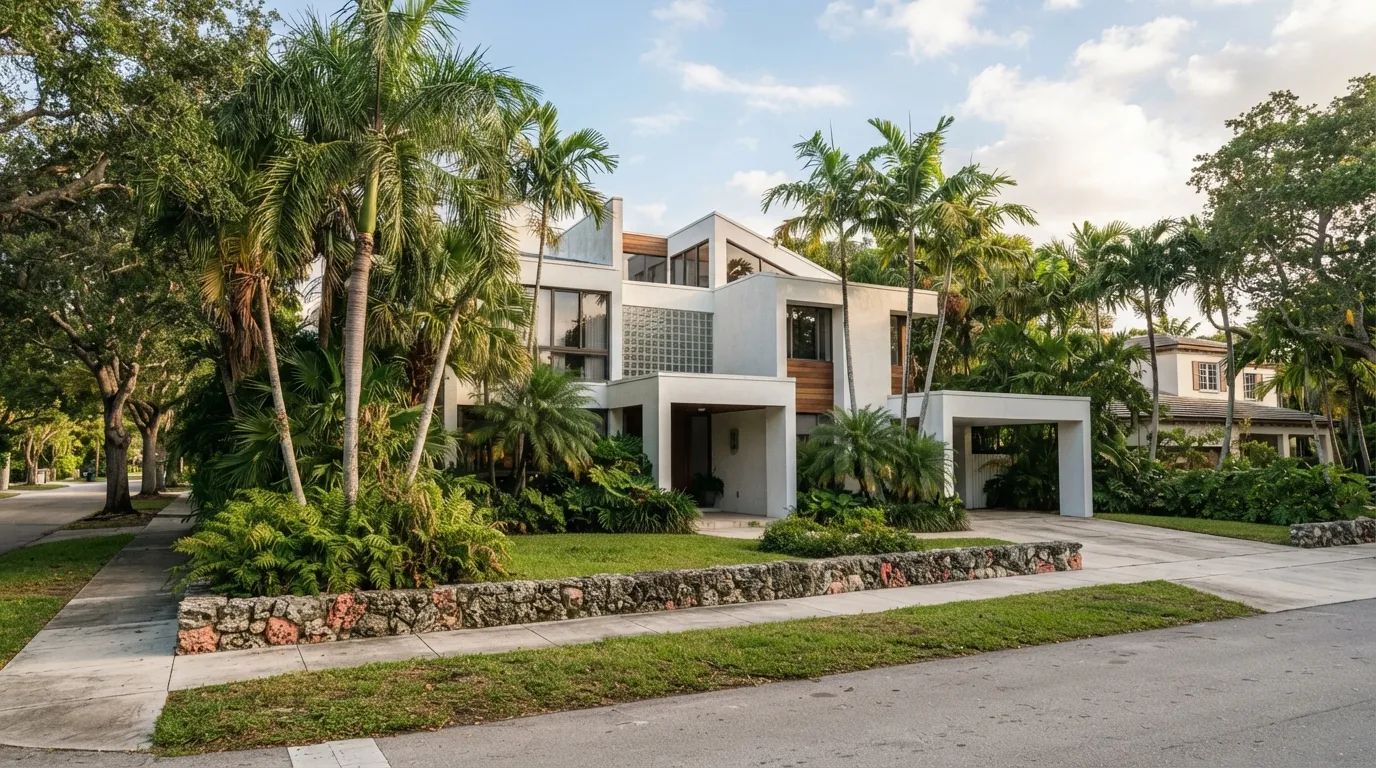
The compound at 7777 SW 127th Street in Pinecrest was discovered by Miami Vice location scouts almost immediately after Miami architect Roney Mateu built it for himself and his family in 1987.1 The house was brand new when the cameras found it, and the series had by then been on the air for about three years.
That timing shows how the production worked, since it kept looking for fresh modern architecture rather than relying only on the old Art Deco streets. It also means this is not a historic site in the usual sense, because the house is younger than most of the buildings on the list.
At a Glance
- Address: 7777 SW 127th Street, Pinecrest
- Architect: Roney Mateu, who built it for his own family
- Year built: 1987, about three years into the series
- Best way to see it: a slow drive past, since it is a private home
Because it was built as a family home, a slow drive down the street is all you should plan. It offers nothing to walk into, which makes it the first stop I would drop from a short itinerary.
Another architect-built modern house, finished five years earlier, turned up in a neighborhood that is far more pleasant to walk through. It was already standing before the show ever existed.
#8 – The Coconut Grove Villa From 1982
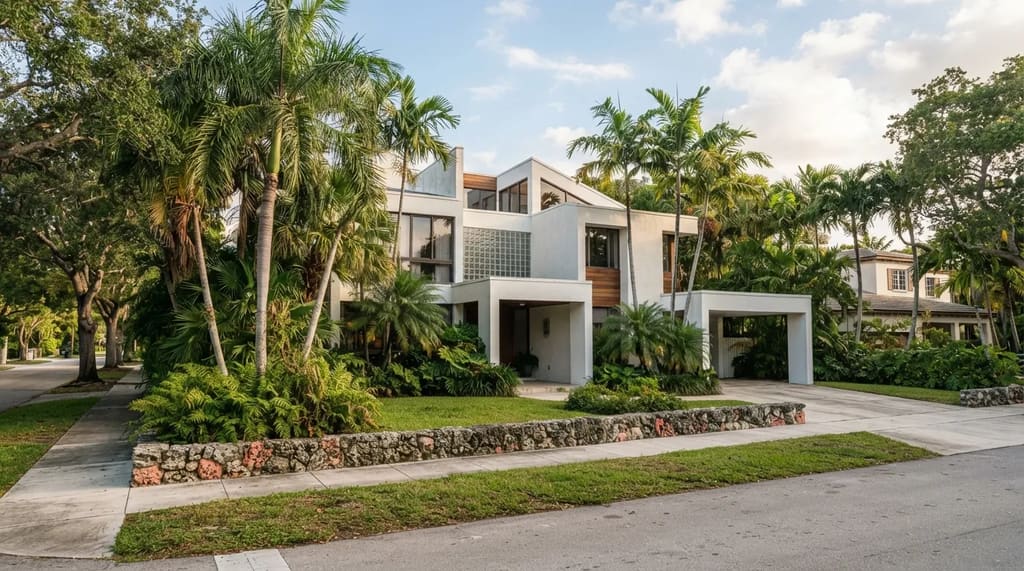
The modern villa at 3067 Jefferson Street in Coconut Grove was designed and built by Peter Blitstein in 1982, and it was one of the first of its kind in Miami. It served as the setting of Brenda’s home on Miami Vice.
That puts it ahead of the Pinecrest compound by five years, and it predates the series itself by two, so the villa was already standing before any location scout came looking. A fan guide says the residential streets around Jefferson Street were featured repeatedly as character homes and safe house exteriors.
Coconut Grove is easiest to reach by car or rideshare from South Beach, so group it with the river park rather than making a separate trip for each. The neighborhood rewards the effort better than most single addresses do, since it is a place you can enjoy on foot once you arrive.
Back north along Biscayne Boulevard, an apartment building holds a secret about how television builds its homes. What you see from the street is only half of the story.
#7 – MiMo Apartments Near Biscayne Boulevard
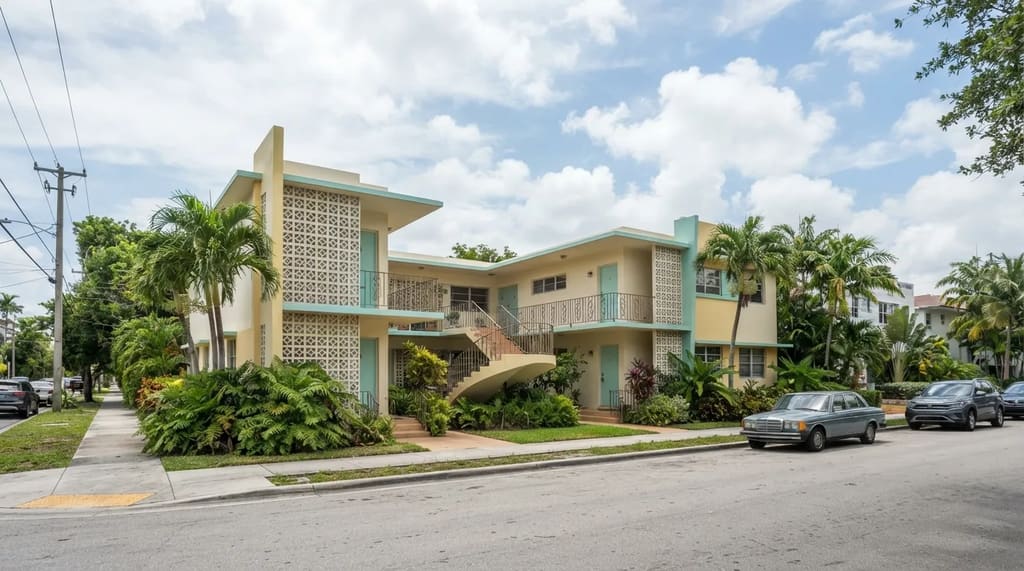
The apartment complex at 4400 NE Second Avenue, on the lower end of the MiMo District around Biscayne Boulevard, was used as the exterior home of freaked-out ex-Vice-cop Hank Weldon in Season 2’s “Out Where the Buses Don’t Run.” The building is a good example of the mid-century Miami style that the district is named for.
Only the exterior was real, and that is the twist. The interior scenes were filmed on a set in North Miami’s defunct Greenwich Studios.
That split is worth remembering when you look at any building on this list, because a television apartment is often a front door in one part of Miami and a sound stage in another. A location tour can only ever show you the front door, which is also why the Little Havana gas station, shell and all, still counts.
Brickell Avenue holds a condominium better known for its courtyard than for any apartment inside it. Its showpiece is a staircase painted bright red.
#6 – The Atlantis Condominium on Brickell Avenue
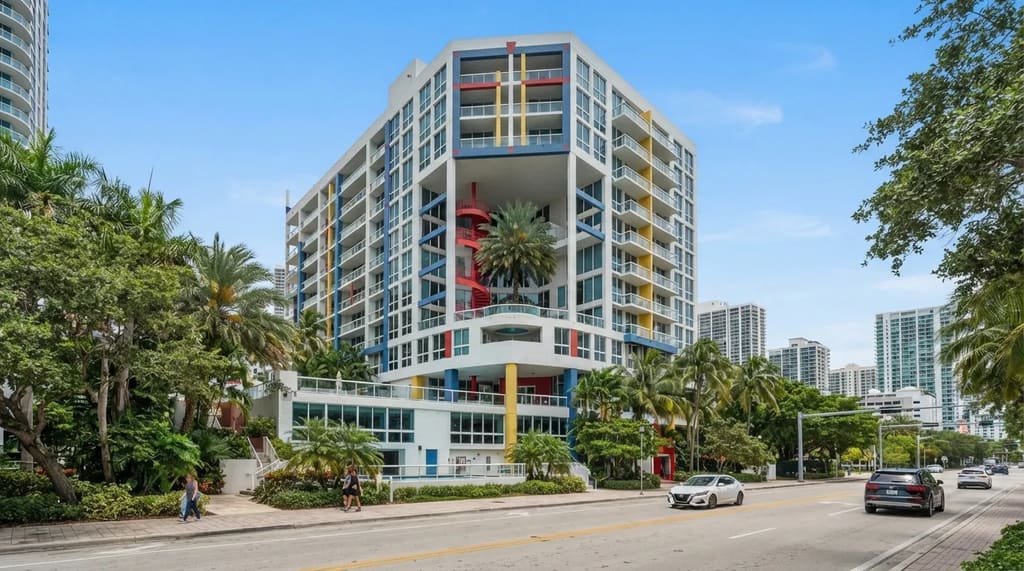
The Atlantis Condominium at 2025 Brickell Avenue was built in the early 1980s and is one of the most famous buildings in Miami’s skyline. That date matters, because the building was only a few years old when the series premiered in 1984.
Its palm court features a red spiral staircase, a jacuzzi and a palm tree.2 Those details are the reason to stop, since the building is the sort of showpiece architecture that suited a series about a fast-growing, newly glamorous city.
Because it is a residential building, you see it the way you would any condominium, from the sidewalk and from the avenue, without an invitation inside. I would still rank it above the Pinecrest compound for a short trip, since it stands on a major street and was built to be looked at.
Downtown, a taller building picked up the show’s name as a nickname when it was sold. Viewers saw it every week without knowing its name.
#5 – The Downtown Tower With a Vice Nickname
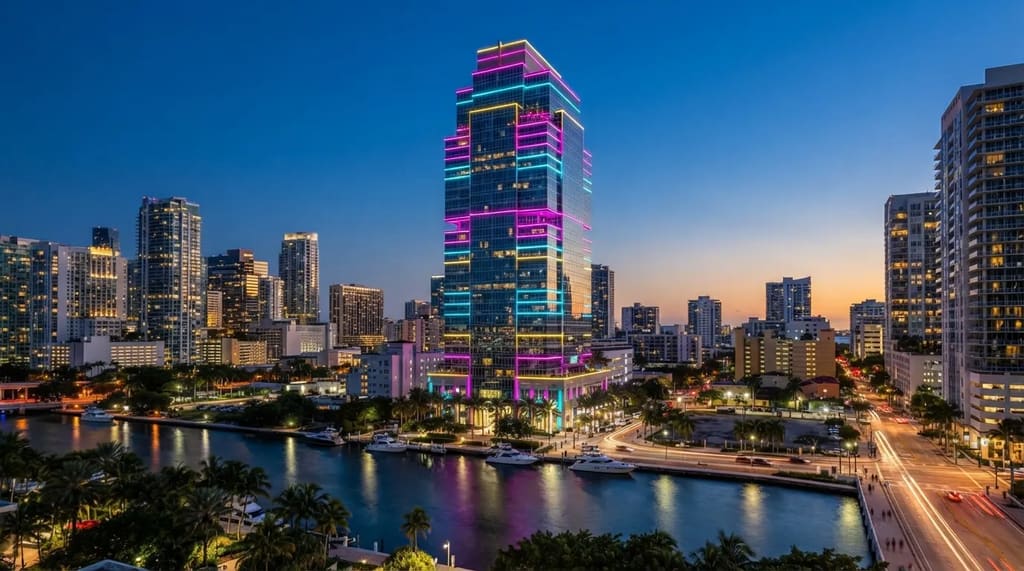
The Miami Tower at 100 Southeast 2nd Street appeared in an episode that aired on December 5, 1986, and in the opening credits of the show from season 3. That makes it one of the few buildings on this list that viewers saw every week, whether or not they knew what it was.
On January 1, 2010, the building was renamed the Miami Tower, and it was even referred to as the “Miami Vice” Tower when it was sold. A building rarely picks up a nickname from a television series that long after the series has ended.
The tower also appears in the Miami Vice film and in a scene in the 2006 version of Casino Royale, so its place in the skyline has outlasted the original show by decades. You do not need to go near it to appreciate it, since the bayfront gives a better view than the sidewalk at its base.
Worth Knowing
- Address: 100 Southeast 2nd Street, downtown
- On screen: an episode that aired December 5, 1986, plus the opening credits from season 3
- Later cameos: the Miami Vice film and the 2006 Casino Royale
- Viewing tip: the bayfront beats the sidewalk at its base
From the bayfront, the marina at the foot of Biscayne Boulevard is where the show kept Crockett’s home on the water. That spot looks very different now.
#4 – Bayside Marketplace and the Old Marina
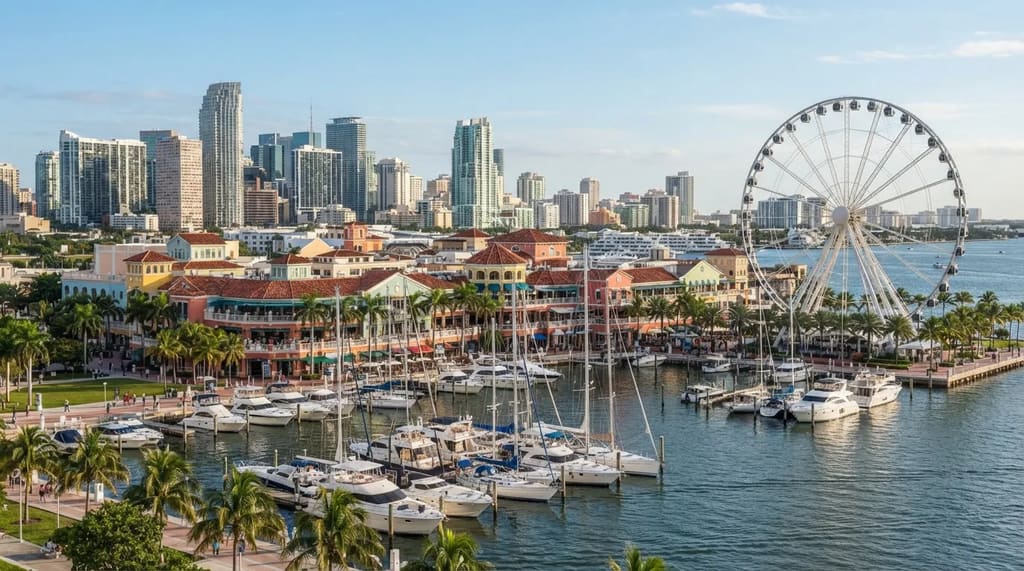
Bayside Marketplace, at 401 Biscayne Boulevard, opened in 1987 and was frequently featured on Miami Vice. A published location list places Crockett’s marina houseboat at this address, and the show’s filming areas included the old Miamarina, now Bayside Market Place.2
The marina was the setting that mattered for the series, and the shopping center grew up beside it. Today it sits between Bayfront Park to the south and the arena to the north, wrapping along the banks of Biscayne Bay.
It now holds nearly 70 shops and 30 restaurants, plus the Sky Views Miami observation wheel at 180 feet. Walking around is free, but on-site parking costs money and visitors report crowds in peak season, so go for the bay view and the boats and treat the Vice connection as a bonus.
Farther south, Key Biscayne holds a state park and a lighthouse that appear on the show’s location lists. One of them is far older than the show.3
#3 – A Lighthouse at the Edge of Key Biscayne
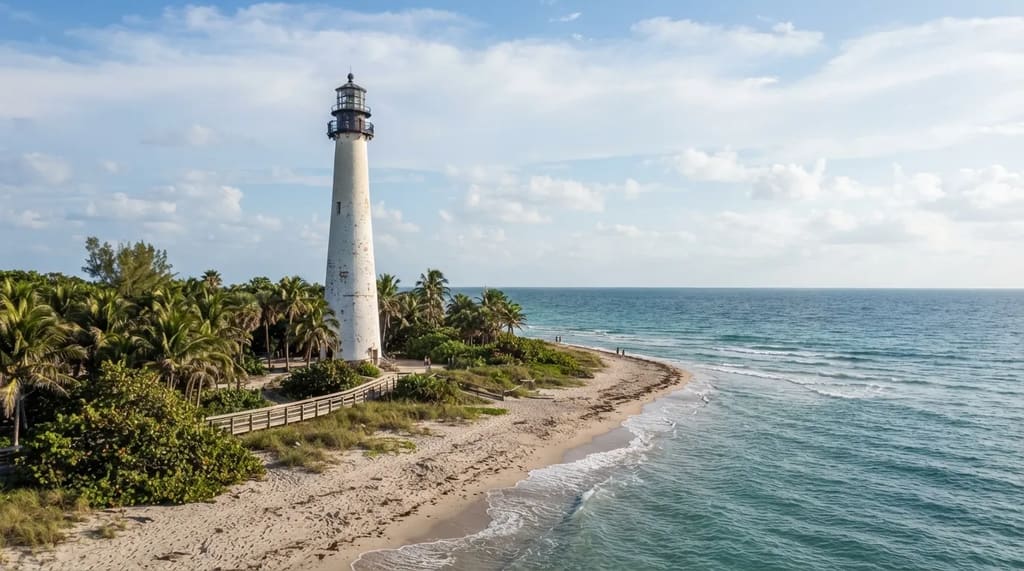
Key Biscayne locations on the show’s lists include Bill Baggs Cape Florida State Park, the Cape Florida Lighthouse and the Rickenbacker Causeway. A fan guide lists the lighthouse as Crockett’s safe house, and it is a long way from the neon of South Beach.4
Key Biscayne itself is one of the show’s named filming areas, along with Coconut Grove, South Beach and downtown Miami. For anyone who likes to be outdoors, this is the best stop outside the city’s core, because the beach and the lighthouse are worth the trip whether or not you ever watched an episode.
Unlike the private houses earlier on this list, a state park is meant to be visited, so you can walk up to the lighthouse during opening hours. Check the park’s hours and fees before you go, since those change and are not something a location list will tell you.
Related Stories From Travelbinger
Why It Stands Out
- It is a public state park, not a private home you can only drive past
- A fan guide lists the lighthouse as Crockett’s safe house
- The Rickenbacker Causeway on the show’s lists is your route out
- The beach and lighthouse are worth the trip even without the show
Two stops remain, and both sit on the same famous strip of South Beach. The first is the street itself.
#2 – Lummus Park and the Ocean Drive Strip
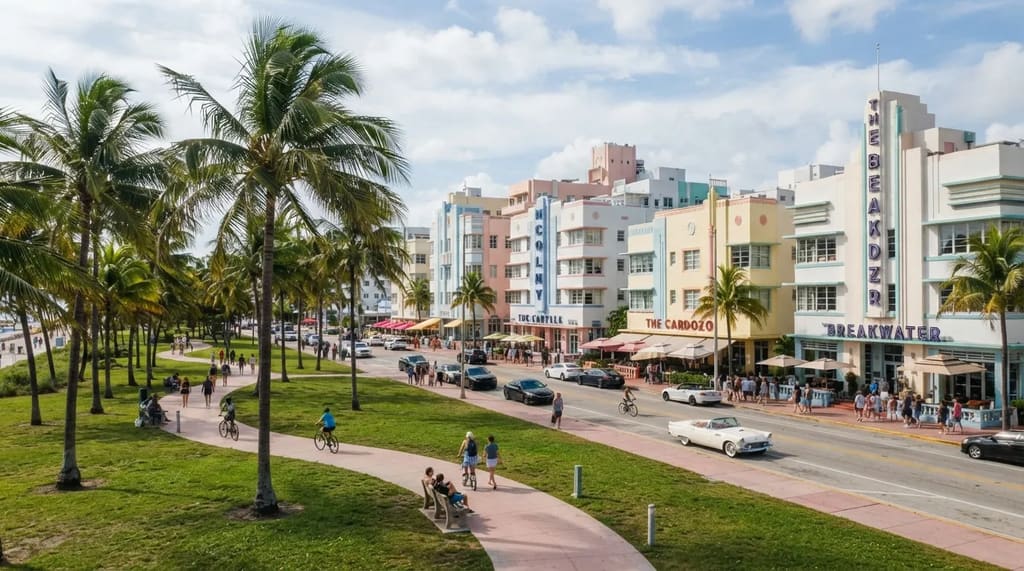
Lummus Park, across from Ocean Drive, was redesigned and improved in the mid-1980s as part of the redevelopment of what is now the Miami Beach Architectural District of South Beach. The park and the street beside it have many cameos in Miami-set movies and television shows like Miami Vice and Burn Notice.
The district holds about 900 preserved, contributing buildings, which is why the stretch can still look like a freeze-frame from the 1980s.5 The tropical pastel color schemes were originated by designer Leonard Horowitz during the late seventies and early eighties preservation drive.
Ocean Drive is best seen on foot, and a rental car is a poor way to see it. Hotels in South Beach put you within walking distance of almost everything in the district.
At 1250 Ocean Drive, the walk passes a building that a fan guide calls the most frequently cited individual building from the show’s early episodes. Its real story starts long before the cameras arrived.
#1 – The Carlyle Hotel at 1250 Ocean Drive
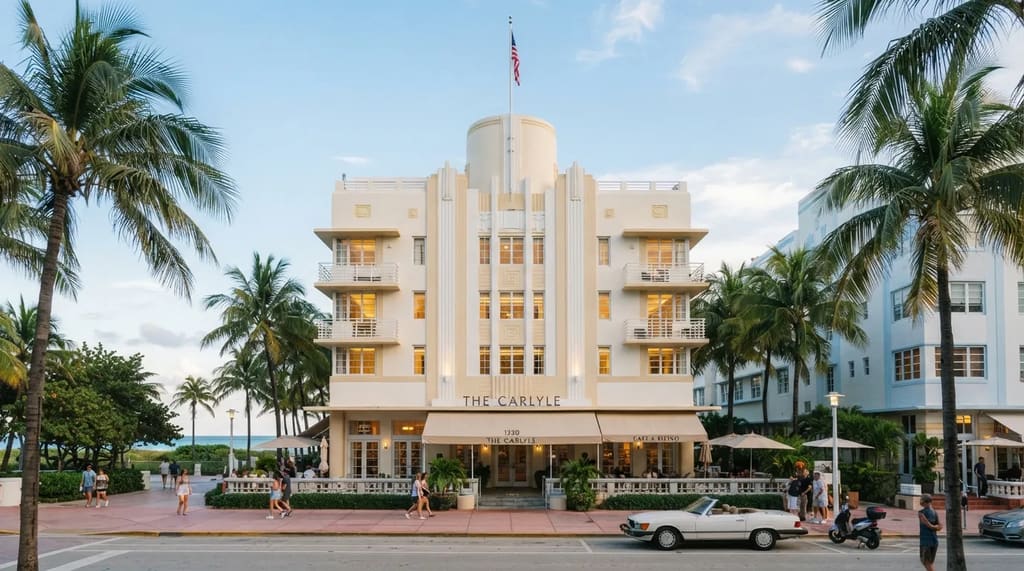
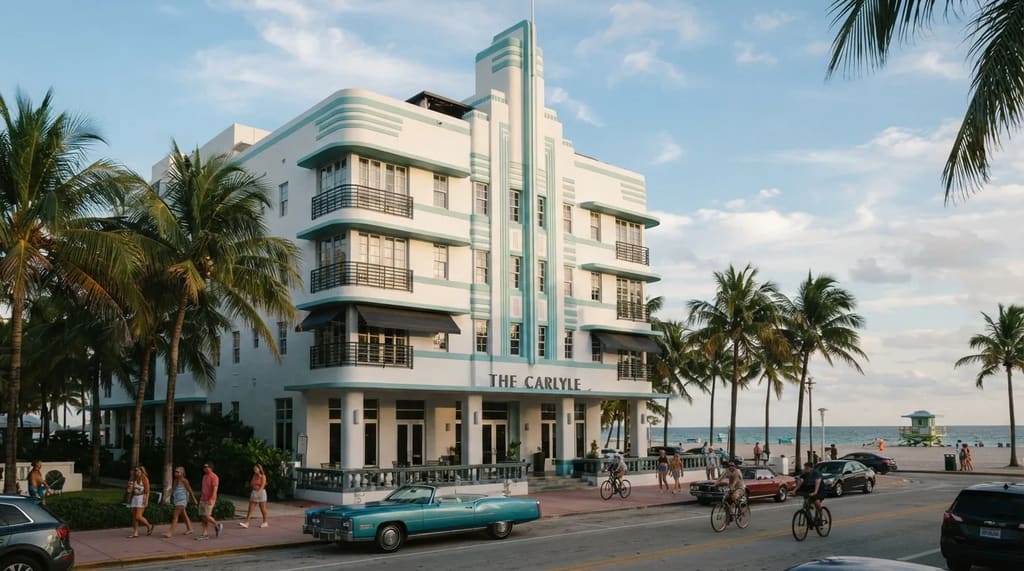
The Carlyle was designed by Pittsburgh-based architects Kiehnel and Elliott, and its facade was purposely understated to contrast with its flashier Ocean Drive neighbors; it has mostly stayed unchanged since 1941. Multiple Miami Vice episodes featured its Art Deco look.
It has a long screen record beyond the series, since it was made famous by films like Bad Boys 2 and The Birdcage. A recent fan guide reports that it still operates today, so check current hours and access before you plan around it.4
Here is the twist behind all that filming. After South Beach fell into disrepair following World War II, the Carlyle and the nearby Cardozo were the first two hotels renovated, in 1978, and many of the area’s buildings are now protected by the Miami Art Deco Preservation Society, particularly through the efforts of Barbara Baer Capitman.
So the building cited most often from the show’s early episodes had been renovated six years before the pilot aired, and the show borrowed a street that preservation work had already made camera-ready. The Ocean Drive that viewers remember was the product of that earlier effort, and the series simply arrived to film it.
Check the Date Before You Check the Scene
When you visit a place from an old television show, look up the year it was built or saved before you look up the episode. The date tells you whether you are standing where the camera stood or in front of a close relative.
That habit works in any city, because a restored hotel, a new villa and a shopping center from 1987 each deserve a different kind of visit. Which building near you has appeared in a movie or a show, and do you know whether it was restored before or after the cameras came?
- Miami New Times Vice Locations: https://www.miaminewtimes.com/arts-culture/miami-vice-locations-you-can-still-see-today-23981666/
- Reel to Real Miami Vice: https://rtrlocations.blogspot.com/2021/04/miami-vice-1984-1989.html
- Cape Florida Lighthouse History: https://www.tclf.org/landscapes/bill-baggs-cape-florida-state-park
- Miami Vice Fan’s Guide: https://www.nomadotravel.app/en/guides/miami-vice-filming-locations-guide
- Ocean Drive Art Deco District: https://en.wikipedia.org/wiki/Ocean_Drive_(South_Beach)