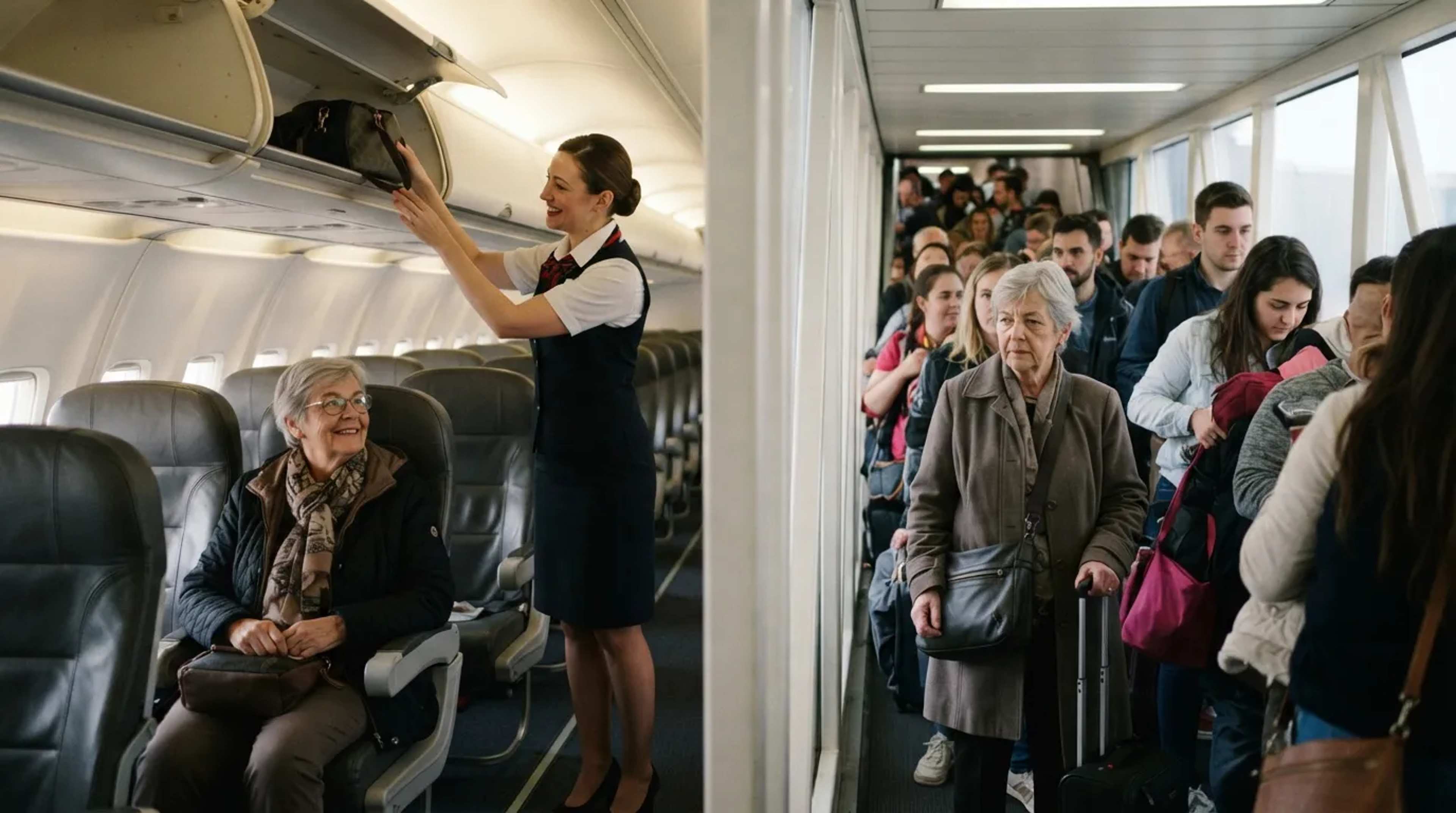
Most travelers over 60 assume the airport quietly goes easier on them once a certain birthday hits. The only age-based screening perk TSA documents doesn’t start until 75, and almost everything else depends on you speaking up first.
That gap between what’s available and what people actually ask for is where the stress starts. Some of the 13 questions below save you a few minutes, a couple can decide whether you board at all, and the one waiting at the end is the one almost nobody thinks to ask.
#13 – “Is My ID Actually Good Enough to Fly?”
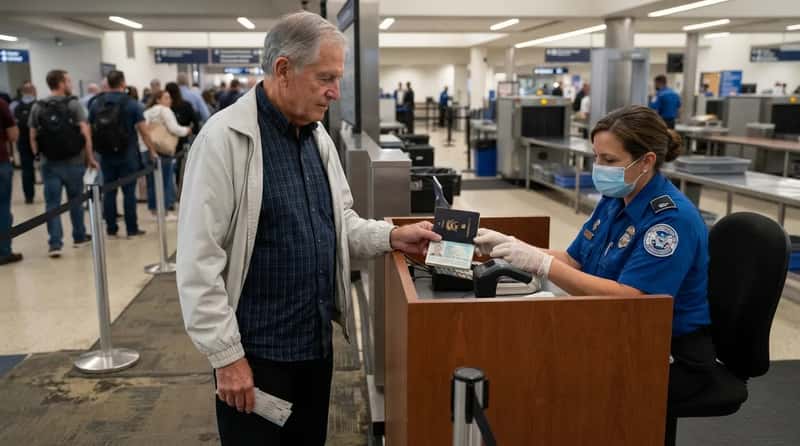
A driver’s license you’ve carried for years may no longer get you past the checkpoint. The card can look perfectly fine and still be the thing that stops your trip.
Since May 7, 2025, TSA has required travelers 18 and older to show a REAL ID-compliant card or another TSA-approved ID. Standard state licenses that aren’t REAL ID-compliant are no longer accepted for domestic air travel.
You have options besides a new license. The accepted alternatives are right below.
At a Glance
- A U.S. passport or passport card works
- An Enhanced Driver’s License works
- DHS trusted traveler cards such as Global Entry work
- A standard, non-REAL ID license does not work for domestic flights
Here’s the part people miss. Since February 1, 2026, travelers with no acceptable ID can pay $45 to use TSA ConfirmID, which is a last-resort identity check.
Our take: that is a costly way to skip a five-minute look through your wallet at home. Check the card before you leave for the airport, not after you’ve parked.
But once your ID is sorted, the next question involves something you’re probably still doing out of habit, and that’s #12…
#12 – “Do My Shoes Really Have to Come Off?”
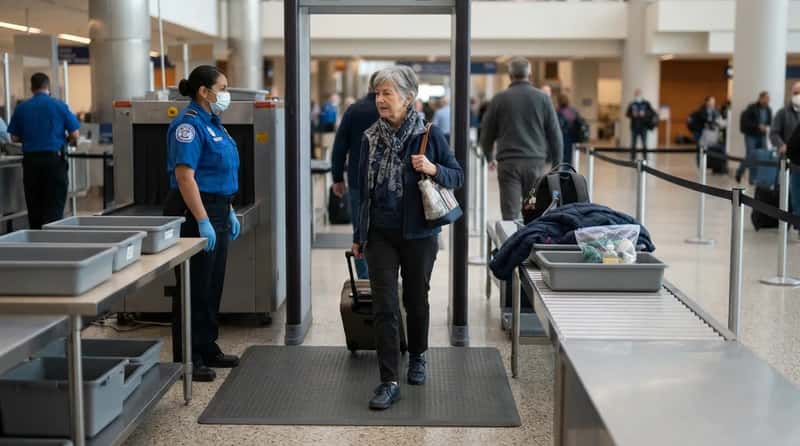
Plenty of older travelers still bend down to untie their shoes because that’s how it has always worked. Then they find out the ritual has mostly disappeared.
TSA says passengers 75 and older can receive some form of expedited screening, which includes keeping their shoes on. For years, that was the closest thing to a senior perk at the checkpoint.
Then the rules shifted for everyone. Reports say that since July 8, 2025, travelers of every age keep their shoes on nationwide.
There’s still a catch. TSA’s own guidance notes that an alarm can mean removing shoes for further screening or a pat-down.
Here’s the uncomfortable truth for the 60-to-74 crowd: the one well-documented age-based perk starts at 75, not 60. Many travelers assume a senior lane exists at 62 or 65, and it doesn’t.
So what happens when the scanner does beep? That’s where a single request changes everything in #11…
#11 – “Can I Sit Down for This?”
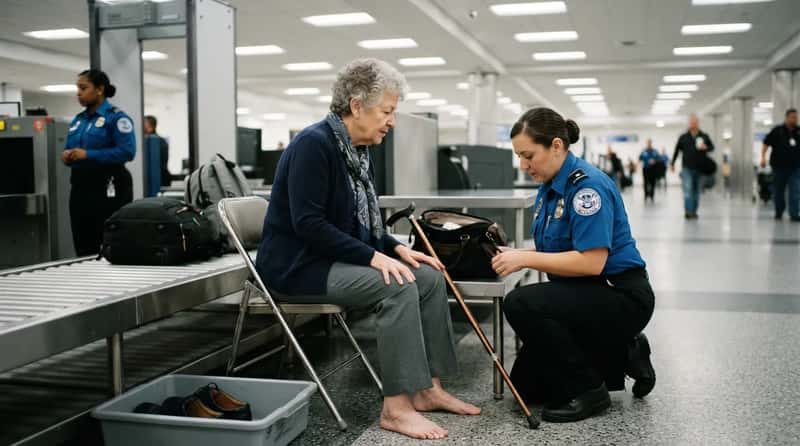
You don’t have to stand through the most tiring part of screening. Most people grit their teeth and do it anyway.
If an alarm goes off, you may be asked to remove your shoes or undergo a pat-down. TSA says you can request to be seated during that portion of the screening.
Passengers 75 and older who can’t stand for screening are cleared through other security methods. For travelers whose medical conditions prevent standing or walking, shoes don’t have to come off, but they are inspected manually.
Don’t expect your cane to be exempt. TSA requires everyone with a scooter, wheelchair, walker or cane to be screened in some fashion, and if the experience falls short, you can ask to speak with a supervisor at the checkpoint.
But sitting down is only half the story, because the next question protects you from a problem you can’t see, and it’s #10…
#10 – “Should I Tell You About My Implant First?”
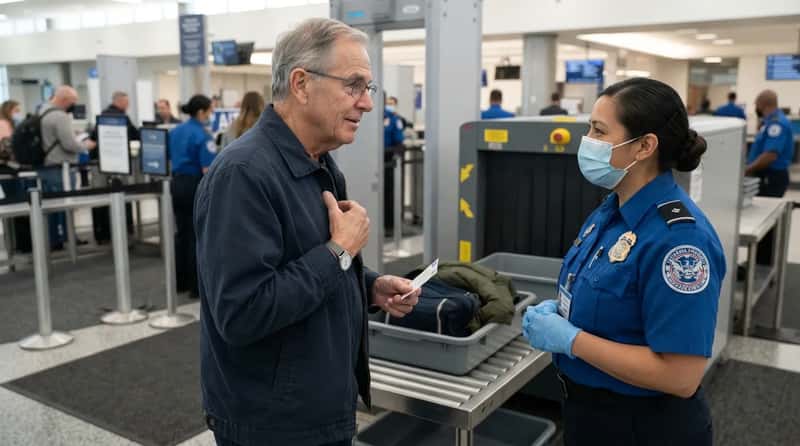
The worst moment to mention a medical device is after the scanner has already alarmed. By then, everyone in line is watching.
TSA notes that other screening procedures may apply if you travel with medical devices or implants. Telling the officer up front is part of how the alternate process starts.
Medications get their own treatment. Officers may test liquids, gels or aerosols, and they may open containers and transfer pills to another container for testing.
You have a say in that process. If you don’t want your medication X-rayed or opened, tell the officer and they will take alternative steps to clear it.
Expect some swabbing too. Your hands, mobility aids, medical devices and shoes may be tested for trace amounts of explosives.
Of course, you could also warn the whole system before you leave home, which brings us to #9…
#9 – “Can You Flag Me With TSA Cares?”
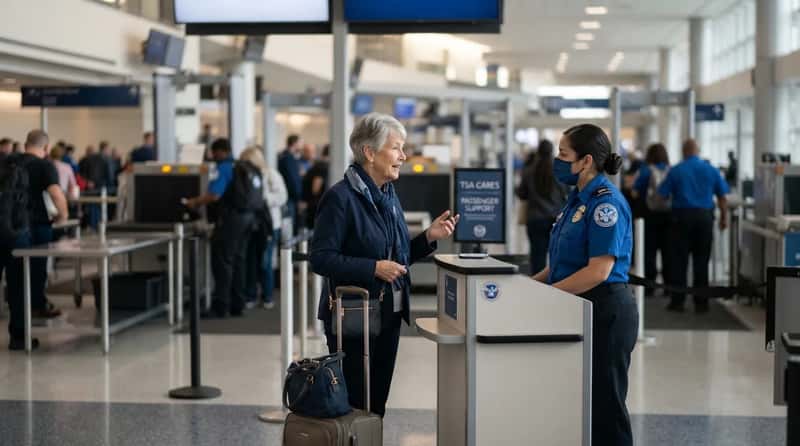
There’s a helpline built for travelers with medical conditions, and most people never dial it. It exists for exactly the moments that make people dread security.
TSA Cares is designed to help travelers with disabilities, medical conditions and other special circumstances. The number is (855) 787-2227, and you can also email [email protected].
You can also get help on the spot. Ask a TSA officer at the checkpoint to request a passenger support specialist, and know that TSA PreCheck and TSA Cares can be used together.
Now for a claim that may start an argument. No senior discount exists for TSA PreCheck, since the fee is the same at every age, so whether it pays off depends on how often you fly, not how old you are.
Once you’re through security, the gate brings a question most people ask too late, and it’s #8…
#8 – “Can I Board Early?”
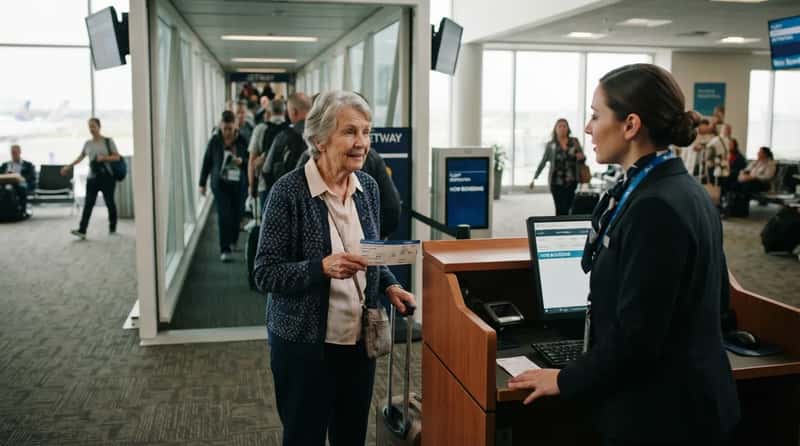
At the gate, one direct question can save you a slow shuffle down a crowded jet bridge. Plenty of travelers never say it out loud.
Airline preboarding policies differ, so check your carrier’s rules before you fly. We found no evidence that age alone earns a guaranteed early slot, but a stated need often gets a different answer.
The clearest guidance comes from oxygen users. Lincare advises arriving at the gate well ahead of departure so you can board with your equipment before the plane gets crowded.
Confirm your information with the airline representative at the gate so they can seat you early. Some travelers hover near the boarding door hoping to be waved forward.
Asking the agent directly is the better plan. A quiet hope is not a boarding strategy.
Worth Knowing
- Preboarding rules vary by airline, so look up yours before travel day
- Age alone isn’t a documented ticket to an early slot
- Name the need plainly, such as oxygen equipment or extra time
- Speak to the gate agent, not the boarding door
But early boarding only helps if the seat you land in is actually allowed, and #7 is where that can go wrong…
#7 – “Is This Seat Safe for My Equipment?”
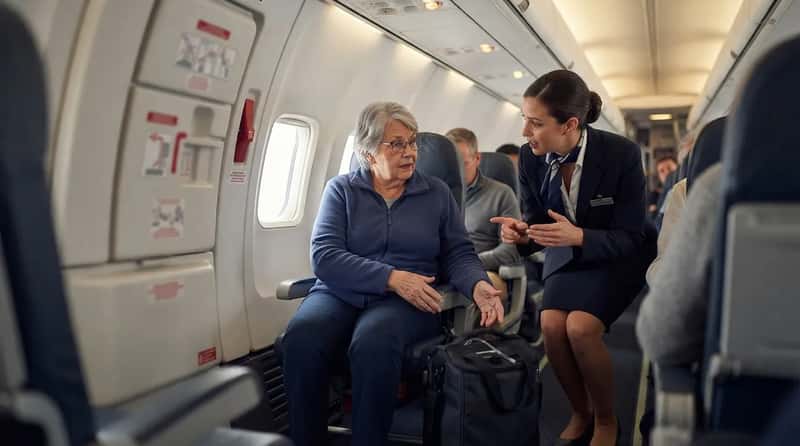
An exit row can become a problem the moment you travel with portable oxygen. The extra legroom that looks like a bonus is off limits.
Federal rules say no person operating a portable oxygen concentrator may occupy an exit seat. If you find yourself in an exit row, ask a flight attendant to switch your seat.
Where the device sits matters too. During movement on the surface, takeoff and landing, it must be stowed under the seat in front of you or in another approved spot that doesn’t block the aisle.
The pilot in command must also be told when the equipment is on board and when it will be used. One more rule surprises people: oxygen tanks can’t come on board, because compressed gas and liquid oxygen are considered hazardous.
Which raises the question that catches even careful planners off guard, and it’s #6…
#6 – “How Many Batteries Do I Really Need?”
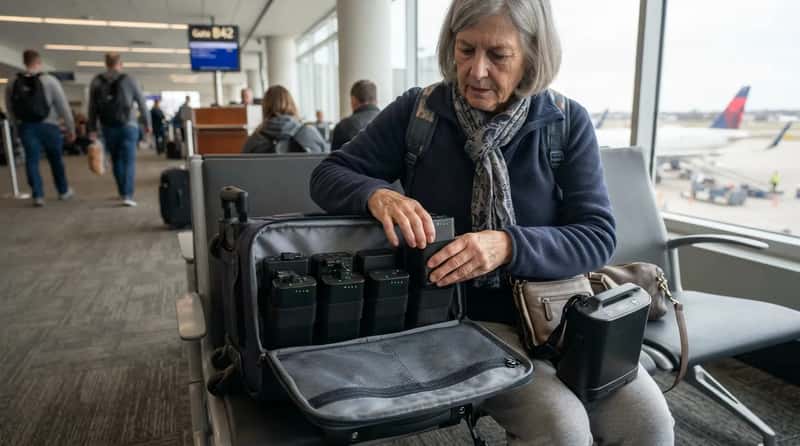
A delayed flight can outlast the batteries you packed. That’s when a routine trip turns into a scramble.
The FAA says people who depend on a portable oxygen concentrator must bring enough spare batteries in carry-on baggage for the duration of the flight. Lincare advises keeping spares in their original packaging or a separate bag, or taping over exposed terminals.
How much is enough? One vendor’s guide says to add up flight, layover, boarding and delay time, then multiply by 1.5 and make sure your battery capacity beats that number.
Quick Compare
- Sample trip (illustration only): 3 hours in the air, 1.5 hours of layover, 0.5 hours of boarding and 1 hour of delay cushion
- Total travel time: 6 hours
- Times 1.5: your batteries should cover about 9 hours
That’s a vendor’s rule of thumb, so confirm the figure with your device maker and airline. Airline knowledge also varies from agent to agent.
One Canadian traveler was denied boarding on a WestJet flight after staff claimed his concentrator wasn’t FAA approved. The airline later apologized and refunded his flight.
Before any of that matters, though, the airline has to know you exist, and the next question trips up more people than you’d think in #5…
#5 – “Do I Still Need to Tell You I Need Help?”
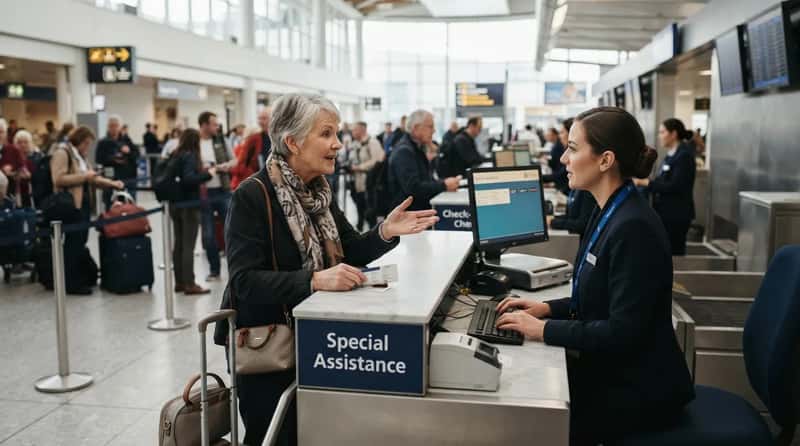
Booking assistance online isn’t the same as claiming it at the airport. Plenty of travelers tick the box and then wait for help that never walks up.
The Department of Transportation says you must self-identify to airline staff at the airport as a person needing this service. Airlines then have to provide help in a timely fashion after you do.
Airlines are not required to help you the moment you arrive at the terminal curb. DOT says to request an airport wheelchair when you make your reservation if you can’t walk long distances.
The scope of that help is wider than most people assume. Airlines must assist you from the terminal entrance to your gate, including the security checkpoint, and onto the aircraft to your seat.
But what happens after you land somewhere else? That’s the gap in #4…
#4 – “Who Meets Me at My Connection?”
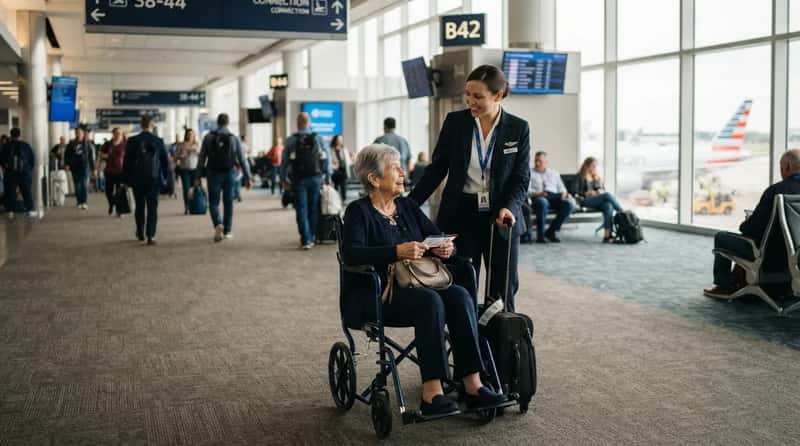
Your help shouldn’t end when the first plane lands. A tight connection in an unfamiliar airport is where good plans fall apart.
DOT rules cover assistance from your seat on an arriving flight through the airport to the gate of your connecting flight. DOT also advises confirming your accessibility needs with all airlines involved in your journey.
A rule announced in December 2024 tightened those expectations. It requires airline staff to provide “prompt” assistance during boarding, deplaning and connections.
It also says a passenger’s own wheelchair should be as close to the aircraft door as possible, if requested. Confirm the help with every airline on your itinerary, not just the first one.
Our view: the cheapest fare with the shortest layover is often false economy for anyone who moves at a measured pace.
And if your mobility device is a power chair, the rules get stricter, as #3 shows…
#3 – “What Happens to My Power Chair?”
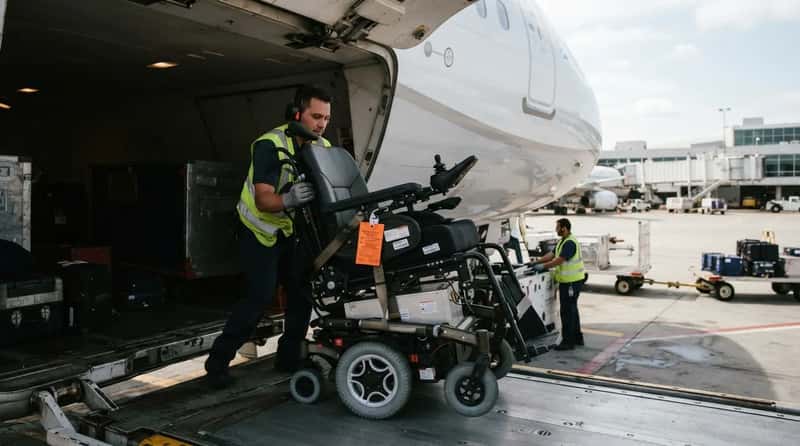
Battery-powered mobility devices come with paperwork and timing rules that catch people off guard. Your chair is your independence, and it travels under its own set of conditions.
DOT says that if you travel with a battery-powered wheelchair, you must arrive one hour before the normal check-in time. Airlines may ask for up to 48 hours’ notice for hazardous-materials packaging of a wheelchair battery, or for carrying a powered chair on an aircraft with fewer than 60 seats.
Electric wheelchairs travel in the hold, and airlines require advance notice and battery specifications. Passengers must not be charged for transporting wheelchairs or mobility aids.
Fast Facts
- Arrive 1 hour before the normal check-in time
- Expect to give up to 48 hours’ notice for battery packaging
- Have your battery specifications ready
- No fee for transporting a wheelchair or mobility aid
If the airline delays your chair, there’s a clock. The 2024 DOT rule calls for delivery within 24 hours for domestic flights and within 30 hours for long international ones.
Airlines must also reimburse transport costs to or from the airport if they delay it.
Yet all of that covers the ground. The next question is about what happens at 35,000 feet, in #2…
#2 – “Can I Get Help to the Lavatory in Flight?”
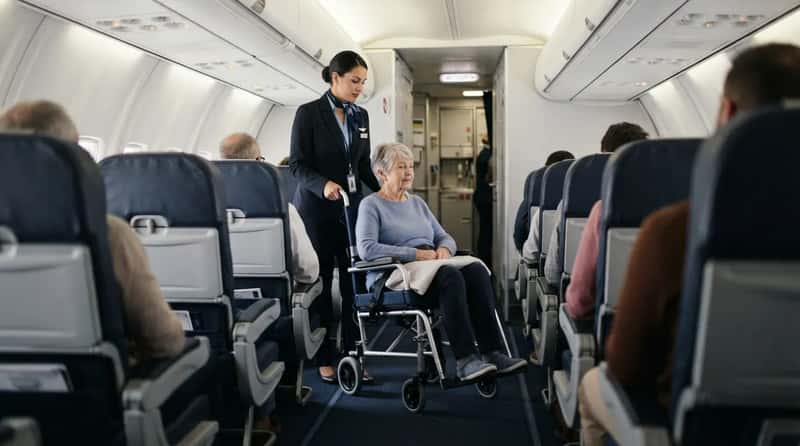
Nobody mentions the toughest part of a long flight until you’re already in the air. Then it’s the only thing you can think about.
An on-board wheelchair is a narrow aisle chair stored on the aircraft to move passengers between their seat and the lavatory. Under the Air Carrier Access Act, they are required on all twin-aisle aircraft.
Don’t assume it will simply appear. One guide says to request it when you book and confirm it at the gate, because it isn’t automatically offered.
DOT says airlines may require 48 hours’ notice for an on-board wheelchair on an aircraft without an accessible lavatory. New DOT performance standards for these chairs are set to take effect October 2, 2026, so expect airline procedures to shift around then.
All of these answers share one weak point, and the final question deals with it directly in #1…
#1 – “Who Do I Talk To If This Goes Wrong?”

The most powerful thing you can say at the gate is a job title. Most passengers never learn it exists.
If you hit a disability-related problem with an airline accommodation, you can ask to speak with the airline’s Complaint Resolution Official or a supervisor. A CRO is the airline’s expert on these rules.
The Air Carrier Access Act makes it illegal for airlines to discriminate against passengers because of a disability. It’s the ACAA, not the ADA, that protects disabled flyers in the air.
The protections are built around need, not birthdays. Most people over 60 never ask for a CRO, and the biggest mistake is staying quiet to avoid “making a fuss.”
At security, the equivalent move is asking for a supervisor at the checkpoint. Put all 13 questions together and a pattern emerges that explains the whole list…
The Bottom Line

Turning 60 doesn’t unlock much on its own, and TSA’s documented age perk starts at 75. What actually smooths the trip is asking early, and asking specifically.
Check your ID before you leave home, tell officers about devices before the scanner does, and confirm assistance at the airport instead of trusting the booking screen. If you use oxygen or a power chair, plan batteries and notice periods well ahead.
Every rule here rewards the passenger who speaks first. Which of these questions do you wish someone had told you to ask on your first trip after 60?
Bonus: The Insider Lifeline Most Travelers Never Save in Their Phone
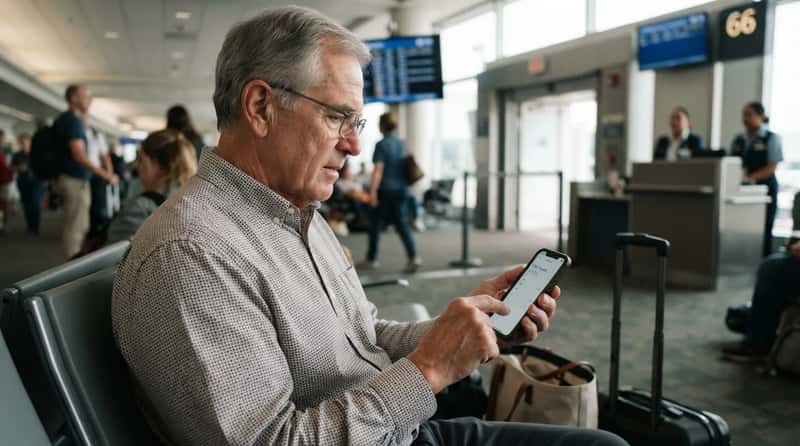
Save the DOT Disability Hotline: 1-800-778-4838 in your phone before you leave home. It’s a federal line that can step in on time-sensitive, disability-related airline problems while you’re still at the airport.
Hotline staff can contact the airline on your behalf in real time. Call it when the airline’s own Complaint Resolution Official can’t or won’t fix the problem.
- Know the hours: it’s staffed Monday to Friday, 9 a.m. to 5 p.m. Eastern, and closed on federal holidays. Weekend or evening trouble means you’ll be relying on the airline’s CRO and your notes.
- Escalate in order: ask the gate agent for a supervisor or CRO first. If that stalls, call the hotline. For a screening problem, call TSA Cares at (855) 787-2227 instead.
- Write it down on the spot: jot the flight number, the time, the agent’s name and exactly what was promised. Those notes matter if you file a written complaint with DOT later.
Do one more thing the night before you fly: put both numbers on a card in your wallet, in case your phone battery dies.