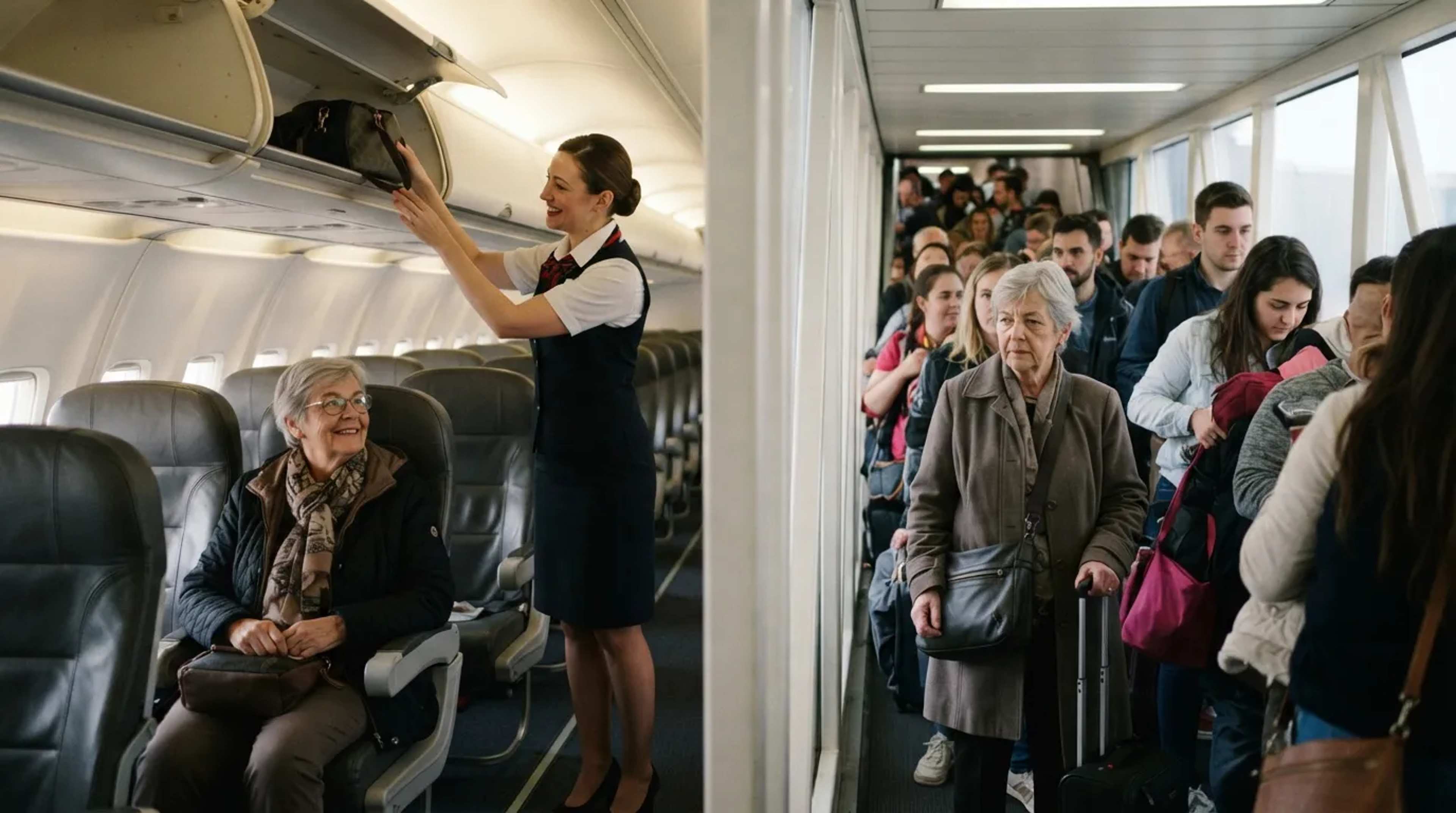
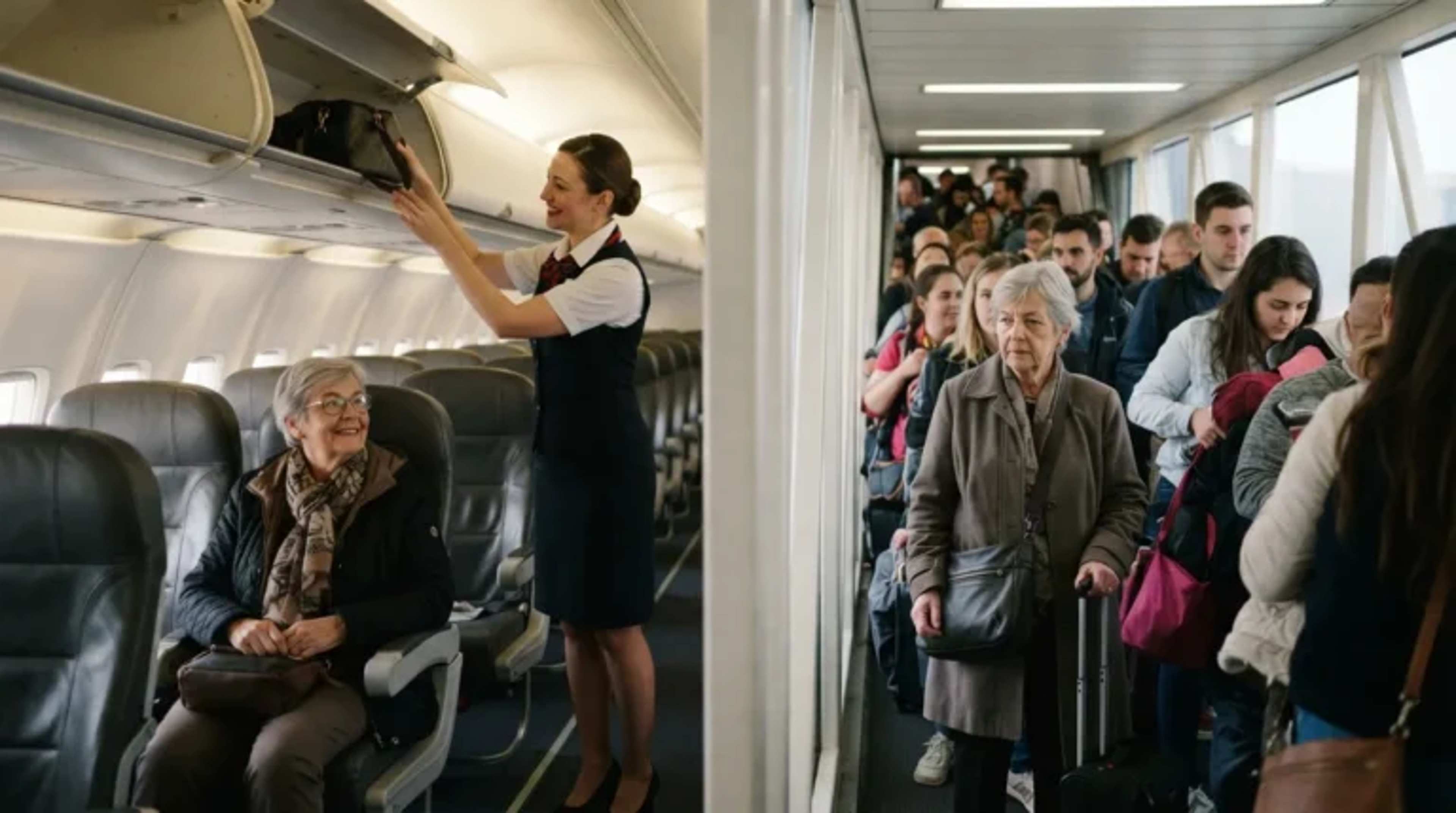
Most travelers assume early boarding is just an airline being generous, giving you a few extra minutes to get settled before a long flight. That’s not even close to the real story. Boarding early has almost nothing to do with your comfort and almost everything to do with money, liability, and a scoreboard you’ll never actually see on your ticket.
Once you understand what’s really driving that early call at the gate, you’ll never look at “Group 1” the same way again. Here’s what airline insiders, gate agents, and aviation data actually say is going on behind that boarding announcement.
#13 – The Overhead Bins Are the Real Prize, Not Your Seat
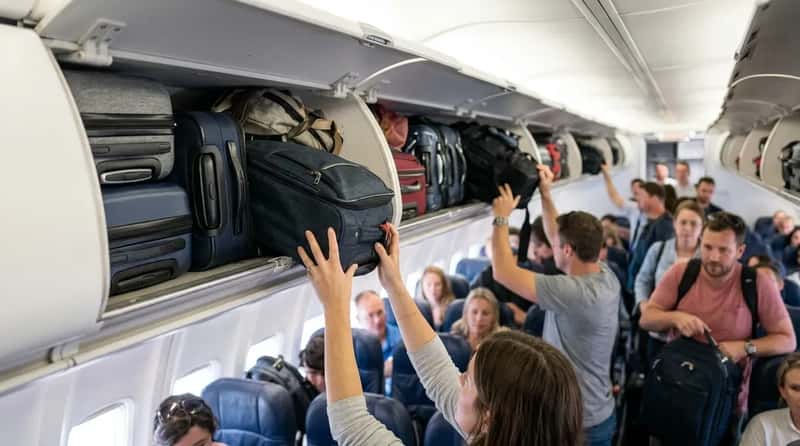
Boarding early isn’t about your seat at all. It’s about the six cubic feet of space above your head. Priority boarding is basically a race for overhead bin space, and travel advisors will tell you that’s the number one reason people pay extra for an early group.
Wait too long and the consequences show up fast. Passengers who board late often lose the choice entirely and get their bag gate-checked, which means no laptop, no headphones, and no snacks until the belt at your destination. That’s the entire game, dressed up as a courtesy. But that’s nothing compared to what we found about #12.
#12 – Every Minute at the Gate Is Costing the Airline Real Money
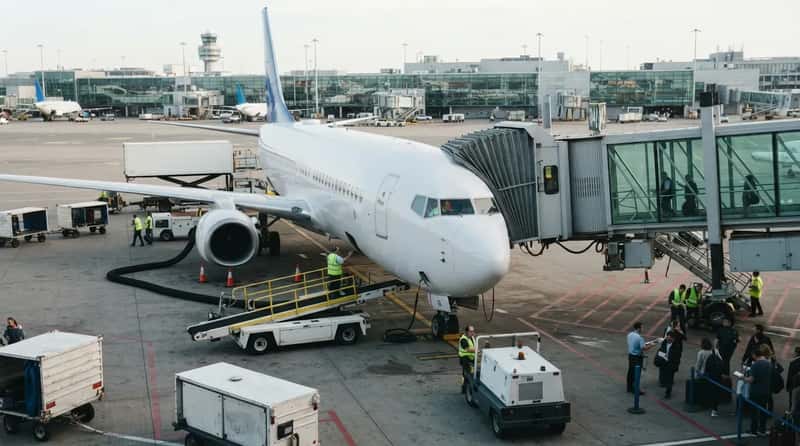
Airlines don’t board early to be nice. They board early because idle planes are expensive planes. Airlines run on razor-thin turnaround windows, and every extra minute a jet sits parked at the gate quietly eats into profit.
That pressure trickles down to your boarding time whether you notice it or not. If boarding starts late and passengers drag their feet, the whole day’s schedule tips over like dominoes, leading to missed connections, tighter landing slots, and delays for the next flight that same aircraft is supposed to fly. Your “early” boarding call is really a financial insurance policy for the airline. #11 is where it gets a little embarrassing for passengers.
#11 – “Gate Lice” Are Quietly Rewriting the Boarding Order
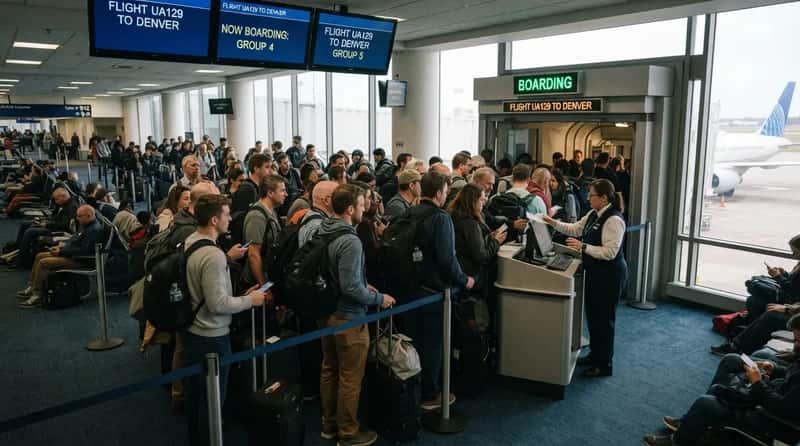
There’s an actual nickname for people who crowd the gate before their group is called, and airline employees use it constantly: gate lice. It sounds harsh, but the behavior is reshaping how boarding actually functions at busy gates across the country.
Here’s the twist: that behavior isn’t as irrational as it looks. On flights that are full or overbooked, there’s a real, tangible benefit to lining up early, since being last in an earlier group can beat being first in a later one. The difference can mean keeping your carry-on instead of watching it get tagged and sent below the plane. Next up, a rule most flyers don’t even realize is federal law.
#10 – Pre-Boarding for Disabilities Isn’t Airline Kindness, It’s Federal Law
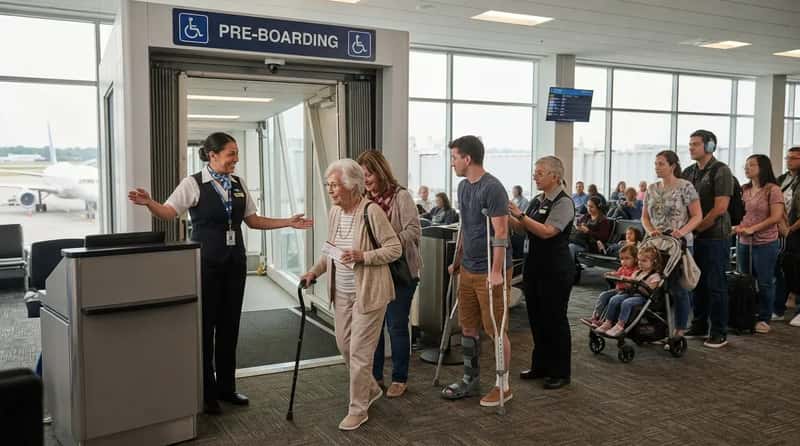
Most passengers assume pre-boarding for disabilities is a courtesy the airline decided to offer out of goodwill. It isn’t optional at all. By law, anyone with a disability who needs special assistance must have the chance to board first, full stop.
What surprises people most is how wide that rule actually stretches. It covers anyone who needs extra time or help boarding, stowing accessibility equipment, or getting seated, which reaches far beyond wheelchair users into a much broader group of travelers. This is federally mandated, not a policy any single airline invented, and gate agents have zero legal room to deny it.
Worth Knowing
- Covers anyone needing extra time to board or reach their seat
- Includes help stowing wheelchairs, scooters, or other mobility devices
- Applies to travelers who need extra time getting settled once seated
- Backed by the Air Carrier Access Act, not individual airline policy
#9 is the one that sparks the most arguments online.
#9 – Families With Toddlers Board First for a Reason Nobody Loves
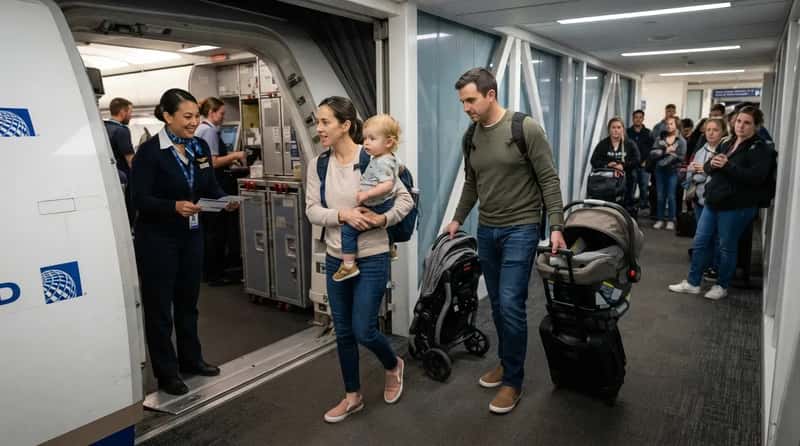
Few boarding rules generate more grumbling on a plane than watching a family with small kids walk straight to the front of the line. United’s pre-boarding group includes anyone traveling with a child two years old or younger, plus anyone who needs extra time getting settled.
Here’s the friction point: even travel writers question the logic out loud. There’s a long-running debate over why families get to board first and effectively slow down everyone behind them, instead of boarding last and holding up nobody. The real reasoning is about wrestling a car seat and stroller into place before the aisle jams up, not about giving toddlers a head start on the pretzels. Still, plenty of travelers privately wish it worked the other way around. #8 has almost nothing to do with comfort and everything to do with duty.
#8 – Active Military Boards Early, and Not Just Out of Respect
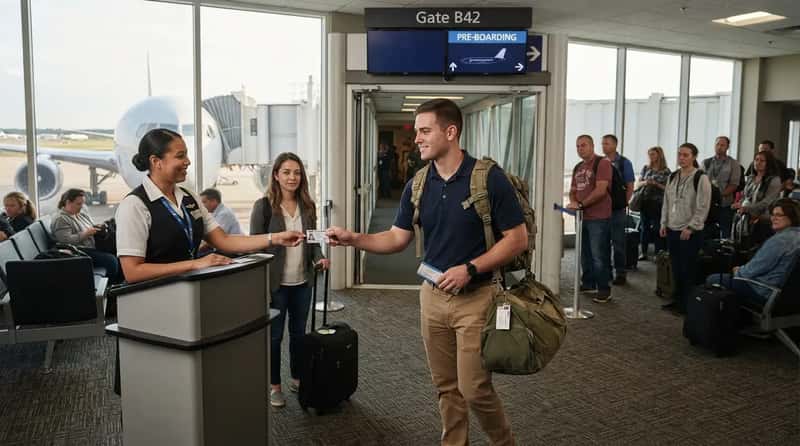
Active-duty service members get pre-boarding on nearly every major U.S. carrier, and the reasoning goes deeper than a simple thank-you gesture at the gate. It’s baked into policy across almost every airline you’d fly domestically.
What most passengers don’t realize is how little proof is actually required. Active military members can board during pre-boarding without even wearing a uniform. Some airlines ask for a military ID and others don’t bother, so it’s smart to have it handy just in case. It’s less about ceremony and more about logistics for personnel who often travel under strict, unforgiving connection windows. #7 involves a boarding rule that quietly contradicts itself depending on the airline.
#7 – Unaccompanied Minors Sometimes Board First, and Sometimes Dead Last
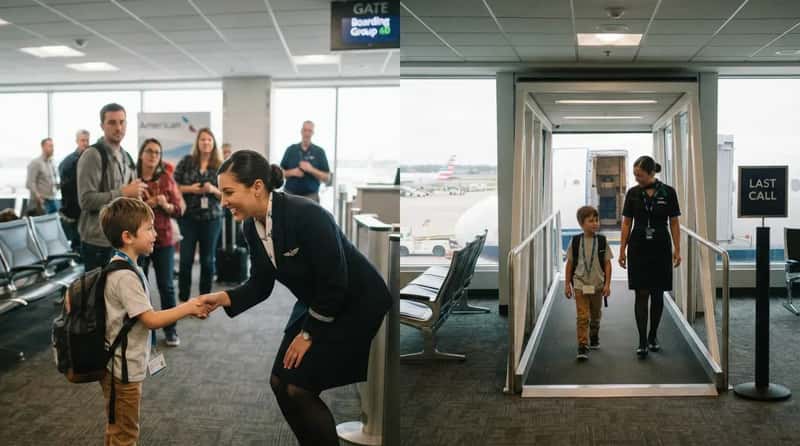
This is the reason nobody mentions, because the policy actually flips entirely depending on which airline you’re flying. On American, kids traveling alone get a warm welcome at the front of the line. American boards the child early so they can meet the flight crew and hear about the plane’s safety features before anyone else gets on.
JetBlue does the exact opposite, and it genuinely surprises most flyers who assume the rule is universal. JetBlue’s own boarding note specifies that unaccompanied minors are escorted onto the aircraft and board last, not first. Same category of passenger, completely opposite placement in line, purely because of which logo is printed on the ticket. #6 is the one that actually pays your airline’s bills.
#6 – Your Loyalty Status Is Quietly Sorting the Entire Cabin
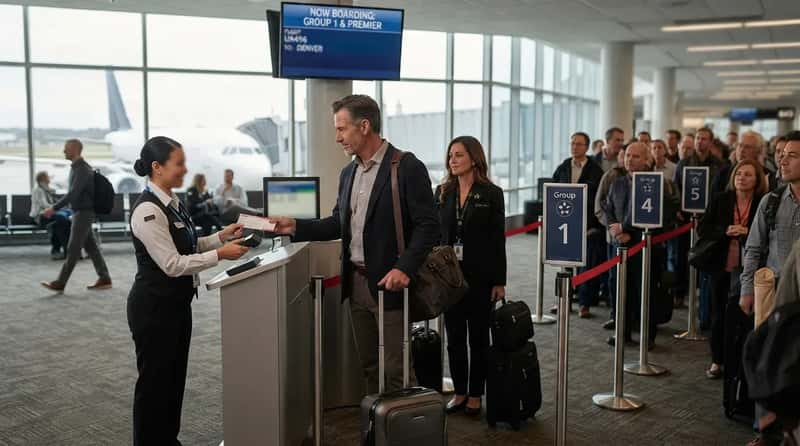
Boarding order isn’t really about comfort tiers. It’s a direct, public map of who spends the most money with the airline, laid out in front of everyone standing at the gate. After pre-boarding, United calls Group 1 for Premier Platinum and Gold members, Star Alliance Gold status holders, and passengers seated in premium cabins.
American’s system is even more granular, splitting elites into layers most casual flyers never notice or understand. Group 1 covers Executive Platinum members and active military, Group 2 covers Platinum Pro and Oneworld Emerald, and Group 3 covers Platinum and Oneworld Sapphire.
Quick Compare
- United Group 1: Premier Platinum, Premier Gold, Star Alliance Gold, premium cabins
- American Group 1: Executive Platinum members and active military
- American Group 2: Platinum Pro and Oneworld Emerald
- American Group 3: Platinum and Oneworld Sapphire
Your boarding group number is basically a public scoreboard of your spending history, whether you meant to advertise it or not. #5 is a genuinely new system most flyers haven’t even seen yet.
#5 – United Now Sorts Economy by Window, Middle, and Aisle
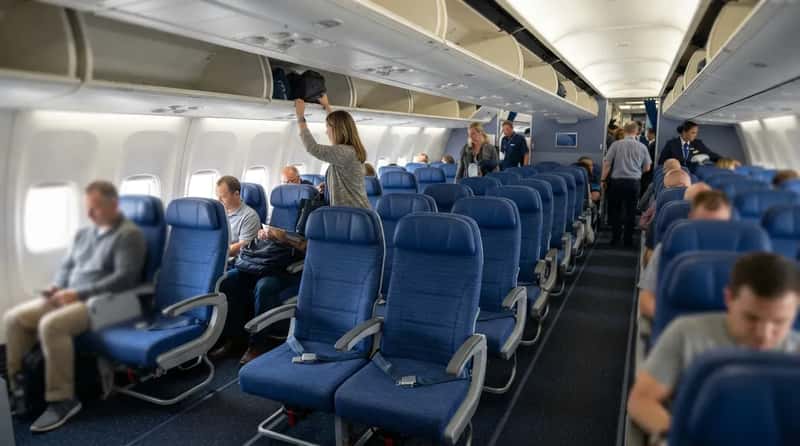
Starting in late 2025, United quietly rolled out a system that changes how coach passengers line up, and it has nothing to do with the group number you’d expect. Groups 3 through 5 now follow the WILMA system introduced that October, with window seats boarding in Group 3, middle seats in Group 4, and aisle seats going last in Group 5.
Fast Facts
- Group 3: Window seats board first among the WILMA rows
- Group 4: Middle seats board next
- Group 5: Aisle seats board last
- Rolled out fleet-wide starting October 2025
The goal is to fix one specific annoyance every flyer already knows too well. It’s designed to erase that awkward moment where a window-seat passenger has to climb over two people who already got settled. If you’ve ever had to stand up and shuffle sideways in a cramped row just so someone could squeeze past, this rule exists purely to make that headache disappear. #4 shows gate agents have more power than most flyers realize.
#4 – Gate Agents Can Quietly Break Their Own Rules for Families
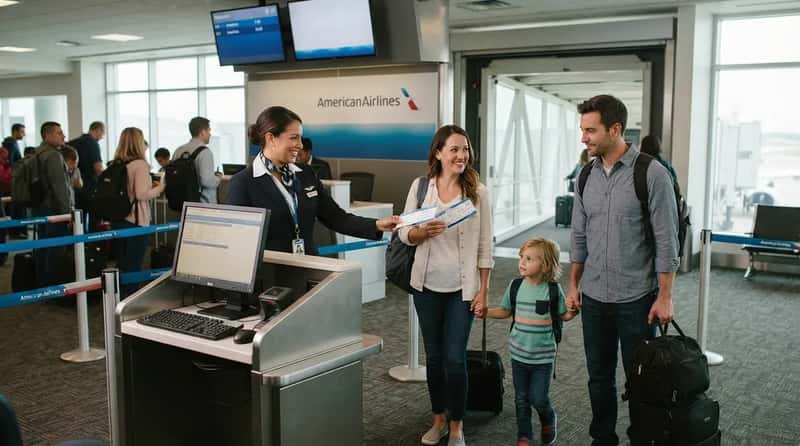
The boarding chart looks rigid on a screen, but it isn’t nearly as strict in practice as most travelers assume. American Airlines has acknowledged that even with its newer, more automated boarding system, gate agents still hold onto some real discretion.
That discretion gets used constantly for one specific situation. If a family or group traveling together gets split across different boarding groups, an agent can quietly let the later-group passenger board early with their companions instead of forcing a separation. Technically that bends the official order, but airlines allow it on purpose to avoid the ugly scene of splitting people up at the jet bridge. #3 is the reason your boarding pass now gets scanned twice.
#3 – Airlines Are Now Using Tech to Catch Line-Jumpers
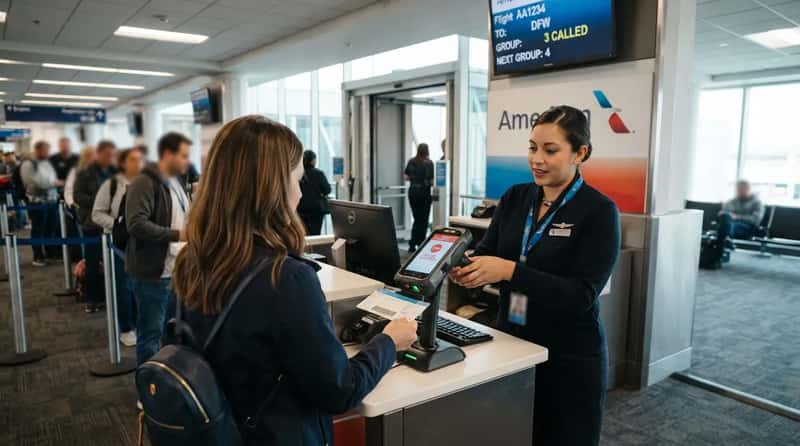
The gate-lice problem got bad enough that American Airlines actually built technology to stop it cold. The airline introduced new scanning tools specifically aimed at preventing line-jumping during boarding.
This isn’t a minor tweak, either. It’s a direct response to years of passengers crowding the jet bridge before their number was called, which slowed everyone else down and created exactly the kind of congestion airlines are desperate to eliminate. Scanners now flag boarding passes that don’t match the group being called, quietly enforcing an order that used to run purely on the honor system. #2 is a change that already happened across the entire American Airlines fleet.
#2 – American Airlines Moved Boarding Five Minutes Earlier, Fleet-Wide
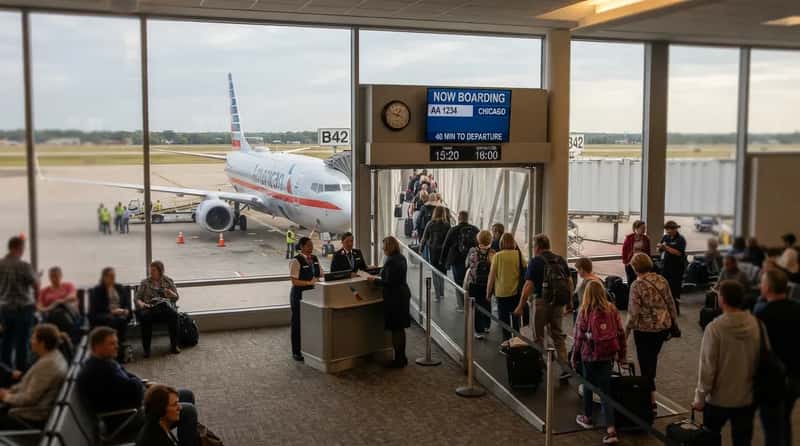
Starting in May 2025, American didn’t just tweak a policy quietly in the background. It moved the clock on every single flight it operates. The new boarding window began May 1, 2025, starting 35 minutes before departure on smaller Airbus jets and 40 minutes before departure on Boeing 737s, Airbus A321s, and every widebody in the fleet.
At a Glance
- Effective date: May 1, 2025
- Smaller Airbus jets: boarding starts 35 minutes before departure
- 737s, A321s, and widebodies: boarding starts 40 minutes before departure
- Stated goal: smoother boarding, less congestion, fewer last-minute gate-checks
The reasoning was refreshingly honest for an airline announcement. It’s a small handful of extra minutes with a real ripple effect on how chaotic your boarding experience feels. #1 is the reason airlines protect above almost everything else.
#1 – Boarding Early Protects a Number You’ll Never See on Your Ticket
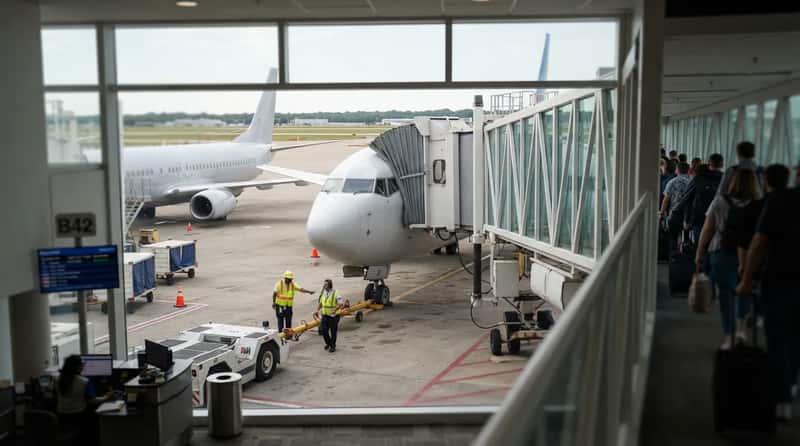
Here’s the reason nobody mentions, because it has nothing to do with passengers at all. Airlines are graded, internally and publicly, on how close they push back from the gate to the scheduled time, not on when the wheels actually leave the ground. That single metric, on-time performance measured at push-back, is treated like gospel inside every airline’s operations center.
On-time performance isn’t measured by wheels-up. It’s measured by push-back from the gate.
U.S. Department of Transportation on-time performance standard
That metric explains almost every early boarding call you’ve ever experienced. Starting boarding early gives airlines a cushion to close the doors and push back on schedule, even if a few passengers move slowly or a bag needs sorting, because boarding is just one item on a much longer checklist. Your comfort was never really the point. The scoreboard was.
Add it all up and the pattern becomes obvious: boarding early is rarely about you. It’s about bins, budgets, liability, loyalty math, and a push-back clock that airlines guard like a scoreboard. The next time a gate agent calls your group ten minutes earlier than expected, you’ll know exactly which of these thirteen forces is actually pulling the strings. Which one surprised you the most? Drop it in the comments.