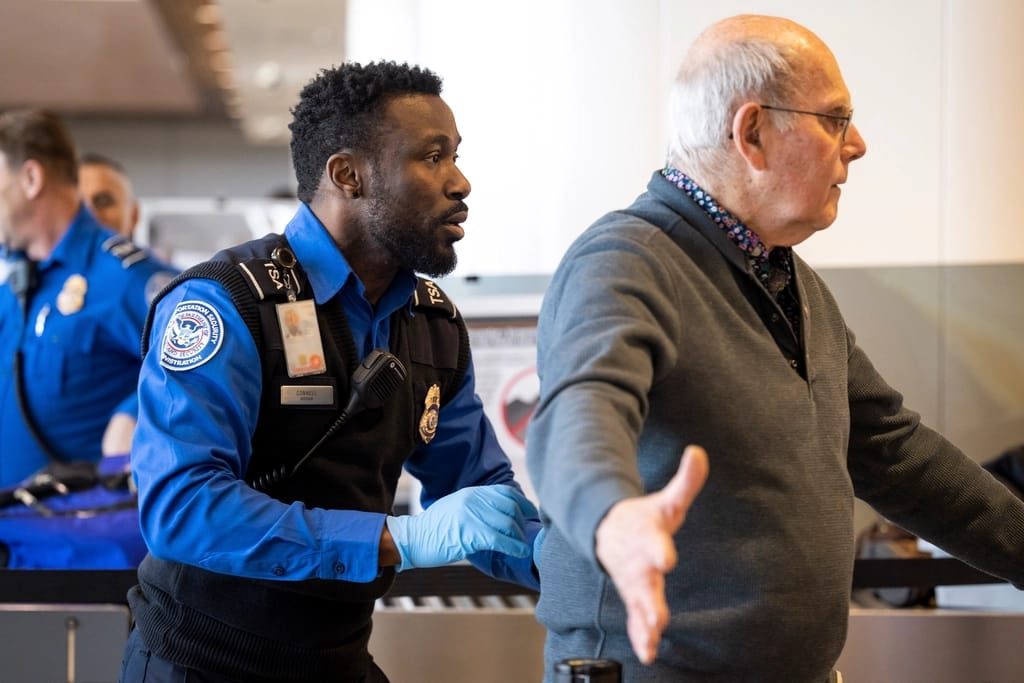
Most people think turning 75 hands you a secret fast lane through airport security. The real story is stranger: the biggest age-75 perk now belongs to everyone, and other accommodations were never really about age at all.
Below are 13 checkpoint accommodations, counted down from the quiet ones to the one almost nobody knows about. Some could save you a headache on your next trip, and one widely repeated rule doesn’t work the way you’ve been told.
#13 – The Hearing Aid Removal Nobody Requires
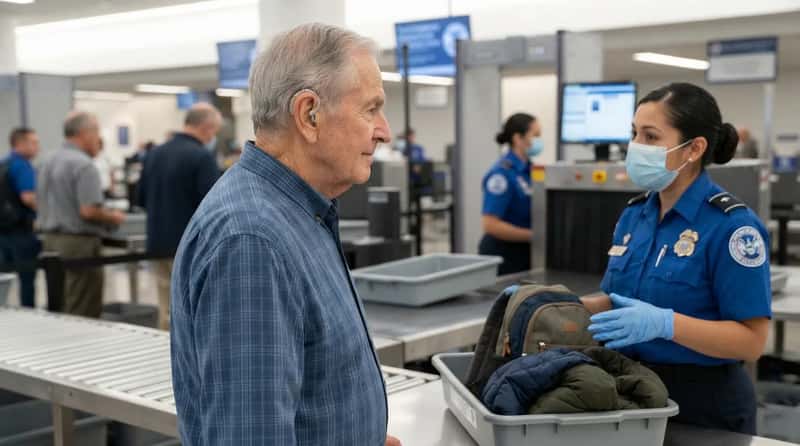
Your hearing aids can stay right where they are. It’s one of the most overlooked allowances at the checkpoint.
TSA guidance says travelers don’t have to remove hearing aids or the exterior part of a cochlear implant. An officer may still ask to check a device if it sets off an alarm.
This is not a 75-only rule. It applies at any age, and older travelers simply use it more often than anyone else.
Senior-travel guidance also recommends telling officers you’re hard of hearing. That way instructions get repeated clearly instead of being shouted over a noisy lane.
It’s a small relief, but it sets the tone for this list. Some accommodations come with conditions, and the next one involves equipment attached to your body.
#12 – Removing Medical Devices Attached to Your Body
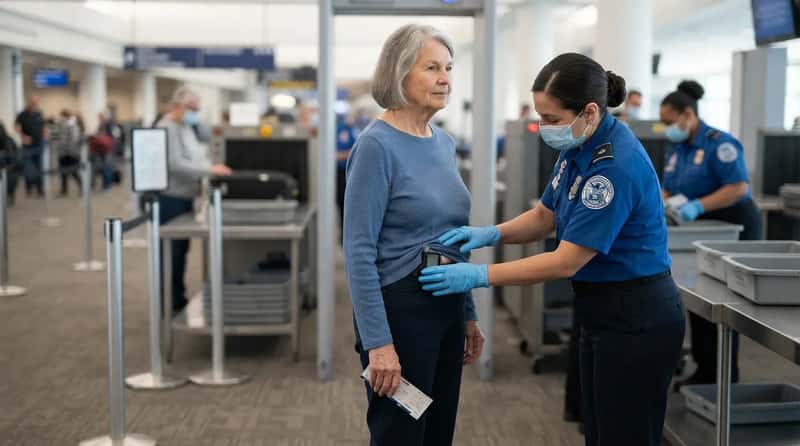
Officers can’t make you take off a device that’s attached to you. That surprises a lot of first-time flyers with medical gear.
TSA says you won’t be required to remove medical devices attached to your body. Separate medical equipment and supplies do need their own screening.
Think insulin pumps or similar devices worn on the body. The device stays on you, and the officer adapts the screening around it.
Oxygen is handled differently. Respiratory devices are screened before the checkpoint, and if yours can’t be disconnected, you tell the officer, who can arrange an alternate inspection.
The next item is where many travelers get caught out, because it sounds like a full exemption and isn’t.
#11 – The 3-1-1 Liquids Limit (For Medicine)
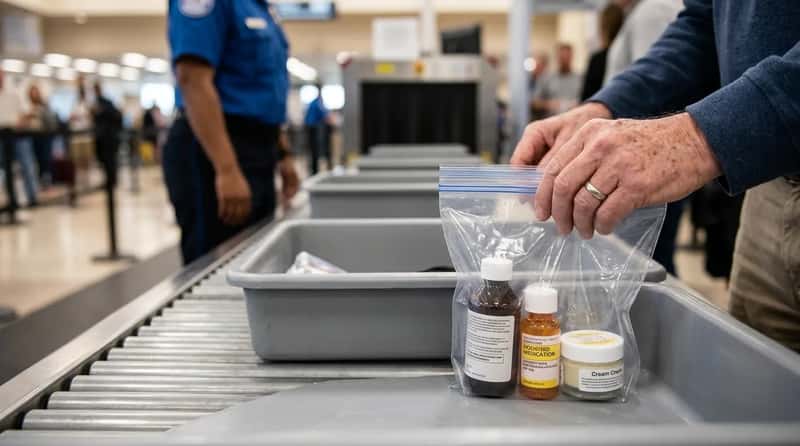
The familiar 3.4-ounce liquids limit has a medical escape hatch. Here’s the catch most people miss.
Medically necessary liquids, gels and aerosols are exempt from the 3-1-1 rule but may require additional screening. This is a medical exemption, not an age perk.
Liquid medications over 3.4 ounces must be separated from your other carry-on items and declared to the officer as medically necessary. Officers may test them for explosives and may open containers.
- Separate larger liquid medications from the rest of your bag.
- Tell the officer they’re medically necessary.
- Expect extra testing.
If a liquid alarms and the alarm can’t be resolved, the item may not be allowed through. Even experienced travelers often overlook that warning.
Medicine raises one more question, though, and the answer is less strict than you’d think.
#10 – The “Original Bottle” Rule That Isn’t a Rule
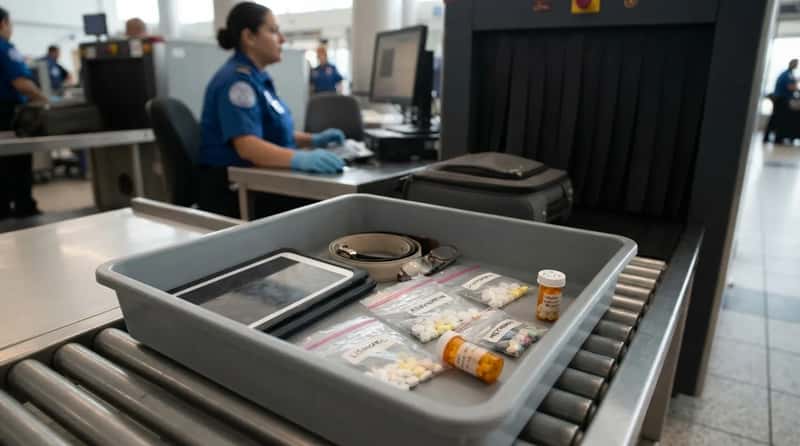
Pills don’t have to travel in their original bottles. Plenty of travelers believe they do.
TSA says prescription pills don’t need to be in original bottles, though it’s helpful. However they’re packaged, they still have to be screened.
That distinction matters. Skipping the bottle is allowed, but skipping the screening never is.
Labeling is where guidance gets firmer. Pills and liquid medications should be clearly labeled, and officers may even transfer pills to another container to test them, according to travel-industry guidance for seniors.
Worth Knowing
- Original bottles are optional, but they’re helpful.
- Every pill gets screened, however it’s packaged.
- Clear labels on pills and liquid medications are recommended.
- Officers may move pills to another container for testing.
Don’t want your medication X-rayed or opened? Tell the officer, and they’ll take alternative steps to clear the items. Asking costs nothing.
Next comes a category where speaking up early really matters, because staying quiet can put your health at risk.
#9 – The Walk-Through Metal Detector (With Implants)
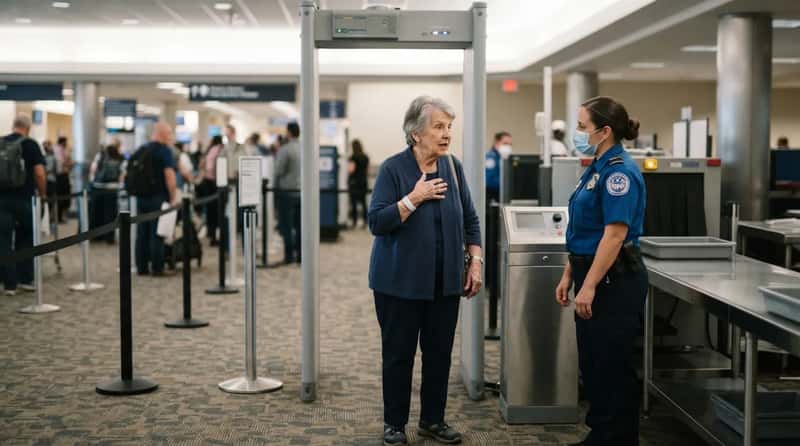
If you have an internal medical device, the metal detector may not be for you. Most travelers never hear this until they’re standing in line.
TSA states that people with internal devices such as pacemakers should not be screened by a walk-through metal detector, and it advises consulting your physician before flying.
Artificial joints, pacemakers and aneurysm clips can all set off detectors. That’s unavoidable, and it isn’t a sign that anything is wrong.
TSA recommends telling officers where any internal device is located. An alarm from an implant is routine, not suspicious.
The next item isn’t about machines at all, and for some families it matters more than any scanner.
#8 – Being Separated From Your Companion
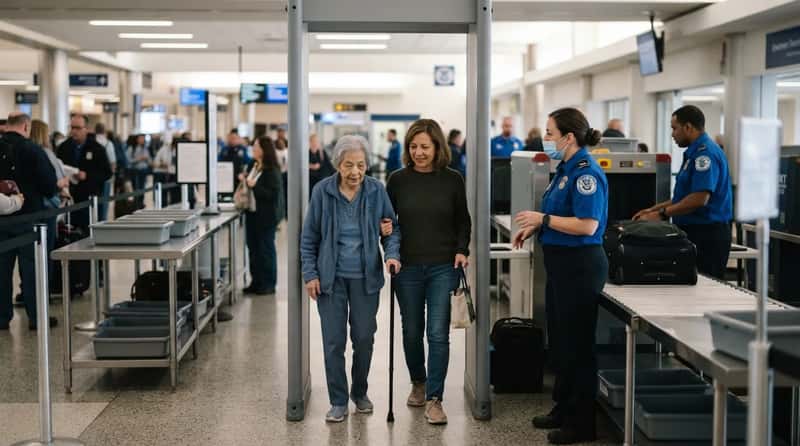
Some travelers can skip the moment where they’re split from the person they came with. It isn’t about age, but it’s vital for many older fliers.
TSA says travelers with non-visible conditions such as Alzheimer’s, autism spectrum disorder and dementia can be screened without being separated from their traveling companion.
The fine print is easy to miss. If a companion helps during screening, they’ll need to be rescreened.
Many families assume a caregiver simply walks through alongside. Guidance for older travelers confirms the caregiver can accompany them but will be re-screened afterward.
A familiar face helps. But privacy is the next thing most travelers forget they can ask for.
#7 – The Public Pat-Down
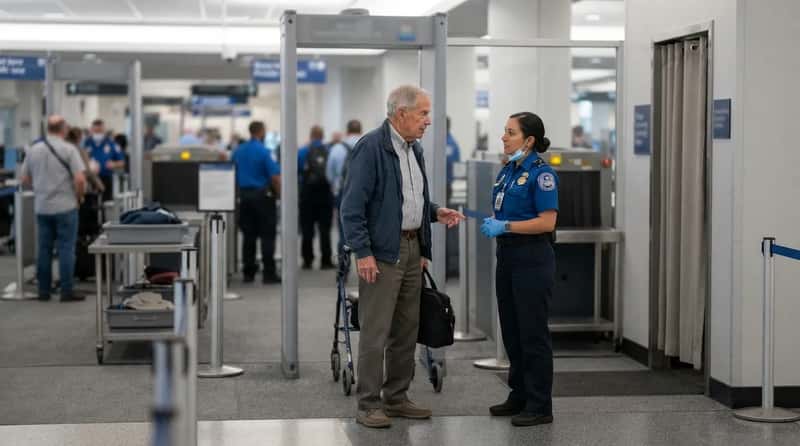
You never have to be patted down in full view of the lane. You only have to ask.
TSA says pat-downs are done by an officer of the same gender, and you may request private screening at any time. That option stays open for the entire screening.
Guidance for older travelers notes that privacy may be preferred for pat-downs involving sensitive areas. You can choose the public area or a private one.
It helps to know why pat-downs happen at all. TSA says they’re used to resolve alarms, as an alternative to scanners, and as an unpredictable security measure.
“Unpredictable” means exactly that. Even a traveler who sails through on most trips can be selected on another.
At a Glance
- Who: An officer of the same gender performs the pat-down.
- Where: Public area or private area, your choice.
- When to ask: Any time during screening.
- Why it happens: To resolve alarms, replace a scanner, or add unpredictability.
That unpredictability is why the next item gets argued over so often, and it involves something you’re wearing right now.
#6 – Taking Off Your Light Jacket
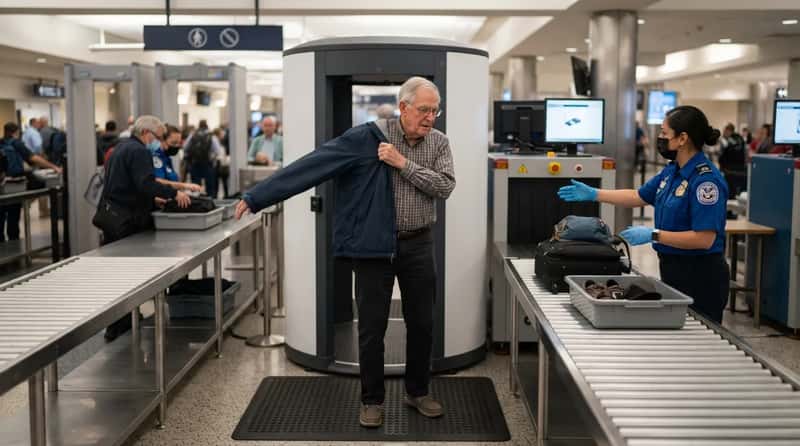
The jacket rule is where the advice turns contradictory. Here’s the honest version.
Older guides say travelers 75 and over can keep shoes and light jackets on. But TSA’s own page for that age group says jacket removal is required for Advanced Imaging Technology screening.
The same TSA page that promises expedited screening also requires the jacket off at the body scanner. Travelers who say they were waved through in a jacket may have gone through a metal detector instead.
PreCheck is different. At PreCheck lanes you don’t remove shoes, laptops, 3-1-1 liquids, light jackets or belts, and there’s no age limit for applying.
The jacket debate is small, though, compared with what happened to the one rule everybody thought they understood.
#5 – Shoe Removal (Now Everyone’s Perk)
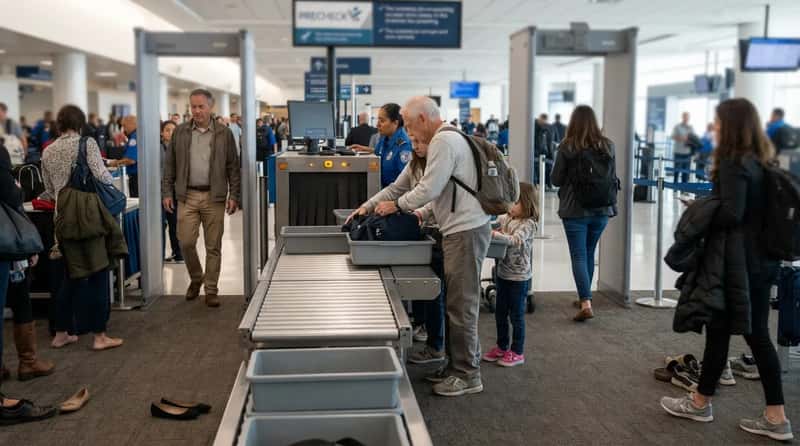
The benefit that once defined the 75-and-over advantage no longer belongs only to them. It now belongs to all of us.
TSA ended its shoe-removal mandate at U.S. checkpoints on July 8, 2025. Children 12 and under and passengers 75 and older had been exempt before, and now everyone can keep shoes on.
The origins go back decades. After the December 2001 shoe-bomb attempt, TSA introduced the shoes-off rule in 2006.
The 75-and-over exemption was tested at four airports starting March 19, 2012: Chicago O’Hare, Denver, Orlando and Portland. Some frequent flyers argue it was always a half-measure, since PreCheck members got far more.
So the headline perk is now universal. The accommodations left are the ones where age 75 and real physical limits still count.
#4 – Standing Through the Entire Screening
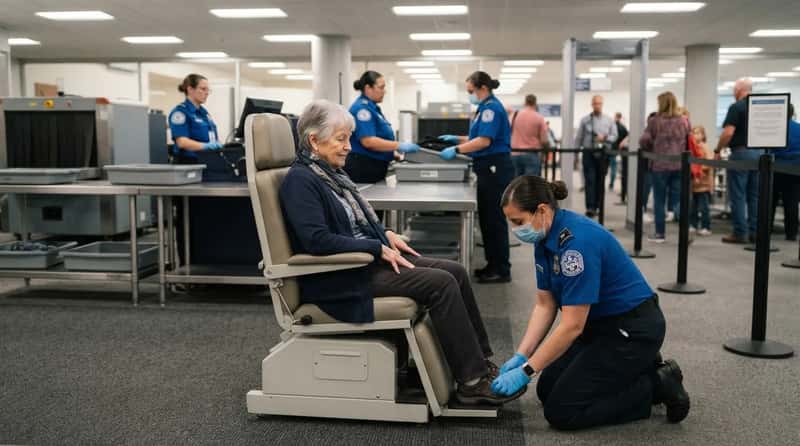
If you can’t stand for screening, you don’t have to. The system has a built-in alternative.
TSA says passengers 75 and older who are unable to stand for screening will be screened through other security methods. Other travelers whose medical conditions prevent standing or walking aren’t required to remove shoes, though their shoes are inspected manually.
That’s a meaningful distinction. Shoes may get a manual inspection instead of a trip through a machine.
Travelers with limited mobility can also request to be seated for at least part of the screening.
- Tell the officer what you can’t do before screening starts.
- Mention limited arm movement too, since scanners require holding a position.
The real complexity starts when a wheelchair or scooter rolls into the lane.
#3 – Getting Out of Your Wheelchair
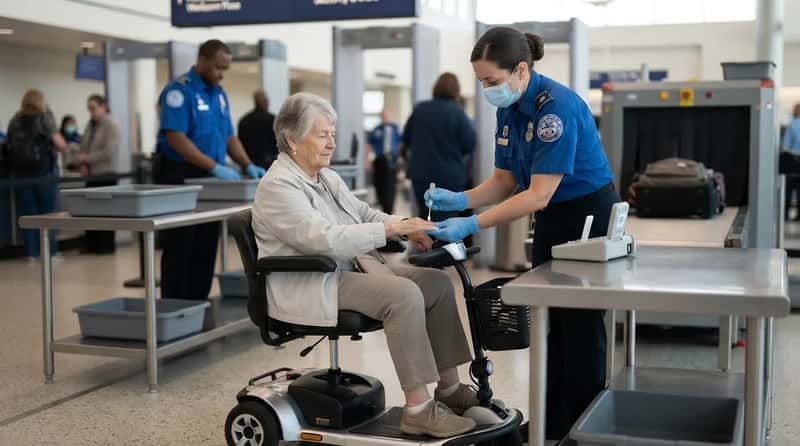
Travelers 75 and older in a wheelchair or scooter get something specific. It’s one of the few perks written explicitly for this age group.
TSA says if you’re 75 or older in a wheelchair or scooter, you may remain seated and the officer will test your hands for traces of explosives. Officers may also check your device and any service animal.
Mobility aids themselves aren’t skipped. TSA requires every scooter, wheelchair, walker or cane to be screened in some way, because unauthorized items have turned up in them.
Bags attached to a mobility device have to come off and go on the X-ray belt. Unclip them before you get to the belt.
Staying seated solves one problem. But one screening step still trips people up, and most never think to ask about it.
#2 – Standing Through a Pat-Down
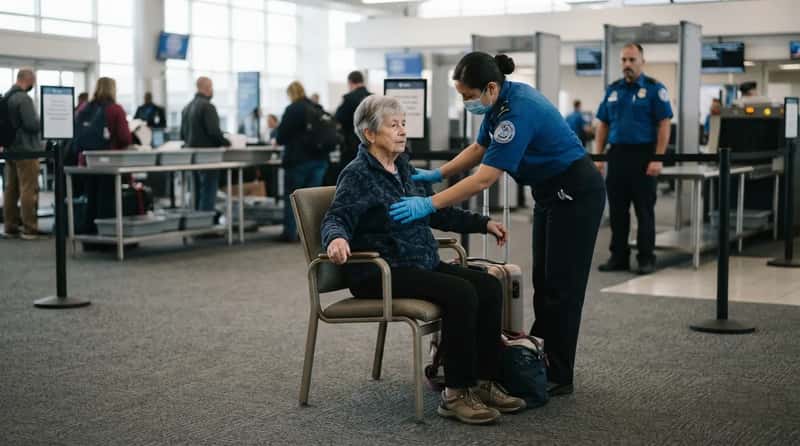
Even when a pat-down happens, you can ask to sit. Many travelers never realize that’s on the table.
If an alarm goes off, you may be asked to remove your shoes or be patted down, and TSA says you can request to be seated during that part. Nobody has to stand through it.
Older-traveler guidance puts it plainly: don’t be afraid to ask to sit down during additional screening. That advice echoes the TSA page.
Ask early, not after you’re already wobbling. Polite, specific requests tend to move faster than long explanations.
But the biggest surprise on this list is what may happen before a pat-down is ever needed.
#1 – The Instant Pat-Down After an Alarm
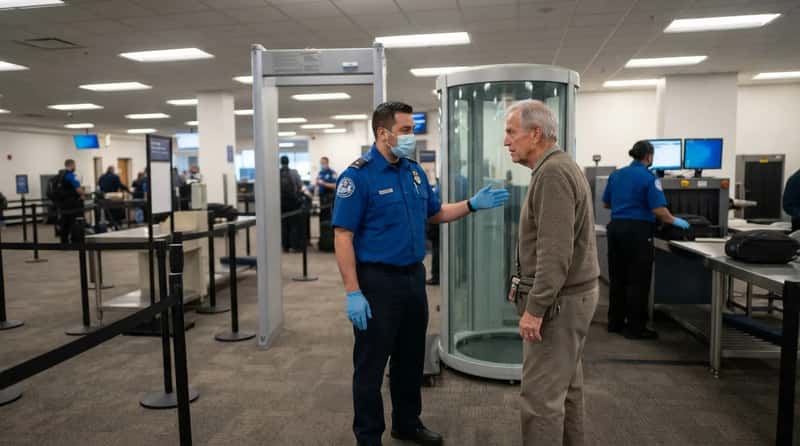
The strongest 75-and-over perk is also the least known. It could spare you the most invasive step of all.
When the program launched as a test, reporting said travelers with anomalies could get a second advanced imaging scan instead of a pat-down. The change was expected to reduce, but not eliminate, pat-downs.
The push came after complaints. Two passengers in their 80s at Kennedy airport said they were effectively strip-searched.
Current secondary guides repeat the benefit. They say seniors who trigger a detector may pass through a second time before a pat-down and shoe removal, but TSA’s page for travelers 75 and older doesn’t spell out the second pass, so treat those guides as reporting, not a guarantee.
Why It Stands Out
- A second scan could replace the most invasive step.
- It grew out of complaints from two passengers in their 80s at Kennedy airport.
- TSA’s 75-and-older page doesn’t spell out the second pass.
- TSA still reserves the right to require a pat-down.
TSA keeps discretion and reserves the right to require a pat-down if anomalies can’t be resolved. Critics of age-based rules argue that any traveler can pose a risk, so the discretion matters more than the cutoff.
So the real perk isn’t a pass. It’s a fairer first chance.
The Bottom Line
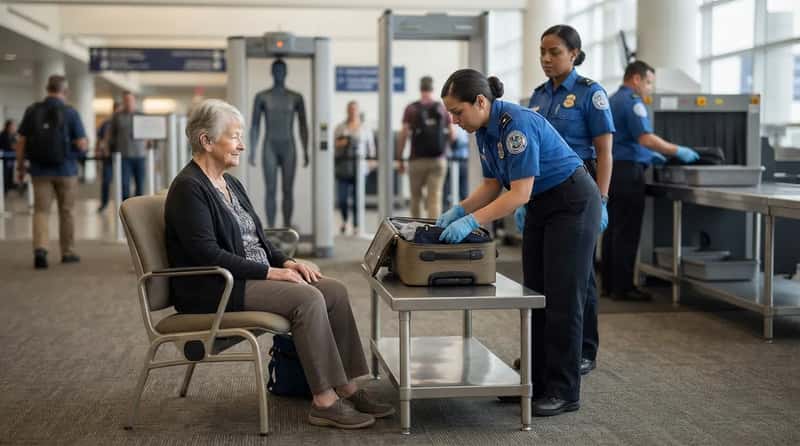
Turning 75 doesn’t unlock a secret fast lane. Shoes-on screening is now available to everyone, and the jacket exemption conflicts with TSA’s own wording for body scanners.
The real 75-and-over perks are seated hand testing, alternative screening if you can’t stand, a seated pat-down request, and reportedly a second scan before a pat-down. Medical accommodations like hearing aids, liquids and implants work at any age.
Which of these surprised you most, and what would you want TSA to change?