Picture Mackinac Island and you probably see fudge shops, flower boxes and carriages clopping down Main Street. Now take all of that away. About 500 people stay on the island year-round, and the place they live in is not a quiet copy of summer. These are the 13 things that catch winter visitors off guard.
Some of the differences are small and almost charming. One is big enough that the island’s winter link to the mainland rests on it, and no official ever signs off on it as safe. The car ban, at least, hasn’t moved an inch, but the road made of Christmas trees is another story.
#13 – The 1898 Car Ban Still Applies, Snow or No Snow
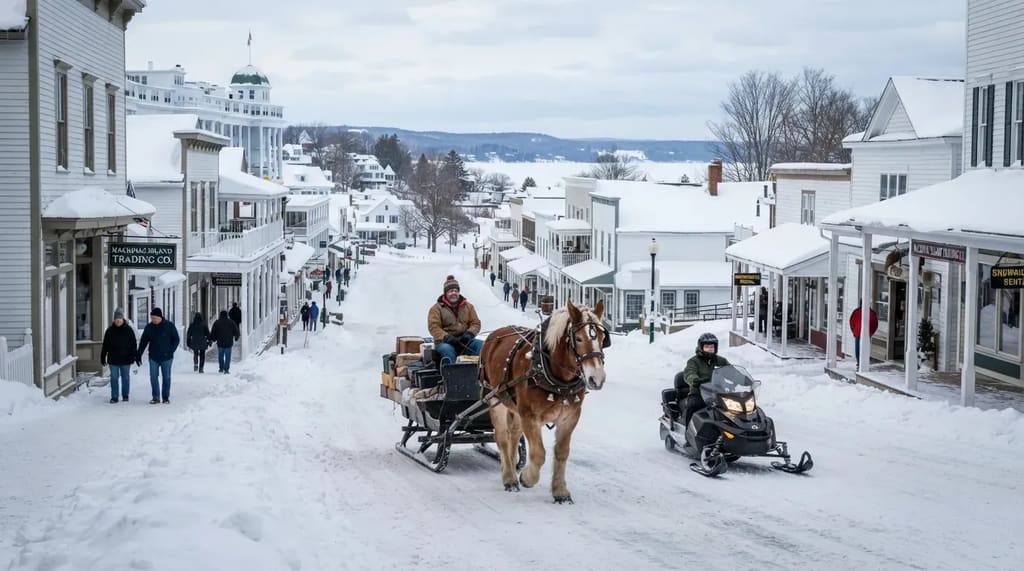
Winter changes almost everything on Mackinac Island except the rule about engines. Village leaders enacted the ban on July 6, 1898, after carriage men petitioned the village council to prohibit “dangerous horseless carriages” that were frightening their horses.1 The state park followed in 1901,2 and the prohibition has held ever since, which makes it more than 125 years old.
The exceptions are short and practical. City emergency vehicles, city service vehicles and snowmobiles in winter are the only motorized vehicles allowed. The island keeps two fire trucks, an ambulance and a police car for emergencies, so even in January a siren is possible, though a passing sedan is not.3 The ban also covers the road that circles the island, and that road holds a distinction no other state highway can claim.
#12 – The Ring Road Is a State Highway With No Cars
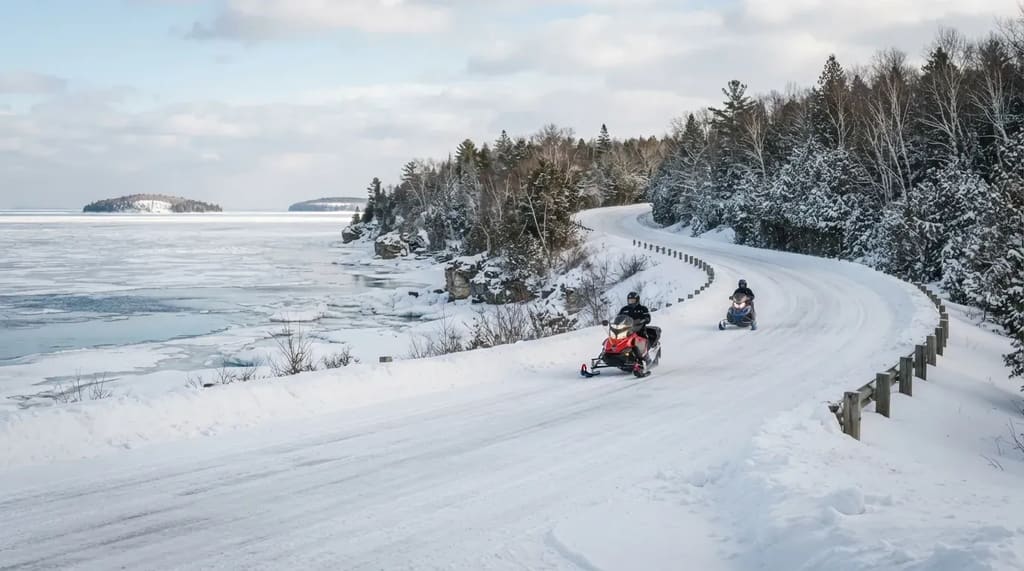
Around the shoreline runs M-185, an 8.2-mile paved loop. It is the only state highway in the country where motor vehicles are not allowed.1 In the busy months its traffic is pedestrians, bicyclists and horse-drawn carriages.
In winter the road changes jobs. When ferry service becomes limited, the highway turns into a snowmobile route, the one exception to the motor ban that covers the whole loop. Eight miles is a long trudge through January snow, which is why the sled exception is the one that makes sense.
Fast Facts
- Length: an 8.2-mile paved loop around the shoreline
- Name: M-185, the only state highway in the country that bans motor vehicles
- Summer traffic: pedestrians, bicyclists and horse-drawn carriages
- Winter traffic: snowmobiles, once ferry service becomes limited
#11 – Snowmobiles Replace Bicycles, and You Can’t Rent One
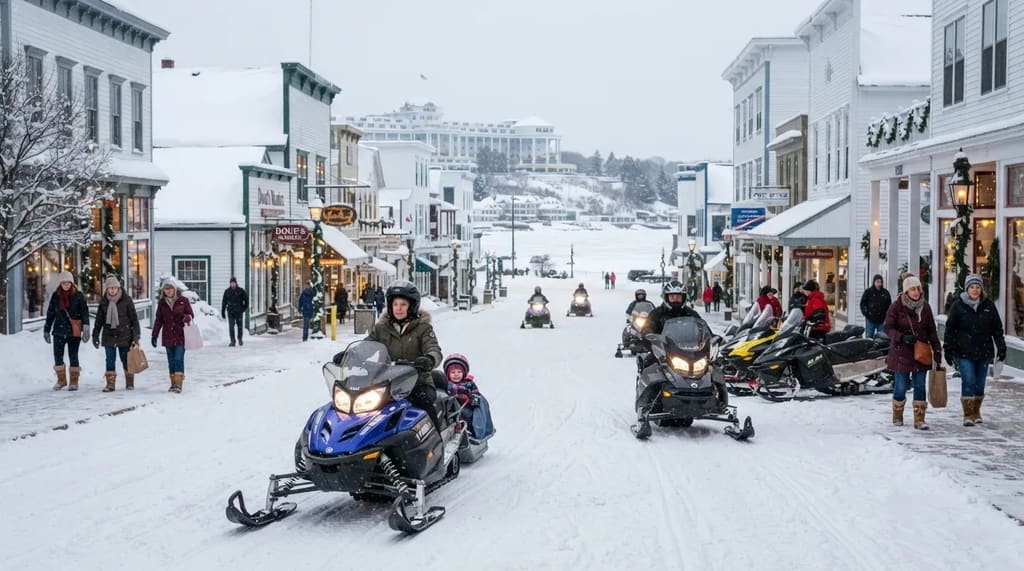
When the bikes are put away, residents switch to snowmobiles for school drop-offs, groceries, mail and errands. One account of winter life says residents may use them from November 15 to April 15, which lines up with the snow season it describes. The island’s school run, in other words, can happen on a sled.
Visitors hit a wall here. There are no snowmobile rentals on the island, so you have to bring your own. Once the ferry stops running, there is no way to get one across unless the ice bridge has formed. If you were picturing an afternoon on a rented machine, plan on warm boots and a lot of walking instead.
#10 – Most Carriage Horses Spend the Winter on the Mainland
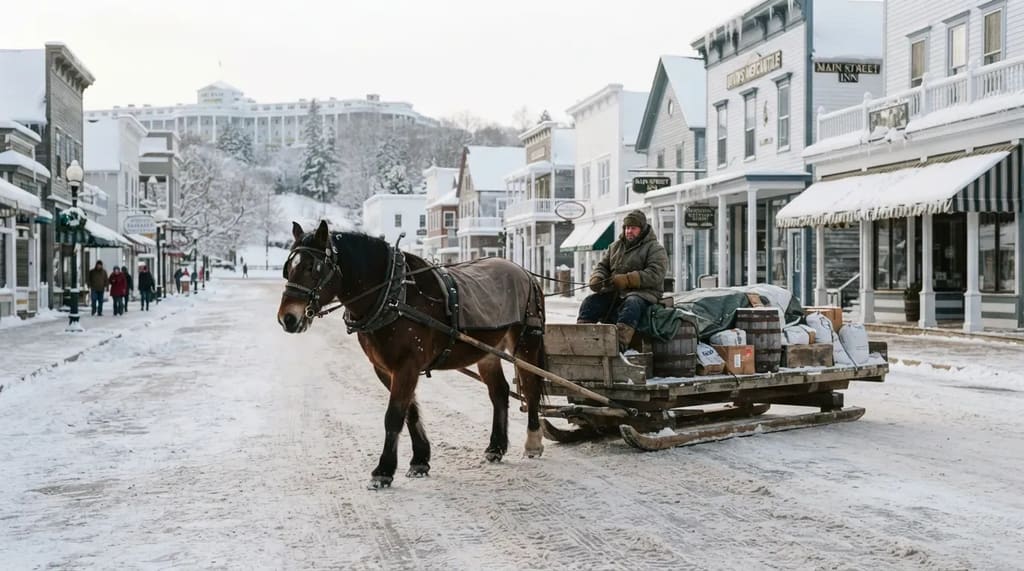
More than 500 horses work on the island in summer. As autumn approaches, many of them are ferried off to winter pastures on the mainland, while a smaller number remain through winter for essential services. The postcard scene of a carriage on Main Street is mostly a summer one.
The horses that stay still work for a living. Horse-drawn drays deliver items across the island year-round. People move by sled and heavy loads move by hoof, so the winter streets are quieter without being entirely free of horses.
With the horses thinned out and the crowds gone, the village center is left with a stillness it never has in July.
#9 – Main Street Goes Quiet and the Grand Hotel Locks Up
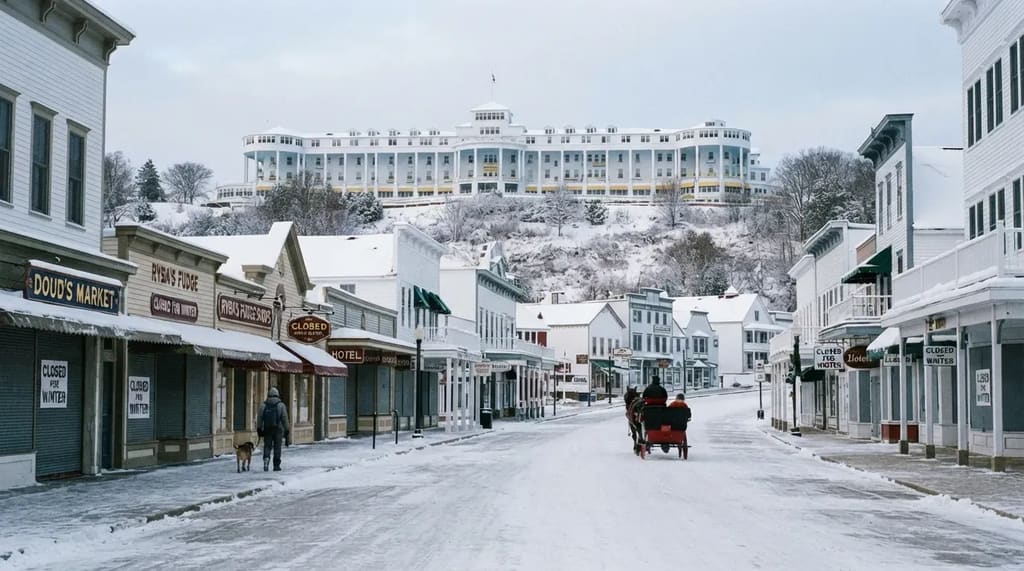
In winter the population shrinks from thousands of seasonal workers and visitors to roughly 500 permanent residents. Most hotels, restaurants, attractions and transportation services close at the end of the fall season, and the Grand Hotel closes entirely for the winter. A street that is jammed with bikes in August can be almost empty on a January afternoon.
Not everything shuts. A couple of stores, restaurants and hotels stay open for tourists and for locals who stay year-round. Older Michigan newspaper coverage described many hotels and bars reopening the week between Christmas and New Year’s, but openings change from year to year, so don’t count on that pattern holding.
The people who do stay are not sitting idle, because a town of 500 makes its own calendar.
#8 – Islanders Make Their Own Winter Calendar
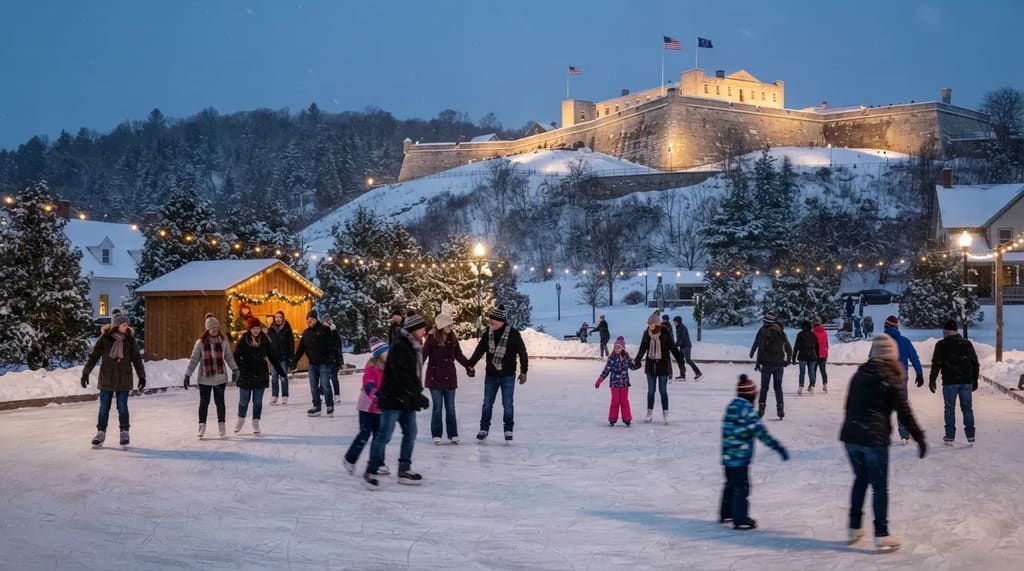
With so few residents, many of them get together through the winter for game nights and community gatherings. Past winters have included a winter festival in early February. Arnold Transit’s winter schedule has also noted a tree lighting and a Christmas bazaar in early December,4 so the holiday season has its own local rhythm.
Outdoors, the pastimes are modest. When most tourists leave, the trails are used for cross-country skiing, and an ice skating rink sits near Fort Mackinac. These are neighborhood pleasures, built for the people who live there, and a visitor is lucky to land in the middle of one.
Worth Knowing
- Indoors: game nights and community gatherings fill the quiet months
- Early December: a tree lighting and Christmas bazaar have appeared on the ferry line’s winter schedule
- Early February: a winter festival has been held in past winters
- Outdoors: cross-country skiing on the trails and a skating rink near Fort Mackinac
#7 – The Ferry Runs a Shrinking Winter Schedule
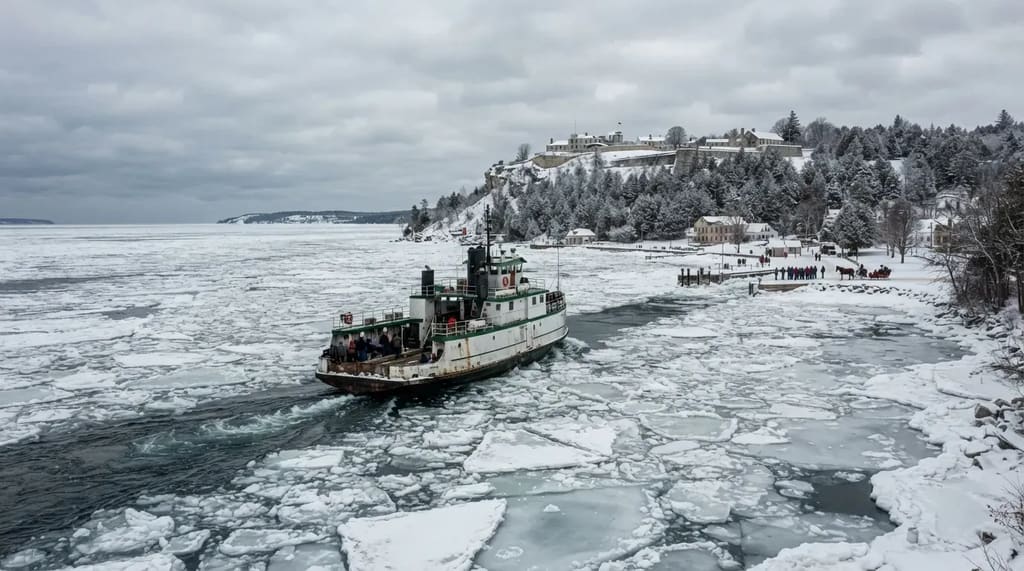
Arnold Transit Company’s 2025-26 winter ferry service ran from November 1, 2025 to April 20, 2026, and its posted schedule thins as the season goes.5 Early November lists five departures a day from St. Ignace, and from mid-November it is four. The earliest run does not operate on Sundays, and Thanksgiving Day drops to two departures each way.4
Even that is not a guarantee. The boats stop when the Straits ice over, typically in January, though in at least one winter service stopped the first week of February. A winter ferry plan needs a fallback for the day the boats don’t run.
A crossing by air is the fallback once the water freezes, though it depends on a different kind of weather.
#6 – Small Planes Become the Lifeline, Until the Fog Rolls In
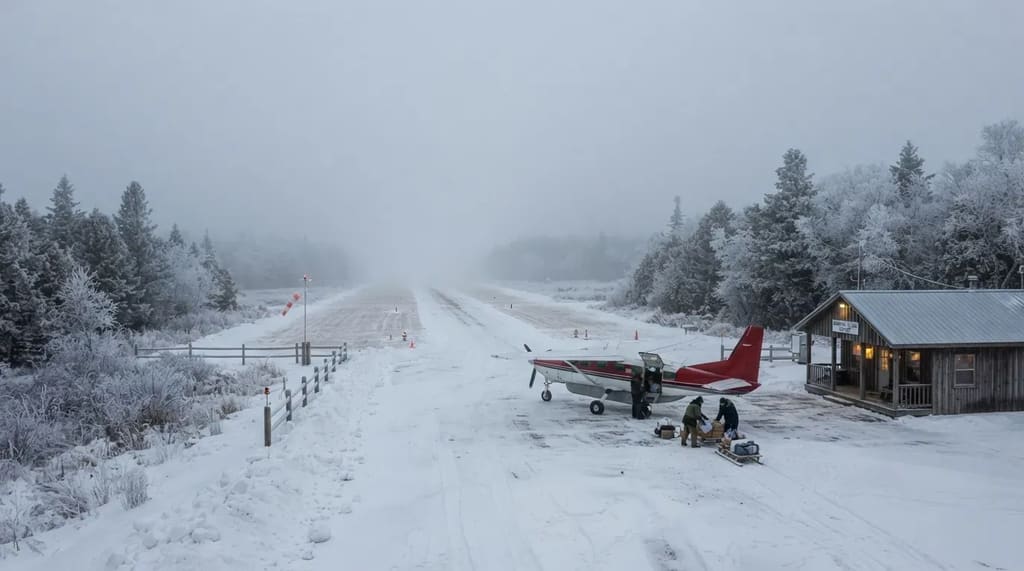
When the Straits are frozen and the ice bridge hasn’t formed, flying is the way in. According to one account of winter life, groceries and mail arrive by small plane from St. Ignace. The airport itself is modest. It started as a grass strip in 1934, and there is no fuel available there.
Weather can ground even that. It is sometimes too foggy for the planes to fly, and one visitor described a stretch when no ice bridge and a low ceiling left the island cut off. Service has also changed: Great Lakes Air, which long served the airport, ceased operations in 2022. Find out which operators fly now before you build a winter plan around a plane.
Families with school-age children live through those outages, which is why the basics on the island don’t close.
#5 – A School, a Grocery Store and a Clinic Never Close
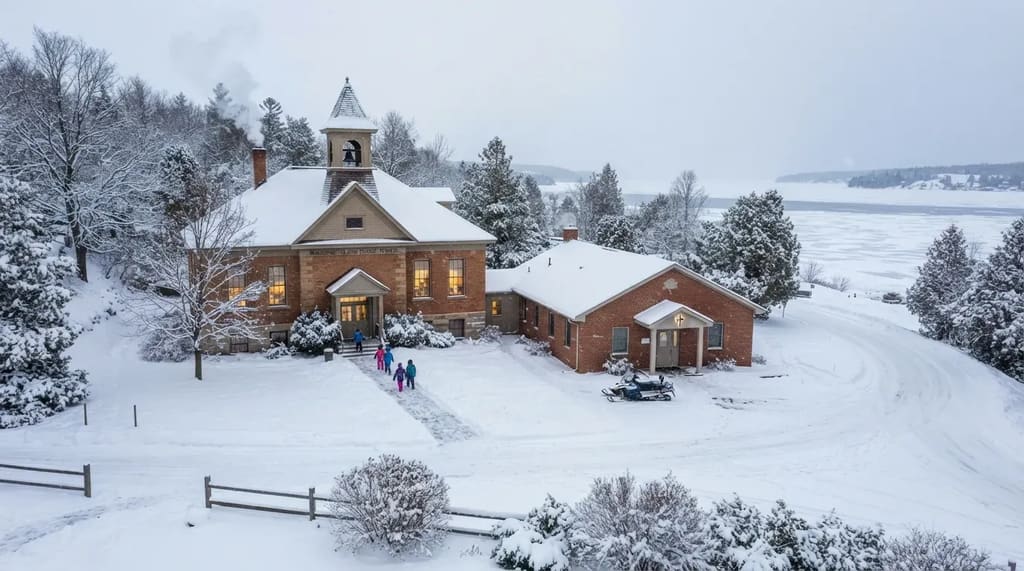
Mackinac Island Public School operates through the winter with fewer than 70 students across all grades.6 A grocery store, a medical clinic and the school stay open during the cold months. The Mackinac Island Medical Center provides year-round healthcare,6 and patients who need urgent care can be transported quickly.
That short list is what makes the winter population a community rather than a caretaker crew. Residents include families, essential service workers, business owners, municipal employees and people with deep generational ties to the island. For about 500 people, that is a lot to keep running when boats and planes can’t always reach them.
At a Glance
- Population: about 500 year-round residents
- School: Mackinac Island Public School, with fewer than 70 students in all grades
- Health: the Mackinac Island Medical Center offers year-round care
- Groceries: a grocery store stays open through the cold months
#4 – The Ice Bridge Doesn’t Always Show Up
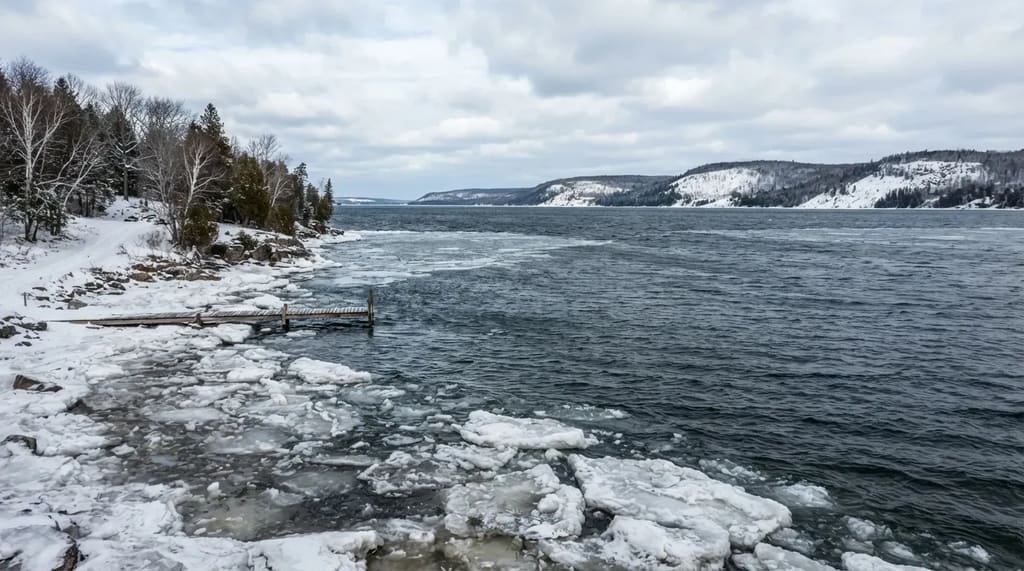
The ice bridge is the winter feature people hear about most, and it is the least dependable. It may last months, days, or not form at all. In 2021, one visitor reported that the lake didn’t freeze, so there was no ice bridge from British Landing to the mainland.
The cause is weather. The bridge depends on a run of deep cold that is becoming less reliable. A historical marker on the island explains that bitter cold and calm winds in January combine to form a solid sheet of ice.7 A mild winter can mean no ice at all, and a rough one can mean a long season.
Where it does form, it follows a route with a history far older than the snowmobile.
#3 – Oxen and Dogsleds Crossed the Same Ice Long Before Snowmobiles
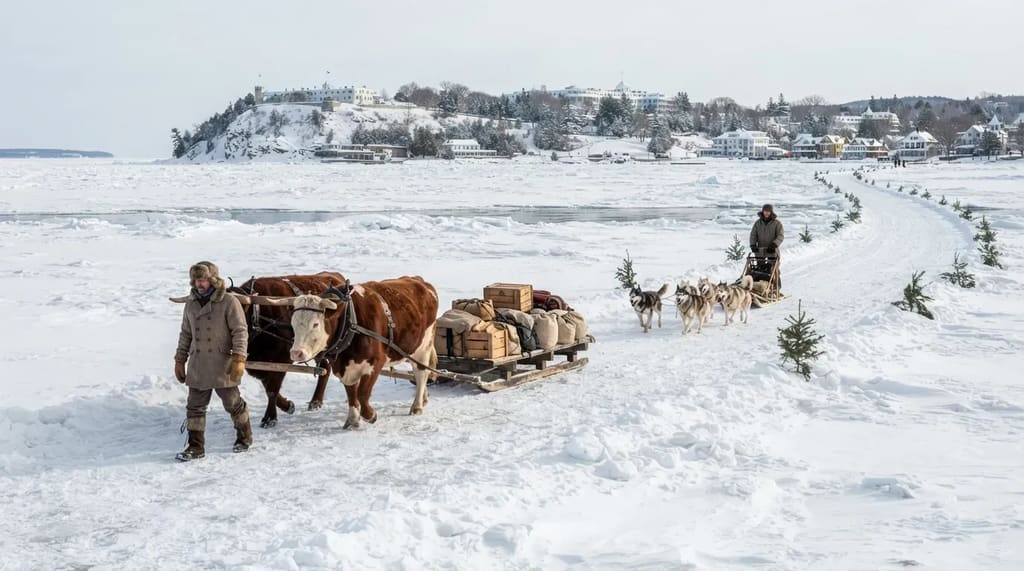
A historical marker on the island, erected by Mackinac Associates and Mackinac State Historic Parks, says British soldiers used teams of oxen to haul men and materials across the ice when they moved Fort Michilimackinac to the island. The marker adds that in the later 1800s the weekly mail was brought by dogsled. Crossing the frozen Straits is an old habit here, not a modern stunt.
Related Stories From Travelbinger

Today it still carries much of the load. When the Straits freeze enough, the route is the primary link for mail, supplies, medical trips and anybody who needs to leave. The vehicles have changed from oxen to snowmobiles, but the job is the same one the ice has always done for the island.
Quick Compare
- Fort move: British soldiers used oxen teams to haul men and materials
- Later 1800s: the weekly mail arrived by dogsled
- Today: snowmobiles carry mail, supplies and medical trips across the same frozen Straits
#2 – Discarded Christmas Trees Mark the Road Across the Straits
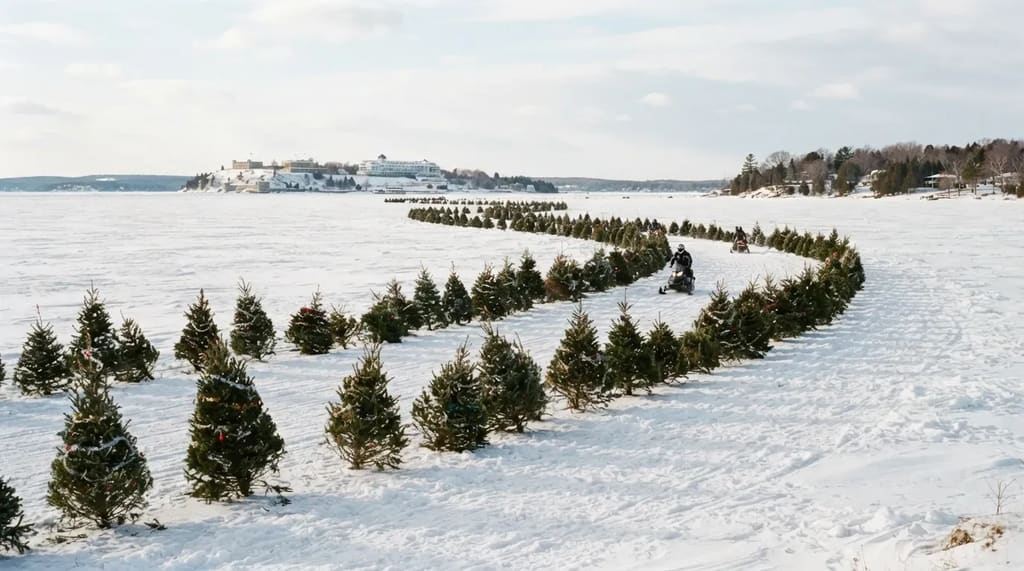
When the ice is ready, people from both shores plant a line of discarded Christmas trees across the lake. Locals on both sides monitor the ice and set the trees along the thickest line.6 The trees are the only waymarking there is, so the island’s most important winter road is signed with last month’s holiday decorations.
The route starts at British Landing on the island side and ends at St. Ignace. Once it is marked, it becomes a busy highway for island snowmobilers, skiers and walkers.7 From shore, a line of evergreens across a white lake looks almost decorative, but it is working as the island’s road sign.
A line of trees shows where people have judged the ice to be thickest, which is a different thing from anyone declaring it safe.
#1 – No Authority Ever Declares the Ice Bridge Safe
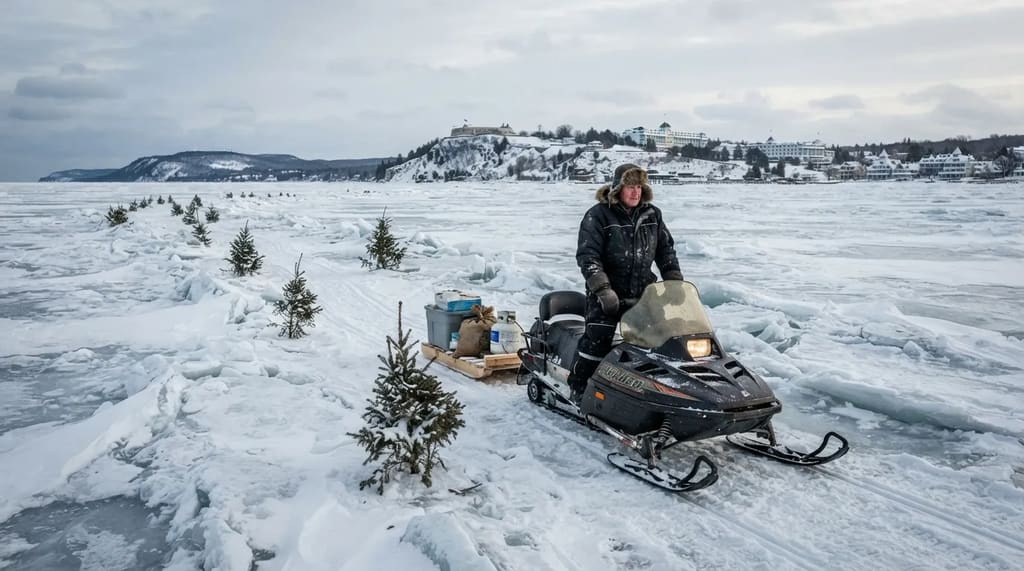
No authority certifies the ice bridge,6 and the language used about it locally is careful. It is never considered officially safe, and ice thickness and stability vary daily. The island’s main winter link for mail, supplies and medical trips rests on neighbors’ judgment calls rather than on inspections.
Visitors can cross as guests of residents, but the bridge exists because islanders need it, not because anybody is selling tickets. Locals who rely on it seem reluctant to promote it to snowmobilers and tourists. If the idea tempts you, that reluctance tells you what the people who know the ice think of it.
If you ever plan a winter visit, treat the getting-there as part of the trip. Check which boats and planes are running on your dates, call ahead to the places you want to see, and keep a day of slack for fog or ice. In these months the island is not set up around your schedule, and the people who live there know it.
Maybe that is the real surprise. The summer island is a postcard, but the winter island is a town of neighbors holding it together with sleds, horses, small planes and a row of used Christmas trees.
- Mackinac Island Tourism Bureau Car-Free History: https://www.mackinacisland.org/blog/post/why-there-are-no-cars-on-mackinac-island/
- Northern Michigan History Ban: https://northernmichiganhistory.com/mackinac-island-bans-automobiles/
- Mackinac Emergency Vehicles Guide: https://www.mackinacisland.org/blog/post/mackinac-island-police-car-fire-truck-and-ambulance-oh-my/
- Arnold Transit Winter Schedule: https://www.arnoldtransitcompany.com/winter-schedule/
- Arnold Transit Winter Service: https://www.arnoldtransitcompany.com/winter/
- WorldAtlas Mackinac Winter: https://www.worldatlas.com/places/what-happens-to-mackinac-island-when-the-ferries-stop-for-winter.html
- Ice Bridge Historical Marker: https://www.hmdb.org/m.asp?m=131769