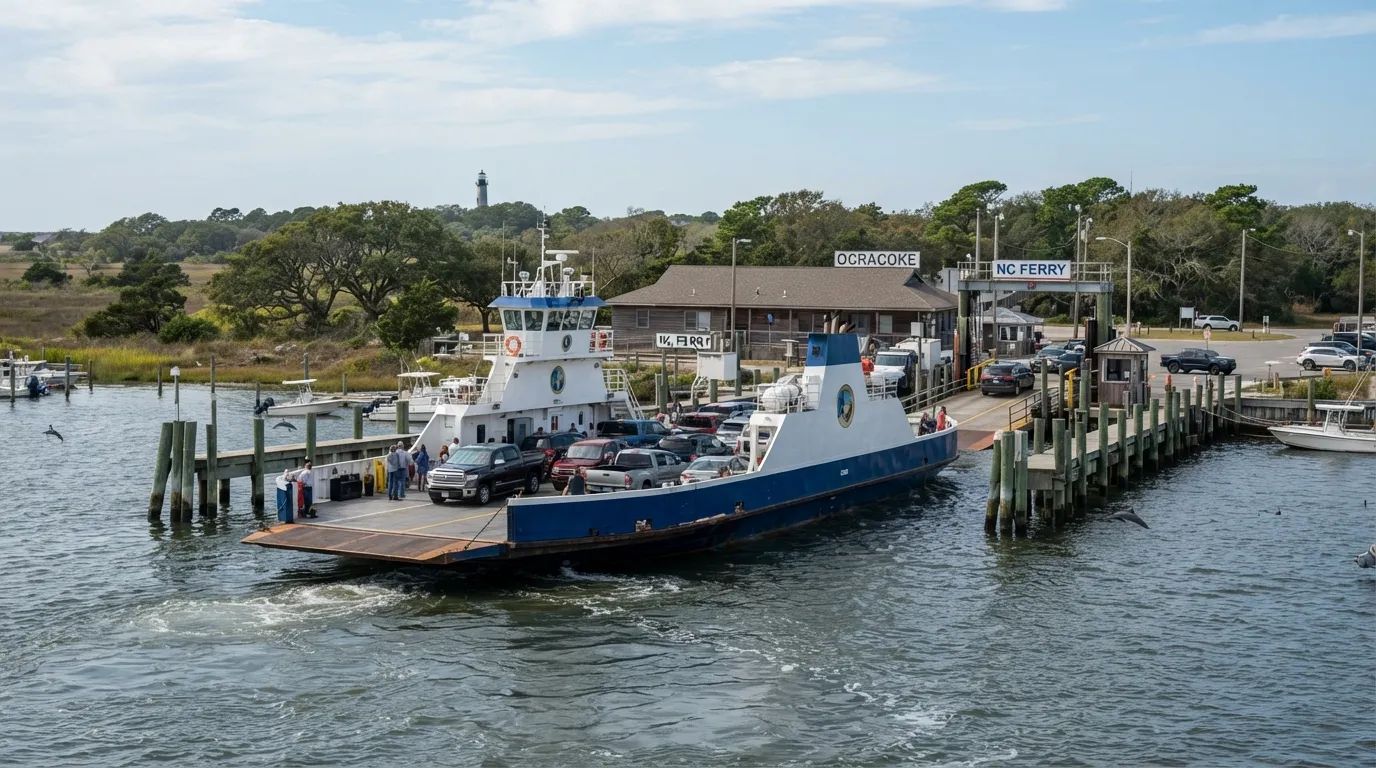
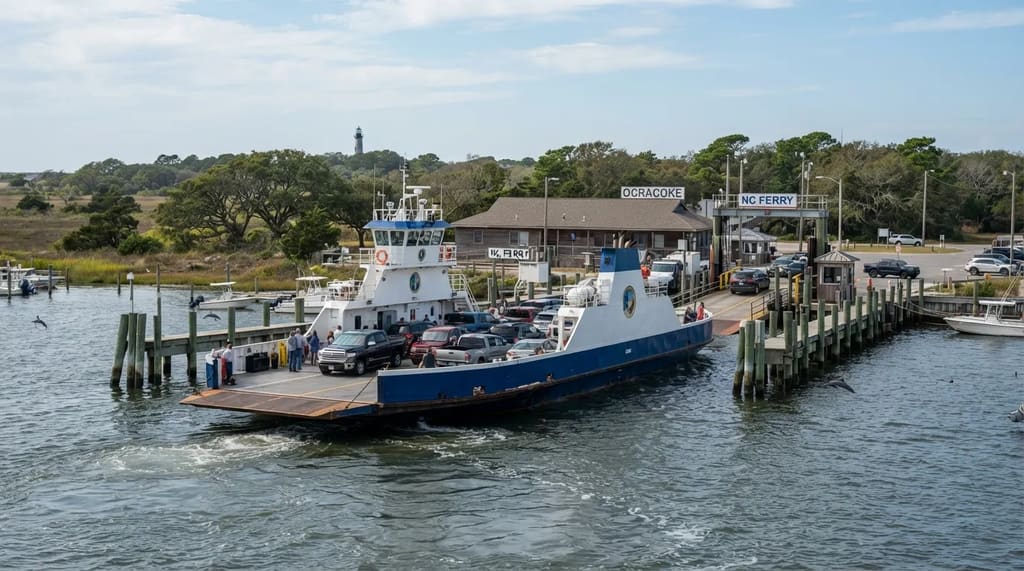
Yes, the ferry from Hatteras to Ocracoke Island is still free for vehicles, through December 31, 2026, after nearly 70 years of free rides.1 That makes it a rare Outer Banks bargain: your car, a boat, open water and no fare to pay at the dock.
But free is the only simple part of this trip. The landing is not where most first-timers expect it, the line plays by its own rules, and this fall the roads on both sides of the water were hit hard enough to shut the crossing down. Start with the ramp, because it sits a lot farther from the village than the postcards suggest.
#9 – The Ferry Lands 13 Miles From Ocracoke Village
The vehicle ferry leaves from the southern end of N.C. 12 at Hatteras village and crosses Hatteras Inlet to a dock on the north end of Ocracoke Island. That dock is about 13 miles from the village itself. Anyone picturing a landing right beside the harbor gets a long island road instead.
You need your own transportation, either a car or a bicycle, to make the trip. Thirteen miles is a serious ride on two wheels and not a walk at all.
Ocracoke has no bridge, and the only ways on are by boat or small plane, so every visit starts with a ferry of some kind.1 The trip home works the same way in reverse.
If you are already on Ocracoke and want to reach Hatteras, you have to drive up to the north end of the island to catch the boat. Give that drive its own slot in the day, especially on your last evening. Once you reach the dock, boarding depends on a line with no reservation system behind it.
#8 – The Free Boat Takes No Reservations at All
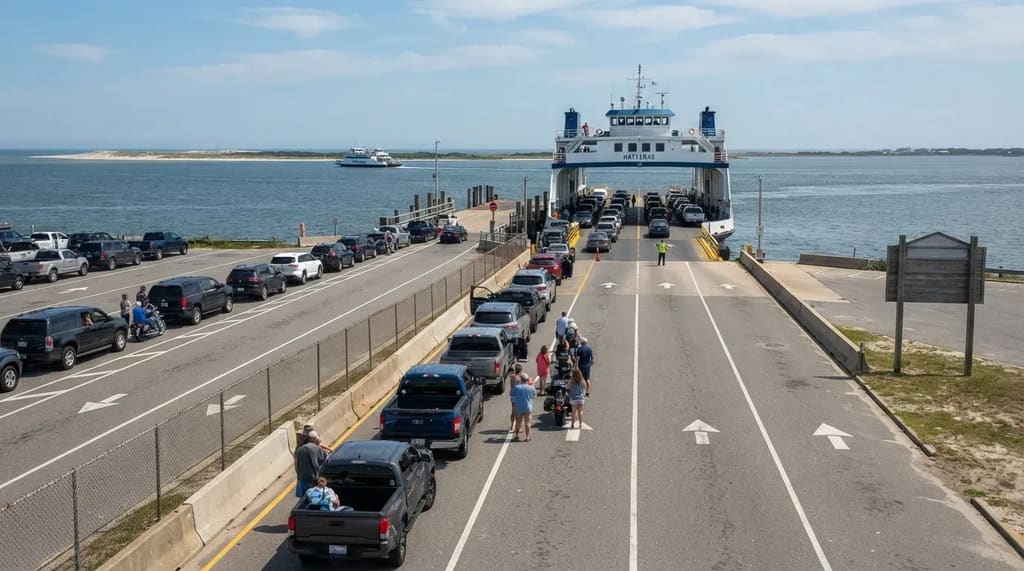
The Hatteras-Ocracoke vehicle ferry is a free, first-come, first-served route that neither requires nor accepts reservations.2 The booking system the state advertises belongs to other routes. The Ferry Division takes reservations up to 90 days ahead for the Cedar Island-Ocracoke and Swan Quarter-Ocracoke ferries.2
So a call to 1-800-BY-FERRY will not hold you a spot on the Hatteras boat. Your place is simply wherever you sit in the line.
At a Glance
- Route: Hatteras to the north end of Ocracoke
- Cost through Dec. 31, 2026: free for vehicles
- Booking: none, first come, first served
- Reservations (up to 90 days out): Cedar Island and Swan Quarter routes only
Residents and personnel with priority passes are allowed to board first, which means the order you see in the lanes is not always the order the cars load.3 If you have a hard deadline on the island, such as a check-in cutoff or a dinner you cannot move, build in a cushion.
A boat that takes no bookings cannot promise anyone a seat. And once you are aboard, the ride has its own uncertainty, because it crosses water where the sand does not stay put.
#7 – The 70-Minute Crossing Depends on Shifting Sand
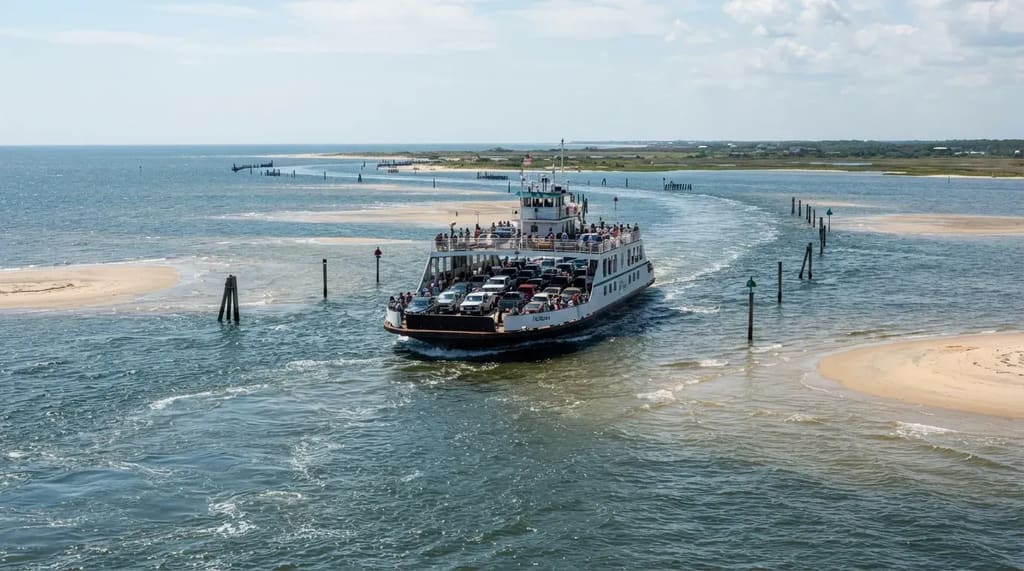
NCDOT’s figure for the Hatteras-Ocracoke ferry is about 70 minutes, although some local guides list the crossing at 60 minutes. Plan on the longer number, because the boats follow channels through water that keeps changing.
Studies shared at a 2025 Ocracoke community meeting cited inlet shoaling, shoreline retreat and rising water levels as problems that continue to compromise ferry access. Shoaling simply means sand building up where boats need deep water.
Keeping the inlet open is ongoing work, and winter dredging projects have been used to keep it navigable. That is why a printed crossing time is best read as a planning number and not a promise, particularly on a day with a deadline at the other end.
Add margin for the ride and the line together. Then check how many boats are actually running, because that changes with the calendar.
#6 – Fifty-Two Departures a Day, and Times That Change by Season
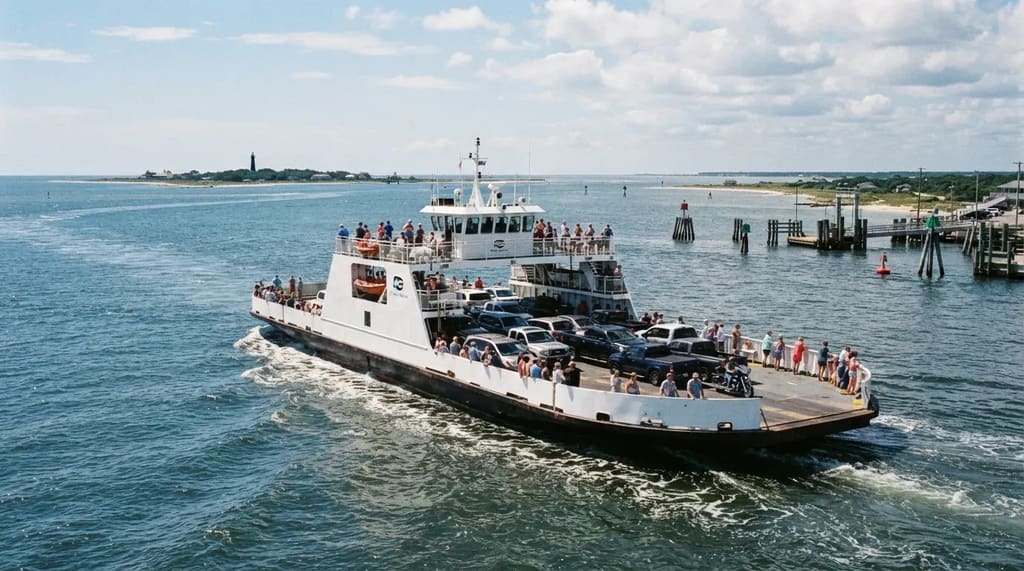
The free vehicle route runs 52 scheduled departures daily between Hatteras and the north end of Ocracoke Island.4 Fifty-two sounds like a boat every few minutes, but that count is spread across a whole day.
Departure times change seasonally, so a timetable you remember from a July trip is a poor guide for a February one. Read the posted schedule for your travel date, and check the column for the end of the crossing where you will be standing, since Hatteras and Ocracoke departures are listed separately.
Ferry operations depend on weather and marine conditions, and schedules may change. A printed timetable is therefore a plan, and the alerts are what tell you when the plan has fallen apart.
Even a full day of departures does not empty the dock on a July weekend. On those days, the real schedule is the length of the line.
#5 – Summer Lines That Can Stretch Past Two Hours
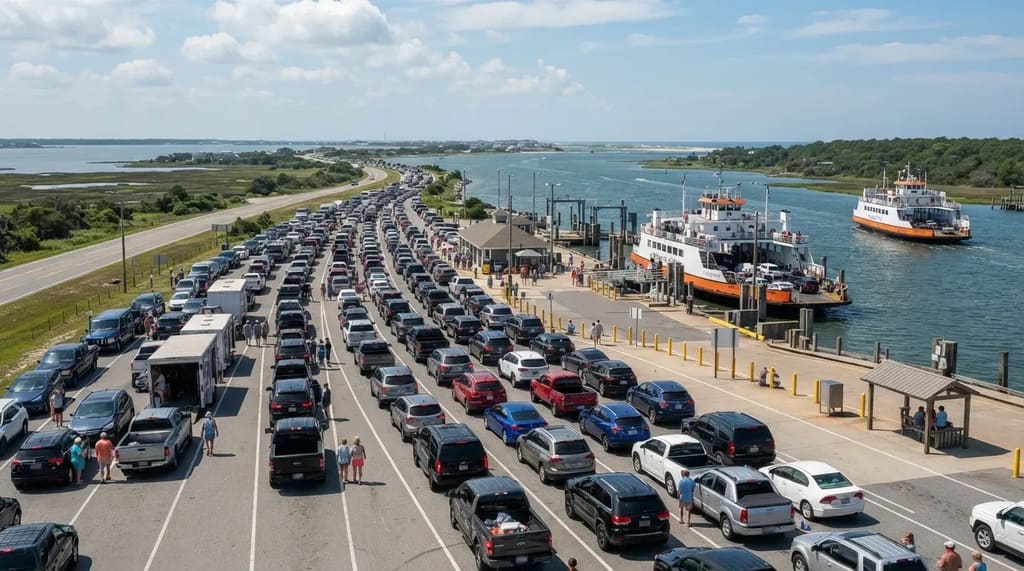
The Outer Banks Chamber of Commerce calls it the busiest route in the state and notes that it runs first come, first served with no reservations, so you should expect lines on summer days.1 Local guides put typical summer waits at one to two hours, and one describes the wait at the Hatteras terminal as 2+ hours each way in peak season.
When the state budget reached the governor’s desk in early July, dozens of drivers were waiting in line to board on a Thursday, according to WTKR.
Worth Knowing
- The state’s busiest ferry route, per the Outer Banks Chamber of Commerce
- Typical summer waits: one to two hours, per local guides
- Peak-season waits at Hatteras: reported at 2+ hours each way
- Best bets: the earliest morning boat or the last evening run
The cheapest fix costs nothing: aim for the earliest morning ferry or the last evening run. Midday on a summer Saturday is the worst place to put a deadline, whether it is a checkout or a flight.
If you are traveling without a car, you can skip the queue entirely. A separate boat built for walk-on passengers lands in the middle of the village, and it is the one boat on this crossing that already charges a fare.
#4 – The Boat That Skips the Line Charges a Fare
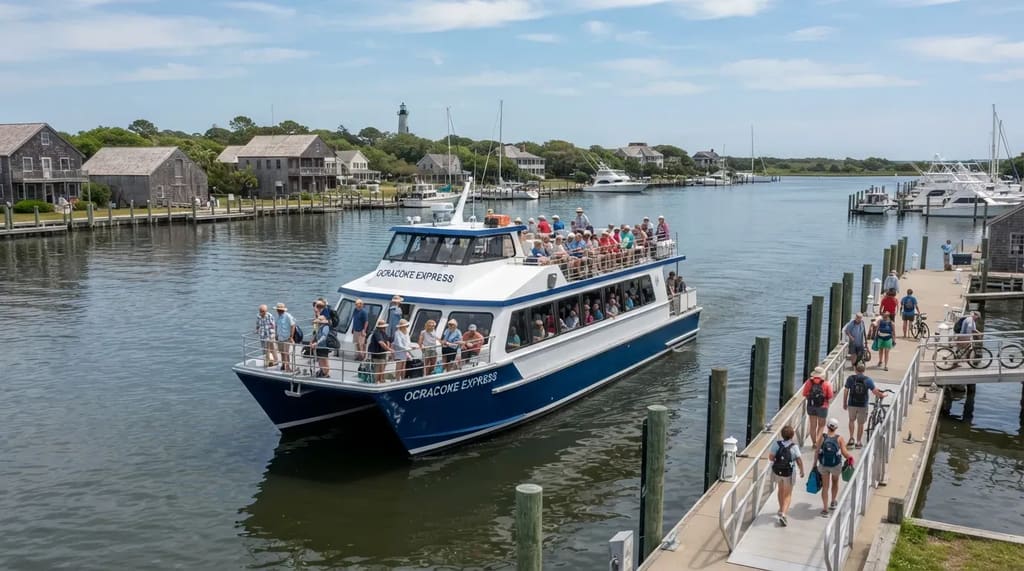
The Ocracoke Express carries up to 129 passengers directly between Hatteras and Silver Lake Harbor in Ocracoke Village, a 70-minute ride that lets you bypass the vehicle lines.4 That matches the car ferry’s running time, but you land in town instead of 13 miles up the island.
In 2026 the fare was $15 round trip per person, children 3 and under rode free, and a bicycle cost $1.5
Reservations are recommended but not required, and without one you must check in at least 20 minutes before departure. The schedule thins out on some days, since Fridays, Saturdays and Mondays have three departures from Hatteras, and there is no service on Sundays.
Once you land, you can walk, rent bicycles or golf carts, or ride Hyde County’s free Ocracoke Village Tram.5 For a couple without much gear, this boat beats two hours in the queue. A family hauling chairs and coolers will probably still want the car.
There is one catch. The 2026 season ran only from May 5 to Sept. 7,5 so the rest of the year the vehicle ferry is the only crossing from Hatteras, and it depends on a road that the ocean does not always leave alone.
#3 – A Road That Closes the Ferry When the Ocean Walks In
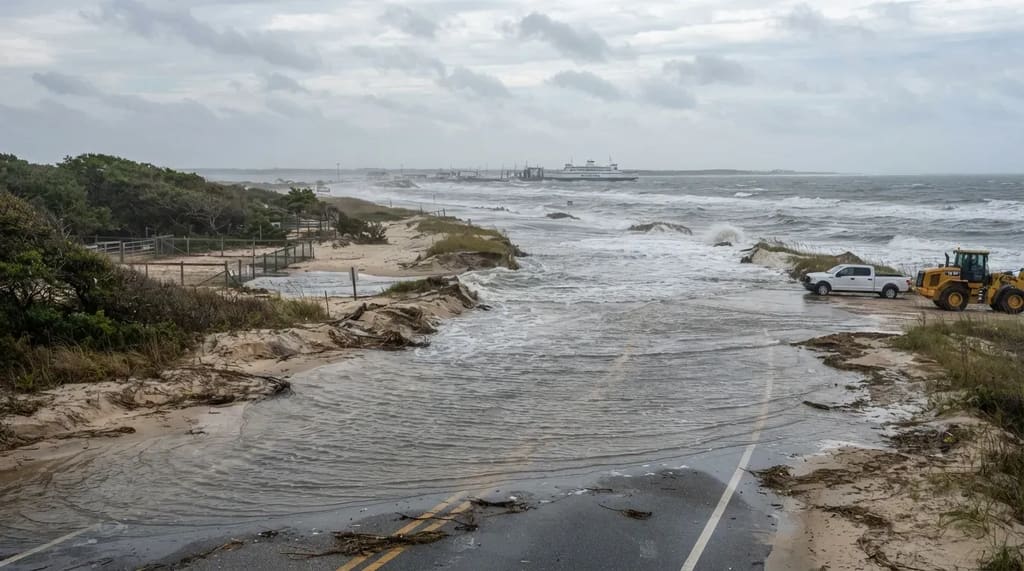
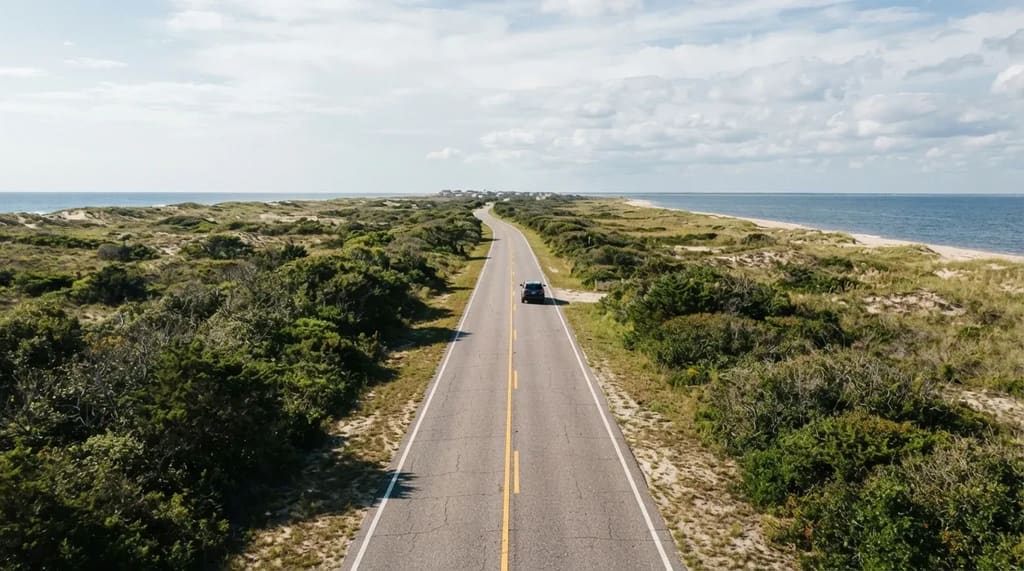
N.C. 12 is Ocracoke Island’s only roadway, and the ferry cannot run normally when the ocean has covered it. In late September 2026, overwash closed the highway between the Pony Pens and the ferry terminal, and regular Hatteras-Ocracoke service was suspended.
Ferry Division vessels carried NCDOT equipment to Ocracoke to help clear the highway. The road reopened at 1:30 p.m. on Sunday, Sept. 27, and ferries resumed on a limited schedule.
This was not a one-time event. That stretch of highway has needed frequent maintenance in recent years, with crews rebuilding dunes, installing sandbags and repairing pavement damaged by ocean flooding. Officials have noted that sandbags provide only temporary relief.
After a second round of storms, limited service on the Hatteras-Ocracoke route resumed on a Wednesday afternoon in late October. On Oct. 24 the Hatteras Inlet ferry was running a reduced schedule, while the Swan Quarter and Cedar Island ferries kept normal schedules.
#2 – The Highway to the Hatteras Dock Failed Twice This Fall
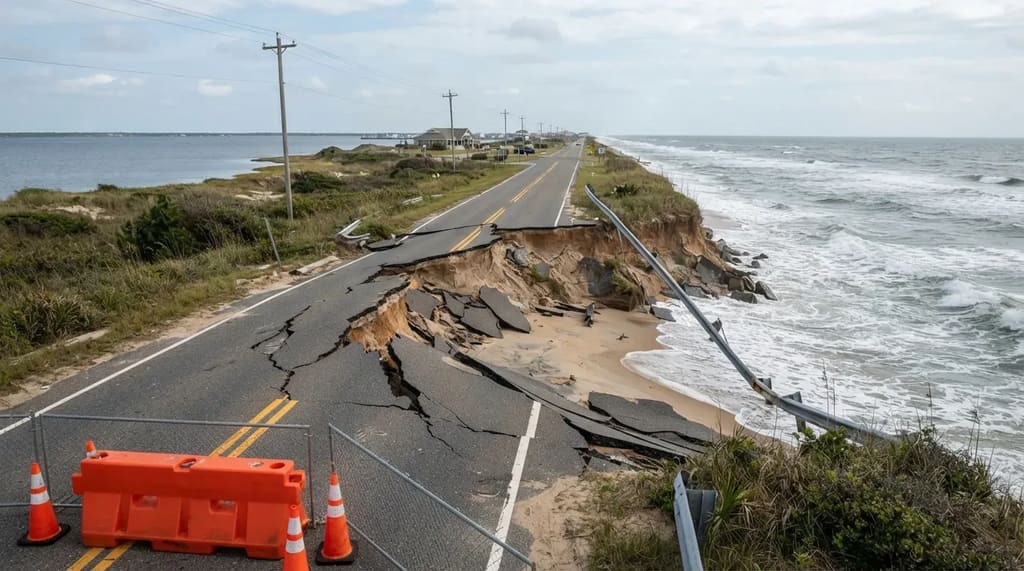
The Ocracoke ferry begins at the Hatteras dock, and reaching it means driving N.C. 12 down Hatteras Island, which has its own weak spot. In late September, extensive damage to N.C. 12 on Pea Island left Hatteras Island cut off from the mainland.
Emergency ferry service began between Rodanthe and Stumpy Point, a crossing of about two hours with limited capacity.6 That emergency route had last been activated in 2013. In one report, up to 400 vehicles were waiting to leave Hatteras Island through the Rodanthe terminal.
Related Stories From Travelbinger
The road was repaired, then failed again. High tide overnight on Oct. 20 undermined and buckled the northbound lane near the Pea Island Visitor Center, on the same stretch a nor’easter had damaged in late September and crews had repaved.
NCDOT reported about 800 feet of pavement damage in the closure area.6 High tides were expected to keep crews from starting repairs, and no reopening date had been announced as of Oct. 24. Dare County’s state of emergency kept visitors from entering Hatteras Island at that point.
Fast Facts
- Where it failed: N.C. 12 on Pea Island, near the Visitor Center
- Damage reported: about 800 feet of pavement
- Emergency route: Rodanthe to Stumpy Point, about two hours
- Last time that route was activated before this fall: 2013
- Cars reportedly waiting at one point: up to 400
A trip that crosses Pea Island to reach the ferry is really two trips, and the first one is the shakier. Check NCDOT for the current road status before you set out.
#1 – The Free Ride Ends January 1 and Costs $10
The budget signed into law on July 7 requires the Ferry Division to begin collecting fares on all state-operated ferry routes by Jan. 1, 2027. That ends the free service on a route where, in the legislation’s words as reported locally, vehicles have crossed free for nearly 70 years.
On Nov. 5, the Board of Transportation approved a toll of $10 one way for a standard vehicle in a single space on the Hatteras-Ocracoke route.7 8 A car making a round trip will pay $20.
That is lower than the $15 one-way toll on the Cedar Island and Swan Quarter routes.7 The toll also changes the math against the passenger boat. At 2026 Express fares of $15 round trip per person, three adults would pay $45, compared with $20 for the car, so the Express is not the cheaper choice for a group.
Until Dec. 31 the car ferry costs nothing, which makes the last day of the year the final free crossing. For most visitors the toll will be a new line in the trip budget and not a reason to cancel, since the hour spent in a summer queue was always the bigger cost.
For most of its history this ferry asked for patience and nothing else, and patience is still the main fare. Starting in 2027 it will also ask for ten dollars each way, a flexible schedule and a look at the road conditions on both islands.
A crossing like this works best when you treat it as part of the day and not as the gap between the parts you came for.
If you have crossed on the Hatteras ferry, which departure time did you choose, and would you pick it again?
- Outer Banks Chamber Ferry Guide: https://www.outerbankschamber.com/vacationguide-mainmenu/outer-banks-ferry/
- NCDOT Ferry Reservations: https://www.ncdot.gov/travel-maps/ferry-tickets-services/Pages/reservations.aspx
- Ocracoke Ferry System Guide: https://www.ocracoke-nc.com/ocracoke-ferry-system.html
- Ocracoke Express Season Launch: https://www.outerbanksnews.org/post/ocracoke-express-passenger-ferry-begins-eighth-season-on-tuesday
- NCDOT Ocracoke Express: https://www.ncdot.gov/travel-maps/ferry-tickets-services/pages/passenger-ferry.aspx
- Island Free Press Pea Island: https://islandfreepress.org/blog/n-c-12-closures-on-pea-island-why-do-they-keep-happening-and-what-can-actually-be-done-about-them/
- Board Approves Ferry Tolls: https://www.outerbanksvoice.com/2026/11/05/nc-transportation-board-approves-new-ferry-tolling-rates/
- NCDOT Ferry Tolling: https://www.ncdot.gov/divisions/ferry/Pages/ferry-tolls.aspx