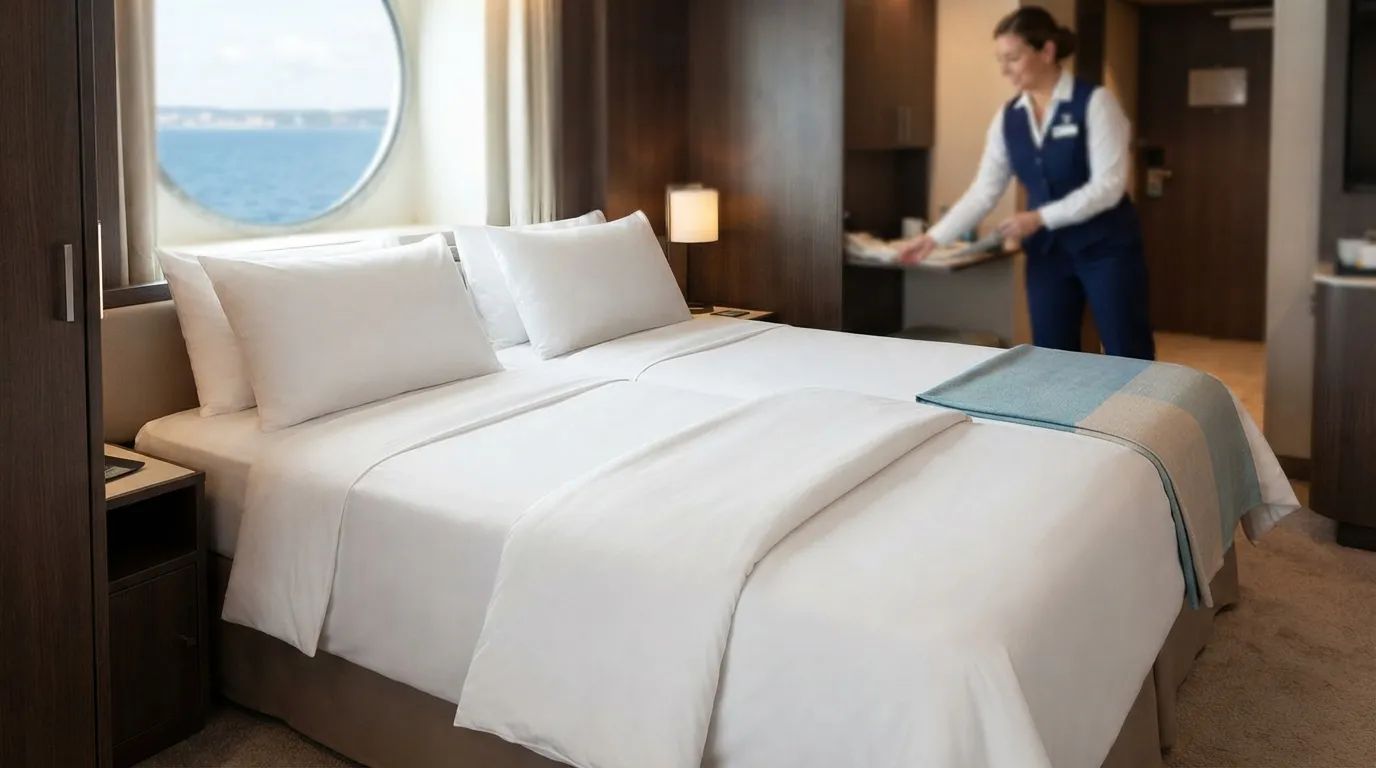
The cabin looks finished when you walk in, and that’s the trick. A bed board, a shower stool and a bed shaker that wakes you for the smoke alarm are all on cruise lines’ own equipment lists, and none of them will be waiting for you.
Princess offers shower stools, bed boards and toilet seat raisers on request, and Disney lists bed boards, bedrails and communication kits.1 Skipping them can cost you sleep, safe footing on a wet bathroom floor, or a week of medication stored at the wrong temperature.
This list covers 15 extras that stewards and guest services can bring or arrange. It starts with the easiest asks and ends with the one item that carries a deadline.
That item decides whether several of the others are available at all, so stay with it. The first ask costs you one sentence.
#15 – Extra Hangers From Your Steward on Day One
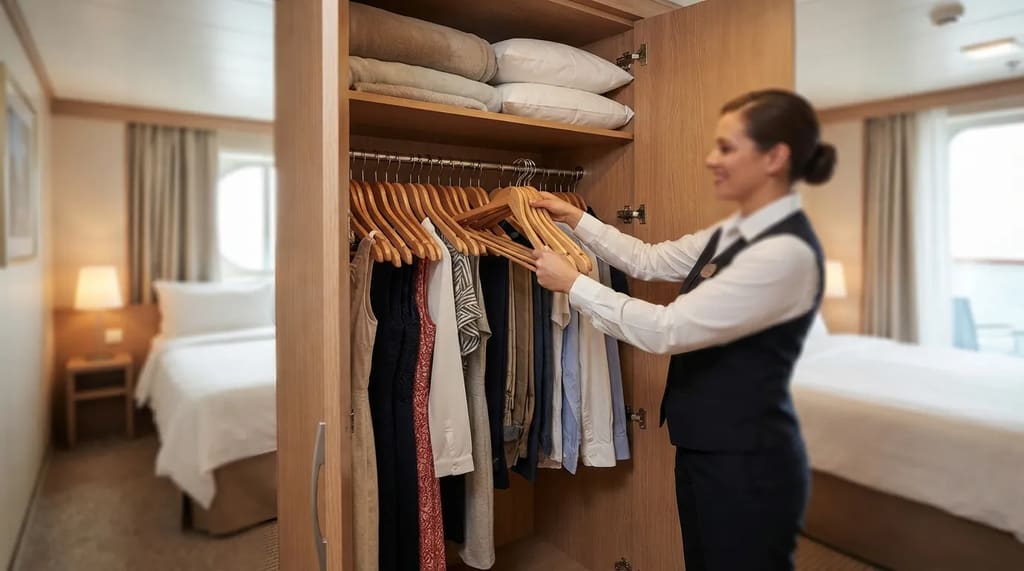
Cruise Critic lists extra hangers among the things a steward can give you on request. That makes them a cheap test of how the rest of this list works.
Ask when you first meet your steward. Use the same conversation to say how you like your bed, whether you need extra bedding, and when you want the cabin serviced.
The reason to do it all at once is practical. A steward can work a single list into the day’s routine more easily than a string of separate calls.
Write your requests on a small card before you board and you won’t forget one halfway through the chat.
Bundle every request into one conversation with your steward.
Hangers fix the closet. The thing you’ll notice at two in the morning is the pillow, and some ships keep a whole menu of them.
#14 – Pillows Softer, Firmer or Extra
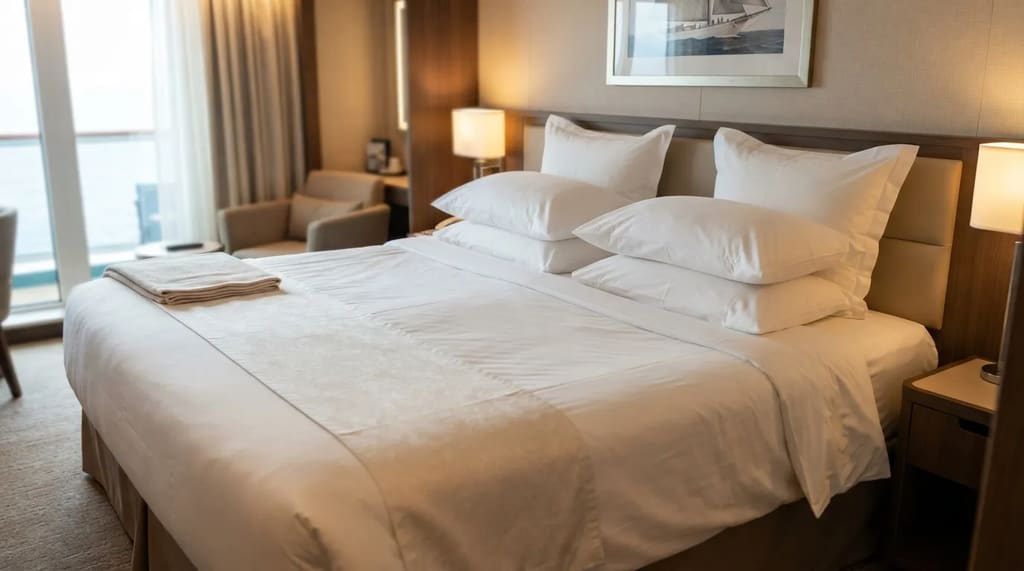
Your cabin normally has enough pillows, but that doesn’t mean they’re the right ones. Some cruise lines and cabin categories have pillow menus, offering softer, firmer, feathered, or non-feathered options.2
Even without an official menu, you can usually just ask for extra pillows. They’re an easy yes compared with requests that need equipment found and delivered.
Make the request on the first afternoon, before the first night in the bed rather than after three bad ones.
Ask for softer, firmer or extra pillows on the first afternoon.
Pillows only change the head end of the bed. Cold air coming from the vent is a separate problem with its own easy fix.
#13 – Extra Blankets for a Cold Cabin
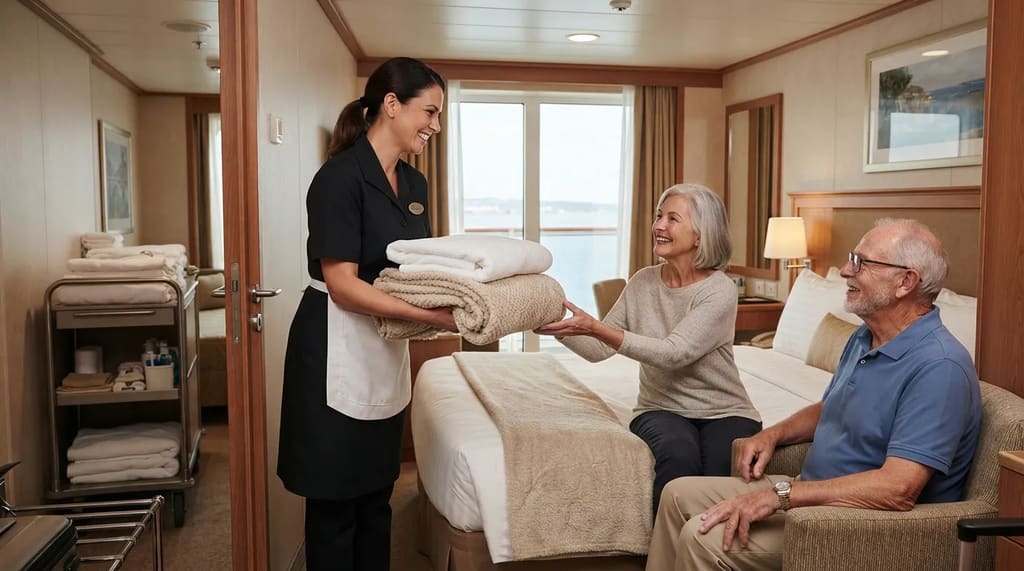
A cold cabin at three in the morning is far easier to fix at three in the afternoon. Cabin air conditioning can run cold for some guests, and stewards can often provide extra blankets when requested.
The steward simply brings more bedding, which makes blankets among the easiest things to add. That has a practical consequence for your packing.
Leave the travel throw at home until you’ve asked. It costs you nothing to find out, and it saves suitcase space.
Ask for extra blankets before you pack your own throw.
Blankets and pillows are the simplest items on the cart. The cart holds more than bedding, and a few things on it come with a price tag.
#12 – Towels, Ice and Glasses, and the Fee Question
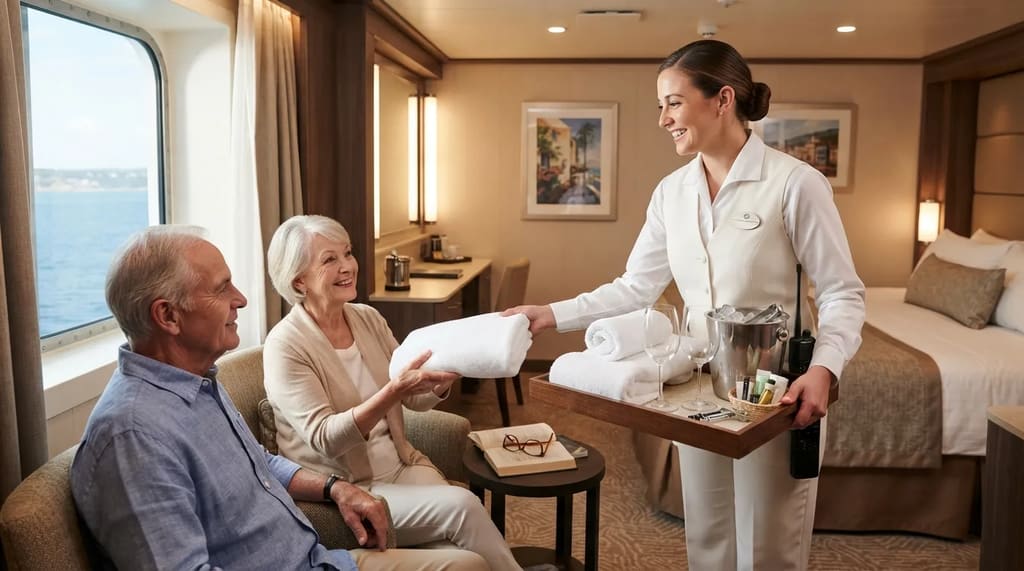
The steward’s cart carries more than towels. Stewards can often provide extra pillows, towels, blankets, wine glasses, a corkscrew, fresh ice and more.
Instead of reusing a towel because the cabin hasn’t been serviced yet, you can ask for a replacement.
The catch is that free isn’t universal. Here is how requests generally split.
Worth Knowing
- Often already covered: extra towels, basic toiletries and certain bedding requests.
- May carry a separate fee: laundry, medical services and specialty beverages.
- Premium amenities can also cost extra.
- What’s free on one ship may not be on another.
Availability and cost vary by line and ship, so make “is there a charge?” part of the request itself. Asking costs nothing, and assuming can show up on your onboard account at the end of the week.
Ask whether there’s a charge before you accept anything.
Towels and ice come to the door. So can a rearranged bed, which matters because some cabins arrive with two beds pushed into one.
#11 – Two Twins Instead of One Queen
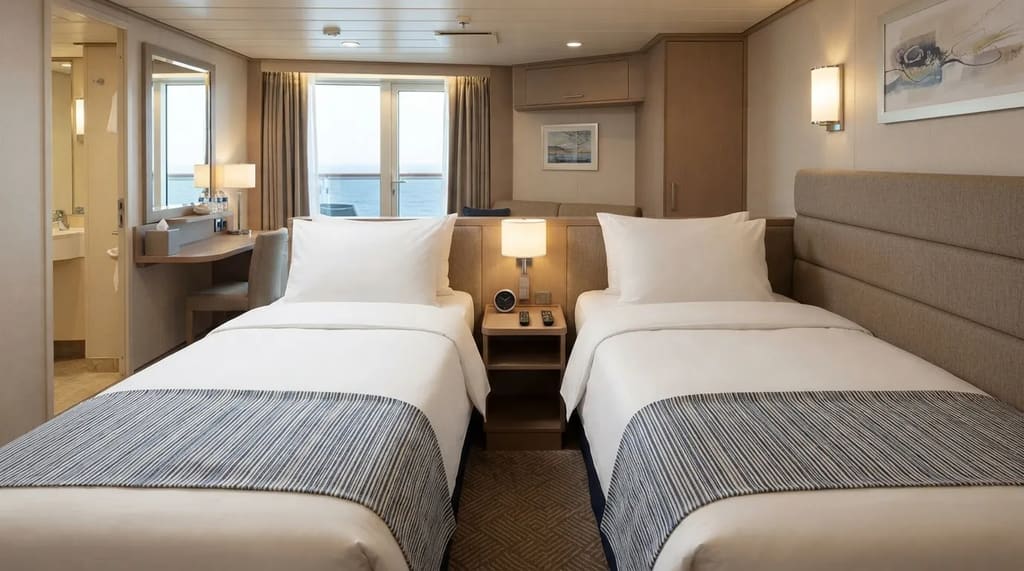
The queen bed in your cabin may really be two twins pushed together. If so, you can ask your steward to separate them into two twin beds.
The seam matters more than it sounds. Pushing the beds together fixes one problem and creates another: a ridge down the middle.
If you and your travel partner keep different hours, or one of you is up in the night, separate beds mean the other sleeper isn’t disturbed.
It works the other way too. A couple who want one wide bed can ask for it made up that way, and a friend sharing the cabin will want the beds apart.
Tell your steward twin or queen on day one.
Once the bed is arranged, the pile of decorative pillows on top is the next thing worth dealing with.
#10 – Pillowcases for the Decorative Pillows
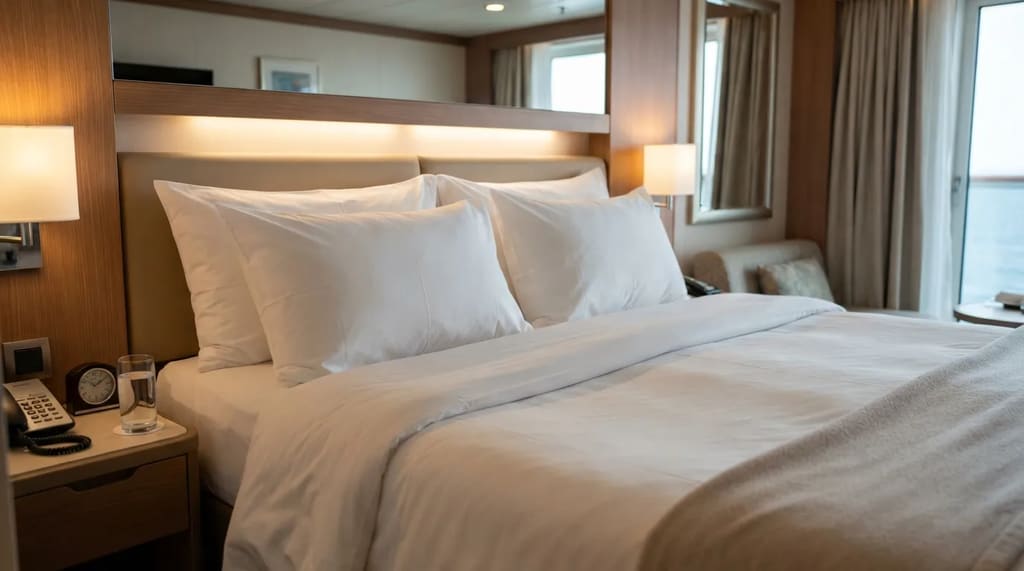
The decorative pillows on a cabin bed are there for the look of the room. You don’t have to put your face on them.
If you want to use them without laying your head on decorative fabric, ask for extra pillowcases. You can also ask your cabin attendant to remove the decorative pillows entirely, or tuck them away yourself.
Ask for extra pillowcases to cover the decorative pillows.
Be courteous about it. Not every request can be accommodated, but most cabin attendants genuinely want to help.
The same goes for the drawer under the bed: if it’s being used to store spare bedding, ask your cabin attendant to relocate it elsewhere. Cabin storage is tight, so that drawer may be the only place your own bags fit.
Pillowcases handle the surface. If feathers are the real problem, the fix starts before you board.
#9 – Feather-Free Bedding Before You Sail
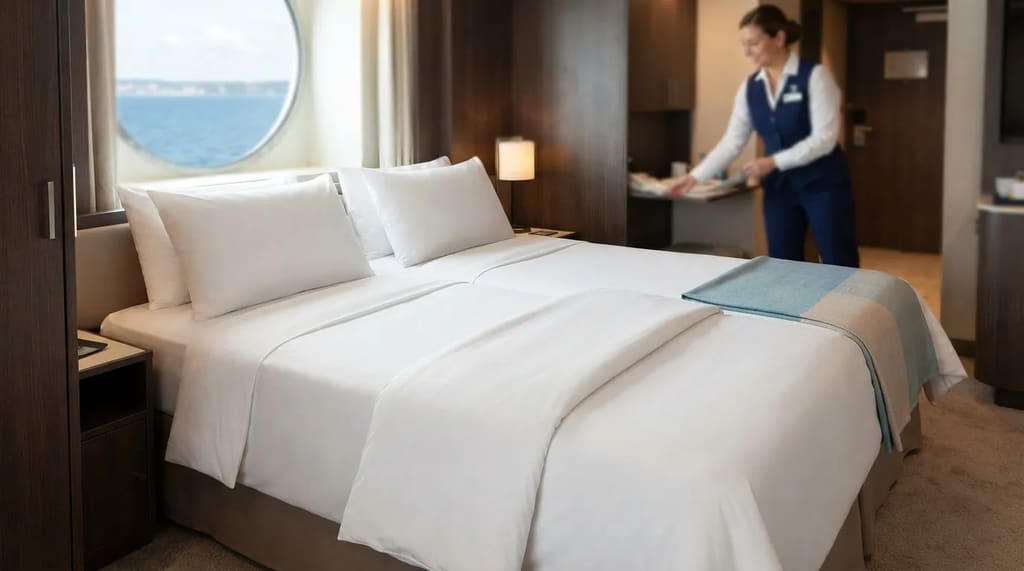
Ships often have alternatives like cotton, polyester or a blend for pillows and duvet covers. If feathers bother you, allergy-friendly bedding comes down to asking.
The timing is what separates this from a pillow swap. With advance notice, Royal Caribbean can typically provide hypoallergenic bedding.
That makes it a booking-time request, not a day-one chat with your steward. You can ask for hypoallergenic or feather-free options without making a fuss.
Ask for hypoallergenic or feather-free bedding before you sail.
Pillows only cover the top of the bed. The mattress underneath can be firmer than you’d like, and the fix is in limited supply.
#8 – A Mattress Topper Worth Requesting Before You Sail
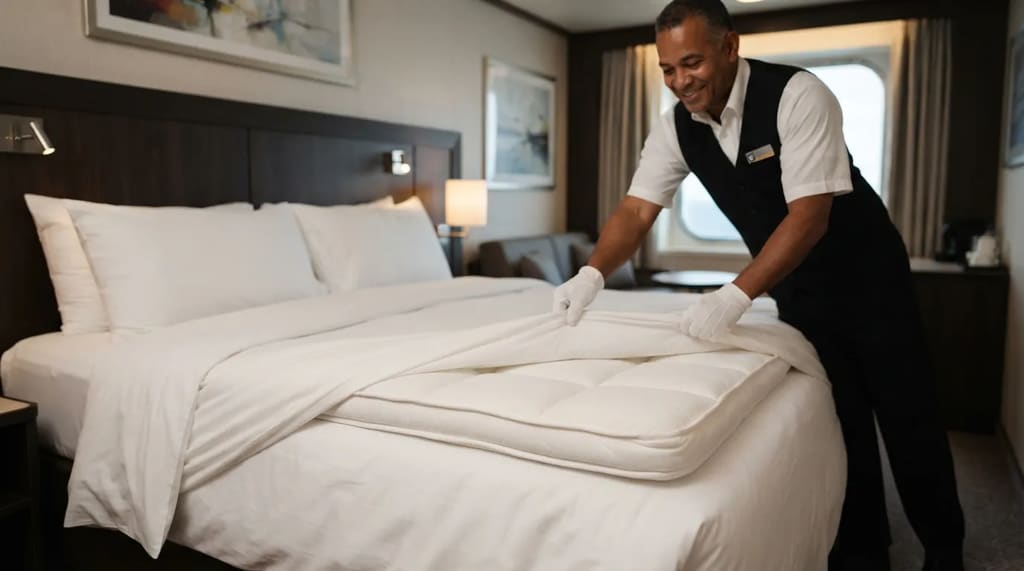
If your cabin bed is too hard, ask your stateroom attendant for a mattress topper, which goes under your sheets. Supply is limited, and what you get differs from ship to ship, from a thick quilt to an egg foam topper or a mattress pad.2
When toppers run out, there’s a fallback. One cruise writer was told toppers were scarcer than before the pandemic, so the steward layered an extra comforter under the sheets, and the writer found it made a noticeable improvement.
If your back is the reason, don’t rely on a first-day lottery. A reply from Royal Caribbean’s Access Department, posted on a cruise blog, offered a two-inch microfiber pillow top at no additional cost for back conditions, placed in the stateroom on sailing day.
Back trouble? Request a topper in writing before you sail.
A topper softens a firm mattress. Some sleepers need the opposite, and the line lists it by name.
#7 – Bed Boards and Bed Rails
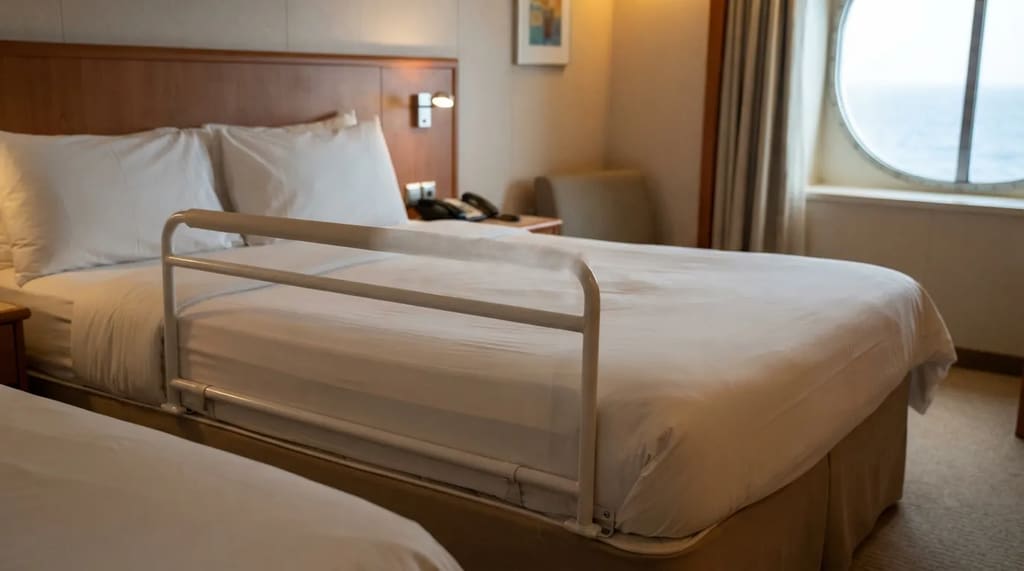
A topper softens a mattress, and a bed board firms it. If your mattress sags in the middle, a topper can’t help you, but a board can.
Princess lists bed boards among the special equipment available on request. Disney lists both a bed board and a bedrail as available on request for use in any stateroom.1
A rail suits anyone who worries about rolling out of bed on a rocking night, so it isn’t only for young children. Bed rails are offered on some ships, not all.
At a Glance
- Princess: bed boards are on its special equipment list, available on request.
- Disney: bed board and bedrail, both usable in any stateroom.
- Bed rails: offered on some ships, not all.
- Topper vs. board: a topper softens, a board firms.
Ask for a bed board if your mattress is too soft.
Equipment lists change, and Disney notes that accommodations vary by cruise line and ship and can change at any time without notice. Check your line’s current list before you sail.
A board fixes the bed. The bathroom is where a rocking ship gets riskier.
#6 – A Shower Stool and Raised Toilet Seat
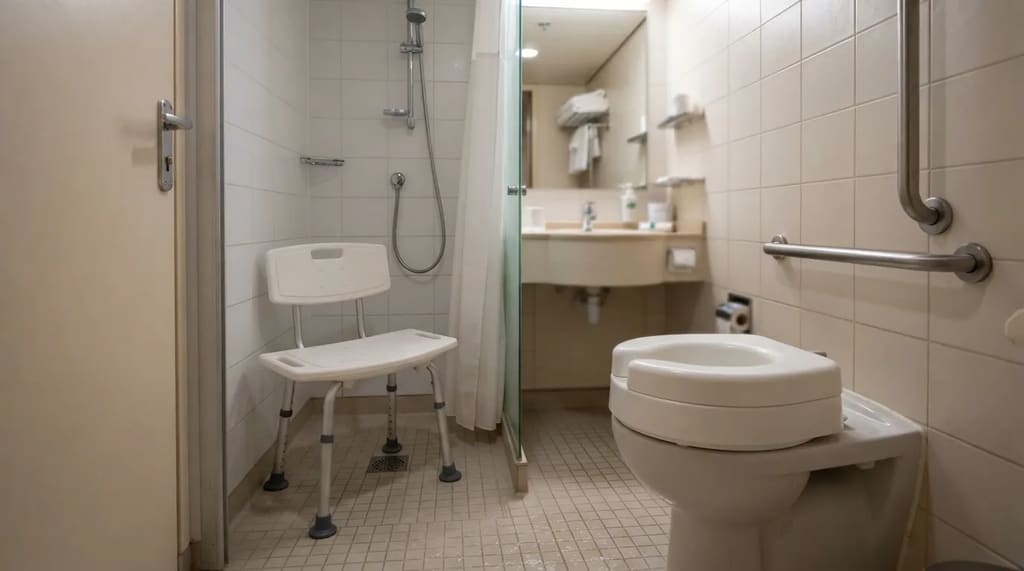
A wet bathroom floor on a moving ship is a risk worth planning for. Standing for a whole shower is harder when the floor shifts under you.
Disney offers bedrails, shower stools and raised toilet seats on request, and Celebrity’s special needs form has boxes for a raised toilet seat, shower stool and commode chair.
You don’t need an accessible cabin to ask. Disney makes these items available for use in any stateroom, and Princess works the same way.
Shower stools and raised toilet seats are available on request at several lines.
The stool solves the bathroom. A smoke detector you can’t hear is a different problem, and the equipment for it comes as a kit.
#5 – A Hearing Kit for Door, Phone and Smoke Alarm
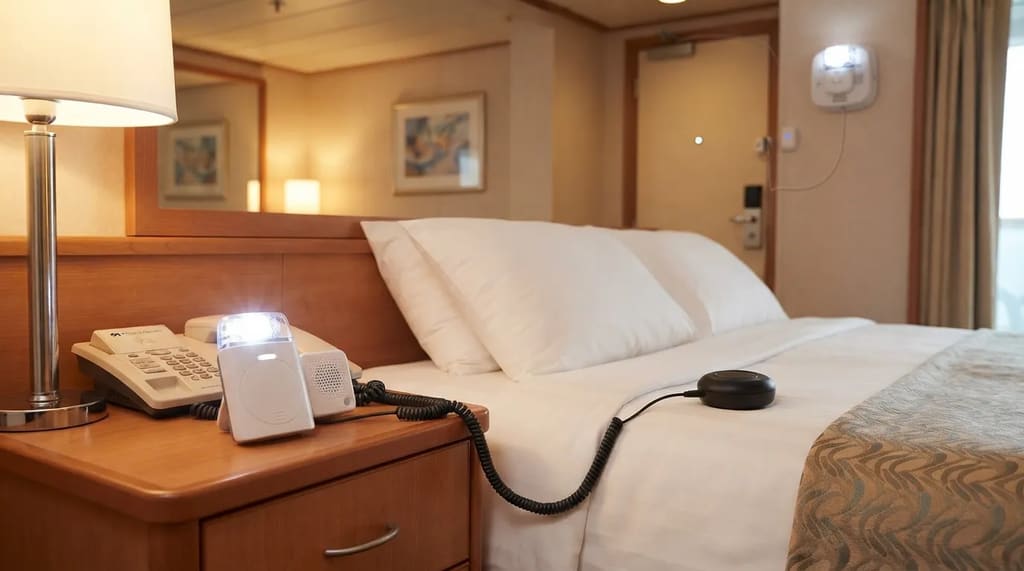
Royal Caribbean’s portable hearing room kit uses visual and tactile alerts for door knocking, telephone ringing, the alarm clock and the smoke detector. It’s available in your stateroom upon request.3 4
Other lines build their kits differently. Princess’s All-In-One Kit includes a TTY text phone, an under-pillow shaker and a flashing light, plus a visual smoke detector.
Disney’s stateroom communication kit adds door knock and phone alerts, a bed shaker and a strobe-light smoke detector.1 If you take your hearing aids out at night, a siren you can’t hear is exactly the gap these kits cover.
Princess lets you specify exactly what you need when requesting the kit, so you don’t have to take the whole bundle.
Quick Compare
- Royal Caribbean: portable hearing room kit with visual and tactile alerts.
- Princess: All-In-One Kit with TTY phone, under-pillow shaker, flashing light and visual smoke detector.
- Disney: door knock and phone alerts, bed shaker and strobe-light smoke detector.
Ask for the kit by name: portable hearing room kit.
A hearing kit is a box you can ask for. Medication that has to stay cold is a different box, and the cabin minibar isn’t it.
#4 – A Medical Refrigerator, Not the Minibar
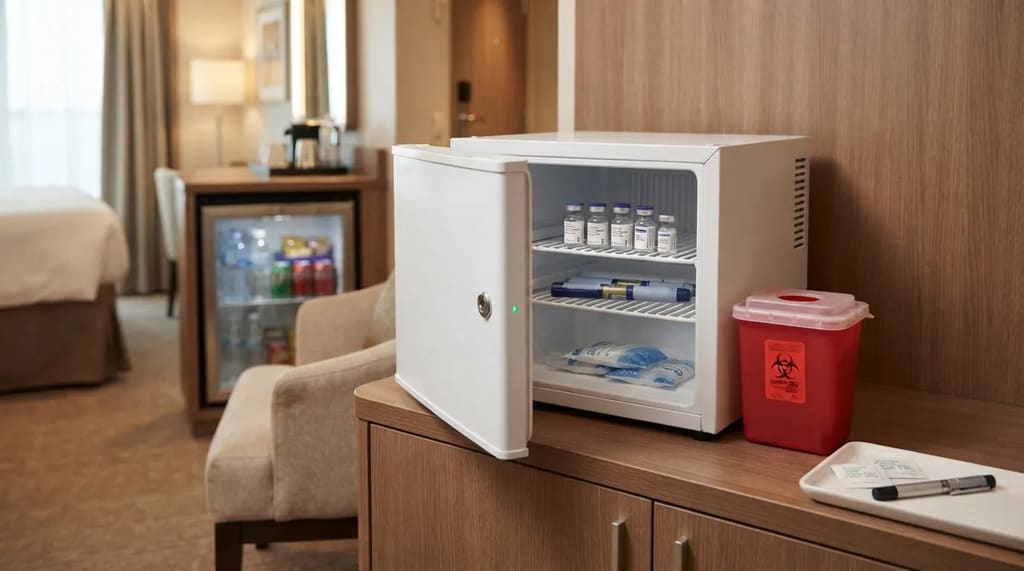
A cabin minibar is built for drinks. Carnival and Royal Caribbean both state that stateroom mini-bars maintain beverage temperatures only and shouldn’t be used for medications.
Disney’s beverage coolers aren’t suitable for refrigerated medication either. The proper route is a form filed before you sail.
Royal Caribbean requires guests with injectable medications to submit a Guest Special Needs Form to request a medical refrigerator and a sharps disposal container. Carnival has its own form for diabetes, sharps or medical storage, and in both cases the request belongs at booking, not at the cabin door.
Don’t lean on a standard fridge as a backup, because typically only balcony, mini suite or suite cabins have one in the room, so an inside cabin may have none. The ship’s Medical Center can store temperature-sensitive medications if cabin arrangements fall through.
Request a medical refrigerator on the special-needs form, not at the cabin door.
A fridge needs a plug, and so does a CPAP. The cabin has one outlet, and the cord you’d bring from home may be confiscated.
Related Stories From Travelbinger
#3 – A Compliant Extension Cord for Your CPAP
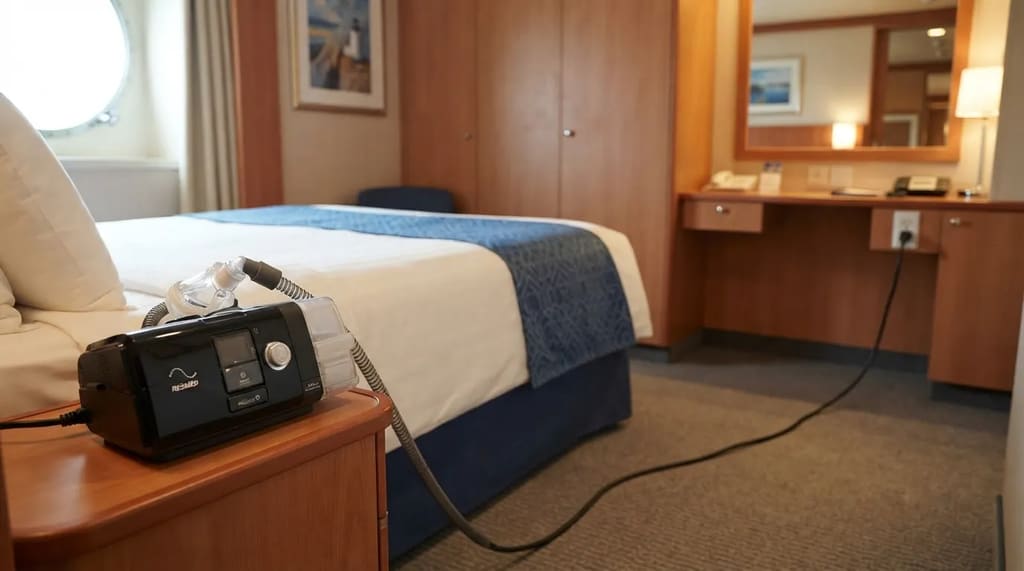
Carnival says there’s one electrical outlet in each stateroom, located near the desk or vanity. If your bed is across the room, your CPAP needs a cord to reach it.
The cord is where travelers go wrong. Carnival allows extension cords and power banks but prohibits surge protectors, and several lines ban cords in general with an exception for medical devices.
Disney’s Special Services team can supply an extension cord and distilled water for medical devices free of charge. Norwegian recommends bringing your own cord, about six feet long, in good condition and without a surge protector.
Surge protectors are prohibited; a plain extension cord is usually fine.
Some cabins use a keycard switch that cuts power when you remove the keycard, so leave the card in the slot. Power interruptions can also occur, so carry a fully charged battery or a backup that doesn’t need electricity.
Cords and refrigerators are single items. Some guests need the whole room built differently, and one line’s form asks for a specific sentence.
#2 – An Accessible Stateroom and a Boarding Escort
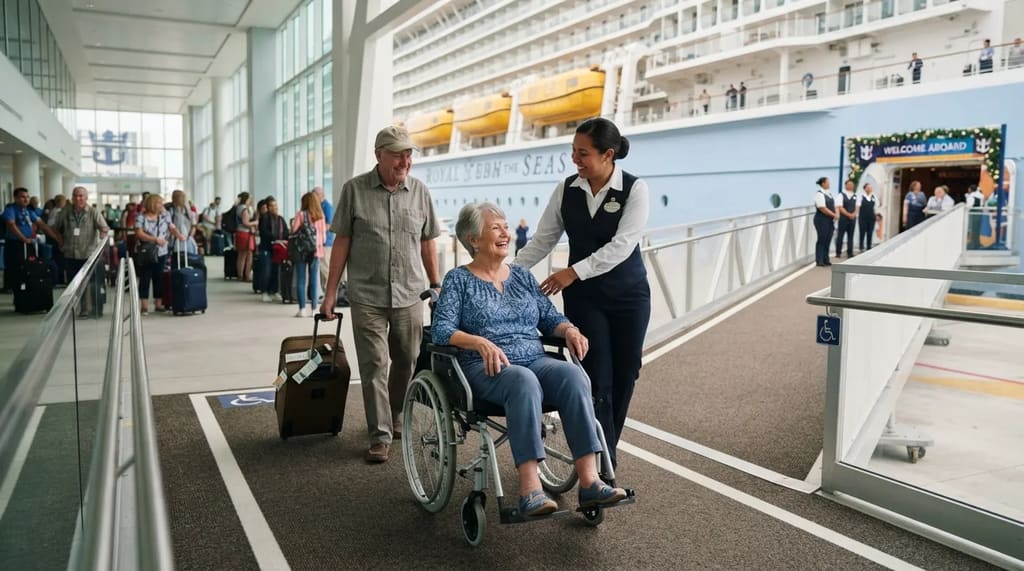
Princess bathrooms in accessible staterooms have a roll-in or transfer shower, fold-down bench seat, distress alarm, handheld showerhead and grab bars. Disney’s list adds ramped bathroom thresholds, open bed frames, adjustable-height shower heads and lowered towel and closet bars.
Getting one is easier than many guests expect. Royal Caribbean doesn’t require medical certificates or disability placards, but it asks you to attest to your need for the stateroom during booking.5
Its form asks you to say you need the accessible features because of a mobility or other disability. The cabin is only half of it.
Royal Caribbean provides wheelchair boarding and departure help, which you can request at the pier or arrange ahead so it can prioritize you. Princess runs an Accessibility Lane for check-in, and anyone traveling with you can use it.
Royal Caribbean requires no medical certificate; you attest to your need at booking.
Everything on this list shares one catch, and it’s a date. The most expensive mistake isn’t a missing item but a form that went in too late.
#1 – The Special Needs Form You File Before Sailing
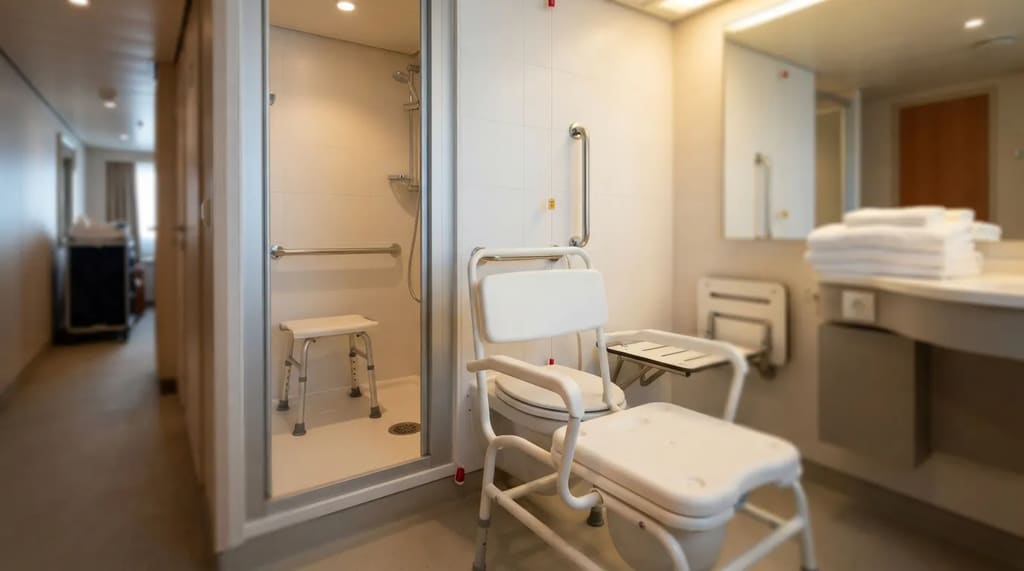
Pillows can be sorted on the first afternoon, but a commode chair can’t. Royal Caribbean’s advance-notice list includes the commode chair, shower stool, transfer bench and assistive listening device.
Deadlines differ by line and request. Royal Caribbean wants sign language interpreting requests 60 days before sailing, and Disney asks for hearing-services requests at least 30 days before the sail date.3 6
Carnival’s portable medi-coolers go first come, first served, which is one more reason not to wait until you’re on board.
Fast Facts
- Royal Caribbean sign language interpreting: request 60 days before sailing.
- Disney hearing services: request at least 30 days before the sail date.
- Royal Caribbean advance-notice items: commode chair, shower stool, transfer bench, assistive listening device.
- Carnival medi-coolers: first come, first served.
That ties together the earlier items: the medical fridge, the sharps container, the shower stool and the feather-free bedding all go smoother when you ask before you sail. Treat the form as part of booking, as routine as picking a dining time, even if you’re unsure you’ll need every item.
Disney hearing services need 30 days’ notice; Royal Caribbean interpreters, 60.
Treat Your Cabin as Something You Set Up
Most of what’s on this list costs little or nothing to ask for. The effort comes before you board, when the forms go in, and not at the cabin door when you’re tired from the trip.
That’s the shift worth making. A cabin isn’t something you put up with for a week, it’s a room you can configure.
The best time to do it is while you’re still at your booking confirmation. Policies vary by line and ship, so check your own line’s current form.
If you’ve sailed before, what’s the one thing in your cabin you put up with for the whole week that a single request might have fixed?
- Disney Special Equipment Overview: https://www.disabledholidays.com/about/disney-disabled-cruises.html
- Cruise Critic Steward Requests: https://www.cruisecritic.com/articles/things-cabin-steward-give-request
- Royal Caribbean Guest Special Needs: https://www.royalcaribbean.com/resources/guest-special-needs
- Royal Caribbean Accessible Seas: https://www.royalcaribbean.com/content/dam/royal/resources/pdf/accessible-seas-brochure.pdf
- Royal Caribbean Accessibility FAQ: https://www.royalcaribbean.com/gbr/en/faq/topics/accessibility-disability-needs
- Royal Caribbean Accessible Cruising: https://www.royalcaribbean.com/experience/accessible-cruising