Most people assume the off season at a resort means scaled-back service, a skeleton staff, and no special treatment for anyone. For guests over 60, the reality is almost exactly the opposite – and that’s the part most travelers never find out before they arrive.
The quiet months don’t just mean better rates and thinner crowds. They mean reception teams with the time, inventory, and staff bandwidth to actually deliver on requests that get brushed aside every July.
Most guests never ask for any of it. Here are the 14 services already sitting behind the front desk, waiting to be requested – starting with the one nearly everyone skips before they even check in.
#14 – The Phone Call That Changes Everything Before You Even Arrive

Most guests hand their requirements to reception on the day they check in – which is already too late for many arrangements to work smoothly. The smarter move is to make contact two or three days before arrival.
The guest experience doesn’t begin at the front desk. It starts the moment a booking is confirmed, and proactive pre-arrival communication is no longer a luxury for hotels aiming to deliver real service.
That early contact gives reception a chance to gather dietary needs, room preferences, or special occasions before you walk in the door. It lets them tailor the welcome instead of scrambling to react to it.
During the off season, reception teams carry lighter guest loads, which means they actually have the bandwidth to act on what you tell them. That window is shorter and busier in peak months, so use the quiet season to your advantage from the very first call.
#13 – The Room Nobody Tells You to Ask For
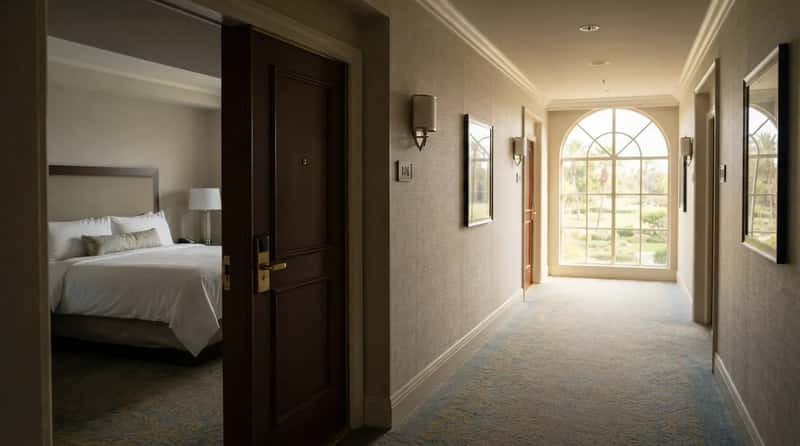
Where your room sits on the property matters far more than most guests realize before they unpack. A room next to the service elevator, the pool bar, or a late-closing restaurant can turn a restful trip into an exhausting one.
Off-season travel already means fewer crowds and a calmer property overall, but placement still matters. With occupancy down during shoulder and low seasons, reception typically has more inventory to work with – and more flexibility to honor specific requests that would be impossible in July.
Asking for a lower floor or a room near an elevator is a completely standard request at any full-service resort, and it costs nothing. During the off season, the odds of that request actually being granted go up considerably.
Mention it specifically when you call ahead: low floor, away from the pool, close to the elevator. The more precise you are, the more likely reception can match the room to what you need – and flag it in the booking notes so it survives any staff handover before you arrive.
#12 – The Discount Most Guests Never Bother Confirming
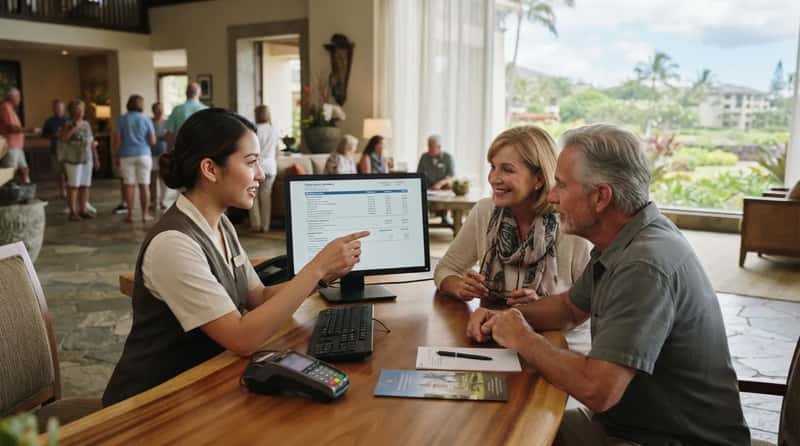
Reception can do more than check you in. They can confirm whether you’re actually getting the best rate available, especially when senior discounts and off-season pricing overlap.
About 40% of leisure travelers are 60 or older, according to 2023 data from SquareMouth, a travel insurance aggregator. Hotels know this demographic drives a significant share of off-season revenue, and chains like Wyndham offer guests 60 and older around 10% off the standard rate – before any seasonal pricing even kicks in.
Fast Facts
- Wyndham advertises up to 10% off for guests who are 60 or older at participating locations.
- Red Roof gives seniors a 10% discount on its already low rates year-round, not just seasonally.
- Choice Hotels runs a dedicated Senior 60+ rate plan alongside a separate AARP member offer, so it’s worth comparing both.
- At Hilton’s Tempo and Spark brands, AARP members can save up to 10% off the best available rate and get late checkout until 2:00 PM when available.
In many cases you can save even more by layering advance-purchase rates or seasonal promotions on top. The front desk or reservations team can often clarify whether stacking a senior rate with an off-season deal is possible, or whether a loyalty rate actually beats the senior discount outright.
Most guests never ask. They accept whatever rate shows on their confirmation. A single two-minute conversation before arrival can change what ends up on the final bill.
#11 – Late Check-Out Without the Fight

Late check-out is one of the most underused perks available to guests over 60, particularly during the off season when the next guest for your room may not even be arriving until the following day.
Hilton and LXR Hotels & Resorts offer late checkout until 2 p.m. for AARP members when availability allows. That’s a published benefit – but plenty of properties extend it informally to senior guests who simply ask politely the evening before departure.
During peak season, housekeeping is turning rooms on a tight two-hour window and a late check-out genuinely costs the property revenue. During the off season, that pressure largely disappears.
Ask the evening before, not at 11:55 a.m. on your travel day. A relaxed morning without a rushed departure makes an enormous difference at the end of a longer trip.
#10 – The One Conversation That Fixes Every Meal, Not Just One

Mentioning a dietary restriction to the restaurant host on the night you want to eat is the hardest possible way to handle this. Reception can do the heavy lifting in advance – and make sure it follows you across every outlet on the property.
Flagging dietary needs ahead of time is a form of proactive communication that helps avoid confusion later. Most reception teams are happy to relay this to dining staff so it’s noted for your entire stay, not just one visit to one restaurant.
Resorts offering nutrition programs with heart-healthy, low-sodium, and diabetic-friendly menus are increasingly common, and reception can confirm which options actually exist before you commit to a reservation. Some can even tailor a custom menu to fit specific needs.
The off-season advantage here is real: kitchen staff are less stretched, which means special preparation requests that would be waved off in August are handled with care in November. Get it confirmed through the front desk before your first meal.
#9 – The Equipment You Don’t Have to Drag Through the Airport

Hauling a walker, wheelchair, or knee scooter through an airport is one of the more exhausting ways to start a trip. Many guests over 60 don’t realize reception can often take that problem off the table entirely.
Plenty of travelers over 60 would rather rent equipment locally than haul it through airports, and reception desks at accessible-friendly properties can often arrange this directly or point you toward a nearby medical supply company.
Worth Knowing
- Many resorts have a standing relationship with a local medical-equipment company for wheelchair, walker, and scooter rentals.
- Some properties keep a small loaner stock on-site for short-distance needs, like getting from a room to a pool area.
- Loaner equipment is far less likely to already be checked out to another guest during the off season.
- Ask reception to confirm exact specs – seat height, ramp width, weight capacity – before you arrive, not after.
Some resorts even keep a small stock of loaner equipment on-site for guests who need something short-term, like getting from a room to a pool area. It’s worth asking specifically what’s available, since policies vary widely between properties.
During the off season, that loaner stock is far less likely to already be in use. Call ahead, describe what you need, and ask reception to confirm whether the property has it on-site or can arrange delivery before you arrive.
#8 – The Refrigerator Request Most Guests Wait Too Long to Make
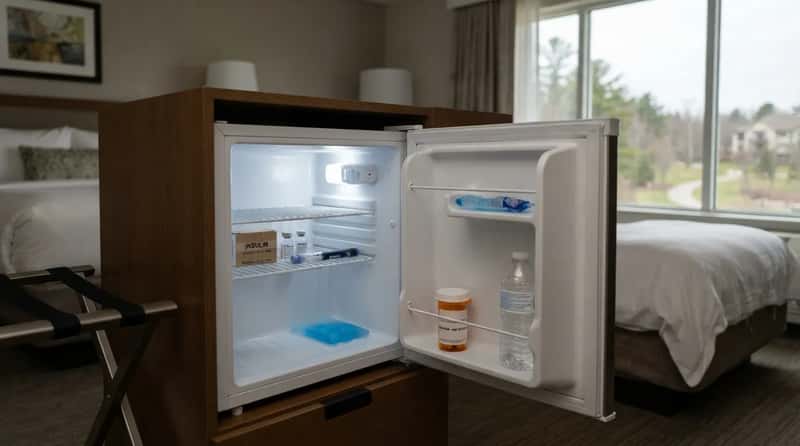
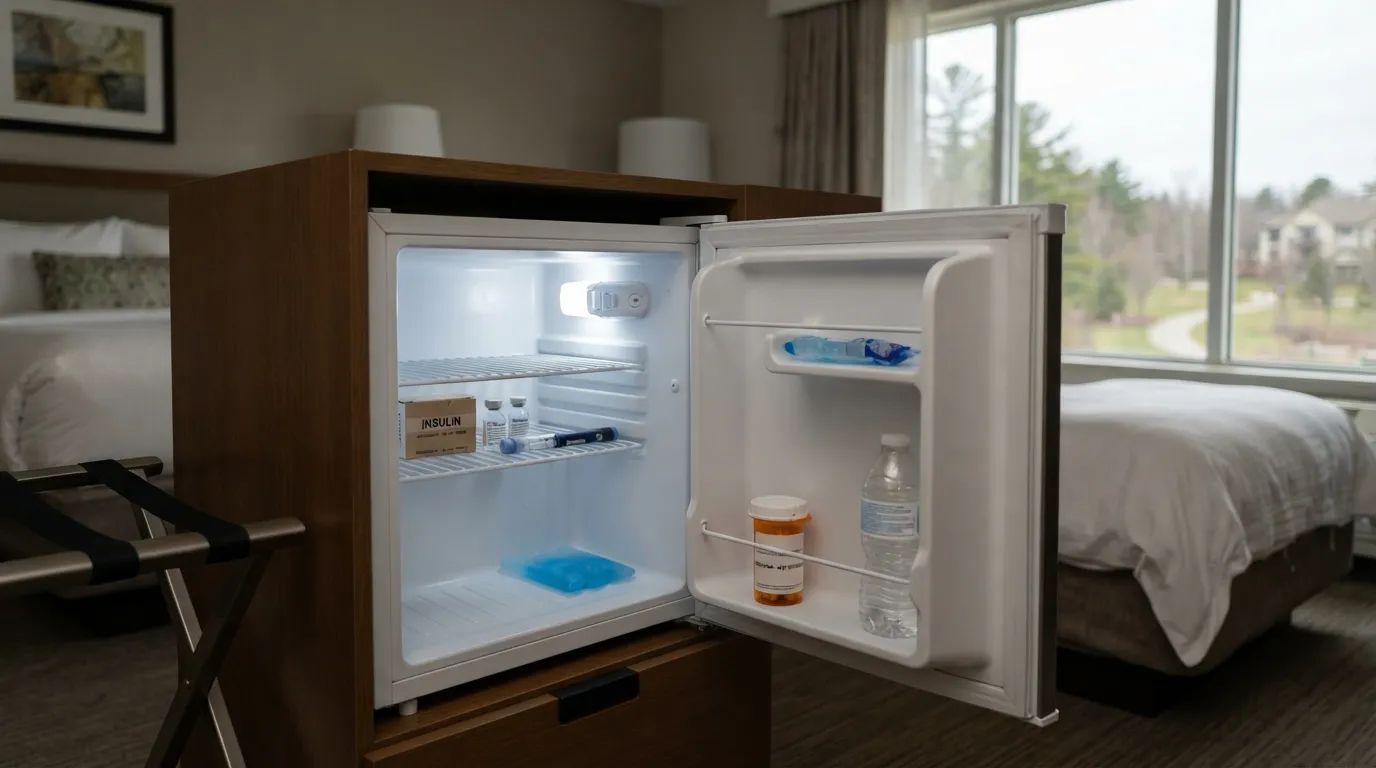
This is one of the most important and least-discussed reception services available to guests over 60. Most people who need it don’t ask until they’re already standing at the front desk with insulin or temperature-sensitive medication in hand.
Many hotels carry refrigerators, phone chargers, specific pillow types, and other unlisted amenities that never appear in the room description – and they’ll set them up in advance if someone thinks to ask.
The key is timing. Call two or three days out and say: “I travel with medication that needs refrigeration. Can you arrange that before I arrive?” At a full-service hotel this is not a complicated request; it just needs to reach the right person early enough.
During the off season, housekeeping isn’t juggling dozens of last-minute room changeovers. A pre-arranged refrigerator will almost certainly be waiting when you walk through the door – not delivered two hours after you needed it.
#7 – The Ride That Should Never Be Left to Chance

Getting to and from the airport is often the most stressful part of any trip for travelers over 60, and it’s an area where reception can add genuine, practical value most guests don’t think to request.
Reception desks routinely arrange accessible shuttles, private transfers, or taxis with advance notice. During the off season, fleet availability is typically higher and lead times are shorter, which means last-minute adjustments are far more feasible.
Local transportation, airport shuttles, and step-free access for excursions are all things reception can verify and book on your behalf, not just for arrival day but for any outing during your stay. Some all-inclusive resorts even include golf carts for on-property transportation.
Ask reception to confirm the specific vehicle and its boarding height, grab handles, or ramp access before you commit. A verbal “we’ll take care of it” is not the same as a written confirmation with a vehicle description attached.
#6 – The Schedule Front Desk Knows Better Than Any Review Site
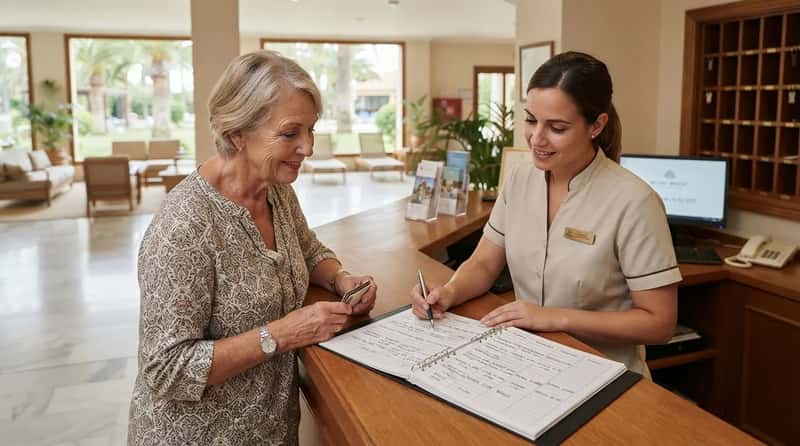
The off season is quieter by definition, but it’s not quiet everywhere on the property at the same time. Reception knows the real schedule, and they can steer you toward the right slots.
Activities like dancing, bingo, aquagym, and gentle gymnastics often run on reduced schedules off-season, with smaller group sizes that actually make participation easier for guests over 60. Reception can tell you which sessions are running and how crowded they typically get.
At a Glance
- Aquagym and gentle gymnastics sessions tend to run in smaller groups during the off season.
- Live music and cultural events usually continue, though on a lighter weekly rotation.
- Dance lessons and bingo hours are easier to fit around a personal routine when the schedule is thinner.
- Front desk staff can often hand you the current week’s activity sheet before it’s posted in the lobby.
Live music, dance lessons, and cultural events typically continue in some form through the off season, though the schedule shifts. Front desk staff can pull the current weekly timetable and block preferred slots before the general guest list fills them.
This matters more than it sounds. Booking a spa session or a guided walk at the right time of day, away from any remaining school-holiday groups, is the difference between genuinely relaxing and simply being somewhere less crowded.
#5 – The Safety Net Most Guests Don’t Know Exists

Most guests over 60 travel with some level of health consideration, whether it’s a managed condition, a medication schedule, or simply needing to know where the nearest clinic is. Reception can be faster and more reliable than a Google search in an unfamiliar location.
Confirming emergency protocols, on-site medication support, and connections to nearby clinics is something reception can do before your arrival, not just in a crisis. Resorts with 24-hour security, emergency response systems, and medical staff on-site exist across multiple price points, and front desk teams there are trained to be the first point of contact.
Even where in-house medical staff aren’t available, reception typically maintains a list of trusted local clinics, pharmacies, and English-speaking doctors they refer guests to regularly. Some inclusive packages even build excursions specifically around older travelers, with in-house medical staff on standby.
Ask reception to confirm, in writing, the emergency protocol and the address of the nearest clinic. That’s not pessimism – it’s the same preparation a travel nurse would recommend before anyone over 60 leaves home.
#4 – The Stash Behind the Desk Nobody Tells You About
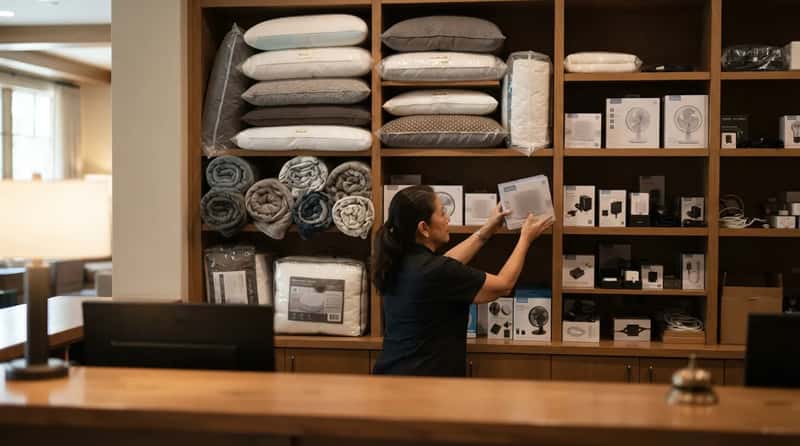
Behind nearly every front desk at a full-service resort is what insiders think of as the amenity closet – a collection of items technically available to any guest but never displayed and almost never offered without someone asking first. Guests over 60 who sleep lightly or have specific comfort needs benefit from this more than any other demographic.
The list is longer than most guests expect: a pillow menu with some hotels offering up to 10 options from memory foam to buckwheat, phone chargers and adapters held behind the desk, extra blankets and foam toppers deliverable with a single call, and noise machines or fans available on request.
During the off season, reception staff have more time to respond to these requests promptly. A noise machine delivered within 20 minutes and a memory-foam pillow swap at 9 p.m. are genuinely easier to arrange in February than in the middle of peak summer occupancy.
All you have to do is ask. Most guests never do.
#3 – The Tour Board Doesn’t Show You Everything

Standard excursion boards list tours for the general guest population. What they don’t advertise, but absolutely can arrange, are lower-intensity alternatives suited to guests who need step-free routes, slower pacing, or smaller group sizes.
A well-briefed reception team can screen excursion operators on your behalf and ask the questions most guests wouldn’t know to ask: Is the terrain paved? Is there seating during the tour? What’s the maximum walking distance?
Quick Compare
| Standard Excursion | Reception-Arranged Alternative |
|---|---|
| Larger, mixed-ability group | Smaller, more manageable group |
| Mixed or uneven terrain | Paved or level walking routes |
| Minimal built-in breaks | Seating and rest stops included |
Beach wheelchairs are available at some accessible resorts, and guests can also relax at the spa, join inclusive wellness activities, or dine at accessible restaurants nearby. Reception knows which of these exist and which local operators have a track record of handling guests with mobility or stamina considerations well.
Off-season tour operators are often more willing to customize since they have fewer bookings and more flexibility. A front desk team that knows their local suppliers can negotiate on your behalf in ways no third-party booking site can replicate.
#2 – The Spa Booking That’s Actually a Health Conversation

Resort spas during the off season are quieter, better staffed relative to guest load, and often running promotional pricing. For guests over 60, the booking process involves more than choosing a treatment – and this is where reception adds value most travelers overlook entirely.
A good reception team will, when pre-booking on your behalf, flag relevant health considerations to the spa – high blood pressure, joint sensitivity, recent surgery – so the therapist is briefed before you walk through the door.
Assistance with booking spa appointments, private dinners, and tours is a core function of concierge and reception services at higher-end properties. The difference between a generic booking and a properly briefed one is the conversation that happens between the front desk and the department taking your appointment.
During the off season, therapists have longer windows between appointments and more capacity to tailor sessions. That’s a real advantage – but only if the front desk passed along what you need before you show up for the treatment.
#1 – The Quiet Service That Ties Everything Together
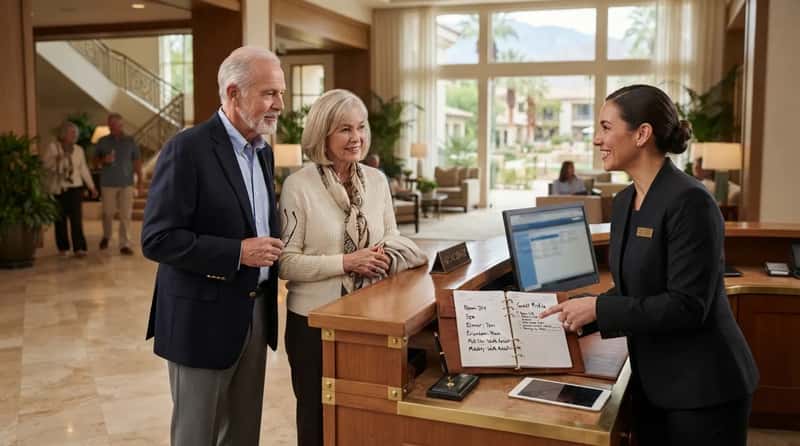
Every service on this list works better when someone at reception is holding the whole picture. That’s the service most guests over 60 never think to request – and it turns out to be the most valuable one of all.
Our guests ask us for many things, and we do everything within our means to satisfy their requests.
Managing Director, Grand Velas Resorts
That single sentence reflects a broader industry reality: the best reception teams don’t wait for guests to piece together a list of individual requests. They build a profile – one person with visibility across your room placement, dietary notes, mobility requirements, spa bookings, and excursion schedule.
When that visibility exists, nothing falls through the gap between departments. None of these requests need a specialized concierge or a luxury price tag; they’re things resort reception teams handle regularly, because a large share of older travelers report needing some form of health or mobility accommodation during their stay.
The off season is when that coordination is easiest to arrange, most reliably executed, and most likely to be remembered. Ask for it by name.
The Bottom Line

The gap between a stressful resort stay and a genuinely restful one almost always comes down to information – specifically, what you told reception before you arrived and how precisely you asked. Most guests over 60 are sitting on access to 14 distinct services and using two or three of them at most.
The off season amplifies every single one: lower occupancy gives reception more flexibility, kitchen staff have more time for dietary requests, spa therapists have longer windows, and excursion operators are more willing to customize. Being over 60 and traveling off-peak is, it turns out, a quiet form of leverage most people never use.
Pre-arrival contact, room placement, rate stacking, mobility equipment, medication refrigeration, dietary coordination, medical liaison, unlisted amenities, accessible transport, low-crowd scheduling, excursion screening, wellness pre-briefing, late check-out – and the one person holding it all together.
Which of these did you already know about? Drop your experience in the comments.