
Most people assume travel gets easier, and cheaper, after 65, with more time, more experience, and a budget you’ve planned carefully. Then the real price shows up, and it looks nothing like the one that made you click “book.”
AARP has told federal regulators that hidden fees hit older adults hard, especially those on fixed incomes. These charges aren’t lurking on shady websites, either; they’re standard practice at airlines, hotels, cruise lines, and booking platforms, and the one most people never notice is saved for last.
#15 – The OTA “Service Fee” That Appears at the Last Second

Online travel agencies are hugely popular with travelers over 65, and they can be one of the costliest tools if you’re not watching closely.
They’re great for finding cheap flights and hotels. But service fees often pop up at the very last step, right before you hit “confirm,” and can noticeably inflate the final cost.
For someone on a fixed income who budgeted carefully, a last-minute jump isn’t a small annoyance. It’s a budget blow.
This is called drip pricing: a low price gets you to book, then taxes, booking fees, and cleaning fees pile on. The details are often tucked into fine print you only find once you’re already committed.
But that OTA fee is just the warm-up. The one waiting at hotel check-in is a whole different animal.
#14 – The Hotel Resort Fee You Never Agreed To Upfront

You book a hotel room at what looks like a fair rate. At check-in, the front desk mentions a mandatory “resort fee” – charged per night, non-negotiable, and barely visible during booking.
Resort fees hide the true cost of a room, often adding $30 or more to every night. In some places, it’s far worse.
Fast Facts
- Charged per night, on top of the advertised room rate
- Often adds $30 or more to every night of your stay
- Usually mandatory, and easy to miss while booking
- May bundle perks like pool access or a room safe you never use
Some Las Vegas hotels advertise room rates so low that the resort fee makes up a huge chunk of the real total. The price you saw and the price you pay can end up worlds apart.
You’re often paying for things like pool access or a room safe whether you use them or not. A traveler who never swims and just wants a quiet room still pays for the pool.
So what does that fee actually cover? Almost nothing you’ll use, and the next fee is just the same trick wearing a different name.
#13 – The “Destination Fee” That’s Just a Resort Fee With a Different Name

Some upscale city hotels – places that are decidedly not resorts – now charge “destination fees” or “urban fees.” It’s the exact same mechanism as a resort fee, just renamed so it sounds less absurd for a downtown business hotel.
These fees range widely, from about $10 to well over $100 a night. The advertised price usually leaves them out, even when they cover basics like internet or pool access.
For many older travelers, the bundled perks – fitness centers, bike rentals, in-room streaming – are things they’ll never touch. You’re paying for a lifestyle you didn’t order.
The FTC’s rule that took effect in May 2025 targets misleading pricing for short-term lodging like hotels and vacation rentals. Still, many properties find ways to present fees in confusing ways, so it pays to do some homework.
The fees don’t stop at your hotel room. They follow you straight to the airport.
#12 – The Airline Checked Baggage Fee That Wasn’t There Last Time You Flew
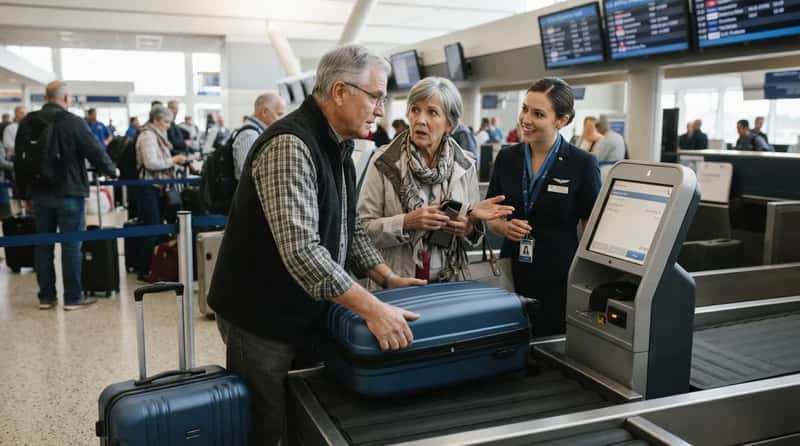
If you haven’t flown in a few years, brace yourself: on most standard fares, checking a bag is no longer included. It’s a separate fee, charged per bag, in each direction.
U.S. airlines collect billions of dollars in baggage fees every year. That tells you how normal this charge has become, and how many travelers get blindsided by it.
The usual advice is to pack only a carry-on and bring your own snacks. But travelers over 65 who carry medications, medical equipment, or simply need more for a longer trip can’t always do that.
The fee compounds fast. Two passengers, two bags each, round trip – you can easily add $200-$400 to a domestic trip that looked affordable at first glance.
Baggage fees are at least visible during booking. The next one often isn’t, until the last screen.
#11 – The Seat Selection Fee for a Seat You Assumed Was Yours

Most travelers over 65 assume a seat comes with the ticket. On many airlines, and on most ultra-low-cost carriers, choosing a specific seat costs extra, and if you don’t pay, you get whatever’s left.
Airlines now collect billions of dollars a year from seat fees. Seat selection has become its own revenue line, and carriers know exactly who needs it.
If you need an aisle for mobility, a front row for easier deplaning, or simply don’t want to be separated from your spouse, this fee isn’t optional in any meaningful sense. It’s a necessity disguised as an upgrade.
One workaround: on some airlines you can skip paying and check in the moment it opens, 24 hours before departure, to be assigned a seat for free. If you need a specific seat, though, that gamble won’t help.
Now for the fee that hits when your plans change, and at this stage of life, plans change.
#10 – The Flight Change Fee That Penalizes Flexibility
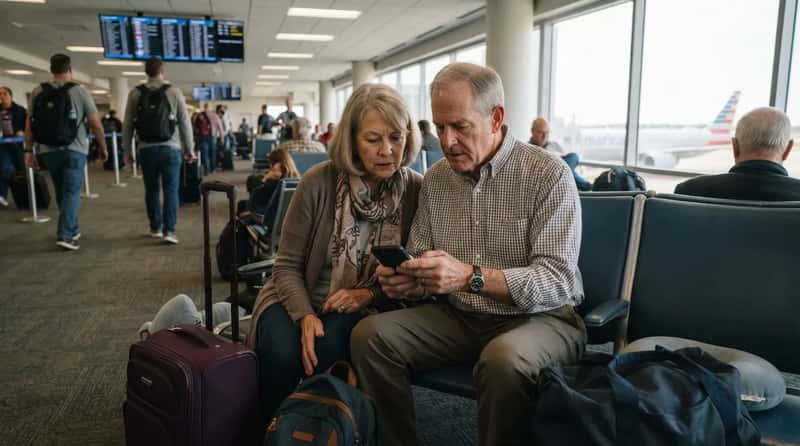
Life after 65 can be unpredictable: a health appointment, a grandchild’s emergency, a sudden change of plans. Changing a non-refundable ticket used to cost $200 or more on major U.S. carriers.
Several major airlines dropped domestic change fees around 2020, but the headlines skipped the catch. The elimination generally doesn’t cover basic economy, the cheapest fares that many budget-conscious travelers choose.
That’s the trap: buy the cheapest fare and you may find it’s essentially non-changeable. Paying extra for a flexible fare is just the change fee in disguise, collected upfront.
Quick Compare
- Basic economy: lowest price today, but usually excluded from change-fee relief, with bags and seats billed separately.
- Next fare tier: a higher sticker price, but more flexibility, and the gap is often small next to a change or cancellation cost.
Other add-ons pile up, too, from overweight-bag charges to in-flight Wi-Fi and, on some flights, even a blanket and pillow.
Flying fees are significant. But some of the most painful charges hit before you leave home, during the booking call.
#9 – The Airline Phone Booking Fee for Calling the Reservations Line

Here’s a frustrating irony: many travelers over 65 prefer to book by phone. It’s easier, there’s a real person to help, and it cuts down on errors.
Yet many airlines charge extra for the privilege, often around $25 per ticket. The fee exists to push travelers toward self-service online booking.
For someone who struggles with complicated booking interfaces, or has vision or dexterity challenges, that fee works like a tax on needing help.
Discounts for older travelers, where they exist, often aren’t advertised prominently, so people call to ask. Being charged for the call is the definition of a fee that shouldn’t exist.
And it’s not just airlines. Cruise lines have perfected the after-booking charge.
#8 – The Cruise Mandatory Gratuity Fee Added After the “All-Inclusive” Price

Cruise lines sell the dream of one price with everything covered. In practice, that’s misleading, because the mandatory gratuity – charged per person, per day – is rarely included in the headline fare.
On top of that, specialty dining can carry extra fees. An automatic 18% gratuity is commonly added to bar purchases and spa services.
For a couple on a 10-night cruise, daily gratuities of roughly $15-$20 per person can add $300-$400 before a single optional purchase. That number is almost never visible in the advertised fare.
Travelers over 65 who planned around the headline price may not notice until the final bill slides under the cabin door. By then, a meaningful chunk of the spending money is already gone.
At a Glance
- Daily gratuity: roughly $15-$20 per person, per day
- Couple, 10 nights: about $300-$400 before optional purchases
- Bar and spa: an automatic 18% is commonly added
- Specialty dining: may carry its own extra fee
It gets even more layered when you look at what cruise lines charge to stay connected at sea.
#7 – The Cruise Internet Fee That Charges Premium Rates for Barely Usable Speeds

Many older travelers want to stay connected at sea, to family, to doctors, to grandchildren at home. Cruise lines price internet as a premium amenity, and the service can be wildly inconsistent.
Packages vary widely by line. Entry-level plans can be cheap but barely load a text message, while premium plans that actually work can approach $90 a day, and streaming can still be hit-or-miss.
At that rate, a premium plan for two people on a 14-night cruise can approach $2,500. That figure appears nowhere near the advertised fare.
For travelers managing health remotely, through telehealth appointments or medication portals, internet isn’t a luxury. It’s a hidden necessity charge.
Always ask whether internet is included before booking, and get the speed tier in writing.
From the high seas to the open road, the next fee hits car renters especially hard.
#6 – The Car Rental “Young Driver” Paradox: The Senior Surcharge No One Talks About

Most travelers know rental companies charge extra for drivers under 25. Far fewer know that some impose surcharges or restrictions on older drivers, sometimes starting around 70 or 75, especially abroad.
Countries such as Ireland are known for upper age limits or extra requirements for older renters. These rules often show up only in the rental terms, not during comparison shopping.
Domestically, companies like Avis and Budget offer discounts to AARP members. Those discounts apply to the base rate, though, and won’t necessarily offset other charges.
Check the rental company’s age policy for the specific country before you book. A surprise fee can undo a discount you went out of your way to claim.
One of the most aggravating charges doesn’t come from a travel company at all. It comes from a third-party ticket seller.
#5 – The Ticketing Platform “Service Fee” That Can Add 30% to Every Attraction

Museums, theater, national park tours, sporting events – many travelers over 65 plan whole trips around them. For many, the only way to book ahead is through a third-party platform that adds a hefty service fee.
A Government Accountability Office report found that ticketing fees averaged roughly 30% of a ticket’s price. At that rate, a $40 museum ticket can easily become a $52 purchase.
Across a longer trip with multiple attractions, those fees compound quietly. They often appear only at final checkout, drip pricing applied to fun.
Booking directly on a venue’s official website, or calling the box office, can cut out the platform fee. Some venues add their own charges, so compare the totals.
Now we’re getting to the fees that feel personal. The next one targets something most older travelers consider essential.
#4 – The Travel Insurance Upsell That Isn’t What It Appears to Be

Airlines, OTAs, and hotel sites almost all offer travel insurance at checkout. For travelers over 65, the pitch lands hard: medical emergencies abroad, trip cancellations, lost luggage.
These are real worries, and the pop-up shows up at exactly the moment you feel them most. But the policy offered at checkout often isn’t the most comprehensive option for older travelers.
Pre-existing condition exclusions are common in basic policies, and after 65, pre-existing conditions are often the rule, not the exception. Finding that out after a claim is denied may be the costliest surprise on this list, because you made decisions believing you were protected.
Insurance for older adults deserves deliberate research, not a checkbox clicked in the final moments of a booking session. Compare policies and read the exclusions before you buy.
We’re nearing the biggest ones. The next hits before you even leave the parking lot.
#3 – The Hotel Parking Fee That’s Charged Even for Guests

Parking at your own hotel used to be free for guests. That assumption is now dangerously outdated, especially at big-city and resort properties.
Self-parking and valet fees at major hotels can run $25 to $65 or more per night. The charge is separate from the room rate and the resort fee, and it repeats every night of the stay.
Hotels have turned once-complimentary extras into billable line items, from parking and Wi-Fi to pool towels and laundry.
Worth Knowing
- Ask for the nightly parking price before you book, not at check-in
- Ask whether a cheaper self-park option exists
- Ask if your AAA or AARP rate includes complimentary parking
- Multiply by your number of nights to see the real add-on
Drive in for five nights at $45 a night and you’ve added $225 to a budget that never included it. Asking about parking before you book can spare you.
Two more to go, and they’re among the most widely overlooked charges on the list.
#2 – The “Fuel Surcharge” on Award Tickets That Erases the Entire Value of Your Miles

Travelers over 65 have often spent decades collecting airline miles. Redeeming them for a “free” flight feels like the payoff, and then the surcharge appears.
Some international airlines, particularly European carriers, pass along fuel or carrier-imposed surcharges even on award tickets. On some routes they run several hundred dollars, turning a “free” flight into one that still costs real money.
For a traveler who expected miles to cover everything, it’s a genuinely shocking charge. Many people only see it on the final booking screen.
U.S. carriers such as Delta and Southwest generally don’t add fuel surcharges to award tickets. But redeem through a partner airline, as many savvy points travelers do, and the surcharge can ambush even experienced collectors.
And now, the fee that’s easiest to miss, and the one that may quietly cost travelers the most.
#1 – The Fee-on-a-Fee: Taxes and Surcharges Calculated on Top of Already-Inflated Resort Fees

Here’s the charge almost no one notices. When a hotel adds a resort fee, that fee is often taxed too, so you pay tax on the room and then again on the resort fee.
It’s a fee on a fee. And it makes a $150 room and a $150 room plus several unavoidable charges two very different deals, even if the first number looked fantastic in search results.
The FTC now requires short-term lodging businesses to show the total price upfront, including mandatory fees. But travelers still need to know which charges deserve a closer look.
For travelers over 65 who stay longer than average, a week at a resort or a 10-night leisure trip, this compounding creates a bill that barely resembles the number that prompted the booking.
The same problem can apply to airline surcharges, cruise port fees, and OTA booking fees, where taxes may be layered on top. The extra percentage is rarely explained while you’re browsing.
The Bottom Line

Travelers over 65 often get hit hardest by this fee maze because they plan ahead, call for help, stay longer, check bags, and budget carefully around advertised prices.
In April 2024, the U.S. Department of Transportation finalized a rule requiring airlines to show all fees upfront. Airlines challenged it, and a federal appeals court paused it.
Until transparency is mandated and enforced, the burden falls on the traveler. The most effective defense is one question before every booking: “What is the total price I will pay, including all mandatory fees?”
Ask it by phone, ask it in writing, and ask it again at check-in. Every fee on this list can be anticipated, but only if you know it exists.
Did we miss a fee you’ve been charged? Drop it in the comments.
Bonus: The Three-Minute Paper Trail That Protects You From Surprise Fees

Asking about fees helps. Getting the answer in writing is what actually protects your money when the bill comes out higher than you were told.
- Screenshot the total. On the final checkout screen, before you click “confirm,” capture the full price with taxes and mandatory fees showing.
- Get the total by email. If you book by phone, ask the agent: “Can you email me the total per night, including every mandatory fee and tax?” Do not hang up until you have the agent’s name and the confirmation in your inbox.
- Pay with a credit card, not a debit card. Federal billing-error rules give you 60 days from the date of the statement showing the charge to dispute it in writing with your card issuer.
At check-in, if the total is higher than your email or screenshot, show it politely and ask the manager to honor the quoted price. Many front desks will adjust it right there.
If they refuse, pay, keep every document, and dispute the difference with your card company. You can also report the business at ReportFraud.ftc.gov, since the FTC’s price-transparency rule covers hotels, short-term rentals, and live-event tickets.