Picture a guest in their late 60s paying full price at the front desk, while a quick question and an ID check could have knocked the rate down. That’s the click, validated: yes, these perks exist, and plenty of guests over 65 never ask for them. Some are discounts. Others are accessibility rules hotels are required to follow, and front desks rarely bring them up.
Here’s the twist. The age cutoffs are all over the map. A few chains start at 55, one famous name waits until 65, and the biggest sleeper perks on this list have nothing to do with a percentage off. Let’s count them down.
#15 – Best Western Starts the Clock at 55, a Full Decade Before Some Chains

Best Western’s senior offer page says guests 55 and older save with discounted room rates. It doesn’t publish a percentage, so the size of the discount depends on the property and your dates. One travel site estimates typical savings of up to 15%, but that’s a third-party estimate, not a promise.
Here’s the catch. Hilton’s own senior rate requires you to be 65 or older. That means someone in their late 50s can qualify at one chain and get shut out at another. The age gap between chains can be ten years. You’ll also need a valid ID at check-in to verify your age.
The next one comes from a budget brand most people only think of for long hauls.
#14 – Extended Stay America Quietly Offers a Rate at 55+

This one rarely makes the headlines. A 2026 roundup says guests 55 or older are eligible for a discounted rate at Extended Stay America. That matters because the brand is built around longer stays, and even a modest nightly discount adds up over weeks.
Think of a winter-long trip, or a month near a family member’s hospital. A few dollars off per night becomes a real number by the end. The brands built for the longest stays are where a senior rate can pay off most. Terms can change, so confirm the details when you book instead of assuming they carry over from last year.
The next chain covers a whole family of budget names, and you’ve probably slept in one.
#13 – Wyndham’s 60+ Rate Covers Budget Names You Already Know

Wyndham offers special senior rates to guests 60 and older at participating hotels. The family includes Days Inn, Ramada, Super 8, Travelodge, La Quinta, and more. That’s a lot of roadside signs with a possibly lower price waiting behind them.
One writer ran a test search near Washington, D.C. A Wyndham Garden showed a standard rate of $139.40 a night against a senior rate of $106.60, roughly a 24% reduction. That’s a single example, not a guarantee. Still, a $33 nightly gap on one search shows why asking beats assuming.
Next up is a chain where “up to” does a lot of heavy lifting.
#12 – Choice Hotels Opens the Door to AARP Members of Any Age

Choice’s senior-rates page says guests 60 and older, or AARP members of any age, save up to 10% with advance reservations at participating hotels. The words “advance reservations” matter. The discount is subject to availability, and you need ID proving your age, or an AARP card, at check-in.
Here’s the part people skim past. “Up to 10%” is a ceiling, not a promise. Walk-up guests are generally left out because the rate rewards booking ahead. The brand list is long, though. It covers Comfort Inn, Quality Inn, Sleep Inn, Clarion, Econo Lodge, Rodeway Inn, Cambria and more.
The next two chains both start at the same age, and both come with fine print.
#11 – Hyatt and IHG Both Want You at 62, With a Catch

Hyatt’s senior rates begin at age 62 at participating hotels. IHG Rewards members who are 62 and older can qualify for senior rates at participating hotels. Notice the word “members” in the IHG line. You may need to be enrolled before the rate shows up.
The word “participating” is easy to skim past. It means a senior rate can exist at one Holiday Inn or Hyatt and be missing at the one across town. Two hotels under the same brand can give you two different answers. A quick search on the exact property beats trusting the brand name.
Quick Compare: Who Qualifies at What Age
- 55+: Best Western and Extended Stay America
- 60+: Wyndham, and Choice (which also opens its rate to AARP members of any age)
- 62+: Hyatt, and IHG for Rewards members
- 65+: Hilton, the latest start on the list
The next entry is the one many people expect to be the best deal, and it might not be.
#10 – Hilton’s 65+ Rate Is Real, but the Savings Are Smaller Than You’d Think

Hilton’s senior rate gives travelers 65 and older a discount off the Best Available Rate, with recent guides putting it at up to about 6%. You can book a maximum of two rooms, the second for family members only. It’s valid for leisure stays and requires proof of eligibility at check-in.
One more twist. One guide reports that Hilton’s old AARP rate has been discontinued, so the 65+ rate may be the only age-linked option left. That’s a big change for anyone still carrying an AARP card and expecting a Hilton discount. To find the rate, open “Special Rates” in the hilton.com search box and check “Senior Rate.”
Speaking of AARP, the next entry shows how a card can beat the age cutoff entirely.
#9 – An AARP Card Can Unlock Rates Before You Hit the Senior Age

If you’re an AARP member, you may qualify for hotel discounts even if you haven’t reached a chain’s regular senior age. That’s most useful when a chain’s senior rate doesn’t start until 60, 62, or 65. Partner lists change. One guide says AARP’s current list features Wyndham, Best Western, Choice and Motel 6.
Another source also names Red Roof, so check aarp.org before you count on it. Many chains’ own senior rates overlap with AARP rates. The card matters most for people in their 50s, who haven’t aged into most senior rates yet. After that, compare AARP and senior rates side by side, because they aren’t always the same price.
Now for a small step that can sink every discount above.
#8 – The Proof-of-Age Rule That Quietly Kills Discounts at the Counter

Senior rates aren’t granted on your say-so. One guide says a valid government ID, such as a driver’s license or passport, proving you meet the minimum age is what you need at check-in. Choice also accepts an AARP card for its member rate.
The trouble starts when the ID is left in the car or the AARP card is sitting at home. A discount booked online can be denied at the desk, and by then you’re tired and holding your bags. Hilton’s senior rate also may not combine with other promotions. Read the terms before you book, and pack the ID right alongside your boarding pass.
At a Glance: Your Check-In Folder
- Bring: a government-issued ID, such as a driver’s license or passport
- Choice stays: an AARP card also works
- Hilton stays: expect proof of eligibility, a two-room limit, and leisure-only use
- Before you pay: check whether the rate can be combined with other promotions
The next move costs nothing and takes about two minutes.
#7 – A Phone Call Can Shake Loose a Better Number Than the App

Rates differ by property. One roundup advises calling before booking to double check the savings, since rates vary by location. A website may show the senior rate, hide it, or bury it under a different label.
A call lets you ask what a booking screen can’t. What ID do they check? Is the rate refundable? Is the price lower than the advance purchase rate? Some travelers find out on the phone that a senior rate isn’t offered at that location at all. That beats finding out at check-in.
The next few entries aren’t discounts at all, and they may matter more.
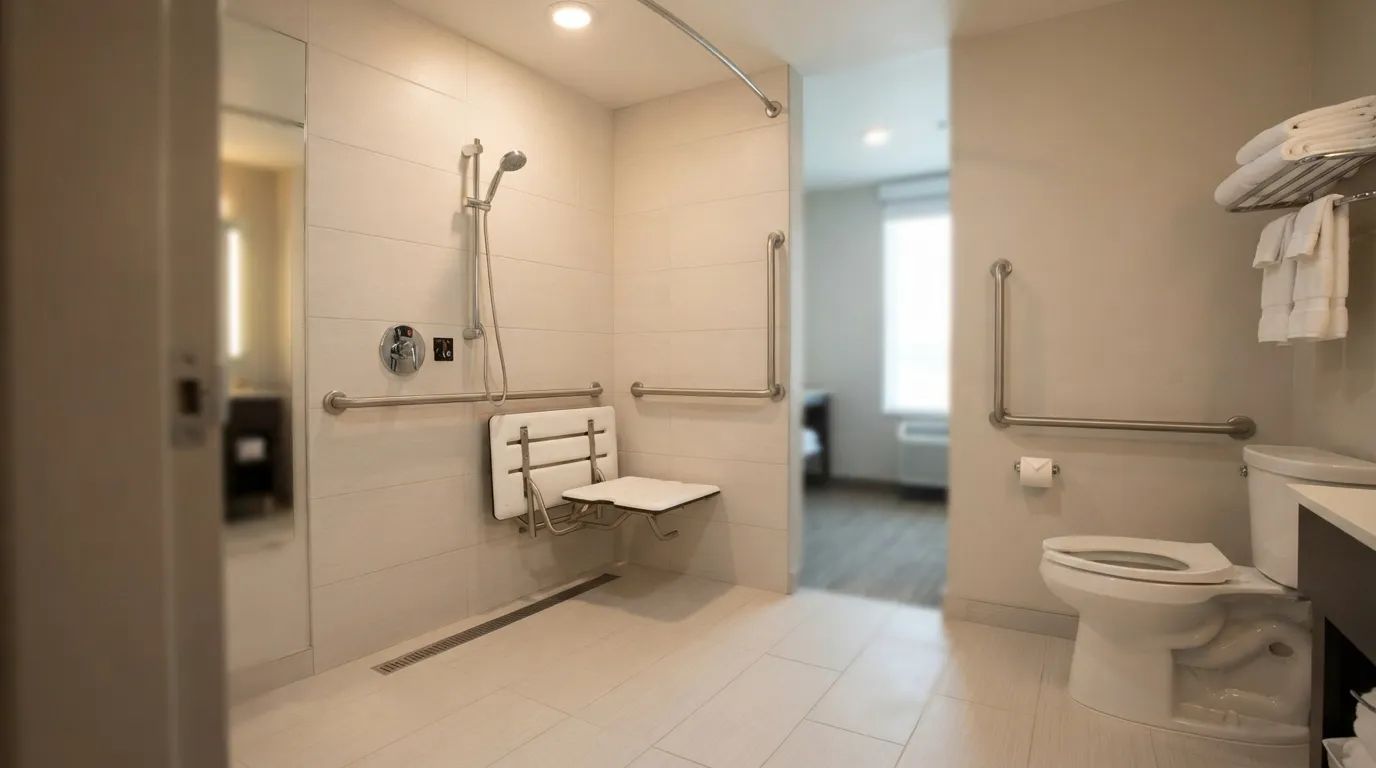
#6 – Shower Seats and Grab Bars Are Built-In Requirements, Not Favors

An accessible room is not an automatic age perk. It’s meant for guests who need accessibility features, and many older guests do. Under the federal accessibility standards, accessible rooms with a roll-in shower must include a shower seat. Grab bars must be on the side wall opposite the seat and along the back wall.
The toilet has rules too. Its height should be no lower than 17 inches and no taller than 19 inches. That’s a specific measurement, which means a “close enough” bathroom can be out of spec. The features help other guests as well. Wider doorways and grab bars benefit parents with strollers, older travelers and anyone recovering from an injury.
Next, a choice between tub and shower that many guests never realize they have.
#5 – Tub or Roll-In Shower: Hotels Must Offer Both Styles

Some guests prefer a bath. Others need to roll right in. Hotels must provide both types across their accessible room inventory, which means you may be able to ask for the style that fits your body and your balance.
Size matters here, and it’s where plans go wrong. Roll-in showers are required once a hotel exceeds 50 rooms. Smaller hotels can legally have only accessible tub rooms. With 0 to 25 rooms, a hotel must have one accessible room, and with 26 to 50 rooms, it must have two. If you need a roll-in shower, check the hotel’s size before you book.
One category here is rarely mentioned, and it has nothing to do with the bathroom.
#4 – Hearing-Friendly Rooms With Flashing Alarms and Door Alerts

Hearing changes are common with age, and hotels have a solution most guests never ask about. Hearing-accessible rooms focus on communication. If a fire alarm sounds, a guest who can’t hear it needs a visual signal.
The list is practical. A hearing room can include visual strobe alarms, a visual door-knock indicator, and a TTY or volume-control phone. A door knock you can’t hear is a problem you don’t think about until housekeeping or an emergency arrives. If you take your hearing aids out at night, these alerts can be the difference between sleeping soundly and sleeping through something important.
Fast Facts: What a Hearing-Accessible Room Can Include
- Visual strobe alarms that flash if the fire alarm sounds
- A visual door-knock indicator so a visitor or staff member doesn’t go unnoticed
- A TTY or volume-control phone for easier calls
- Best timing to ask: when you reserve, not when you arrive
The next entry is about money, and it surprises people.
#3 – An Accessible Room Can’t Cost More Than the Standard One
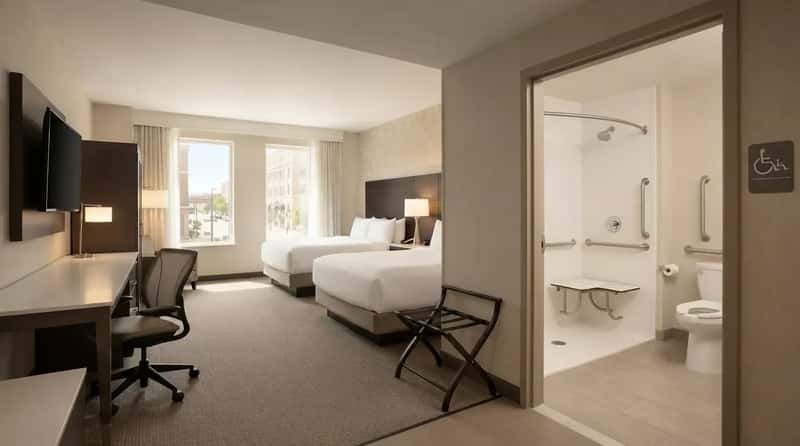
Many travelers assume extra features mean an extra charge. One guide says a hotel cannot charge more for an accessible room just because it has additional features. Price parity is a core rule.
The law reaches most lodging. Hotels, motels, and inns with six or more rentable rooms, where the owner doesn’t live on-site, must comply with ADA Title III. That covers far more than the big-name chains. It reaches small independent places too.
Now the part that decides whether the room is actually waiting for you.
#2 – The Last Accessible Room Must Be Held for Guests Who Need It
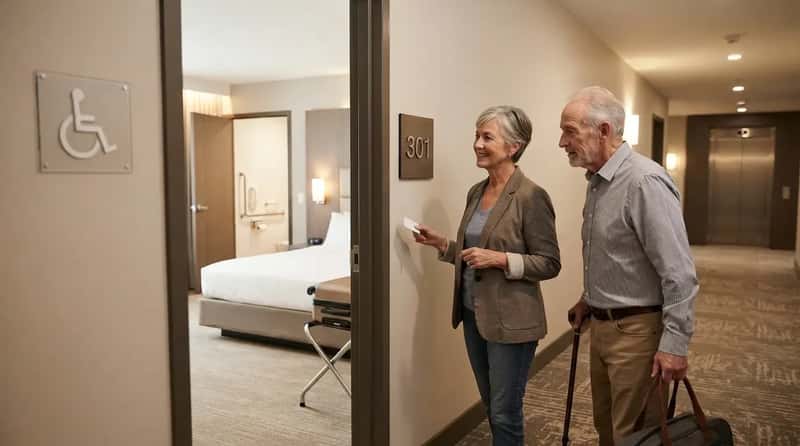
Booking isn’t always the same as getting the room. Federal reservation rules say systems must let guests book accessible rooms the same way as standard rooms, hold them until other rooms of that type sell out, and guarantee the room booked.
One guide puts it bluntly. A hotel can’t sell the last accessible room to a guest who doesn’t need it while it still has non-accessible rooms to sell. That rule exists because a “request noted” is not a reservation. Some hotels will say they’ve put your request in the notes instead of promising the room itself.
And the last entry matters most, especially if you’ve ever walked into a room that didn’t work.
#1 – Hotels Must Describe Accessible Rooms in Detail, So Ask to See the Specifics

“Accessible room” is not supposed to be the whole description. The reservation system must clearly describe the accessible features, such as roll-in shower versus bathtub, room layout, grab bars, and door widths, so guests can decide if the room fits. Generic terms like “accessible room” are not enough.
The stakes are real. Features in a room marked ADA can vary, so following up with the hotel for exact details helps avoid disappointment. Common roll-in shower problems include missing seats and controls that sit out of reach of a seat. The benefit most guests need is a clear answer before they arrive. Ask for door widths, shower type, and seat details, then ask the hotel to put them in writing.
Worth Knowing: Four Questions to Ask Before You Arrive
- Is the bathroom a roll-in shower or a tub?
- Does the shower include a seat, and where are the controls?
- Are grab bars installed, and how wide are the doorways?
- Can the hotel confirm all of this in an email?
Some of these perks start at 55, some at 60, 62, or 65, and a few depend on need rather than age. Senior rates almost always apply only at participating hotels, so the property matters as much as the chain.
Bring your ID, compare against advance purchase rates, and ask before you arrive. The front desk may never offer, but the answer is often just one question away.