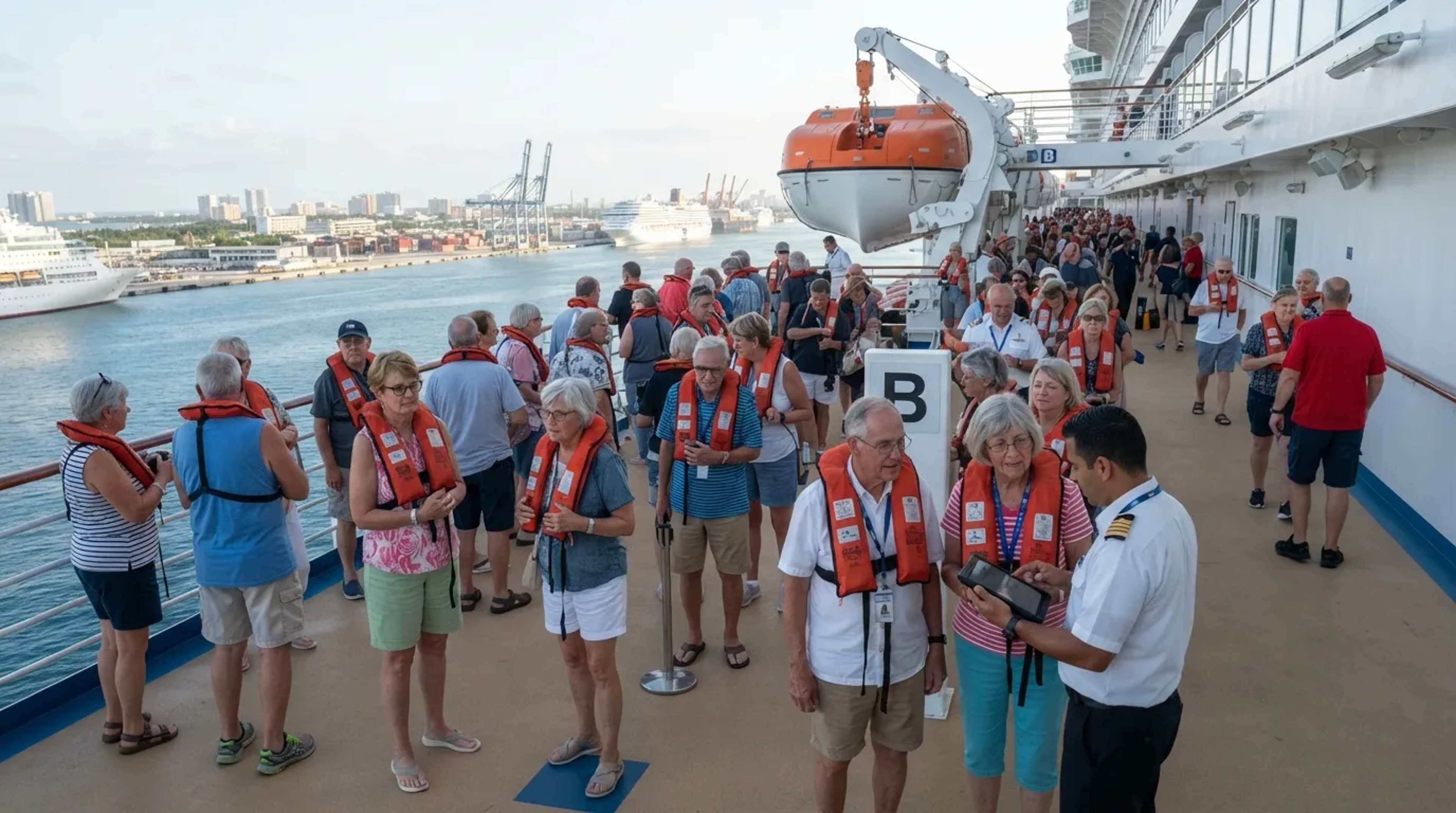

A cabin at midship on deck 12 will feel more movement than an identical one on deck 5, and care at the ship’s medical center is not part of the cruise fare. These 15 habits are what repeat cruisers over 65 settle on before the ship leaves the pier: where to sleep, what to swallow, and how to keep the medical desk out of the picture.
Most take five minutes and a pen, but the last one involves a figure past $100,000 that a phone call from your kitchen table can answer. The countdown starts with the thing even the best cabin cannot overrule: the ship itself.
#15 – The Ship’s Size and Stabilizers Come First

Three things decide how much motion you feel, in this order: the ship’s size by gross tonnage, its stabilizer technology, and your cabin location. A 230,000-ton ship with active hydraulic stabilizers and a midship low-deck cabin will feel almost nothing in normal seas.
A small older ship in rough water rocks visibly, whatever deck you are on. That is why I would give the ship more of your research time than the cabin.
A good cabin on a poorly suited ship has less to work with. Look at the tonnage and the stabilizer details before you open a deck plan.
The cabin rule still earns its place as a tie-breaker. Passenger studies have not consistently found that cabin location alone predicts who gets seasick, but it is the one factor you control once the ship is booked.
That control works in two directions on a deck plan, along the length of the ship and up and down it.
#14 – A Low Cabin Midway Along the Ship
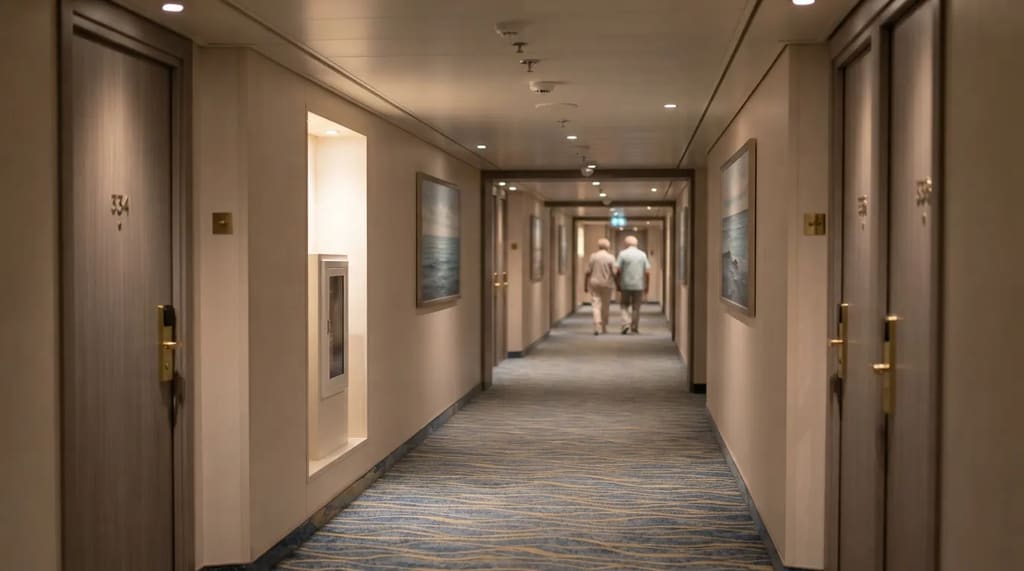
A ship pivots around its middle, so the ends move the most. That is why the cabins between roughly one third and two thirds of the way along the ship’s length are the usual recommendation.
Height matters too, because roll motion amplifies the higher you go. A cabin on deck 3 at the waterline will sway far less than an identical one on deck 12.
On the deck plan, find the cabin closest to halfway between bow and stern on the lowest passenger deck available. The ideal deck number varies by ship, so there is no figure worth memorizing.
Midship, low-deck cabins are in high demand. If you are sensitive to motion, reserve one when you book instead of waiting for a late price drop.
Staterooms on high decks and far forward or aft are prized for their views, and that is where the motion is greatest.
#13 – What a Bow or High-Deck View Costs
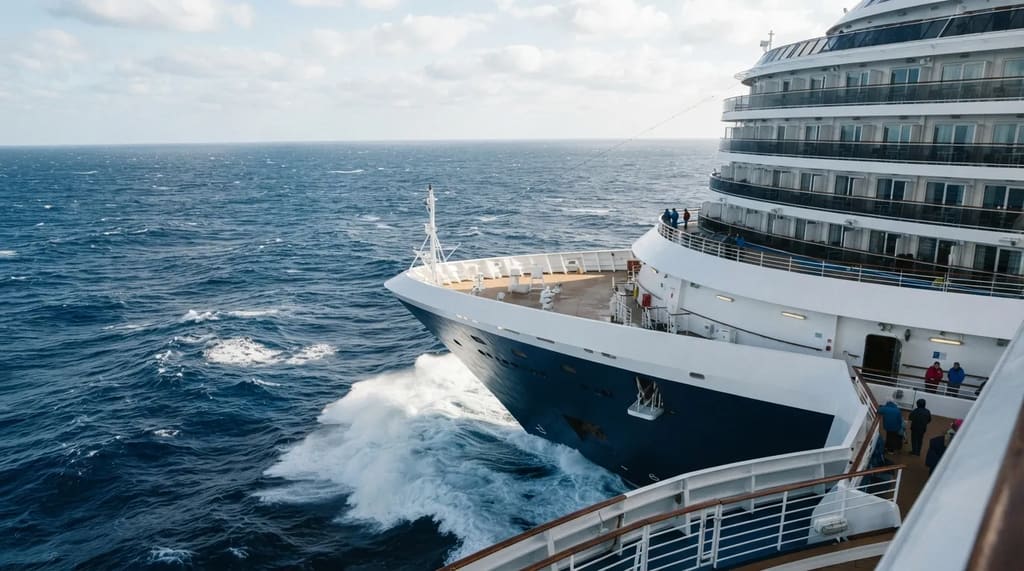
A cruise ship works like a seesaw: the bow and stern pitch the most, while upper decks amplify the side-to-side roll as the ship crests waves. A forward cabin on a high deck gets both effects at once.1
Those high and far-end staterooms are the worst choice for avoiding motion sickness, even though they are the ones sold on their views.
If you are sensitive, a premium room at the front or top of the ship pays you in scenery and charges you in queasiness.
My own view is that a calmer room lower and nearer the middle wins over a high-deck balcony. A view you cannot enjoy because you feel sick does not add much to the trip.
Watching the sea from a balcony helps some travelers and bothers others, which leaves the choice of room type open.
#12 – Inside Cabin or Balcony on a Calm Deck
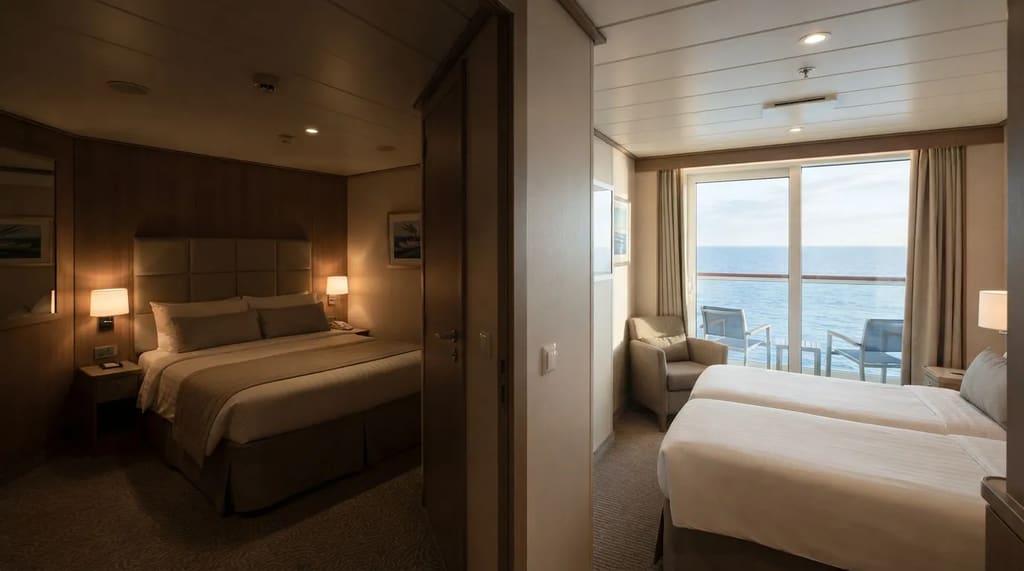
Advice on room type splits, and both camps have a point. Some cruisers favor interior cabins on lower midship decks, because you do not see the waves outside and the room is also darker and quieter.
Others point out that a window cabin gives a fixed horizon and daylight. The room that lets you see the horizon and get air may be the better motion-sickness choice.
If watching moving water makes you feel worse, a midship interior on a lower deck may be more comfortable. If you want fresh air, a midship balcony on a moderate deck, such as deck 6 or 7 rather than deck 14, is a reasonable compromise.
Quick Compare
- Midship interior, lower deck: no waves in view, and a darker, quieter room.
- Midship balcony, moderate deck: a fixed horizon, daylight and fresh air.
- If you are asked to stay in: a balcony beats a windowless room.
There is one more thing to weigh. When passengers report stomach illness, cruise staff ask them to stay in their cabins until symptoms pass.
Confinement is unlikely to be on your itinerary. If it happens, a balcony beats a windowless room, and that tips my own choice toward a balcony on a moderate deck.
#11 – What Age Changes About Seasickness Risk
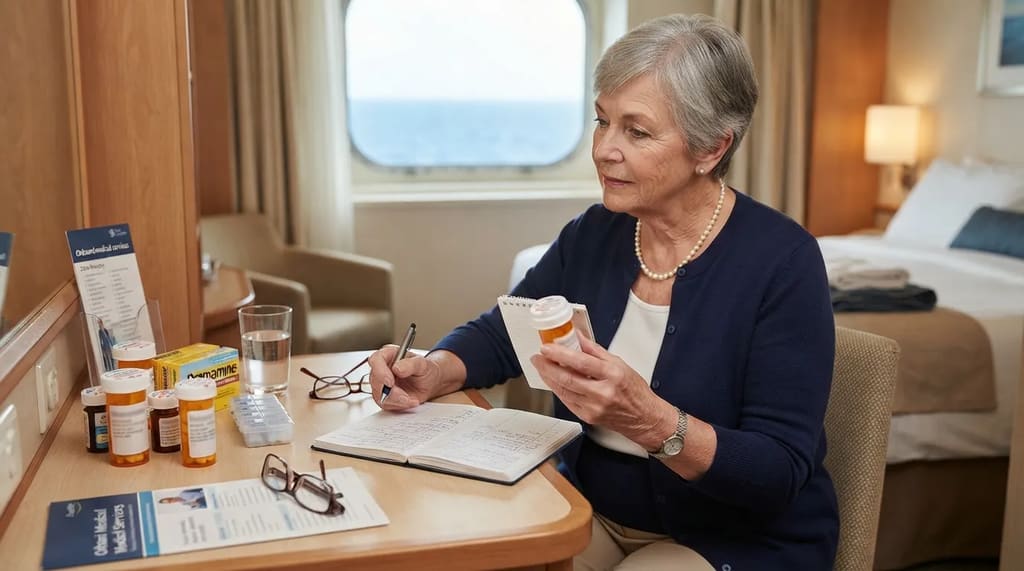
The CDC’s Yellow Book lists age, sex, preexisting medical conditions and concurrent medications among the risk factors for motion sickness. It adds that adults over 50 are less susceptible.
That is good news with a condition attached. The same list includes the medicines you already take, and some prescriptions can worsen motion sickness–associated nausea.
A traveler over 65 is more likely than a younger one to be on several prescriptions. So the contents of your medicine cabinet deserve as much attention as the deck plan.
Before you book, ask your doctor or pharmacist whether anything you take can aggravate nausea. Bring the full list, including over-the-counter products and supplements.
#10 – Take the Pill Before the Ship Moves
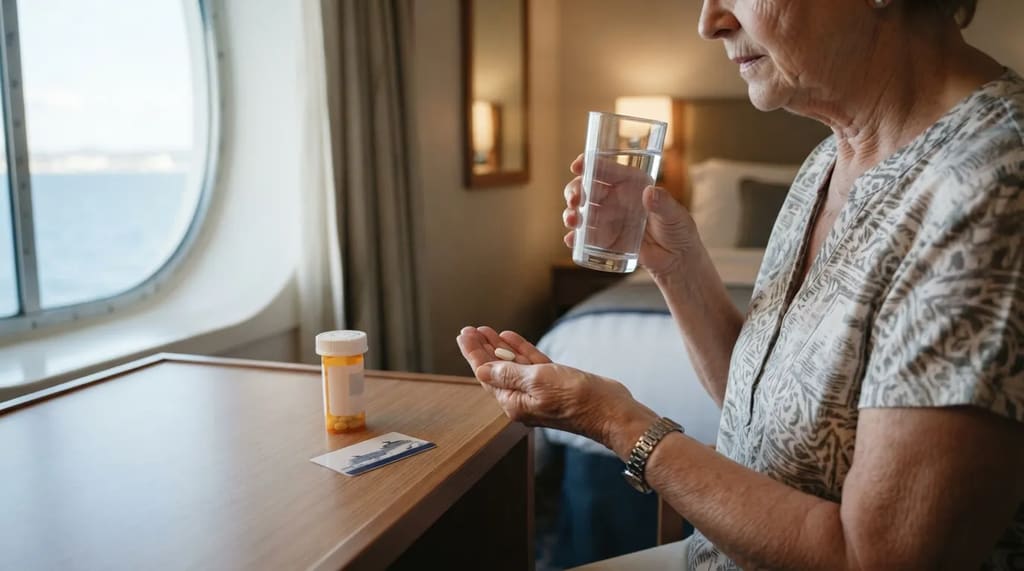
The CDC advises that medication is most effective when taken before exposure, rather than after the onset of symptoms. The reason is that established nausea slows stomach emptying and can delay absorption.1
A tablet swallowed after you feel sick may just sit there while you feel worse. For meclizine, the label says to take it one hour before travel, and one dose covers up to 24 hours.2
Fast Facts
- Medication works best when taken before exposure, not after symptoms start.
- Nausea that has already set in slows stomach emptying.
- The meclizine label says one hour before travel.
- One meclizine dose covers up to 24 hours.
Plan the dose around the label, not around the moment the ship leaves the pier. I would not wait for the first sign of queasiness on a sailing day, because the point of the medicine is to be ahead of it.
Taken for the first time on the pier, a dose also brings its side effects with it. Those are better met at home.
#9 – A Trial Dose at Home

Medications used to treat motion sickness vary in effectiveness and side effects. The CDC suggests travelers take a trial dose at home before departure to find what works best.
A pill that makes you drowsy on a quiet afternoon in your living room is a nuisance. The same pill on a ship, with its stairways and moving decks, deserves more thought.
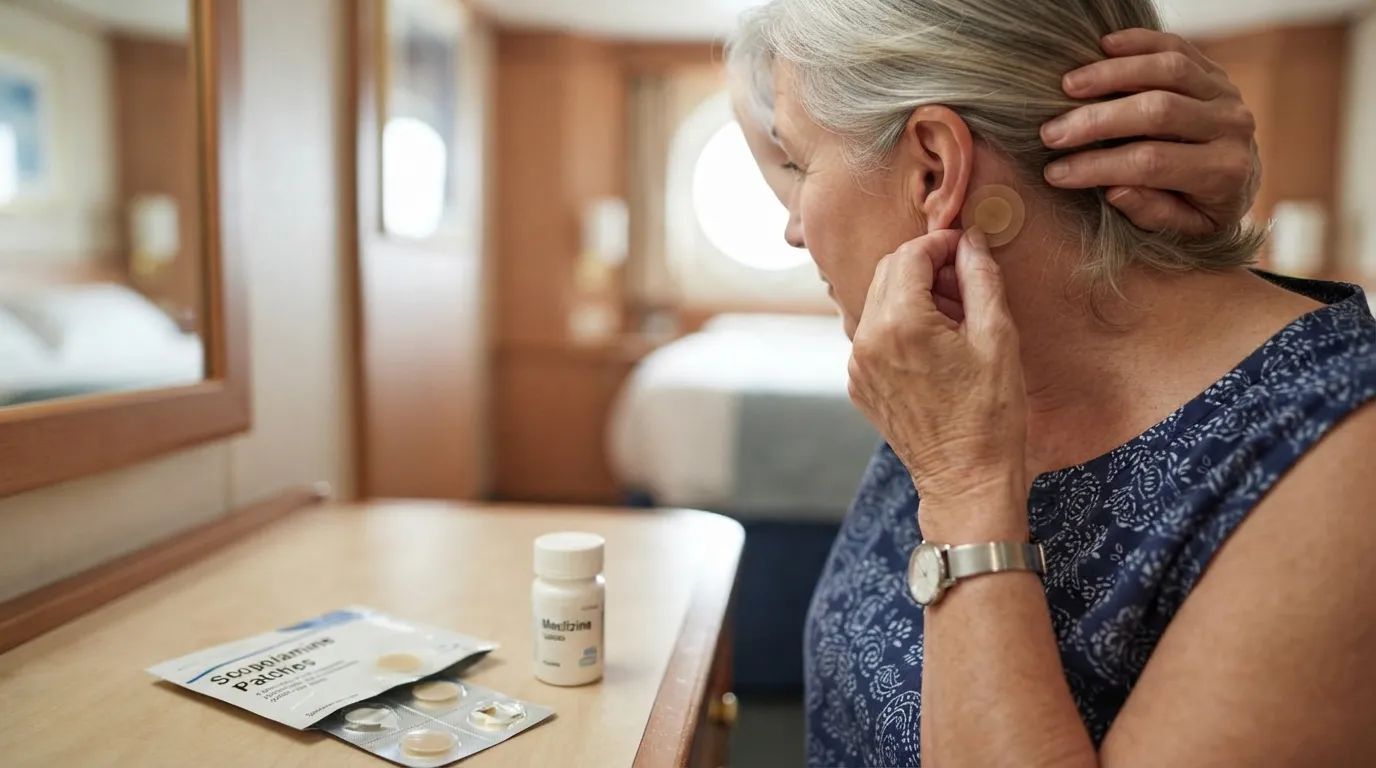
If your doctor is considering the patch, the trial has to go through the doctor’s office, because scopolamine (Transderm Scop) is prescription-only.
Trial dosing settles how you tolerate a drug and leaves open which form suits the length of your sailing.
#8 – Pill or Patch for the Length of the Trip
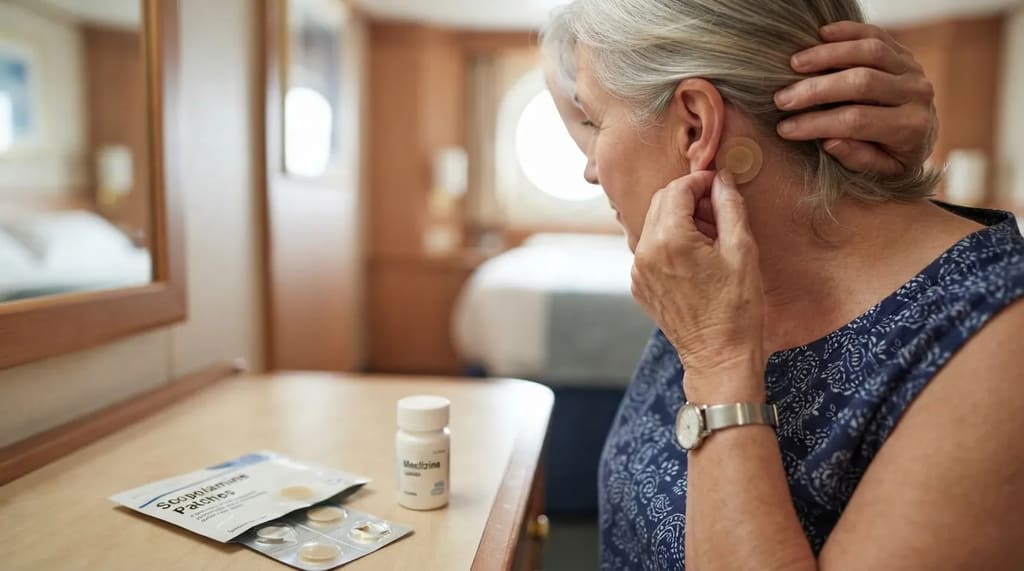
The CDC’s Yellow Book matches the drug to the strength of the motion. For mild to moderate stimulus it lists meclizine or dimenhydrinate, and for moderate to intense stimulus the scopolamine patch.
The two differ in timing. Over-the-counter chewable meclizine starts in about two hours and runs 8 to 24 hours.
The patch is slower to start. The label minimum is four hours ahead, but CDC guidance puts its onset at six to eight hours, so apply it the evening before you sail.
For a three-night sailing on sheltered water, I would start with the milder pill after talking it over with your doctor. For a week on open ocean, a patch that you change every three days may be easier to manage, if it suits you.
The patch is not for everyone. The CDC says scopolamine should not be used by travelers with glaucoma or those at risk of prostatic urinary retention, and dry mouth and dry eyes are more common with it.
#7 – Sleep Aids, Alcohol and the Fall Risk

All seasickness medications should be used cautiously by people 65 and older, because older adults are more sensitive to drowsiness, dizziness and dry mouth. The sedating and anticholinergic drugs involved can also bring confusion, urinary retention, blurred vision, constipation and falls in older adults.
That matters on a ship because of the sleep aid you take at night and the drink you have at dinner. Do not combine meclizine, dimenhydrinate, scopolamine, sleep aids, opioid pain medicine, sedatives or alcohol without professional guidance.
Worth Knowing
- Older adults are more sensitive to drowsiness, dizziness and dry mouth.
- Falls are the risk that matters most on stairways and moving decks.
- Name every seasickness product, sleep aid and evening drink to your pharmacist before you sail.
Many over-the-counter sleep products contain antihistamines too, so read the labels for overlap. If you take a sleep aid at home, the first night aboard is the wrong time to pair it with a seasickness pill without checking.
Your bathroom sink handles a different risk on board, the stomach virus that cruise ships are known for.
#6 – Soap and Water Before the Sanitizer Bottle
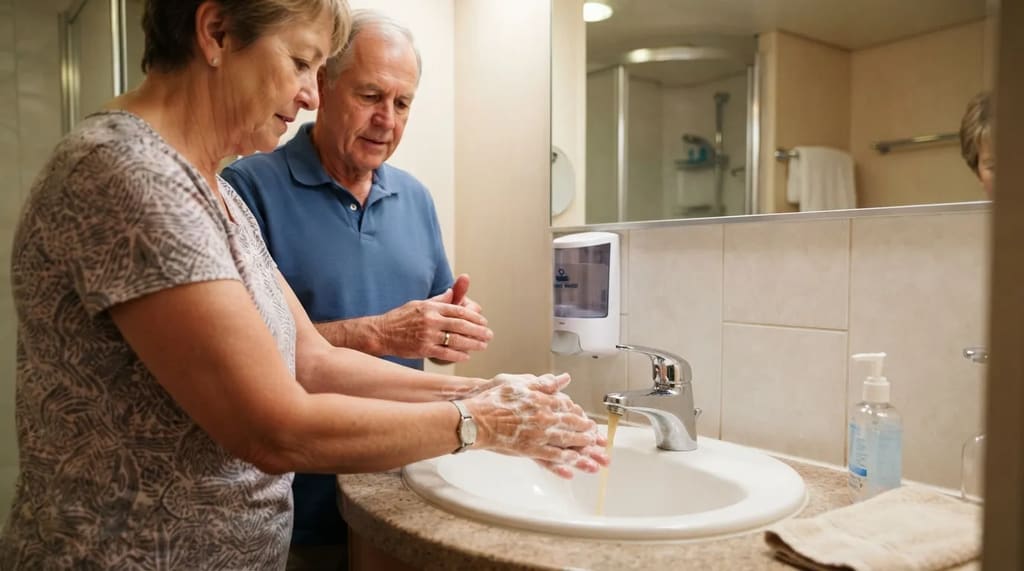
The CDC’s advice to cruise passengers is to wash their hands often and not rely on hand sanitizer. Sanitizer is less effective against norovirus than handwashing with soap and water.3
The usual guidance is hot water and soap for at least 20 seconds, especially before eating and after restroom use.
A sanitizer bottle is still reasonable as an extra layer when no sink is near, and one with at least 60 percent alcohol is the kind to carry.3 I would not treat it as protection on its own at a buffet line.
Disinfecting wipes on door handles, remotes and light switches work alongside handwashing, not in place of it.
Washing helps you avoid the virus but does little once you are already sick, and that situation has its own rules aboard.
#5 – Tell the Medical Center and Stay in the Cabin
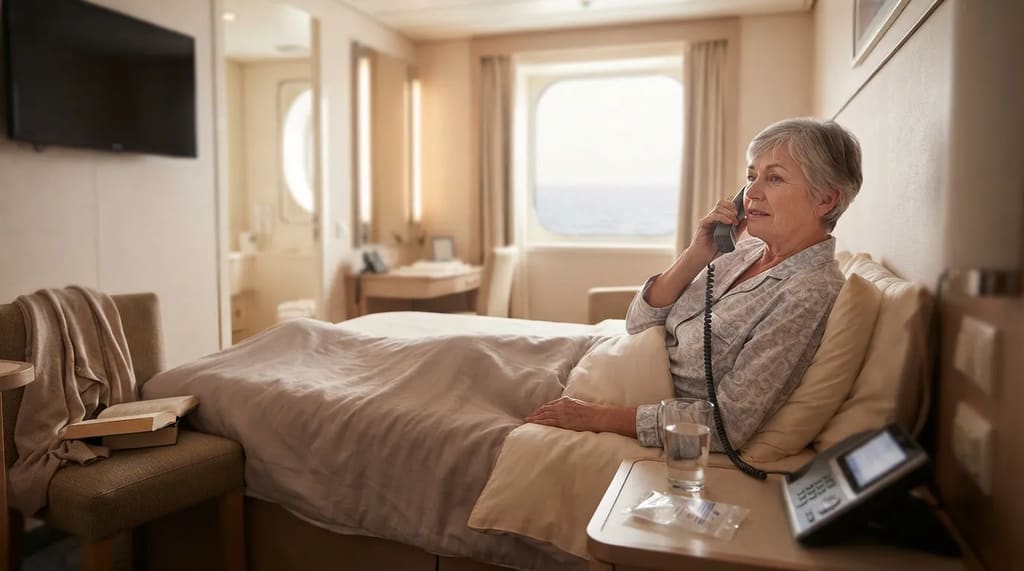
If you develop vomiting or diarrhea on board, the CDC’s guidance is to tell the cruise ship’s medical center. These illnesses are very contagious, so if the medical center advises you to stay in your cabin, it is important to do so.1
Skipping the call to avoid a fee is a poor saving. Staff ask passengers to report illness so it does not escalate into an outbreak.
The CDC’s tips also include drinking plenty of water and getting plenty of rest. Oral rehydration packets in your bag help you manage a mild case.
Before you board, do not sail with active vomiting or diarrhea, and check the cruise line’s health declaration and rebooking policy. Your travel insurance or a qualifying credit card might reimburse a missed sailing if you fall ill before embarkation.
#4 – Prescriptions in the Carry-On, in Original Bottles
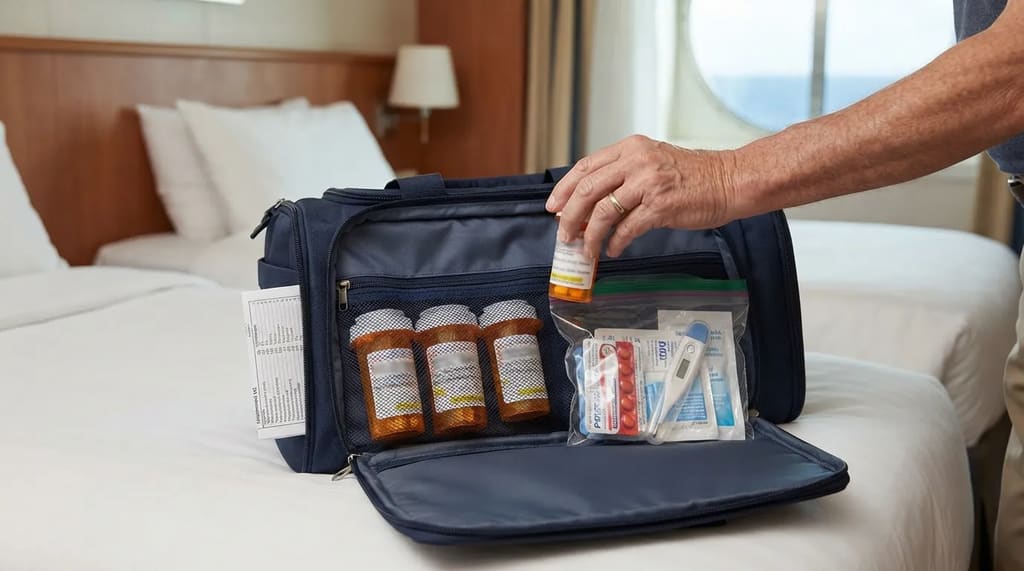
Pack prescription medicine in its original labeled pharmacy containers. Carry it in your hand luggage rather than checked bags, with a copy of the prescription.
Checked bags can reach your cabin hours after you board, and customs in some ports may inspect medications. A few extra days’ supply covers a delayed trip home, and your pharmacist can tell you whether your plan allows it.
Add oral rehydration packets, a pain reliever and a thermometer. That way a mild illness in the cabin does not automatically mean a paid visit.
Anything beyond what you carry goes through the medical center, which charges for each visit.
#3 – How the Medical Center Bills You
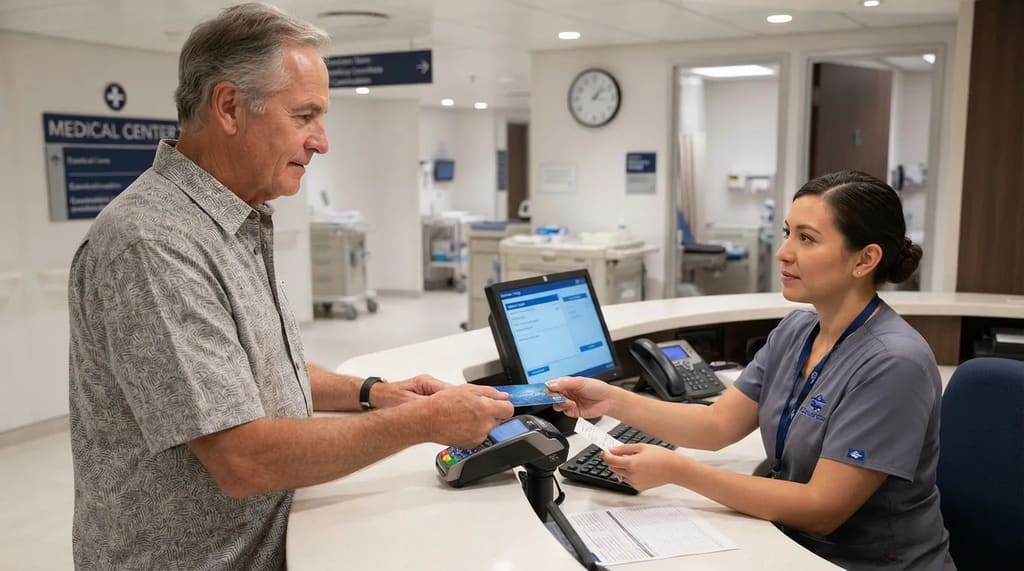
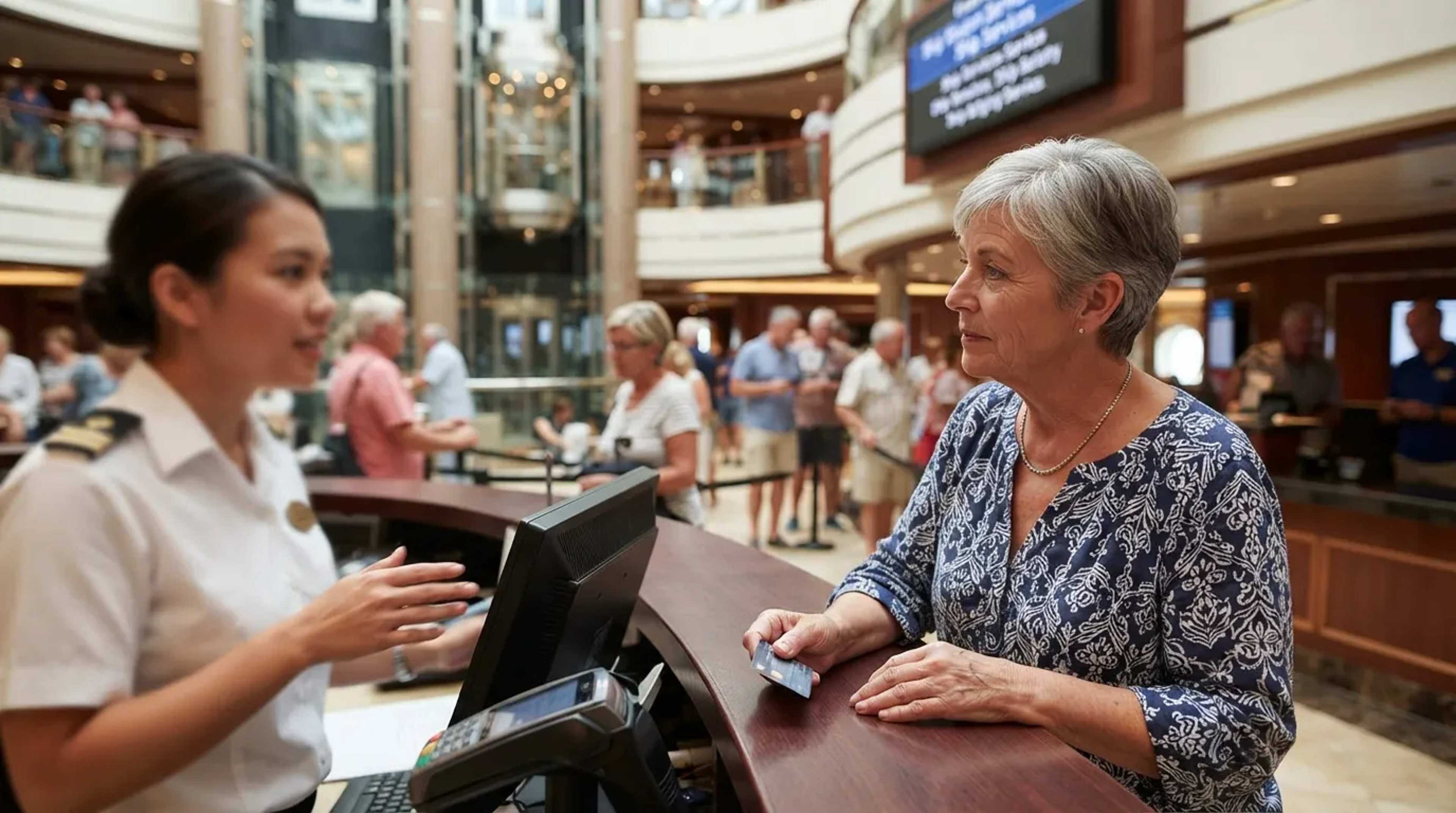
Cruise lines typically run their medical facilities as fee-for-service operations, so passengers are billed directly for consultations, treatments, medications and diagnostic tests. The charges post to the same onboard account that tracks drink packages and specialty dinners.
Figures quoted by travel-insurance sellers run from $100 to $300 for a daytime consultation and $300 to $600 or more after hours. That means the clock on the wall changes the bill.
The physicians on board are independent contractors who set customary fees that vary by ship and time of day. The ship’s medical center is not going to bill your insurance company, so you pay at the time of service and apply for reimbursement later, if your plan allows it at all.
Related Stories From Travelbinger



Keep itemized receipts, and note the posted opening hours on your first day. That way a problem that can wait until morning does not land in the after-hours price band.
What Medicare will pay depends on where the ship is, measured in hours from a U.S. port.
#2 – Medicare’s Six-Hour Line at Sea
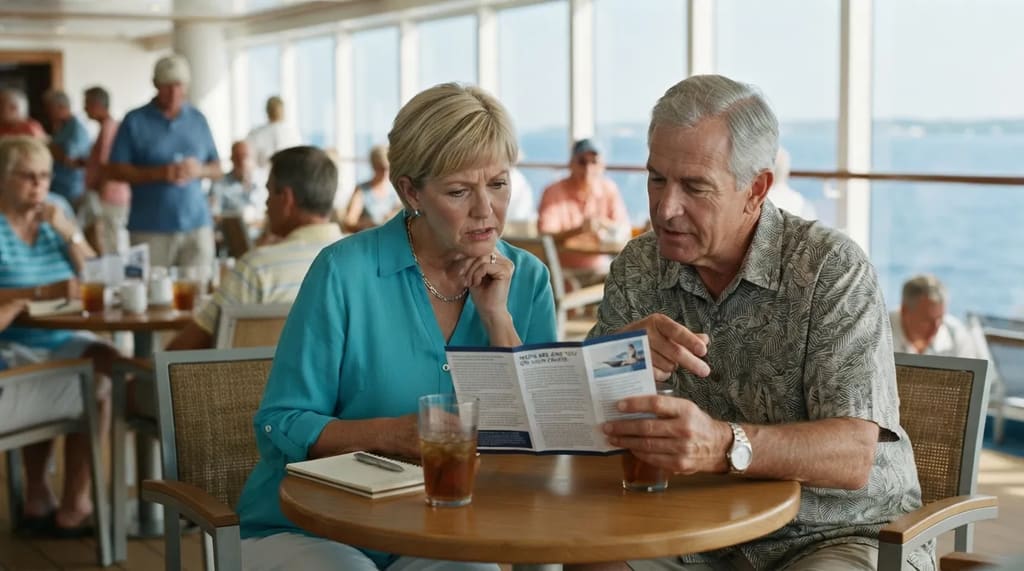
Medicare makes one narrow exception for ships. It may pay for medically necessary care on board only when the vessel is in a U.S. port or within six hours of one, according to Medicare’s own guidance.4 5
Medicare doesn’t cover services you get when the ship is more than six hours away from a U.S. port. The doctor must also be allowed under certain laws to provide care on the ship.4
On a sea day in open water, that window is closed. Regular health insurance, Medicare included, will in most cases not be accepted at the medical center at all.
Medigap is the next place to look. Some Medigap plans provide foreign emergency coverage, but only up to $50,000 lifetime.
Check whether your Medicare or supplemental plan has any overseas or at-sea provisions. The same call applies if your coverage comes from a Medicare Advantage or employer plan.
Even where Medicare applies, the bills that follow a transfer off the ship are of a different size.
#1 – Evacuation Coverage Bought Before You Sail
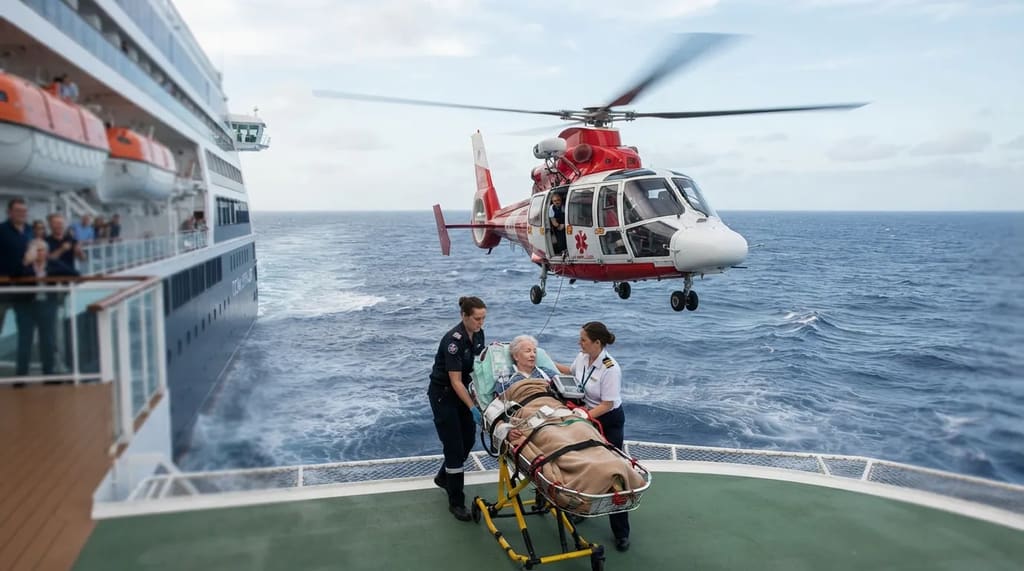
Quoted estimates for a medical evacuation run from about $20,000 for a ship-to-shore transport to a Florida hospital to well over $100,000. The price depends on distance and method.
A serious emergency can involve onboard fees, a hospital bill in another country and an expensive evacuation. The plan sold at booking may be thinner than you expect.
Squaremouth, a travel insurance comparison site, reports that Carnival covers only up to $20,000 of medical expenses and $50,000 for medical evacuation.6 It recommends $100,000 of emergency medical and $250,000 of evacuation coverage for cruises, while another agent’s guide suggests $500,000 or more for trips far from a major hospital.7 8
I would read any cruise-line plan against those numbers before accepting it. Squaremouth’s average prices are a modest sum against a six-figure exposure.
At a Glance
- Carnival’s included cover, per Squaremouth: up to $20,000 medical and $50,000 evacuation.
- Squaremouth’s cruise recommendation: $100,000 emergency medical and $250,000 evacuation.
- Average prices reported: $102 for medical-only and $540 for comprehensive.
- Evacuation estimates: about $20,000 for a ship-to-Florida transport, and well over $100,000 at the high end.
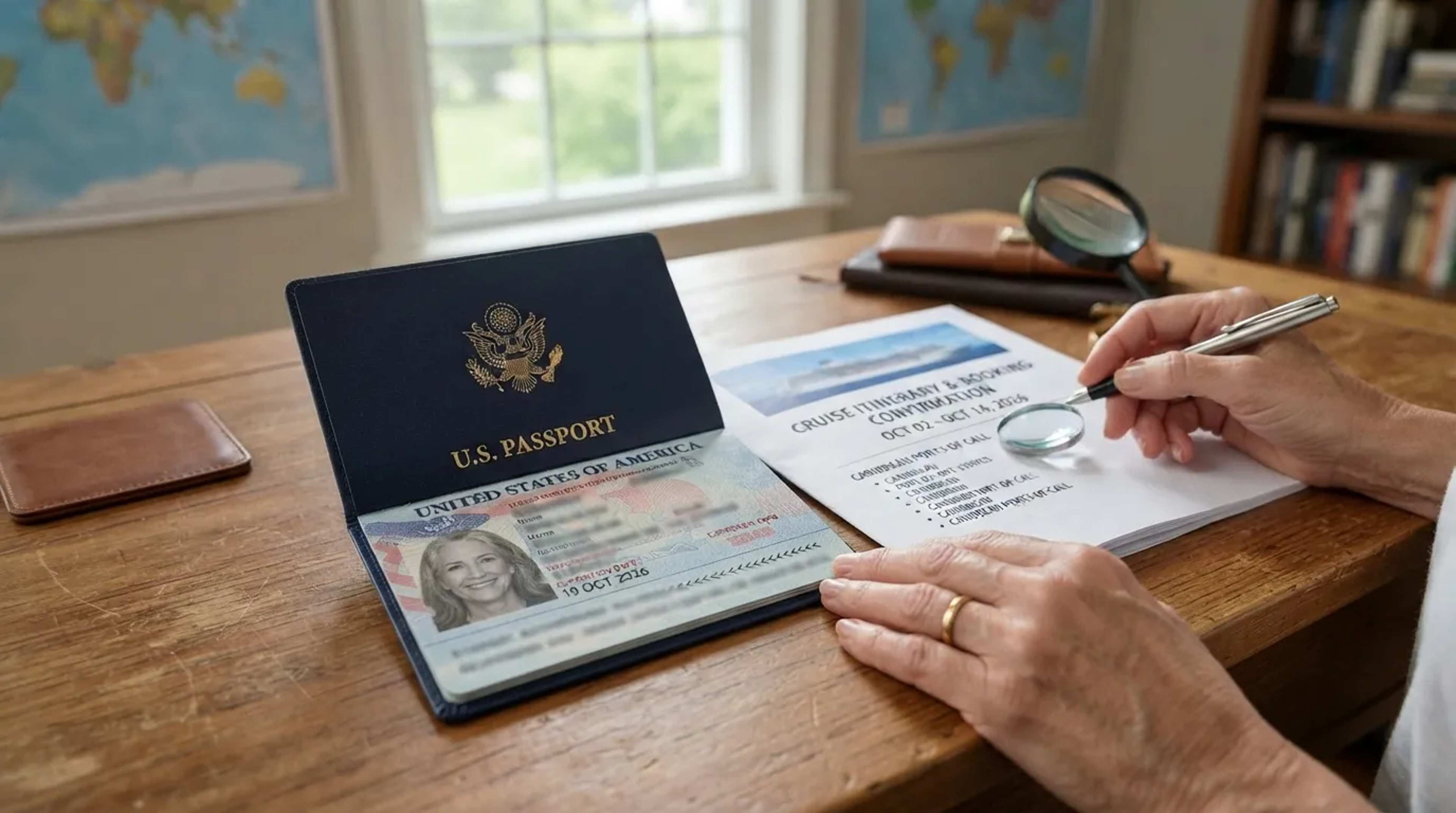
Read the policy for each coverage type: medical coverage pays for treatment, evacuation coverage pays to move a seriously ill passenger to care, and trip interruption helps when illness cuts a vacation short. The time to learn where coverage ends is before departure, not at the ship’s medical desk.
Confirm the exact limits with the insurer or a licensed agent, because policies differ. That one call costs nothing next to what it protects.
Treat the Infirmary as the Last Stop
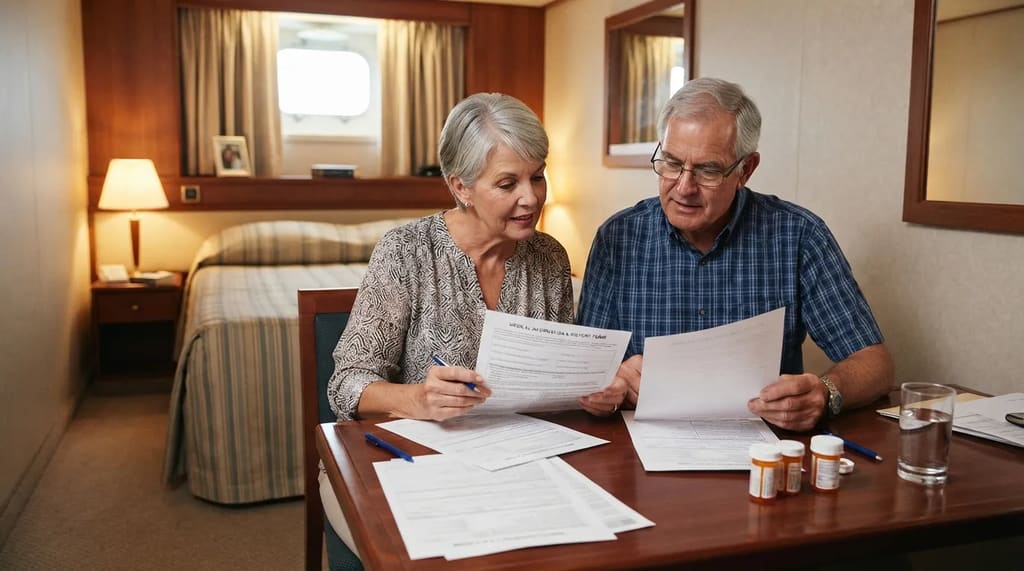
Every habit above the last two is meant to keep you out of the medical center. A cabin low and near the middle, a pill taken on schedule and a soapy twenty seconds at the sink cost little and are made before anything goes wrong.
The paperwork is the one piece that matters only after something has gone wrong, and you can read it today at your own table. Think of the first thirteen habits as keeping you comfortable and the last two as keeping a bad day from becoming a bad year.
On your last cruise, how far up and along the ship was your cabin, and how did the motion feel there?
- CDC Yellow Book Motion Sickness: https://www.cdc.gov/yellow-book/hcp/travel-air-sea/motion-sickness.html
- DailyMed Meclizine Label: https://dailymed.nlm.nih.gov/dailymed/drugInfo.cfm?setid=648570f0-2def-4d15-87bc-ca631439e7f4
- Quartz Cruise Health Packing: https://qz.com/pack-cruise-avoid-getting-sick
- Medicare Travel Outside U.S.: https://www.medicare.gov/coverage/travel-outside-the-u.s.
- Kiplinger Medicare Six-Hour Rule: https://www.kiplinger.com/retirement/medicare/medicare-and-cruises-the-6-hour-rule
- Cruise Ship Medical Costs: https://travel.yahoo.com/cruises/articles/cruise-ship-medical-centers-treatment-173900934.html
- Squaremouth Carnival Insurance Review: https://www.squaremouth.com/travel-advice/carnival-cruise-insurance-review
- Squaremouth Cruise Insurance Plans: https://www.squaremouth.com/plans/cruise