Most passengers think they know what cruise crew life looks like: a pressed uniform, a permanent smile, a front-row seat to paradise. Almost none of that is the real story – and the crew members living it will tell you so, if you ever actually ask them.
From secret hallways running the length of the ship to a pay structure most guests never think to question, the truth sits just a few decks below the frozen cocktails and towel animals. Here are fifteen of the things crew wish someone would ask, building from strange to genuinely unforgettable.
15. The “I-95” Highway Nobody Down Below Ever Talks About
Passengers glide from the pool deck to the dining room without a second thought.
The crew making that experience feel effortless are moving through a completely different ship.
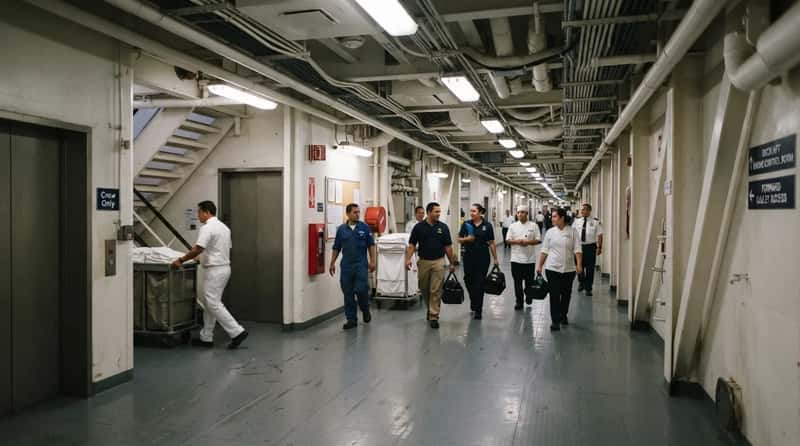
Most crew use what’s called the “I-95” – an interior corridor low in the ship that runs its entire length.
It lets them move without ever entering passenger areas, then branch off through internal staircases to reach their work areas.
The nickname, borrowed from the real American interstate, fits perfectly: a high-speed artery running invisibly beneath everything guests experience.
Fast Facts
- The “I-95” corridor runs the entire length of the ship on a low, hidden deck.
- It connects to internal stairwells and elevators crew use to reach work areas unseen.
- Crew quarters below deck four can house up to 1,200 crew members.
- On the busiest ships, the corridor gets its own kind of rush-hour traffic.
These hidden tunnels, stairways, and elevators let crew move fast between decks without disrupting a single guest activity.
On a ship carrying 5,000 passengers, that invisible choreography is the only reason service ever feels seamless.
On the busiest ships, that hidden network runs like an actual rush hour, and crew learn to work around the traffic just like commuters do.
What almost nobody asks is how far this parallel world actually extends.
Below deck four – a level passengers never see – sits a labyrinth of narrow corridors and windowless cabins housing up to 1,200 crew members.
It’s a fully operational city within a city, one most guests never glimpse across an entire seven-night sailing.
But the hidden geography is just the opening act.
What crew actually earn for navigating it every single day is the part almost nobody thinks to ask about.
14. Crew Wages Are Not What You Think – And Nationality Changes Everything
Here’s something that will genuinely stop you mid-sip of your cocktail.
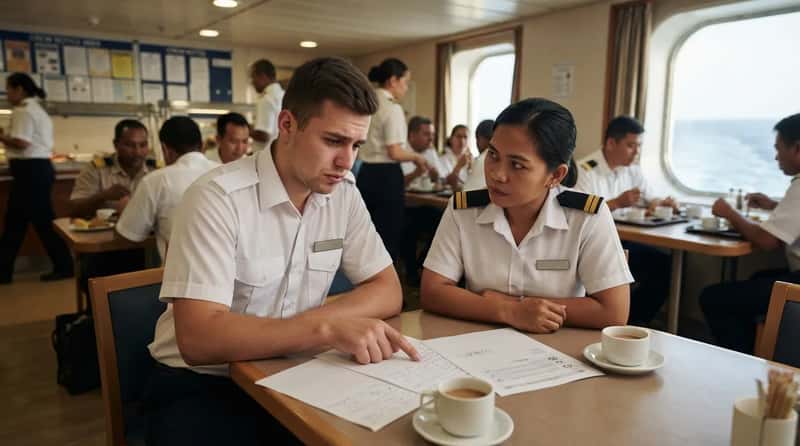
Two crew members doing the exact same job, at the exact same level, are often not paid the same rate.
Pay isn’t just tied to role and seniority – it’s tied to where you’re from.
Crew hired out of Eastern Europe, South America, and Asia – particularly the Philippines and India – are frequently on different contract structures than crew hired from the country where the cruise line is based.
Cruise lines often frame the gap as reflecting differences in cost of living back home, but crew rarely see it explained that plainly to their face.
For service-oriented roles, gratuities do most of the heavy lifting.
Base wages can be as low as a few dollars a day, meaning tips can represent as much as 95 percent of a crew member’s total take-home pay.
For some roles, the math gets even starker.
A laundry attendant usually isn’t eligible for gratuities at all and might earn as little as $700 a month, doing some of the most physically demanding, least visible work on the entire ship.
And yet the structure isn’t quite the flat exploitation it first appears to be – the nuance just never comes up in casual conversation.
What happens to the tips passengers do hand over is a whole separate story.
13. Your Tips Don’t Go Where You Think They Do
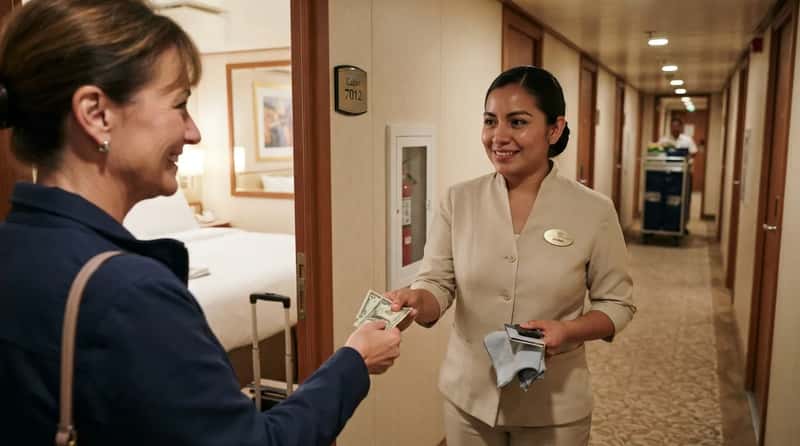
Passengers who slip a cash tip to their room steward feel good about it.
Most have no idea where that money actually ends up.
On most cruise lines, gratuities get added automatically to every guest’s bill, pooled, then distributed across the departments keeping guest service running.
It’s nothing like tipping a server at a restaurant on land who keeps their own table’s cash.
The pool gets split according to a formula the cruise line sets, usually weighted toward guest-facing roles.
Behind-the-scenes staff – like the galley cooks preparing the food guests praise their waiter for – often get a smaller slice through a separate internal formula.
And if you remove automatic gratuities from your bill, assuming you’ll just tip cash instead, the ripple reaches people you never once interacted with.
Crew rarely say anything about it, because they legally can’t.
But they absolutely notice.
What crew don’t tell you about tipping is uncomfortable enough – what they don’t tell you about their working hours is arguably worse.
12. The Hours Are Genuinely Extreme, and Crew Don’t Complain
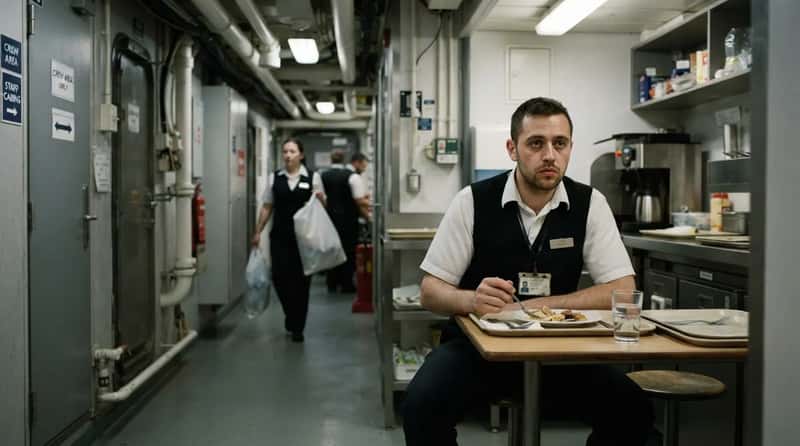
Passengers on vacation have a hard time imagining the working reality happening all around them.
The contrast is almost surreal.
Many crew members work 10 to 14 hour days, seven days a week, for six to nine months at a stretch.
There are no weekend lie-ins, no sick days that don’t threaten your contract, and no built-in days off.
One documented contract stipulated 11 hours of work a day, seven days a week, for eight straight months.
No days off, no sick days – if you couldn’t work, you were sent home at your own expense and blacklisted from future contracts.
What crew rarely volunteer, even when asked directly, is the financial gamble baked into that pressure.
Most crew from developing countries pay hefty agency fees just to get hired, sometimes equal to three months’ salary.
They arrive already in debt, sending most of what they earn straight home to extended families.
And yet the smiles stay firmly in place.
Learning how crew manage that day after day leads straight into the next thing almost nobody asks about.
11. Crew Have a Bar You’ll Never Set Foot In – And It’s Intentional
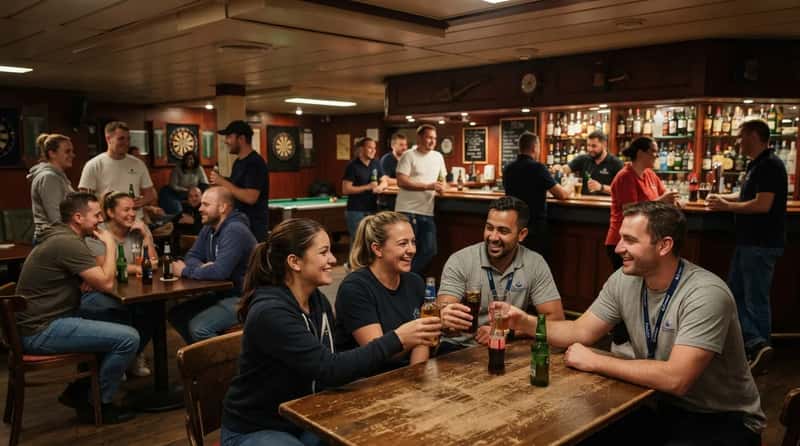
After 11 hours of catering to strangers, crew need somewhere to decompress.
That somewhere is off-limits to passengers by design.
Most major ships have a crew bar tucked deep in the lower decks, where drinks are heavily subsidized and the uniform stays in the locker.
Crew also get free room and board, cheap drinks, free flights to and from the ship, and free medical care while onboard.
The crew bar is one of the only places crew can exhale, speak freely, and drop the guest-facing persona for a few hours.
The crew live in a hidden “ship within a ship,” and many never leave it during an entire contract.
Only senior crew, the entertainment team, and some concession staff – spa or shop employees – get any access to passenger facilities like the buffet.
That separation is intentional and strictly enforced.
Crew do plenty of drinking, partying, and socializing among themselves to blow off steam.
But fraternizing with guests is one of the fastest ways to get fired and put off the ship at the next port.
That divide runs even deeper once you see what crew actually know about the ship that passengers never do.
10. They Know Which Cabins Are Problem Rooms – and Won’t Tell You Upfront
Here’s one of the most genuinely useful things crew know that they almost never volunteer unless pressed.
Crew have access to an internal document, sometimes called the “Noise Map” or “Problem Map,” listing every cabin on every deck with a known issue.
Most of those issues are noise-related: engine vibration, sound bleed from a public venue, or a structural quirk that carries noise straight into a cabin.
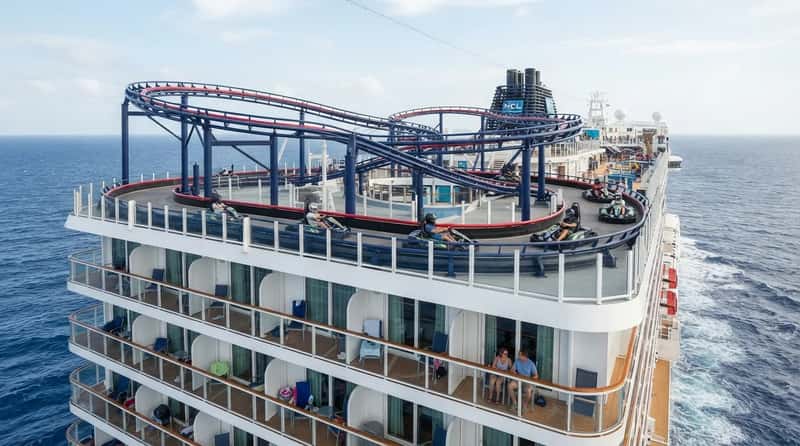
One crew member who worked on Norwegian pointed to Deck 14 forward cabins, which sit under the outdoor sports complex where the go-kart track runs.
They know the complaints are coming almost every single cruise, and they’ll move guests if space allows – but they wait for the passenger to raise it first.
Here’s the part that matters most: if you contact guest services about a noise issue, they already know from that map whether it’s a real, documented problem.
It is not a public list, and staff will never acknowledge it exists.
The practical takeaway is blunt.
If your cabin sits near a late-night venue or above a mechanical space, ask to move – crew won’t bring it up first.
What else are they quietly tracking? Quite a lot, it turns out.
9. Security Is Watching More Than You Realize – With No Obvious Presence
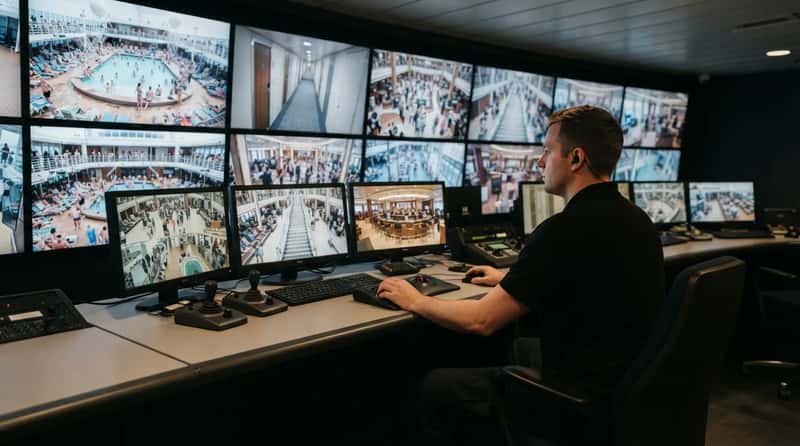
The security operation on a cruise ship is engineered to be invisible.
Passengers assume there’s a guard at the gangway and not much else – that’s a serious underestimate.
Cruise ship security operates discreetly but effectively, keeping an eye on everything happening onboard, even when nobody notices.
Thousands of cameras cover the public areas around the clock, feeding a security team most passengers will never even lay eyes on.
Many cruise lines also use secret codes and hand signals to alert security the moment something needs attention.
During a busy event or a crowded pool deck, trained staff can respond to incidents in seconds.
When one passenger on a Celebrity cruise had too much to drink and turned disorderly, the bartender discreetly signaled security – and they arrived within 30 seconds.
Worth Knowing
- Thousands of cameras monitor public areas around the clock.
- Crew use secret codes and hand signals to summon security without alarming guests.
- Response times can be startlingly fast – one Celebrity incident was handled in about 30 seconds.
- The entire system is built to stay invisible unless something actually goes wrong.
That response speed only works because staff across every department are trained to communicate without alarming anyone nearby.
Bartenders, waitstaff, and stewards all feed into the same system, trained to act without breaking the mood at the table next to yours.
Most passengers never think to ask how any of it works.
The ones who do usually get a polished non-answer – but what crew really know about staying safe at sea leads straight into the next thing.
8. Every Crew Member Is Also Emergency-Trained, Whether They Pour Drinks or Fix Engines
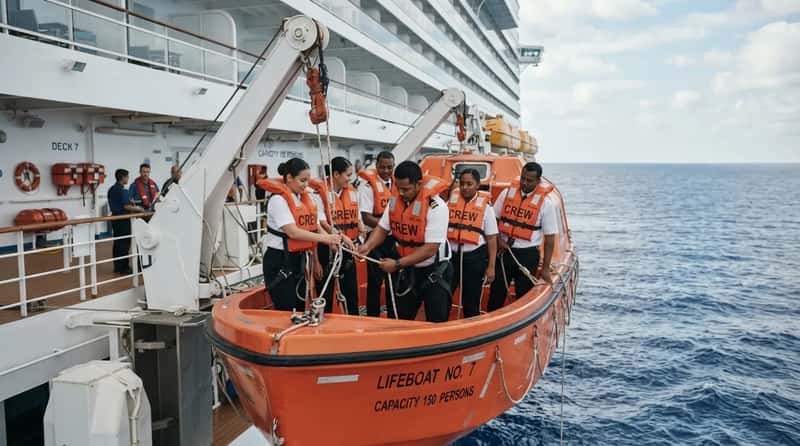
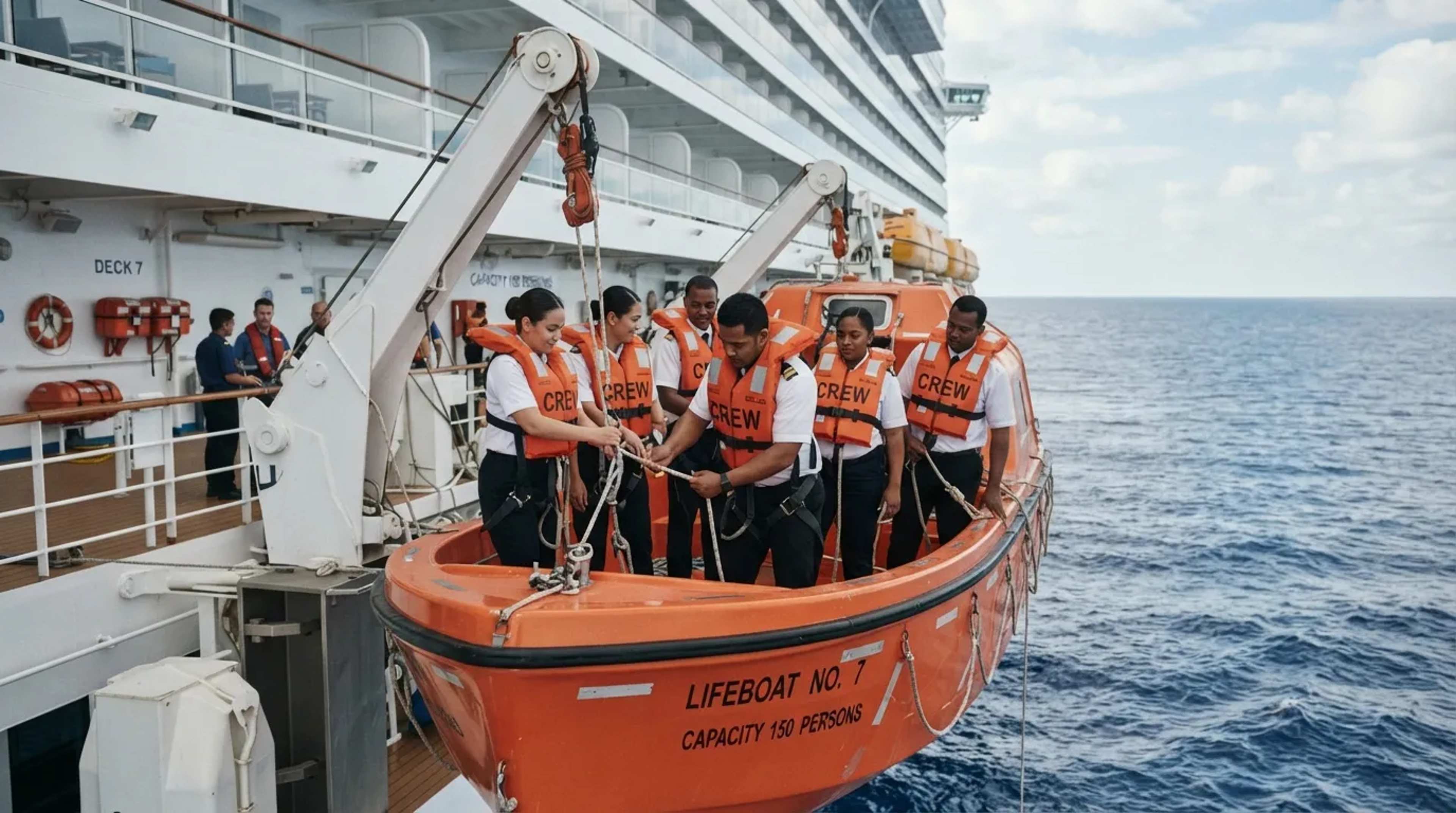
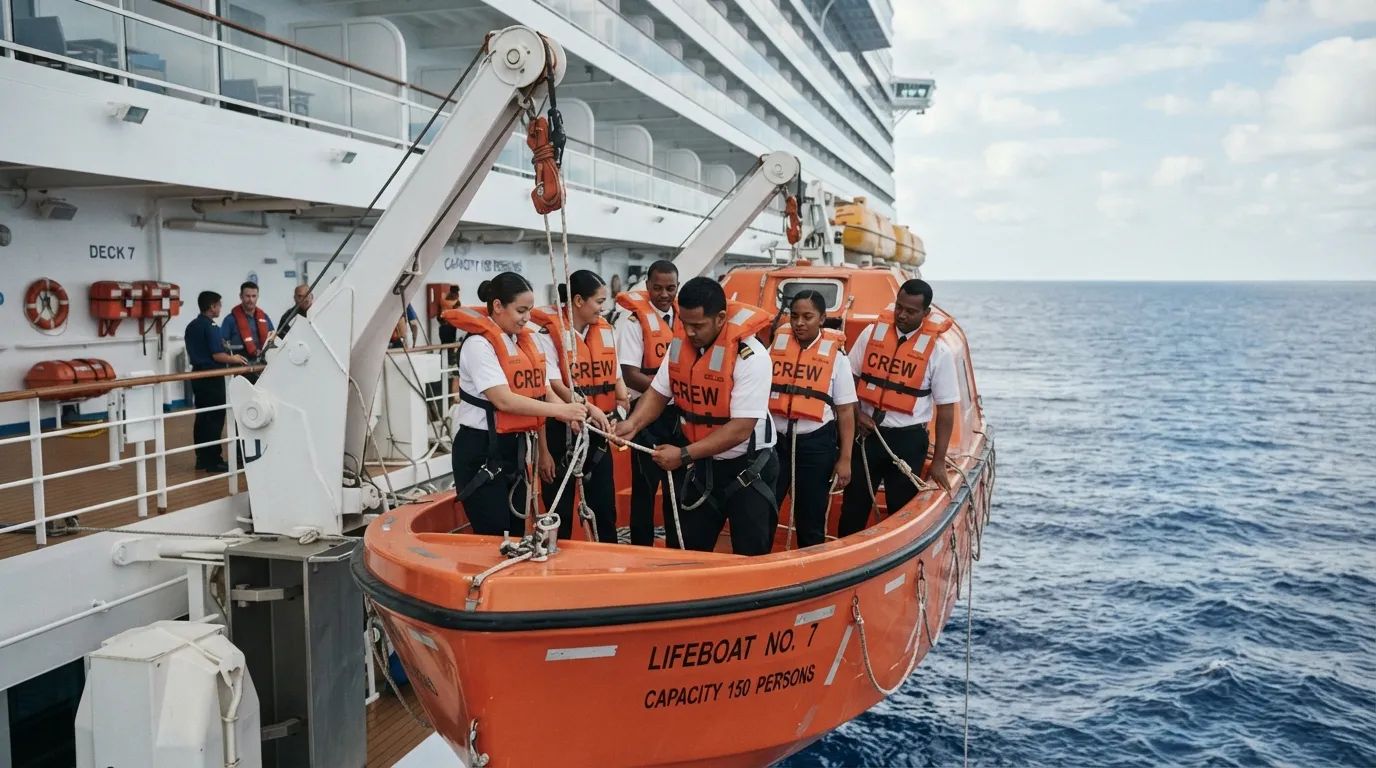
The person mixing your piña colada almost certainly knows how to launch a lifeboat.
Before joining a ship, every crew member completes STCW Basic Training – covering personal survival techniques, elementary first aid, and safety and social responsibility.
It doesn’t matter if you work the galley, the casino, or the engine room – maritime law requires that baseline of safety competence across the entire crew.
That means the crew around you in any real emergency are not just bystanders waiting for an officer to show up.
Every single one has an assigned muster station and a specific role in the emergency plan.
The “abandon ship” drill passengers groan through on embarkation day is something crew practice with genuine seriousness, often multiple times a contract without a single passenger present.
What almost nobody asks is how frequently crew run those drills solo, or how the communication chain actually works during a real incident.
Nobody asks who has the authority to sound which alarm, either.
The answers would genuinely change how most people think about safety at sea.
And if crew training rarely gets questioned, what crew do – and pointedly don’t do – in port is even less understood.
7. Crew Know Every Port Better Than Any Tour Operator – and Nobody Asks

If you’ve ever paid for a ship-run shore excursion, crew members are probably grimacing quietly on your behalf.
They know which restaurants serve the best food at local prices and where to find the street food vendors most tourists walk right past.
Avoiding tourist traps, finding authentic experiences, saving real money – cruise crew have all of it figured out already.
They’ve visited the same ports dozens of times across multiple contracts.
They know the taxi driver who won’t overcharge you, the beach a ten-minute walk from the pier instead of a 45-minute bus ride, and the café where coffee actually costs what coffee should cost.
If you ever get the chance to chat with a cabin steward, dining staff member, or bartender, ask them where they’d go.
Almost nobody does.
The crew recommendation is genuinely the most valuable free upgrade on any cruise, and it’s almost universally ignored.
That insider knowledge only exists because crew return to these same ports over and over – which raises a question about the contract cycle almost nobody explores.
6. Contracts Are Structured to Make Saving Money Almost Unavoidable
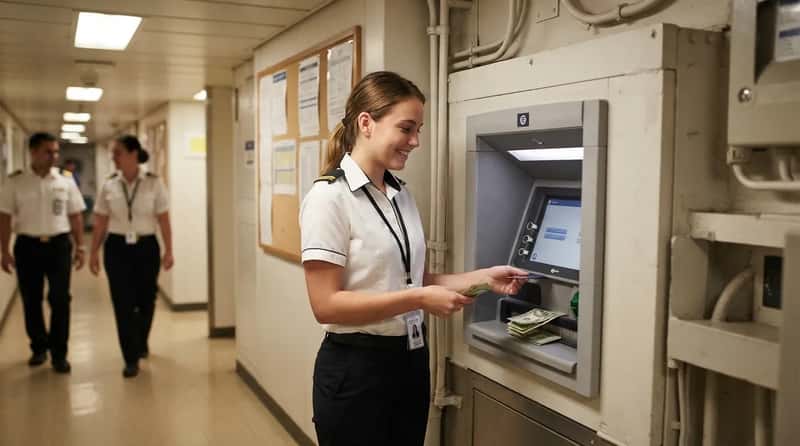
Here’s the financial reality of ship life that rarely surfaces in casual conversation: it’s basically a forced savings machine.
Contracts usually run two to eleven months, with most falling between four and eight.
After that, crew typically get a couple of months off to rest and spend some of what they earned.
The key financial lever is simple – there is almost nothing to spend money on while at sea.
Salary numbers already cover accommodation, meals, medical care, travel to and from the ship, onboard training, and uniforms.
Replicate all of that on land and you’d need another $1,500 to $2,500 a month just to break even.
At a Glance
- Contracts typically run two to eleven months, most commonly four to eight.
- Room, board, meals, medical care, and travel to the ship are already covered.
- Replicating those costs on land would run $1,500 to $2,500 a month.
- With almost nothing to spend on, saving becomes close to automatic.
One American crew member described colleagues proudly showing him photos of homes they’d built back in their home countries.
Three-bedroom houses with ocean views and private pools, entirely funded by cruise ship earnings.
The financial argument for a cruise career is real – but only for those who go in with an actual plan.
The crew who genuinely build wealth at sea are the ones with a savings strategy, not just an income target.
That’s a level of financial discipline most passengers never imagine is happening a few decks below their sun lounger.
But the money isn’t the strangest part of the hidden reality – the medical system running parallel to everything else is.
5. Crew Medical Cover Is Real – and Remarkably Comprehensive
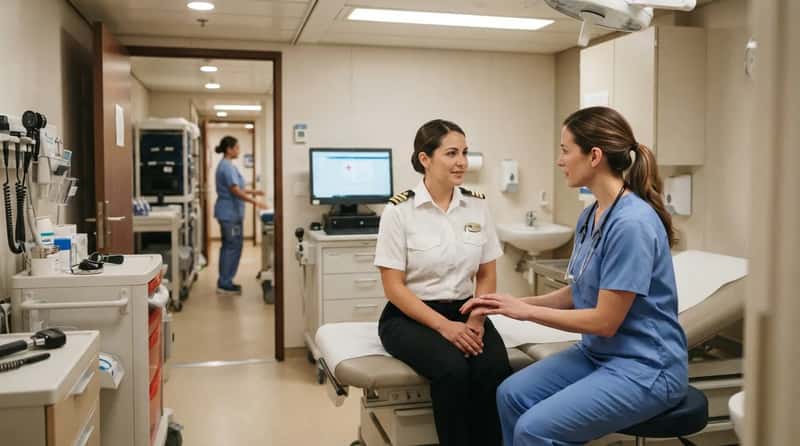
Passengers rarely ask what happens when a crew member gets sick.
The answer is more robust than most would expect.
Crew typically don’t pay for medical bills tied to onboard illness or injury – the cruise line covers costs, including prescriptions.
There are exceptions, like pre-existing conditions, but if a crew member has to be disembarked for medical reasons, the line still covers the treatment.
That’s a wider safety net than most land-based jobs offer an equivalent workforce.
For crew from countries with limited public healthcare, it’s often one of the most meaningful perks of the job.
What’s less openly discussed is the ship’s medical center itself.
Large ships carry a full physician and nursing staff, and their job goes well past handing out seasickness tablets.
It’s a serious medical role with serious pay to match – cruise ship physicians earn around $7,500 a month, and chief doctors can bring in up to $12,000, depending on the line and experience level.
Crew know all of this.
Passengers almost never ask.
And the deeper you go into crew culture, the stranger the hidden details get.
4. The Informal Economy Running Below Decks
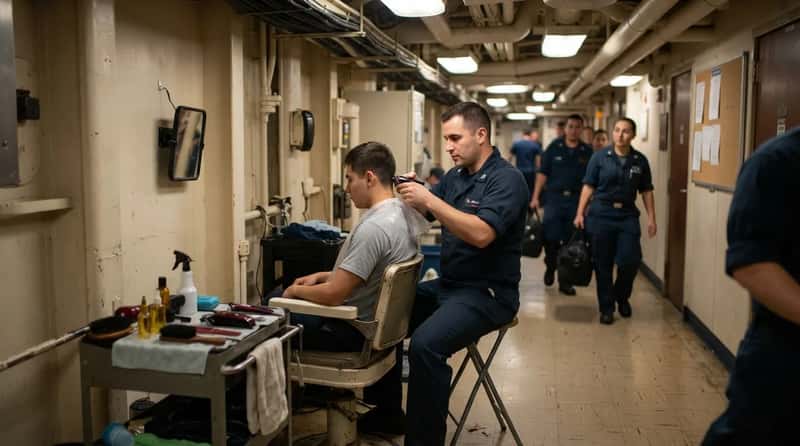
Life below deck generates its own informal marketplace, and crew talk about it constantly among themselves – just never upstairs.
Any crew member can set up as a barber, working out of a random hallway or stairwell below deck.
If they’re good, they can charge for haircuts across hundreds of crew members in a single contract.
That’s just one slice of a much bigger pattern of below-deck commerce passengers have zero idea exists.
There are informal food traders, phone repair setups, and crew who specialize in sourcing things from port that others don’t have time to find themselves.
The economy running through the I-95 corridor is genuinely its own ecosystem.
It’s driven by hundreds of people from dozens of countries living and working in close quarters with very limited access to the outside world.
Cruise companies don’t advertise this social structure, and passengers rarely think to ask about it.
What crew find genuinely strange is that guests are far more curious about towel animals than about the actual lives of the people folding them.
And yet the gap between those two worlds can shift fast – the instant a single alarm code changes everything.
3. The Code System Passengers Hear But Never Understand
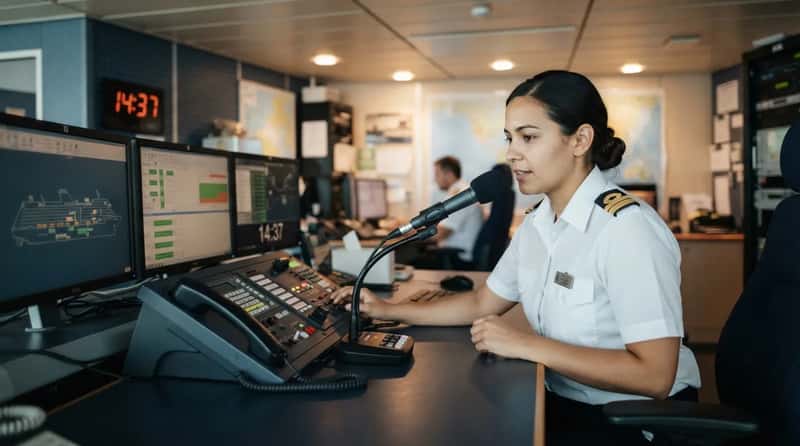
If you’ve sailed before, you’ve heard coded phrases or number sequences over the ship’s PA.
Most passengers shrug and go back to their drinks.
Crew know exactly what each code means and respond without hesitation.
Common codes – which vary by cruise line but follow broadly similar patterns industry-wide – cover medical emergencies, fires, overboard incidents, and security situations.
The reasoning for keeping emergencies coded instead of announced plainly is simple.
A ship full of thousands of alarmed passengers is far more dangerous than one where trained crew respond quietly while guests stay calm.
That logic is sound – but it also means passengers routinely have less information about their immediate environment than in almost any other form of travel.
Crew are trained not to explain the code system to guests, and most won’t volunteer what they just heard.
What they will do is move – and passengers paying attention will notice the pace of crew changes the instant a code sounds.
That transparency gap is real, and worth remembering before you dismiss the next PA announcement as routine.
What comes at the very end of this list is the thing crew say they most wish passengers would ask.
2. Crew Remember the Passengers Who Treat Them Like People – for Entire Careers

This sounds soft.
It isn’t – there’s a hard operational reality embedded in it.
Tipping goes a long way on a cruise, and crew members never forget those who show real appreciation.
But what crew actually say off duty, in the crew bar, on their way home after an eight-month contract, is different than you’d expect.
The guests they remember most clearly are not always the biggest tippers.
They’re the ones who used their name, asked a genuine question, and actually listened to the answer.
The people who remember your name usually get remembered right back.
Common refrain among long-serving cruise crew
While passengers wander the pool deck with a frozen cocktail in hand, crew are working long hours to make the whole experience feel effortless.
That effort is constant and delivered with a smile no matter what’s happening in a crew member’s personal life.
That could mean not having seen family in six months, carrying homesickness they’re not allowed to show on deck, or running on empty after a 14-hour shift.
Crew hold real informal power over a guest’s experience – whether a request gets prioritized, whether a table gets a slightly better spot, whether a small complaint turns into genuine effort.
None of that is transactional.
It follows naturally from how a passenger treats the human being standing in front of them.
Seasoned travelers already know this.
First-timers almost never do.
That leads straight into the single most surprising thing crew say almost nobody asks – the one that reframes the entire cruise if you actually sit with it.
1. Most Crew Have Never Been Passengers – and See the Ship Completely Differently
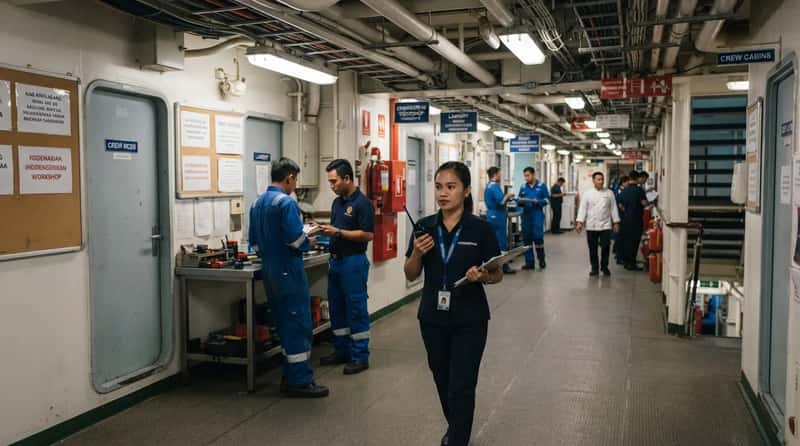
Here’s the question crew members across multiple lines say passengers almost never think to ask: what does this ship actually look like to you?
The real truth about cruise ships lives five decks below the pool deck, whispered during midnight shifts, revealed only when passengers aren’t looking.
For most crew – particularly those from the Philippines, Indonesia, India, and Eastern Europe, who make up the majority of shipboard workforces – the vessel isn’t a holiday destination at all.
It’s a workplace, a temporary home, a financial lifeline, and a tight-knit community, all at once.
They navigate the ship differently, understand it structurally in ways passengers never will, and carry an institutional memory of every sailing’s patterns, rhythms, and pressure points.
Why It Stands Out
- Most shipboard crew come from the Philippines, Indonesia, India, and Eastern Europe.
- For them, the ship is a workplace, a home, and a financial lifeline all at once.
- Crew carry institutional memory of a ship’s rhythms that no passenger ever accumulates.
- A genuine question, actually listened to, is rarer to them than any tip.
These aren’t just secrets – they’re the unspoken realities shaping every voyage, every smile, and every “have a wonderful day” you hear onboard.
The crew member saying that greeting has likely repeated it 200 times already today.
Whether it still lands as genuine usually comes down to whether someone, at some point on that sailing, chose to ask a real question and actually waited for the answer.
The most revealing conversation you can have on any cruise ship costs nothing and requires no special access.
It almost never happens.
All it takes is asking something real.
The Bottom Line
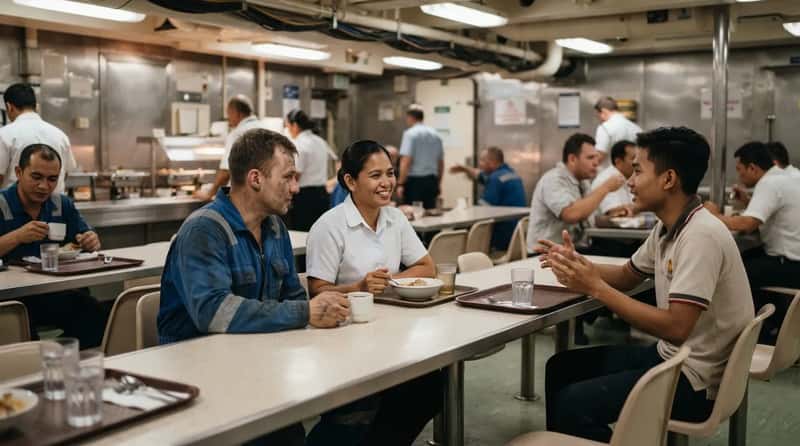
Cruise crew are running a parallel world beneath every passenger experience – its own geography, its own economy, its own pay structures and codes.
Most of it never surfaces unless a passenger asks directly, and most passengers never do.
The practical takeaways are simple enough to use on your next sailing.
Ask your steward which cabin on the deck has known vibration issues before you complain about one.
Ask your bartender where to actually eat in port before you book the ship’s excursion.
Remember that removing automatic gratuities affects people you never once interacted with directly.
And the next time a coded announcement plays over the PA, know that every crew member near you just silently shifted into a specific response mode.
The biggest unlock on any cruise is treating crew as the experts they actually are – on the ship, on the ports, on the entire experience.
Most passengers board and disembark without ever tapping into that knowledge.
Which one of these surprised you most?