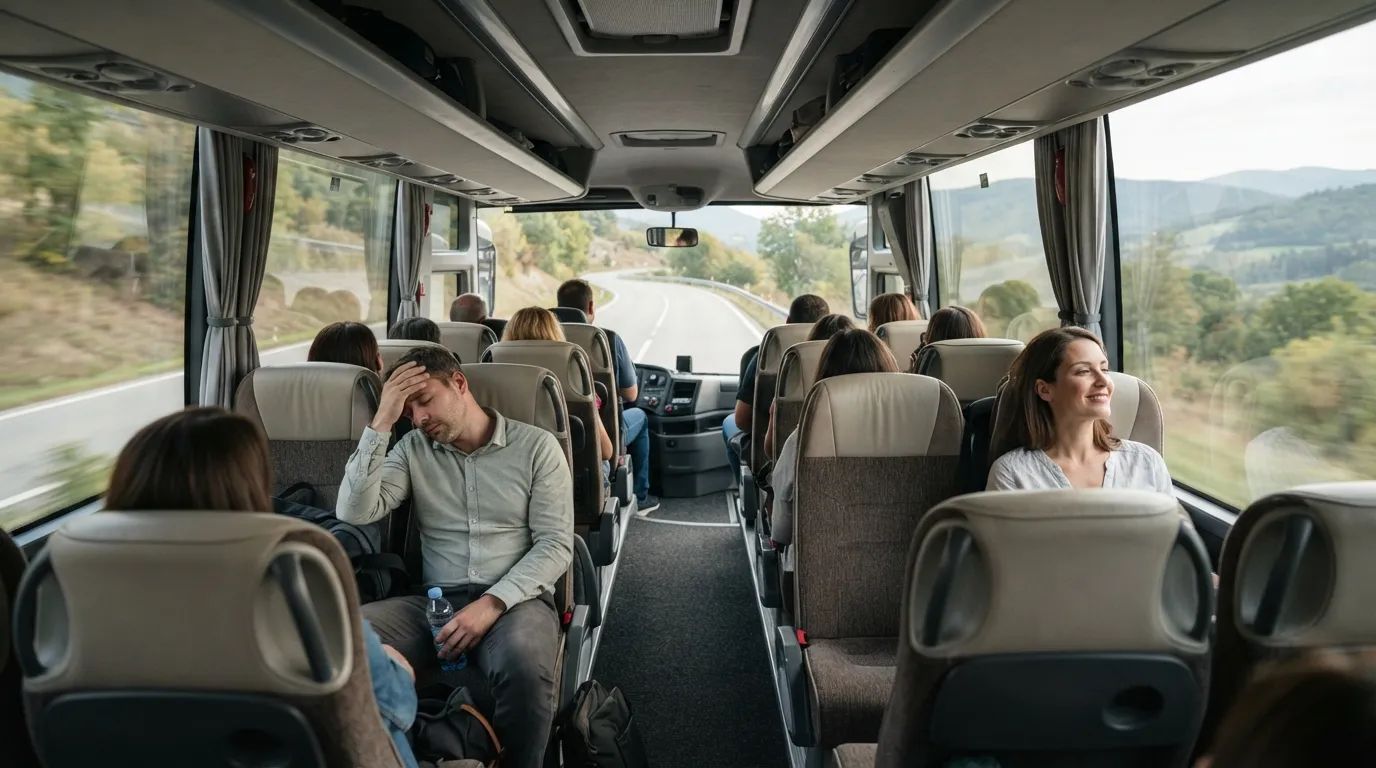
Most people picture a coach tour as the easy holiday: sit down, switch off, let someone else do the driving. Then the first hour rolls by, and the calm version of the trip starts to crack.
Before the second stop, seats, suitcases, phones and a driver’s legal clock have all started to bite, and in one UK survey of 3,256 passengers, 28.4% felt ill on ordinary journeys. Some of what follows is petty, some is surprising, and one item is the reason guides never forget the ten-minute stop.
#15 – Someone Claims a Seat Like It’s Theirs for Life
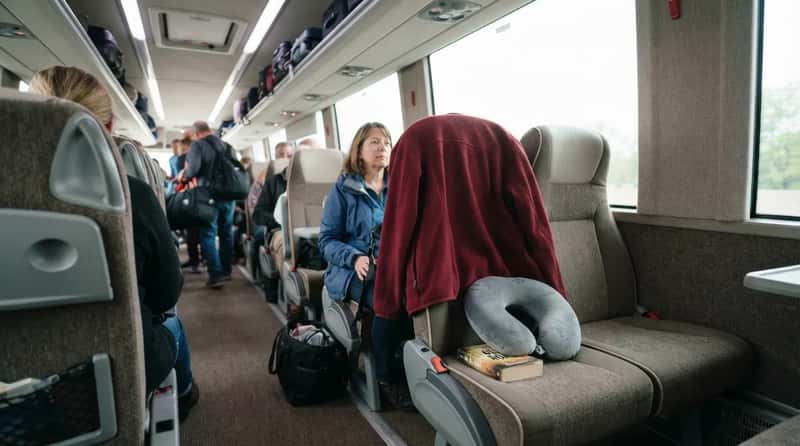
The first thing to go wrong is often a jacket draped over a seat. Seats on most coach tours aren’t assigned, and groups are usually encouraged to rotate each day.
That doesn’t stop people from staking a claim. Plenty of first-day travelers plant a jacket, a neck pillow or a paperback on one seat and treat it as theirs for life.
The friction starts almost immediately. It hits hardest with couples who assume the window-and-aisle pair is locked in for the whole trip.
Guides say the fix is embarrassingly simple. Ask about the rotation policy on the first morning, a thirty-second question that can save you a week of side-eyes.
But that’s nothing compared to what one oversized suitcase can do to a coach’s luggage bay in #14…
#14 – Your Suitcase Is Too Big for the Bay

The luggage bay looks huge from the pavement. Then the bags start going in.
Coach storage bays are roomy but not bottomless, and first-timers routinely bring luggage that eats double the space it should. One oversized case can push someone else’s bag out of the loading plan.
The bay also gets worked hard. It is loaded and unloaded almost daily, sometimes at hotels with no staff around to help.
That means you may be lifting your own bag, more than once. A case you can’t lift alone becomes a problem for the whole group.
And the luggage mistake pales next to the one that happens at the very first coffee stop in #13…
#13 – People Haul the Whole Suitcase Off for a Short Stop

Seasoned tour directors are still baffled by this one. First-timers haven’t worked out what’s safe to leave behind, so they drag a 40-pound suitcase off for a ten-minute coffee stop.
The logic is understandable. Nobody wants to lose their belongings on day one.
But picture the scene from the driver’s seat. Bags come out of the bay, doors stay open, and the clock keeps running while everyone waits on one heavy case.
The stop is only as fast as its slowest, heaviest passenger. A small daypack with your essentials does the job.
Worth Knowing
- Your phone and a charging cable belong in the daypack, not the bay.
- Keep ID and booking details on you, not in a checked case.
- Any medication you may need before the next hotel should ride with you.
- Water and a small snack make a short stop feel less rushed.
Next up is a problem that has nothing to do with luggage, and it lives in your pocket in #12…
#12 – The Phone Dies Before the Scenery Starts

Your phone is often the first thing to quit. Experienced travelers charge at every stop, even a five-minute one, rather than waiting until they’re down to ten percent.
It matters more than most people realize. That one battery is your camera, your ticket and your map, all in one.
There’s a practical side too. Your phone often holds your booking, your meeting point and your guide’s number.
Lose the battery and you can lose your way back to the group. That’s a much bigger problem than a missed photo.
But a dead phone is minor compared to the facility everyone assumes will work in #11…
#11 – The Toilet Isn’t There, or Doesn’t Work
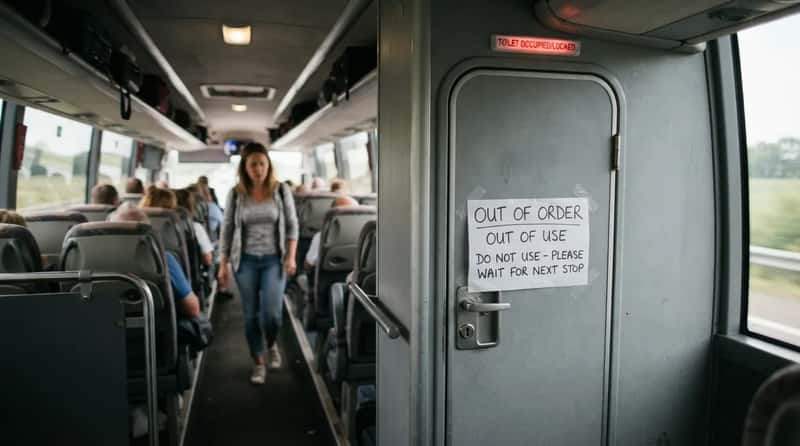
Most travelers assume every coach has a working toilet. That’s not guaranteed, and one traveler’s review noted that some coach tours and companies have toilets while others don’t and rely on stops instead.
Even when there is one, it’s a gamble. A reviewer of a two-day tour reported that the toilet went wrong after two or three uses early in the morning and wasn’t fixed. That’s one traveler’s account, not an industry average.
Drivers have their own view. One driver on a transport forum said people who know there’s no toilet are mentally prepared, while people who have one think they need it.
Some drivers reportedly lock the on-board toilet to protect it. That’s one driver’s story, but it shows how fragile these facilities can be.
Which brings us to the stops that are planned, and the passengers who skip them in #10…
#10 – Someone Skips the Planned Break
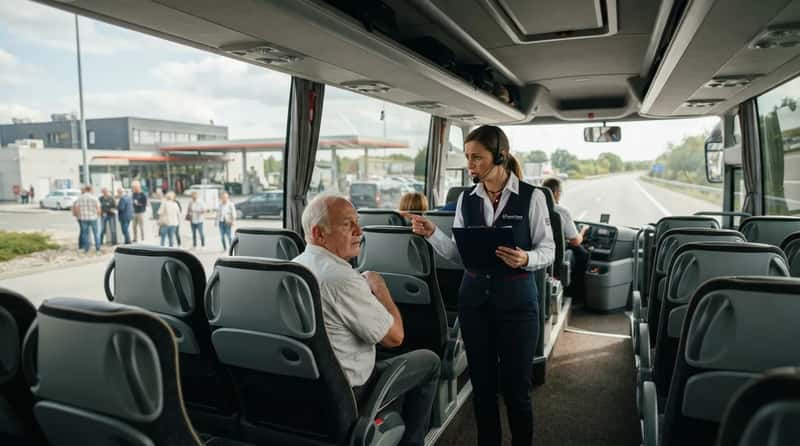
“I’m fine” may be the most expensive phrase on a coach. Guides plan bathroom stops with far more care than travelers assume, weighing group size, road conditions and how likely a second stop will be needed.
So a skipped break isn’t free. It often turns into an unplanned stop later that costs the whole group time.
Guides say the plan even accounts for who will need another stop within about twenty minutes. It’s a schedule built on averages, and averages don’t bend easily.
One person’s “I’m fine” can quietly rewrite the day’s timetable. And the timetable is tighter than it looks.
But an extra stop is a mild problem next to what happens to some passengers in #9…
#9 – Travel Sickness Hits More People Than You’d Think
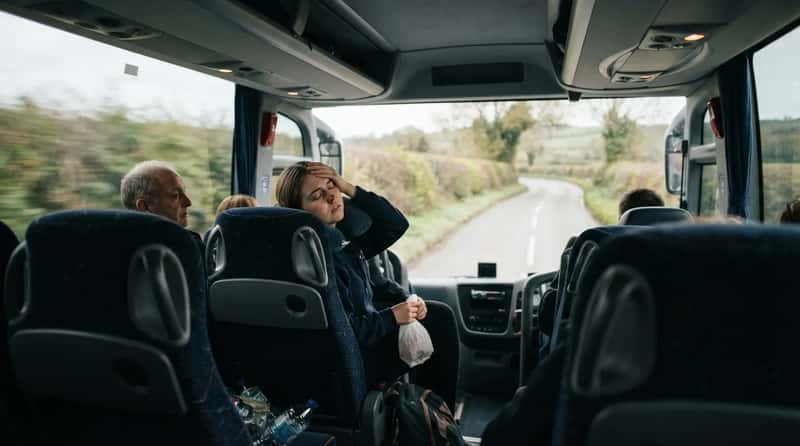
Nearly three in ten. A survey of 3,256 passengers on 56 UK bus or coach journeys found that 28.4% felt ill, 12.8% reported nausea and 1.7% reported vomiting.
It isn’t just about the road itself. Sickness was higher with drivers whose driving produced more fore-and-aft and side-to-side motion.
Routes matter too. Nausea was more common on predominantly cross-country routes, where side-to-side motion was significantly higher.
Your driver’s style and the route can change how sick you feel. Experience helps, though: travel sickness decreased with increasing passenger age and greater travel experience.
Here’s where seat choice gets serious, and where the front-seat fights in #8 start to make sense…
#8 – You Picked the Wrong End of the Coach

Where you sit changes how you feel. In that same UK research, side-to-side motion and motion sickness increased from the front to the rear of each vehicle.
What you can see matters even more. Illness was roughly three times higher for passengers with no view of the road ahead (34.6%) than for those with an excellent view (12.7%).
That helps explain the seat wars. The front rows offer the best view and the shortest walk to the door.
A seat with a clear view ahead can be the difference between a good day and a bad one. Yet the same seat can’t be permanent for everyone, which is exactly why rotation exists.
But finding a good seat is easy compared with finding your own coach in #7…
#7 – Every Coach in the Car Park Looks the Same
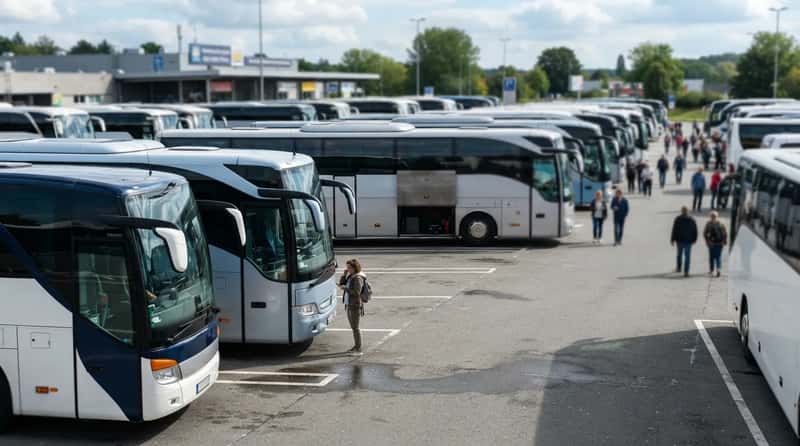
It sounds silly until it happens to you. Every coach at a busy rest stop looks nearly identical from fifty feet away.
That’s why guides suggest a simple habit. Take a photo of your bus and where it’s parked.
Rest stops are crowded, rushed and unfamiliar. Add several similar vehicles and a wrong turn is easy.
Boarding the wrong coach is a real risk at busy stops. A photo takes two seconds and removes the guesswork.
The plate, the company name and the bay number are the details people forget. Check them before you walk off.
At a Glance
- Snap the whole coach, including the front and the plate.
- Catch a landmark in the shot, such as a sign or a shop front.
- Note the bay or row number if the car park has one.
- Keep the photo where you can find it in seconds.
And once everyone is finally back on board, the schedule faces its next test in #6…
#6 – Traffic Eats the Schedule Before Lunch
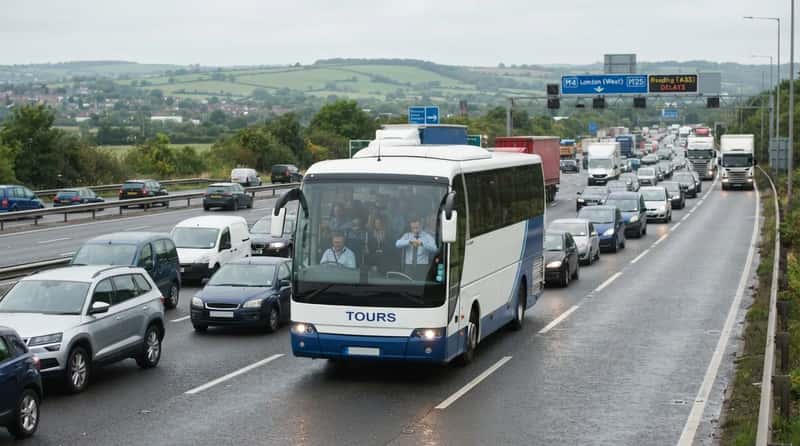
Coach itineraries are planned tightly, with timed entries and hotel check-ins waiting down the road. There isn’t much slack to spend.
Traffic is the usual culprit. An official UK worked example of a coach day includes a leg where traffic adds an extra half hour.
Delays don’t stay put. Late arrival at one stop compresses the next one, and the next after that.
A single traffic jam can shorten every stop that follows. That’s why guides tend to keep stops brisk.
But the delay isn’t the only clock ticking, and the next one is legally enforced in #5…
#5 – The Driver’s Legal Clock Is Already Running
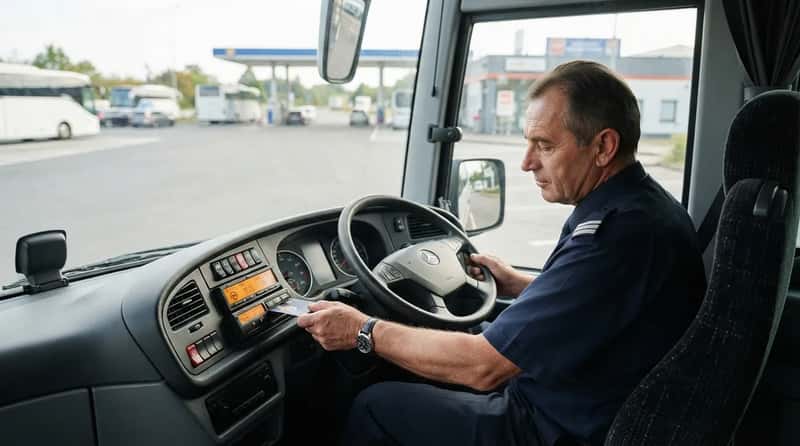
Your driver can’t just keep going. Under EU rules, a driver must not drive more than 4.5 hours without a break, and then needs at least 45 minutes.
That rule covers passenger vehicles with more than eight passenger seats, which takes in most touring coaches in Europe. There is some flexibility, though.
The 45 minutes can be split into two breaks, the first at least 15 minutes and the second at least 30. The order matters, because the shorter break must come first.
That break isn’t a favor from the driver. It’s a legal requirement, and no group can negotiate it away.
What most people don’t realize is that even the time between driving is counted, as #4 shows…
#4 – Time Spent Not Driving Still Counts
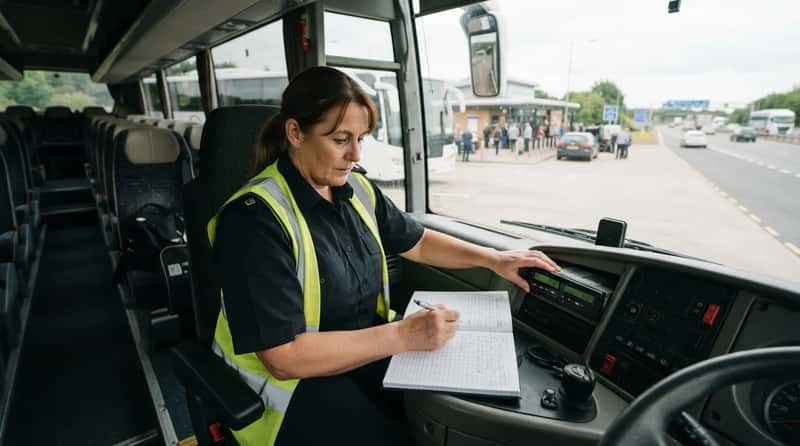
You’d think a coach only has to worry about driving hours. It turns out working time has its own limits.
In UK guidance, a worked example describes a coach driver who completed only four hours of driving but still broke working time rules. She had worked six hours and 22 minutes without a break.
The rule behind it is simple. After working six hours, a mobile worker must take a break of at least 15 minutes.
In the example, she could have stayed legal with a break at the pick-up point. Loading, safety talks and dealing with the group all count as work.
Your driver’s day includes far more than the time spent on the road. That’s another reason stops can’t be stretched.
Quick Compare
- Driving clock (EU): a break of at least 45 minutes after 4.5 hours behind the wheel.
- Working clock (UK): a break of at least 15 minutes after six hours of work.
- What counts as work: loading, safety talks and handling the group, not just driving.
But rules on the clock are only half the story, because the next risk sits right at your hip in #3…
#3 – A Seat Belt Left Unbuckled Puts Other People at Risk
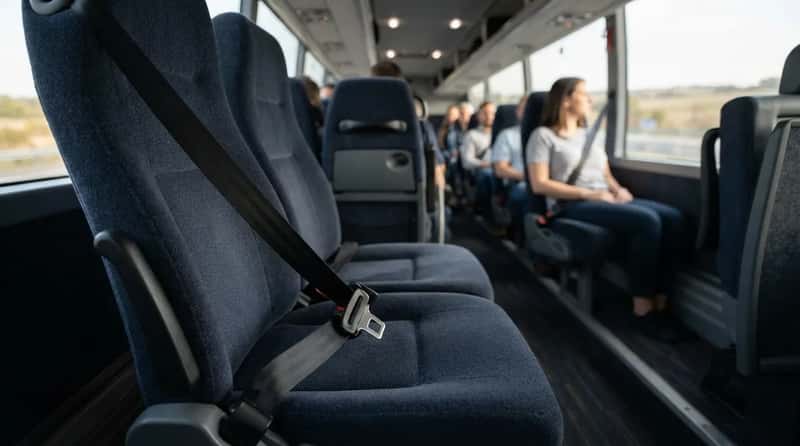
Belt use is easy to ignore on a relaxed day. The evidence says it shouldn’t be.
Research summarized by the IIHS states that exposure to unbelted occupants increases the risk of injury or death to other occupants by 40%. Those findings come from passenger vehicles in general, not tour coaches specifically.
Ejection is the other danger. Ejected occupants are nearly twice as likely to die in nonrollover crashes and four times more likely in rollovers.
Coach rules vary by country. A Transport Canada report on a 2001 coach rollover concluded that, had the children worn seatbelts, they would not have been ejected.
Your unbuckled belt is not only your risk. If your coach has belts, use them from the first minute.
But the quietest problem takes days to show up, and it starts with a decision in #2…
#2 – Skipping the Welcome Chat Costs You Later

It feels skippable. The first-day welcome meeting sounds like admin, so plenty of travelers duck out to unpack or nap.
That’s usually where the housekeeping is explained. It’s where you learn the meeting times, the seat rotation and the rules of the road.
Skip it, and you learn those rules the awkward way. Seating tension is a good example.
Seat territory on a coach becomes surprisingly tribal within the first 48 hours, guides say. Their most common complaints are about who got the good seats again.
Guides say the complaints they hear most aren’t about destinations at all. Most of those fights could be avoided in the first ten minutes.
Fast Facts
- Meeting times and departure times are usually confirmed here.
- The seat rotation policy is typically explained in the same session.
- Rules of the road, including belts and stop etiquette, tend to come up too.
- Seat tension can set in within the first 48 hours, guides say.
Now for the mistake guides say matters most, and the one that can end a trip early in #1…
#1 – Everyone Assumes Someone Else Is Watching the Clock
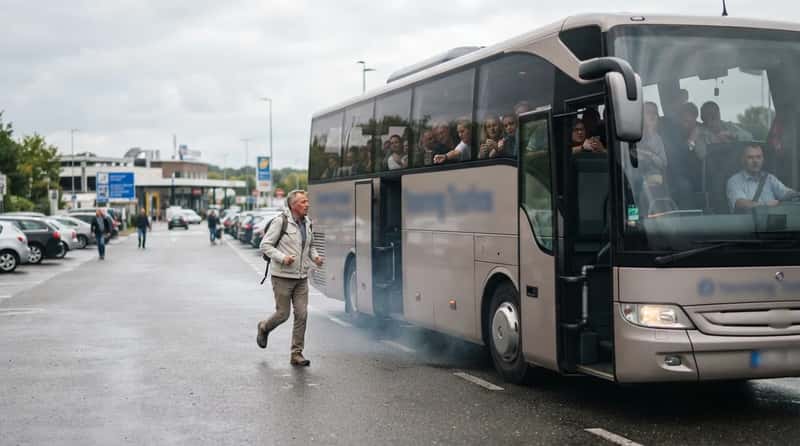
This is the one guides never forget. The biggest mistakes rarely happen on the road but in the rushed ten minutes at a stop, when everyone assumes someone else is watching the clock.
Picture the last passenger jogging across the car park while the engine idles and forty faces watch through the glass. It never happens at a convenient moment, and guides say it tends to happen minutes before a border crossing or a timed museum entry.
Being on time is essentially rule number one of every coach tour briefing. With a driver’s legal clock running, a coach can’t wait around for one late passenger.
The most dangerous moment of a coach tour is a ten-minute stop where nobody is in charge of the time.
That’s the last surprise, and it says a lot about what really goes wrong first.
The Bottom Line

Most first-stop problems are small and avoidable. A jacket on a seat, an oversized case, a dead phone or a skipped break can each ripple through a tight schedule.
The bigger issues are less visible. Almost three in ten coach passengers in one large UK survey felt ill, and a driver’s legal break clock can’t be argued with.
The biggest risk is quiet: ten minutes at a stop where everyone assumes someone else is watching the time. Which of these have you seen happen on a coach trip, and which one do you think travelers get most wrong?