You’d expect the biggest airports to be the hardest to cross. The real numbers are stranger than the reputations. The longest measured walk in the US tops two miles, while some airports measure their longest walk in hundreds of feet.
We pulled the measured figures, flagged where studies disagree, and ranked 15 airports from the shortest stretch to the longest. Some of the “worst” airports have a trick that makes the walk optional. Some of the “easy” ones have a catch you only discover on arrival.
#15 – Lexington’s Blue Grass: The Walk That Barely Counts
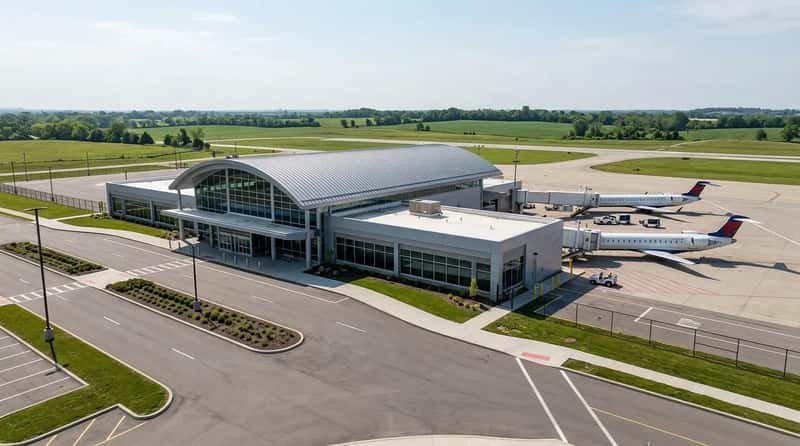
Lexington’s Blue Grass Airport has the shortest walk in the whole KURU Footwear data set. It measured 0.11 miles, with one terminal and 16 gates. That’s roughly 580 feet from the entrance to the farthest gate, shorter than a lot of parking lot hikes.
KURU measured the largest and smallest US airports by land area, then used airport maps and Google Maps to find the distance to the nearest and farthest gates. Lexington is the control group. Even if you tried to get lost here, you’d run out of airport first.
The next airport is even more surprising, given the metro it serves.
#14 – Westchester County: A Six-Gate Airport With a Big-City Address
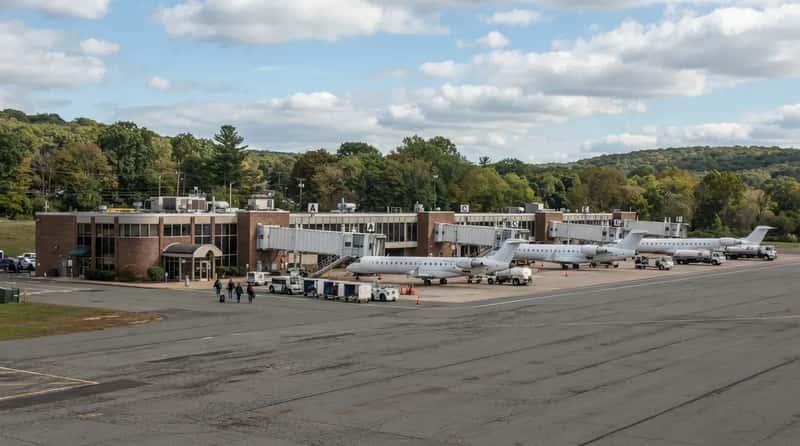
Westchester County Airport sits next to one of the biggest metros in America and still has one of the shortest walks. It measured 0.12 miles, with a single terminal and just six gates. You could cross it before your coffee cools.
A small footprint doesn’t mean a small crowd. Millions of people live within reach of this airport, but the building itself stays compact. The crowds are in the region, not in the corridors, which is the opposite of the sprawling hubs coming up.
Fast Facts
- Longest measured walk: 0.12 miles, or roughly 630 feet.
- Layout: one terminal, six gates.
- Fewest gates of the three shortest airports on this list.
- Its walk is only a hair longer than Lexington’s 0.11 miles.
That tiny number will look even smaller once you see Harrisburg.
#13 – Harrisburg International: Twelve Gates, Zero Stress
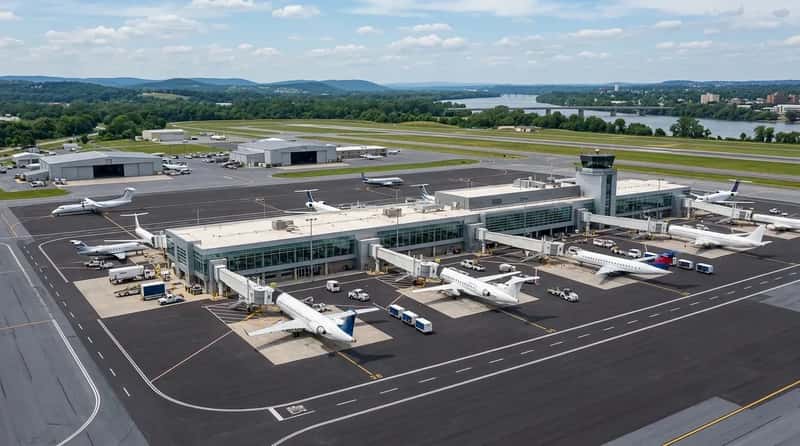
Harrisburg’s longest walk is 0.13 miles, which is under 700 feet. The airport has one terminal and 12 gates. Nothing here asks much of your legs.
That’s the quiet lesson of this ranking. Terminal distance is partly about how many airlines and gates an airport has to juggle, and Harrisburg has few of either. A last-minute gate change costs you a minute, not a sprint.
The first airport with real separation between its buildings is next, and you may know it well.
#12 – Orlando: Two Buildings You Can’t Walk Between
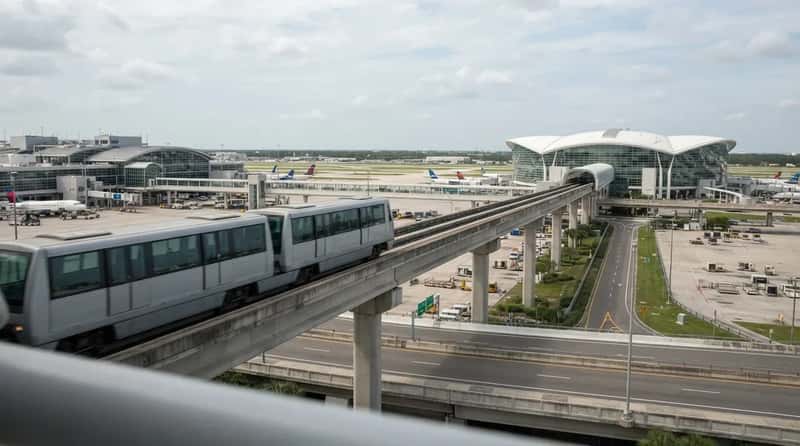
Orlando’s longest walk from the entrance to a gate is about 0.7 miles, but Terminal C is what catches travelers off guard. Terminals A and B sit on opposite sides of the same building, linked by a short walk through an atrium. Terminal C is a different story.
You can’t simply stroll over, and you have to clear security again. The trip involves the Terminal Link, then a walk of roughly 0.2 miles through a parking garage. For families dragging strollers and souvenir bags, that’s a rough ending to a vacation.
- Terminal C handles mainly international flights on non-US airlines, plus all JetBlue flights.
- Check the terminal on your boarding pass early, because the wrong building costs you real time.
Las Vegas has a different problem, and it comes from how the gates are split up.
#11 – Las Vegas: Three Gate Groups That Add Up Fast
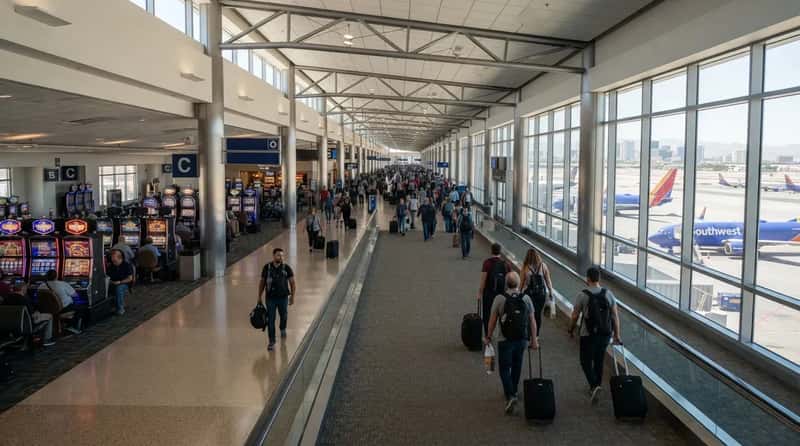
Las Vegas’s farthest A gates and farthest C gates are 4,068 feet apart. That’s about 0.77 miles, slightly more than three-quarters of a mile. The figure comes from a travel writer’s 2015 measurement, back when the airport was still called McCarran.
It’s a full-sized trek in an airport famous for slot machines at the gates. The airport is now Harry Reid International, so older articles may use the previous name. Layouts change, so treat the number as a snapshot, not a promise.
Phoenix comes next, and its “one terminal” label is quietly misleading.
#10 – Phoenix: One Terminal, Nearly a Mile Inside It
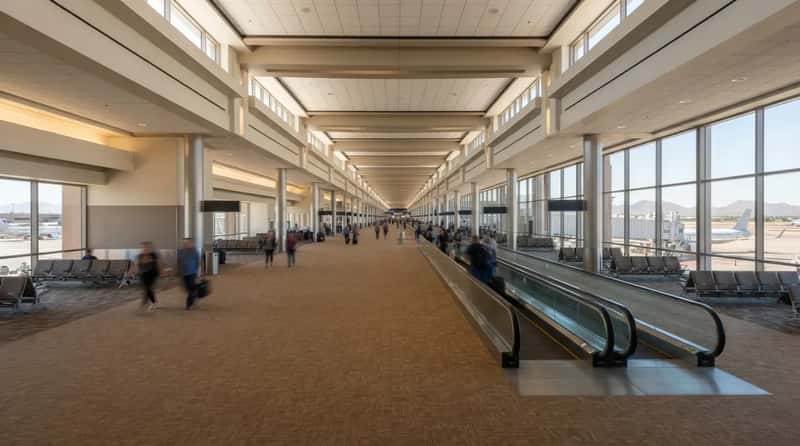
Phoenix Sky Harbor’s Terminal 4 has a gate-to-gate span of 5,222 feet. That’s almost a mile, from Gate A30 to Gate D8, inside the airport’s largest terminal. The figure comes from the airport’s own fitness-trail brochure.
Phoenix is proof that “one terminal” doesn’t mean “short walk.” A single building can hold a mile of corridor, while a hub with several terminals might have a shorter stretch. Count the building, not the label.
Minneapolis has an even longer single-terminal walk, and it’s easy to miss on a map.
#9 – Minneapolis–St. Paul: The Terminal 1 Marathon-Lite
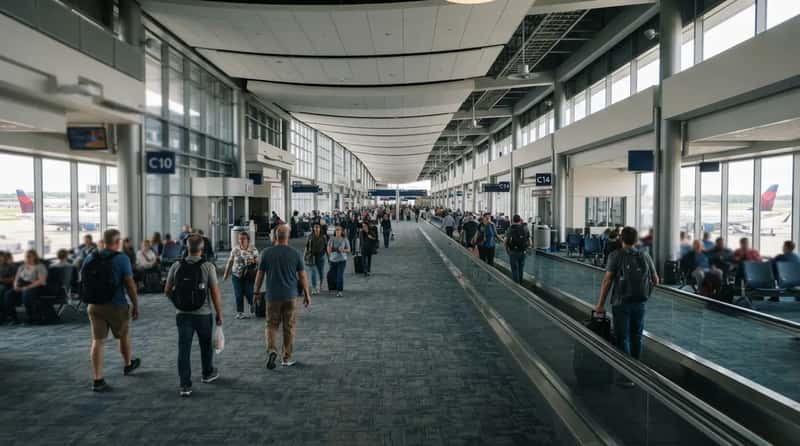
Minneapolis–St. Paul’s longest walkable stretch is about 5,700 feet in Terminal 1. That’s roughly 1.08 miles. It’s the first airport on this list to cross the one-mile line inside a single walkable terminal.
Here’s the trap. Travelers see “one terminal” in a flight app and assume the walk will be short. Figures like this one come from past measurements, so check a current map before you bet your connection on it.
At a Glance
- Lexington, one terminal: about 580 feet.
- Phoenix, Terminal 4: 5,222 feet, nearly a mile.
- Minneapolis–St. Paul, Terminal 1: about 5,700 feet, just over a mile.
- Same “one terminal” label, a walk that’s roughly ten times longer.
Philadelphia is next, and its distance depends on whether you’re willing to go through security twice.
#8 – Philadelphia: 1.1 Miles, or 1.34 If You Rescreen
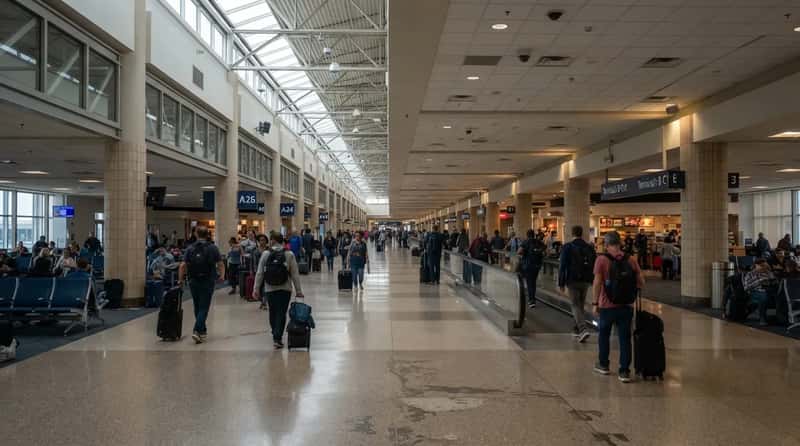
Philadelphia has two longest-walk answers, depending on one extra security line. The longest secure-side route runs from Gate A26 in Terminal A-West to E12 in Terminal E. That’s 5,838 feet, or about 1.1 miles, and it’s already a real walk.
Walking from A-26 to F-39 in Terminal F is 7,072 feet, or 1.34 miles, but it requires rescreening at security. So the “real” distance is partly a question of how much patience you have left.
Los Angeles is next, and its famous U-shaped layout hides a different kind of problem.
#7 – Los Angeles: The U-Shaped Sprawl That Fools Everyone
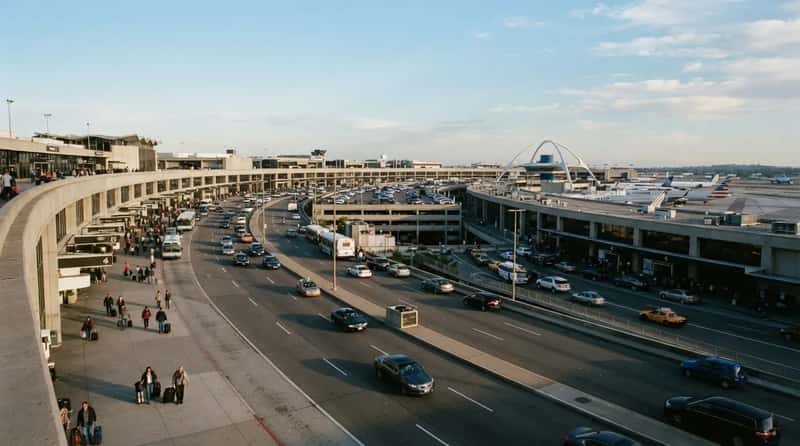
The longest LAX measurement on record is 6,433 feet, about 1.2 miles. A distance wheel clocked it from the southernmost gate in the Tom Bradley International Terminal to Gate 88 in United’s Terminal 8. For anyone trying to make a connection, that’s a very long way.
Even the shorter hops are bigger than they look. Terminal 1 to Terminal 7 spans over half a mile. LAX is best understood as a loop, not a line, so the terminals look close on a map and feel far apart on foot.
Chicago comes next, and its number is bigger than its reputation suggests.
#6 – Chicago O’Hare: The Hub With a 1.34-Mile Reputation
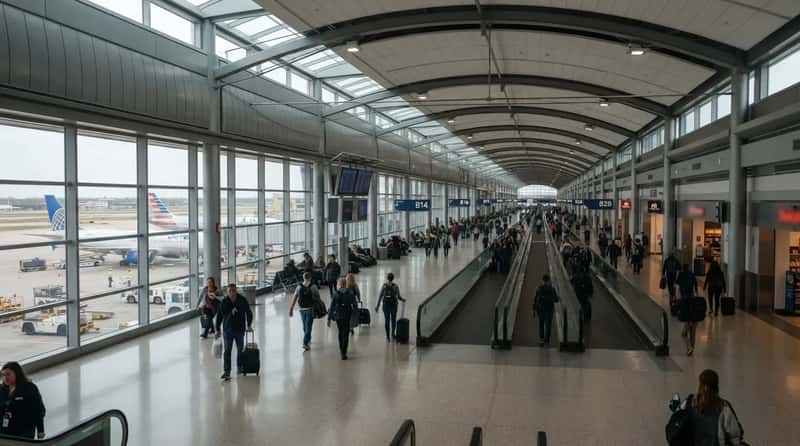
O’Hare is listed with a maximum continuous walk of 1.34 miles. Recent roundups of the KURU study place it near the top of the list. The layout matters most for passengers moving between domestic gates and international terminals.
That figure appears mostly in secondary coverage, so it’s worth checking against the airport’s own map. Roundups also note that Atlanta and Denver can demand walks of a mile or more. Rankings shift with the method, and Chicago is a good example of how a hub’s reputation and its measured number can drift apart.
New York is next, and it’s the walk you’d rather skip.
#5 – New York JFK: 1.38 Miles and a Choice of Three Ways Out
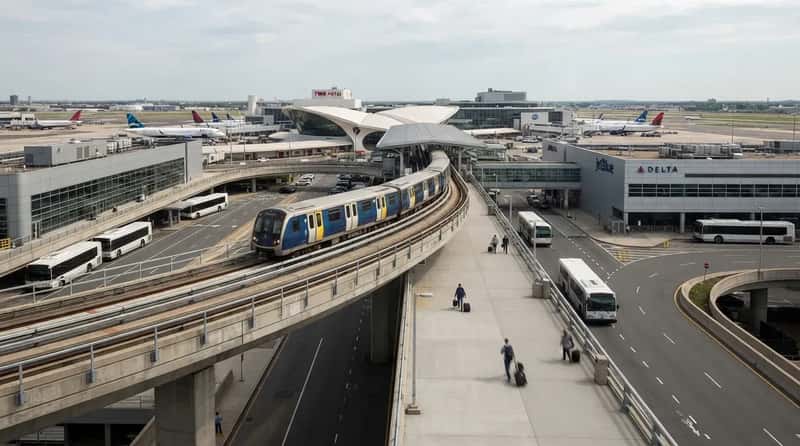
Walking JFK from one end to the other can take at least 28 minutes. Passengers at opposite ends may have to cover as much as 1.38 miles. That’s a real hike with a carry-on in tow.
Travelers can walk, take a shuttle bus, or ride the AirTrain JFK to reach another terminal. So the distance is real, but the smart move is rarely to walk it. JFK is a place where the sensible answer is to let the machines do the work.
Denver is fourth, but how its distance gets counted is the real story.
#4 – Denver: The Biggest Airport by Area, Cut Down by a Train

Denver’s measured walk is 1.45 miles in one study and 1.14 in another. KURU lists it at 1.45. A 2025 roundup says 1.14 miles at the largest US airport by area, covering over 50 square miles. The methods differ, and so do the answers.
Here’s the catch. The underground train is the only way for departing passengers to reach Concourses B and C, with a maximum travel time of 10 minutes from Jeppesen Terminal to Gate C. Denver’s big number matters less than it looks, because you can’t really walk it.
- Jeppesen Terminal to Gate A is 1,130 feet, about 5 minutes on foot.
- Concourses B and C are the ones where the train takes over.
Houston is next, and it has a train of its own with a catch.
#3 – Houston Bush: 1.52 Miles and a Train That Doesn’t Fix Everything
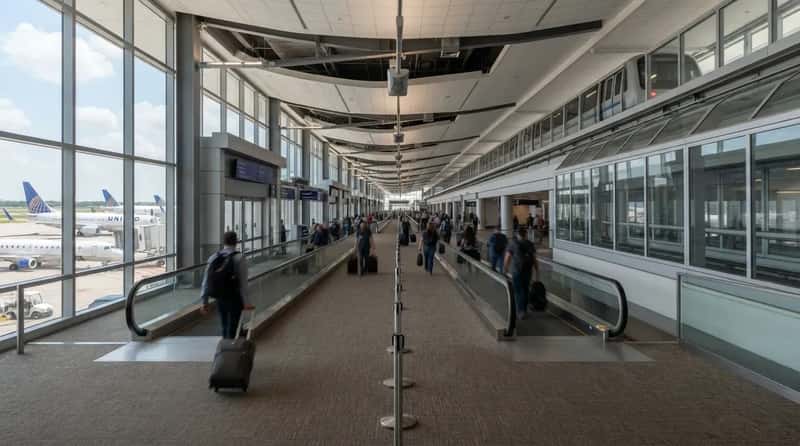
Houston’s George Bush Intercontinental measured 1.52 miles to its most distant gates. The airport has 130 gates and sits on about 11,413 acres. It’s the third-longest in the KURU data.
The airport has an interterminal train, but a train doesn’t erase every long walk. Some routes still leave you on foot, and that’s the Houston twist. The shortcut exists, but you have to know when it helps.
Washington Dulles is next, and its numbers argue with each other.
#2 – Washington Dulles: The Underground Train and the Number That Won’t Sit Still
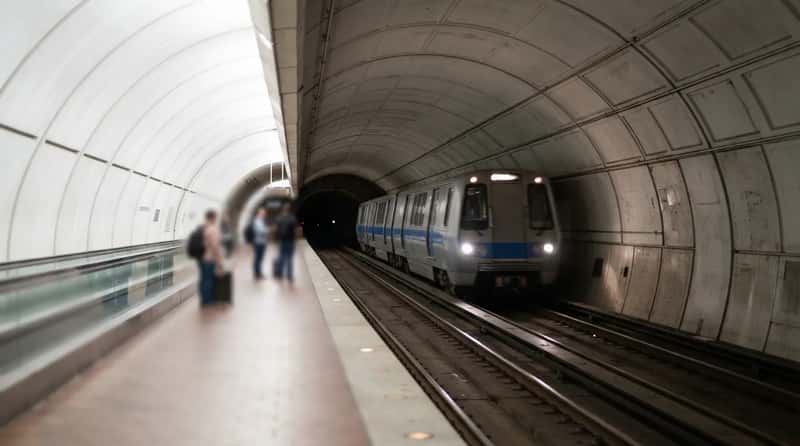
Dulles has a 1.62-mile figure in one study and 0.97 in another. KURU lists 1.62 miles, about 12,000 acres, and 123 gates. A 2025 roundup describes one main terminal with five concourses, 113 gates, and a longest walk of up to 0.97 miles.
The AeroTrain is an underground system that shortens many trips, but depending on your route you may still face a long walk. The honest answer is that the exact number depends on the path and the method. A gap that wide is a good reason not to trust any single figure.
But the longest walk in the country is in Texas, and it comes with a train built to rescue you.
#1 – Dallas/Fort Worth: The Two-Mile Walk Nobody Actually Does
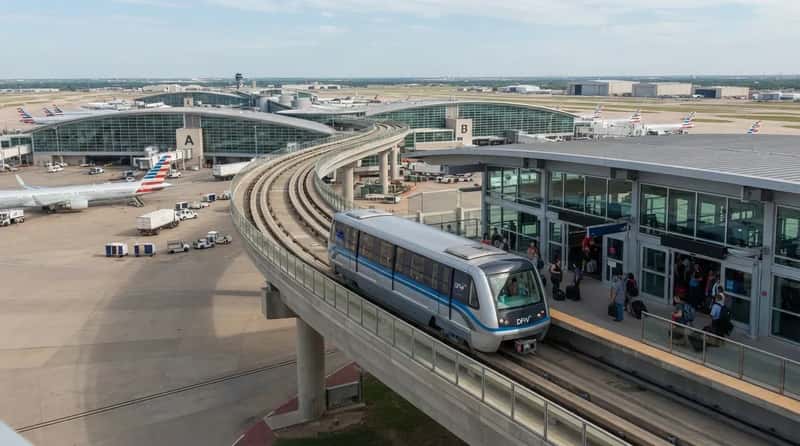
DFW has the longest measured walk in the US at 2.16 miles. It spans about 17,207 acres and 182 gates. That’s roughly 5,000 steps for the average person. An older measurement by DFW officials put the longest interior walk, Gate D6 to Gate A8, at 1.45 miles.
The airport saw this coming. Its Skylink train runs on elevated track with stops inside security at all five terminals, so you don’t have to recheck security. It tops out at 37 mph and the old system topped out at 17 mph.
- Skylink departs every 2 minutes.
- Riding it keeps you inside security the whole way.
The biggest number on the list belongs to an airport that built its way out of the problem. Smaller airports with fewer miles but no shortcut can feel far worse. The distance on the map is only half the story. What stands between you and your gate is the other half, whether that’s a train, a shuttle, or a second security line.
Quick Compare
- DFW: Skylink runs inside security at all five terminals.
- Denver: the underground train is the only way to Concourses B and C.
- Dulles: the AeroTrain shortens many trips, but some routes still mean walking.
- JFK: walk, take a shuttle bus, or ride the AirTrain.
Every figure here is a snapshot, and different studies can disagree by half a mile or more. So the next time an airport looks huge on paper, check for the train before you start counting steps.