You packed carefully, left early, and still ended up rattled at the gate with sore feet and a sinking feeling. Here’s the twist: the airport usually isn’t what eats the day. For many travelers over 65, it’s a stack of tiny habits, and some of them are left over from rules that no longer exist.
These 16 are the ones that quietly cost the most minutes, and each comes with a fix that’s easier than it sounds. A few look too small to matter. One is a brand-new $45 fee that still doesn’t guarantee you a seat. And the habit at #1 has stopped people at the checkpoint holding a driver’s license that worked fine for years.
#16 – Walking In Blind and Hoping the Line Is Short

Showing up with no idea how busy the checkpoint is may be the oldest airport habit there is. Many airports post checkpoint wait estimates online, and TSA’s MyTSA app offers similar info. A two-minute check on the drive over can change your whole plan. Skip it, and you only learn about the line once you’re standing in it.
Here’s a take that may start an argument. Arriving “way too early, just to be safe” is a time cost too. Three hours at a gate is three hours you didn’t spend at home with coffee and a chair that doesn’t have a charging cord attached. A quick look lets you pick a sensible arrival time instead of a panicked one.
But a dying phone can wreck a trip faster than any line, as #15 shows…
#15 – Trusting a Phone at 4% Battery With Your Whole Trip

Boarding pass, gate number, ride home, and the airline app all live on one device. When the battery quits, the whole trip stalls with it. Outlets near the gate are often taken, and airline counters can have their own lines. One dead battery can turn a smooth morning into a long, awkward detour to a service desk.
The fix is boring and it works. Charge fully before you leave and carry a small power bank. Keep a printed boarding pass, or a note with your flight number and gate, in a pocket. The backup feels silly right up until the moment you need it.
Your pockets might be doing even more damage at the checkpoint, as #14 shows…
#14 – Loading Every Pocket and Wearing Half a Hardware Store

Keys, coins, phone, glasses case, and a chunky belt buckle all end up in one jacket. Each one is a possible reason for a second trip through the scanner. TSA’s own travel tips steer people away from clothing and jewelry with a lot of metal. Every alarm means a pause for you and for everyone stacked up behind you.
A repeat pass costs more than most people expect. You step back, empty your pockets, and wait for another officer to be free. A simple habit prevents it: before you reach the belt, everything goes into your carry-on and the pockets stay empty. It’s less glamorous than a gadget, but it works every time.
And the item that causes the most checkpoint scrambling isn’t metal at all. It’s tucked in your bag in #13…
#13 – Burying Your Medications Under Everything Else

Pill bottles at the bottom of a packed bag are a classic checkpoint holdup. If an officer needs a closer look, the whole bag gets unpacked on the table. TSA generally allows medically necessary liquids in reasonable quantities, and you should tell the officer about them. Medication is the one thing you never want in a checked bag that could get delayed or lost.
Original labeled containers make the conversation faster. A small pouch near the top of your bag means no digging while a line watches. The lost time usually comes from the search, not from the rules.
Then there’s the unpacking ritual many travelers still perform on muscle memory, in #12…
#12 – Unpacking the Whole Bag in a Lane That Doesn’t Require It

Many travelers start pulling out laptops, tablets, and the liquids bag the moment a checkpoint comes into view. In a standard lane at many airports, that step is still expected. TSA says PreCheck lets electronics and liquids stay in your carry-on. Not every lane works the same way, and not every airport has the same equipment.
The time loss runs in both directions. Some people unpack when they don’t need to, and others don’t unpack when they should and get pulled aside. Watch the signs and the officers at your airport instead of assuming it works like your last trip.
Quick Compare
- Standard lane: Laptops and the liquids bag usually come out of the carry-on, and shoes generally stay on unless an officer asks.
- PreCheck lane: Electronics and liquids stay in the bag, and you keep your belt and light jacket on.
- Either lane: Follow the officer’s instructions, because equipment varies by airport.
Speaking of habits that outlived their rule, #11 is the biggest one yet…
#11 – Still Taking Your Shoes Off Like It’s 2019

For almost 20 years, shoes in a gray bin were simply part of flying. That changed when TSA ended its shoe removal requirement at U.S. checkpoints on July 8, 2025. Before then, only children 12 and under and passengers 75 and older were exempt. Many travelers still sit down and untie their laces out of pure habit.
There’s fine print. Officers can still ask for shoes to come off if an alarm goes off or during extra screening, and some smaller airports may not have the newer scanners yet. Slip-ons are a smart choice, but don’t start undoing laces until someone actually asks.
Even with shoes staying on, another small fumble adds up fast in #10…
#10 – Digging for ID and Boarding Pass at Every Single Stop

Purse, jacket, tote bag, repeat. Every time an agent asks for ID or a boarding pass, the search starts over. Across check-in, security, and boarding, those searches pile up. The time lost is rarely one big delay. It’s ten small ones.
Pick one spot and keep both items there. A neck wallet, a zipped front pocket, or a lanyard pouch will do. TSA also lists some digital IDs, such as Apple Digital ID and Google ID passes, as accepted at select checkpoints. That list can change, so check tsa.gov before you rely on one.
If walking is the slow part of your airport day, #9 is where most people hold back…
#9 – Marching Every Terminal Mile Instead of Asking for a Ride

Big airports can mean a long hike between check-in, security, and a far-off gate. Many travelers push through it out of pride and arrive at the gate exhausted. Airlines provide wheelchair and other mobility assistance on request, and they don’t charge for it. Asking in advance is the point, not showing up and hoping.
That help isn’t for everyone. It’s meant for people for whom long distances are a real struggle. If that’s you, ask when you book or check in. The person guiding you also tends to know the shortest route.
But the real time bomb isn’t on foot. It’s hiding in your itinerary, in #8…
#8 – Booking a Connection That Looks Fine on Paper
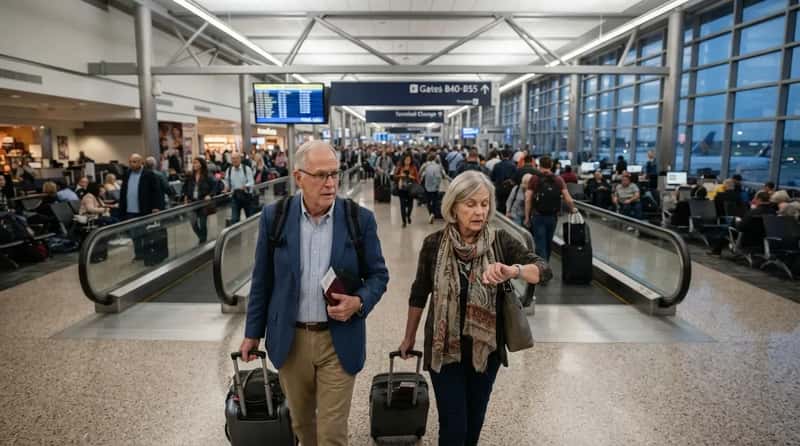
A 45-minute layover sounds easy on a booking screen. In real life, it can mean a terminal change, a long walk, and a late first flight. A connection that fits on paper can break in practice the moment anything runs behind. A missed one often means rebooking and a long wait.
Here’s an opinion that will split readers. A nonstop flight that costs a bit more is often the better deal once you count hours and stress. If you must connect, build in breathing room. Check the terminal map before you book, not after you land.
Worth Knowing
- Flights booked together on one ticket are usually the airline’s job to rebook if you miss a connection.
- Flights booked separately are usually your problem, and a missed second flight can mean buying a new ticket.
- A connection that changes terminals can take far longer than the layover time suggests.
- A longer layover costs you a few boring hours. A missed one can cost you the day.
Another trick can save you more time than you’d guess, and it works overseas too, in #7…
#7 – Skipping Global Entry When You Fly Abroad

Coming home from an international trip, the passport line can be the longest wait of the whole journey. Global Entry exists to shorten it. The fee is $120 for five years, per CBP, and it includes TSA PreCheck. One application covers both the customs line and the security line.
Many travelers dismiss it as “something for business flyers.” For anyone who leaves the country even occasionally, that logic falls apart. Weigh the cost against how often you fly abroad. If it’s rare, plain PreCheck may be enough.
The next habit costs you minutes before you even reach a line, in #6…
#6 – Ignoring Gate Changes Until the Screen Says It’s Too Late

Gates change, and sometimes flights shift terminals. If you only glance at the board once, you may march to the wrong end of the airport. The longest walk in any airport is the one you take twice. Airline apps and text alerts exist to prevent exactly that.
Turn on notifications before you leave home. Look at the monitors again once you’re through security. If tech isn’t your thing, ask a gate agent or a family member to set up alerts for you. It’s a ten-minute favor that saves a lot of hurrying.
Alarms are a different kind of delay, and they catch a lot of travelers off guard in #5…
#5 – Letting a Joint Replacement Surprise You at the Scanner

Metal implants can sometimes trigger an alarm, and an unexpected pat-down feels awful when you haven’t prepared for it. Many travelers freeze or argue, which stretches the whole process. Preparation turns an awkward scene into a quick routine. You can tell the officer about your device before screening starts.
TSA’s notification card exists for this purpose. It lets you describe a medical device or condition discreetly instead of explaining it out loud in a crowded line. You can also ask for private screening. Knowing those options exist takes much of the sting out of the moment.
Canes and walkers bring their own set of questions, and #4 explains the rules…
#4 – Not Knowing What Happens to Your Cane or Walker

Mobility aids go through screening too, and not knowing how can make the line feel tense. TSA says canes, walkers, crutches, and similar aids are either X-rayed or hand-inspected. Your aid may be separated from you for a moment, so plan your balance first. Ask for help getting through that gap.
If you can’t stand for screening, officers have other ways to clear you, including a manual inspection. Tell the officer up front what you need. A calm word early means fewer awkward stops later.
At a Glance
- Screening: Your cane or walker is X-rayed or hand-inspected.
- If you can’t stand: Officers can use other screening methods, including a manual inspection.
- Your move: Tell the officer what you need before screening begins.
- Extra backup: TSA Cares can arrange support if you contact it ahead of time (more on that at #2).
The next one is the best deal in the airport, and plenty of people still pass on it in #3…
#3 – Skipping PreCheck Because “I Don’t Fly Enough”

The standard line is the biggest time drain at most airports, and PreCheck exists to avoid it. TSA says about 99% of PreCheck passengers wait less than 10 minutes. You also keep your belt and light jacket on, and leave electronics and liquids in the bag. That’s a lot less bending, bin-juggling, and repacking.
Enrollment needs a background check and a short in-person appointment. It buys about five years of benefits for $85 or less. The one catch: PreCheck lanes can have limited hours at some airports, so check your airport’s schedule first.
But a free helpline that few travelers use may be even more overlooked, in #2…
#2 – Waiting Until You’re at the Checkpoint to Ask for Help

TSA Cares is a free helpline for travelers with disabilities, medical conditions, or other needs. Travelers are asked to contact TSA 72 hours before traveling, by phone at (855) 787-2227 or through an online form. Waiting until the day of travel can mean you miss the arranged help. The 72-hour window gives staff time to coordinate at your airport.
A caller can be connected with a Passenger Support Specialist, a TSA officer with extra training who can meet you at the checkpoint. It’s about preparation and support, not skipping screening. Make the call as soon as the ticket is booked.
None of this compares to the single costliest mistake on the list, waiting in #1…
#1 – Showing Up With a License That Isn’t REAL ID Compliant

This one is the costliest, and it’s the freshest rule on the list. REAL ID enforcement began May 7, 2025. Since February 1, 2026, travelers without an acceptable ID can pay a $45 fee to use TSA ConfirmID. TSA says there’s no guarantee it can verify your identity, so the fee doesn’t guarantee you a flight.
TSA has warned that the process can take up to 30 minutes, and missing a flight is a real risk. About 94% of passengers already carry a REAL ID or another acceptable ID, according to TSA. A passport, a Global Entry card, or a Veteran Health ID Card can also work. Look for the star on your license before you leave.
The biggest time-wasters at the airport are rarely the dramatic ones. They’re old routines, like untying shoes that no longer need to come off, or phone calls that should have happened days earlier.
The costliest mistake is a license without the star, which can mean a $45 fee and up to 30 extra minutes. The cheapest fix is PreCheck, at $85 or less for five years. Most of these habits take seconds to change, and the minutes they give back go to the trip itself.