
Picture two people on the same SEPTA Regional Rail train in Pennsylvania. One holds the right card and rides free. The person next to them pays the regular price. Across American rail, the senior price usually sits behind a card, a permit, a promo code or one small field on a booking screen. Skip that step and you pay the adult fare.
The ages vary, and so do the rules. One deal on this list costs riders nothing, and it stops dead at a state line. The last item explains where. First comes Amtrak, whose cutoff age is not the number many older guides still repeat.
#16 – Amtrak’s Senior Cutoff Is 65, Not 62

Amtrak’s standard senior discount begins at age 65, a point Capitol Corridor spells out on its own rider page.1 Plenty of guides still online say 62, which is the age some regional services use. A 63-year-old working from one of those articles could book expecting a reduction the national railroad does not offer.
On most trains, the senior fare is 15% off for passengers 65 and older. It comes off the base fare before taxes and fees are added. Because it is a percentage, a long trip rewards it far more than a short hop. Confirm the figure on your own booking screen, since promotions change it.
Fast Facts
- Standard Amtrak senior age: 65 and older
- Typical reduction: 15% off the base fare
- Taxes and fees are added after the discount
- Some regional services start earlier, at 62
The cutoff also only matters if the booking screen knows your age, and entering it is left to you.
#15 – The Age Field That Unlocks Amtrak’s Senior Price

The only way to see the actual senior price on Amtrak is to enter your age during booking. The first fare you see is not necessarily the one you are owed. Amtrak does not ask for proof of age when you book, so the discount rests entirely on what you type.2
That is convenient, but nothing corrects a blank field for you. You will need a valid ID showing your age when you board, so put a photo ID in the bag with the printed or phone ticket. The same rule holds at a station window, where you tell the ticket agent you are 65 or older and the discount applies.
#14 – Why a Sleeper Room Barely Feels the Discount

Amtrak’s senior discount does not reduce the price of a sleeper car room itself. If you book a roomette or bedroom, you pay full price for the room but receive 15% off the base coach fare. The ticket is built from a coach fare plus a room charge, and the percentage only touches the first piece.
That leaves total savings much smaller than on a coach ticket for the same route. If you are weighing coach against a room, decide based on whether you want a bed overnight, because the senior discount will not tip that choice either way.
Sleeper rooms are not the only fares the senior percentage skips. The cheapest Saver fares on some routes leave it out too.
#13 – Saver Fares and Sales That Override the 15 Percent

Saver fares, the lowest-priced tickets on some routes, sometimes exclude the senior discount, though you can still buy a regular coach fare with the percentage taken off. Sales work differently again. If Amtrak is running a sale offering more than 15% off, you get the better deal, not both.
Sources describing Amtrak’s rules do not all agree on stacking, so the total on the payment screen is the number to trust. Treat the senior percentage as a floor. Run one search with your age entered and another looking at advertised promotions before you buy.
The percentage follows the senior alone, which means whoever travels with you is priced on separate terms.
#12 – Your Companion Pays Full Fare on Amtrak

Your companion pays the full fare unless they are also 65 or older. Each passenger must book under their own name and age, so one person’s age cannot carry a younger spouse or friend along.
Packaged trips work the same way. Amtrak Vacations tours have their own pricing and do not take the 15% senior discount on top. If you are comparing a package against booking the train and hotel separately, price both ways, because the package will not give you the senior reduction.
#11 – Capitol Corridor’s Promo Code Starts at 62

California’s Capitol Corridor service gives senior passengers 15% off every train ticket, and it offers the discount from age 62.1 That is three years ahead of Amtrak’s standard cutoff on the same tracks. If you are in your early 60s in Northern California, this is one of the few places where a younger senior gets a train discount.
The discount is not applied on its own. You select the Adult fare and enter a promo code at checkout, so a rider who forgets the code pays full price. Proof of age is required, so carry it.1
The code costs about a minute at checkout and is worth that minute on every ride. Capitol Corridor handles its discount with a code typed at checkout, while Chicago’s Metra hands it out through a permit that has to be issued first.
#10 – Metra’s Reduced Fare Needs a Permit First

Metra offers reduced fares to senior citizens 65 or older, customers with disabilities and Medicare cardholders who have a Reduced Fare Permit from the region’s transit authority. K-12 students and active-duty military qualify with identification. Without the permit, the reduced ticket is not yours to buy, so the application comes before the first ride.3
Once you hold it, the buying is easy. Reduced fare riders can buy tickets from vending machines, the Ventra app or conductors, and will be asked to show their permit or ID when using the ticket. Keep the permit with you on every ride, not only when you buy.
#9 – Metra’s $6 Day Pass for Older Riders
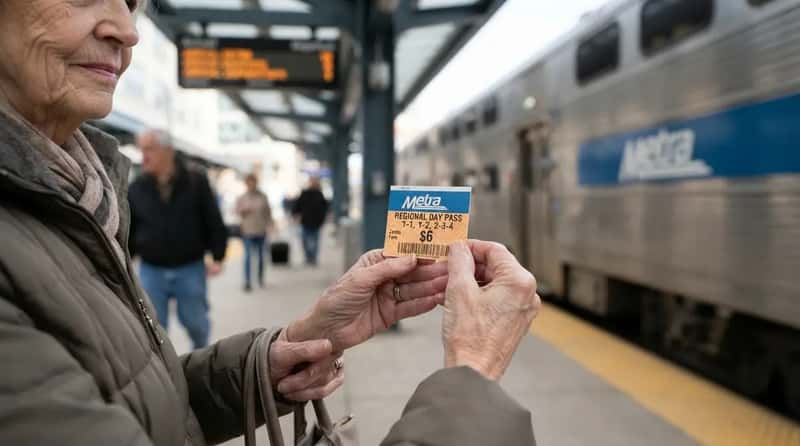
The Northern Illinois Transit Authority’s fare table lists the weekday Regional Day Pass for Metra zones 1-1, 1-2 and 2-3-4 at $10 full fare and $6 reduced. The same table lists the Saturday, Sunday and holiday pass at $9.50 for full fare. A senior with a permit who is making several stops around the city on a weekday pays $4 less than a full-fare rider for the very same pass.
A day pass makes the most sense when you plan more than one ride that day. For a single round trip, compare it with two reduced one-way tickets before you pay.
The $6 pass is still a fare, though. Illinois has a separate permit that removes the fare altogether for some older riders.
#8 – Illinois Seniors Who Ride Metra for Nothing
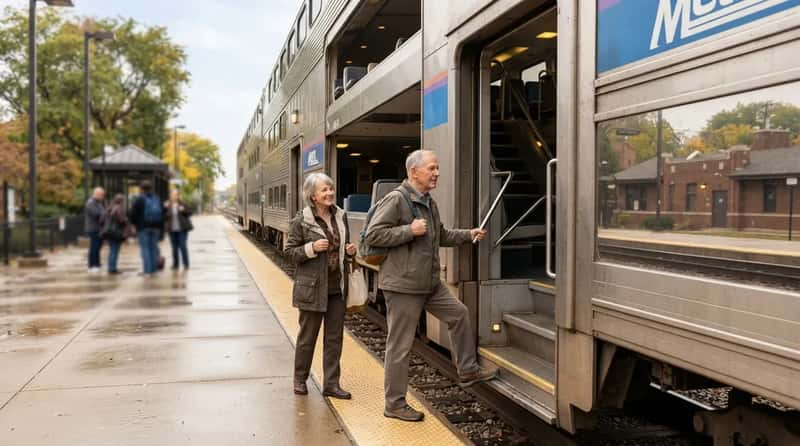
Illinois has a ride-free track as well as a reduced one. Older adults enrolled in the Illinois Department on Aging’s Benefit Access program ride free on Pace, CTA and Metra. The Senior Ride Free Permit lets qualifying customers 65 and older ride at no cost on CTA, Metra and Pace fixed route service.4
The free permit is a different product from the reduced one. Applicants must be enrolled in the Benefit Access Program, so enrollment comes first and the permit follows from it. Seniors not enrolled in that state program can still apply for the reduced permit.
Quick Compare
- Senior Ride Free Permit: for riders 65 and older enrolled in Benefit Access, with no fare on CTA, Metra or Pace
- Reduced Fare Permit: for seniors not enrolled, with lower fares such as the $6 weekday Metra day pass
Both permits begin with an application, and the application has its own window around the 65th birthday.
#7 – The Three-Week Window Before Your 65th Birthday

Chicago-area seniors may apply within three weeks of their 65th birthday4, so you do not have to wait for the day itself to have the permit in hand. At the application you need a 2-by-2 color photo and a current government-issued ID card. There is no benefit in waiting past the birthday, so file as soon as the window opens.
The permit is not only for people who have turned 65. Medicare recipients receiving Social Security benefits are also listed as eligible, which matters to someone on Medicare before 65. Local township offices, such as Libertyville Township’s, serve as application sites.
Chicago’s permit starts at 65, but one big Northeast system lowers that line to 62.
#6 – NJ Transit’s Half Fare Begins at 62

NJ Transit members of the Reduced Fare Program save 50 percent on a regular one-way ticket, on any bus, rail or light rail service at any time. The senior age is 62. You show your Reduced Fare ID or Medicare card with your ticket to the operator or conductor.5
There is one exception on the rail side: the age is 65 for travel to or from Metro-North stations. A program listing also notes that you don’t need to be a New Jersey resident to be eligible, so a visiting 62-year-old can use it.
#5 – Other Agencies’ Senior Cards That NJ Transit Honors

NJ Transit’s list of acceptable senior ID is wider than its own card. It names an MTA Reduced Fare Card, a PATH Senior Fare Card and a PA Senior Citizen Transit ID or PACE Card, along with a Medicare card, driver’s license, passport and birth certificate.5
That matters because a card you already own can save a trip to apply for a new one. A Pennsylvania senior who rides SEPTA free at home may already be carrying proof that works in New Jersey. Seniors may be asked to present a valid ID to get the reduced fare, so keep the one you plan to use within reach.
Worth Knowing
- The discount is 50 percent off a regular one-way ticket
- The senior age is 62, but 65 for Metro-North travel
- New Jersey residency is not required
- Cards from MTA, PATH and Pennsylvania programs are on the accepted list
A card that is accepted today still has to meet NJ Transit’s own rules for its own ID, and those changed at the start of 2026.
#4 – NJ Transit’s Photo Rule and a Fare Hike That Spared Seniors
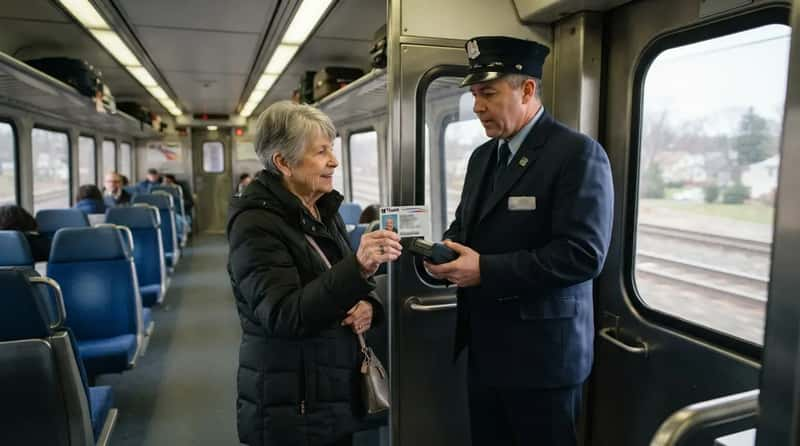
NJ Transit’s own Reduced Fare ID must have a photo, since non-photo cards stopped being accepted on January 1, 2026. A rider with an older card showing no picture needs a replacement before the next trip.
The agency’s 3% fare increase was a different story for seniors. Reduced fares for children, seniors and riders with disabilities didn’t change. The regular ticket got more expensive and the senior price stayed put, so the savings gap against a full fare grew a little.
#3 – St. Louis MetroLink at Half Price for 65 and Up

Metro Transit in St. Louis sells a Senior Reduced Fare Permit that allows seniors 65 and older to ride MetroBus and MetroLink for half price. To get it you need a government-issued photo ID verifying your age, such as a driver’s license, state ID or passport. The permit comes through the Transit Access Center.6
Medicare is a second way in. Customers who possess a Medicare ID are eligible for a Reduced Fare Permit, along with seniors and people with disabilities. For an older rider on a light-rail line, half price on every trip adds up faster than you might expect.
St. Louis sets the senior price at half, while Washington ties its senior rate to the peak fare.
#2 – Washington Metrorail’s Senior SmarTrip Card

In the Washington area, customers age 65 and older automatically qualify for reduced fares whether or not they have a disability. Older adults may ride for half the peak fare on Metrorail and for $1 on regular Metrobus routes. The card is what carries the price, so the first task is getting one.
You buy a Senior SmarTrip card by showing a valid photo ID with proof of age at any Metro sales office, commuter store or selected retail outlet.7 Applicants 65 and older are not issued a Metro Disability ID card, so the senior card is the one to ask for.
At a Glance
- Eligible age: 65 and older, with no disability required
- Metrorail: half the peak fare
- Regular Metrobus routes: $1
- Where to buy: Metro sales offices, commuter stores or selected retail outlets
Half of the peak fare still leaves a charge on the card. One Pennsylvania system drops the charge entirely inside the state.
#1 – Pennsylvania’s Free Regional Rail Ride Has a State Line

On SEPTA, seniors 65 and older ride free on Regional Rail with a valid Senior Fare card, as long as departure and arrival stations are in Pennsylvania.8 The same card is free on SEPTA’s bus, trolley and Metro routes. The card is valid for four years, so one application covers a long stretch.
The free ride ends at the state line. For stations in New Jersey or Delaware the cost is 50% of the weekday fare, which can be paid on board with cash or a major credit card. The card is required for any of it, and seniors living outside Pennsylvania must obtain one upon arrival.
On Regional Rail you tap on and off. The free ride is not paid for out of SEPTA’s budget, because the Pennsylvania Lottery covers it.8
Across these systems, the reduction rarely arrives by itself. It hangs on an age typed into a form, a promo code, a permit or a card, and the full fare is what you pay when you skip the step.
So the first job before a trip is not comparing percentages. It is finding out what each operator wants you to show. Most of these can be settled with a photo ID and one application.
Which senior card, permit or promo code is in your wallet right now, and how did you get it?
- Capitol Corridor Rider Discounts: https://www.capitolcorridor.org/rider-discounts/
- Amtrak Sleeper Senior Fares: https://allaboutvehicles.com/auto-maintenance-repair/general-auto-maintenance/amtrak-fares-for-seniors-sleeper-car
- Metra Fares: https://www.metra.com/fares
- Libertyville Township RTA Permit: https://www.libertyvilletownship.us/services/rta-reduced-fare-program
- NJ Transit Senior Fares: https://www.njtransit.com/seniors
- Metro St. Louis Reduced Fare: https://www.metrostlouis.org/reduced-fare-program/
- Metro Reduced Fare Program: https://disabilitynavigator.org/program/53666/metro-reduced-fare-program-older-adults-and-people-disabilities
- SEPTA Senior Fare Program: https://wwww.septa.org/fares/senior-fare-card/