The hotel lobby at noon and the hotel lobby at 3 a.m. are two different places. Day staff see polished check-ins, luggage carts, and guests who have had their coffee. Night staff see what’s left after the performance ends: the real faces, the real habits, and the strange little moments nobody plans to show anyone.
You might expect the overnight shift to be the boring one. It’s usually the opposite. After midnight, travelers say things they’d never say at breakfast, and small details start to look like clues. Some of what night staff notice is funny, some is heartbreaking, and one of them might change how you walk through a hotel hallway.
#16 – The 3 A.M. Lobby Wanderer Isn’t Lost, Just Wide Awake

Night clerks see the same figure again and again. It’s a guest in socks or slippers drifting through the lobby, flipping through the brochure rack, and staring at the fish tank like it’s a late-night movie. They aren’t looking for anything. The body clock is the problem, because crossing time zones can leave your internal clock hours out of sync with local time.
Fast Facts
- Jet lag is a mismatch between your internal clock and the local time.
- Common signs include daytime sleepiness, broken sleep at night, and odd hunger.
- Travelers flying east usually have a harder time adjusting than those flying west.
- The night desk is where it shows, because the lobby is the one quiet, lit place awake at 3 a.m.
That’s why a guest from another continent may treat 3 a.m. like mid-afternoon. Day staff never meet this version of the guest, because by morning the wanderer has finally slept and looks perfectly normal. The night desk is where jet lag actually shows. Staff usually just nod, offer a cup of water, and let the guest drift. The next one, though, is a sign most people never think twice about…
#15 – The “Do Not Disturb” Sign That Never Comes Down

A DND sign looks harmless at 2 p.m. At 2 a.m., the same sign on the same door can start to worry the night team. They’re the ones who notice that the light under the door never changes and the tray outside never moves. Many hotels have policies requiring a welfare check after a DND stays up for a set period, though the exact rules vary by property.
Here’s the part guests rarely hear. Housekeepers see the door during the day, but the night shift notices the silence. A quiet room is often the one staff think about most, because nobody wants to be the person who assumed everything was fine.
But the ice machine hallway tells an even stranger story about who we really are…
#14 – The Ice Machine Run Brings Out the Real Personality

Nobody dresses up for ice. Night staff watch guests shuffle down the hall in robes, oversized T-shirts, and mismatched socks, holding a plastic bucket like a lifeline. The confident executive from the afternoon meeting suddenly looks like anyone else at 1 a.m.
Guests wave, joke, and chat in a way they never would at the front desk. The hallway is the one spot in the hotel where almost everyone looks equally unprepared. Night staff say that makes people friendlier, not ruder. Then again, some guests skip the hallway completely and pick up the phone instead.
And those phone calls get stranger than you’d expect…
#13 – Some Calls to the Desk Aren’t Really About Towels

The front desk phone rings at 2:40 a.m. The question is about extra pillows, but the call keeps going. Night clerks describe guests who ask about the weather, the neighborhood, or nothing in particular. The request is a thin excuse, and what the guest actually wants is a human voice.
Day staff handle fast, practical requests in a busy lobby. Overnight, the pace slows and conversations stretch out. For some guests, the night clerk is the only person they’ll talk to all day. Most clerks say they don’t mind, and many say they notice when a regular caller goes quiet. Meanwhile, another group of guests only appears when their travel plans fall apart.
#12 – The Last Check-In of the Night Is Usually a Travel Disaster

Few guests choose to check in at 1 a.m. Most are people whose flights were delayed, canceled, or rerouted, or whose road trip went sideways. They show up with dead phones, wrinkled clothes, and a story they’ve already told three times. Airport disruptions are a regular reason hotels fill up with stranded travelers overnight.
The day shift gets cheerful arrivals who have time to ask about the pool. Night staff get people who haven’t eaten since a gate-side pretzel. A kind word and a quick key card go a long way. The first few minutes at the desk often set the tone for the whole stay.
But the next scene starts with a click, and a door that won’t open…
#11 – The Hallway Lockout Is the Night Shift’s Most Awkward Rescue

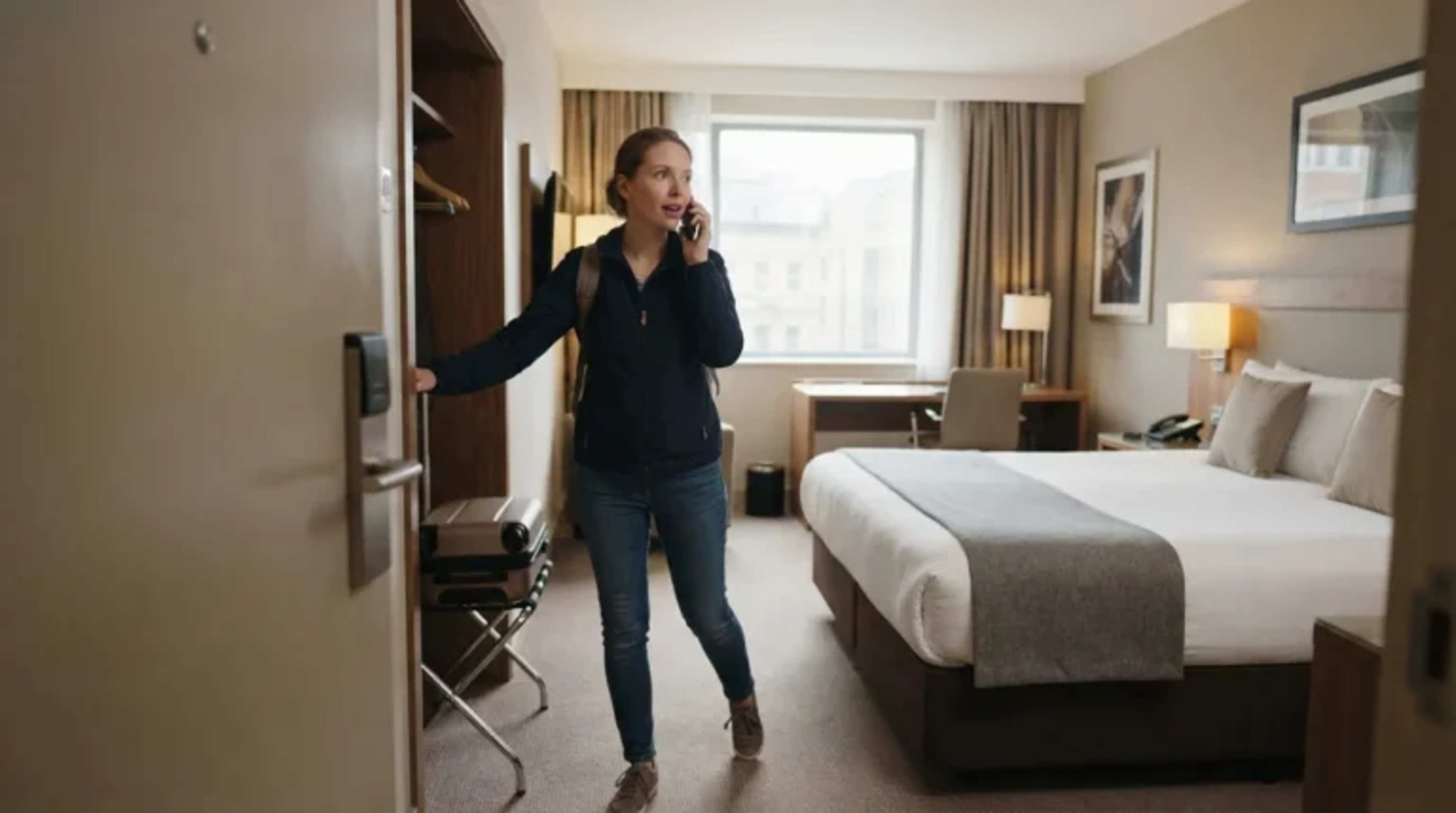
It happens the same way every time. A guest steps out for ice or a vending snack, the door clicks shut, and the key is sitting on the nightstand. Now they’re standing in the hallway in pajamas, or sometimes less. Night staff say these are among the most common after-hours calls.
Quick Compare
- What the guest hopes: “Just open it, I’m the one staying here.”
- What the clerk needs: ID that matches the name on the reservation.
- What happens next: A new key card and a walk back upstairs.
The staff member can’t just open the door for a stranger. Hotels generally require ID matching the registered guest before they let anyone back in, and that rule protects every other guest too. So the clerk checks ID, re-keys the card, and walks the guest back upstairs. Day staff rarely see anyone this embarrassed. But the card itself deserves a closer look…
#10 – The Truth About “Demagnetized” Key Cards

Most guests blame their phone. They swear it wiped the card, and they arrive at the desk at midnight with an apologetic look. The truth is more boring. Many hotels now use RFID cards instead of the old magnetic stripe, so a phone in your pocket is not the likely culprit.
Night staff see this more than day staff because late arrivals are the ones testing the card for the first time at 1 a.m. The most common fixes are a re-encode or a lock check, not a new phone habit. Some insiders argue the myth has lasted this long simply because it’s an easy thing to blame. Next up is a smell that clears a hallway fast…
#9 – Smoke in “Non-Smoking” Rooms Shows Up After Dark

Night staff are often the first to catch a whiff of smoke drifting from under a door. Plenty of hotels are fully non-smoking, and many charge cleaning fees when they find evidence of smoking in a room. The smell tends to be strongest in quiet hallways late at night, when the ventilation hums and nobody else is around.
Day staff mostly see the aftermath on housekeeping reports. The night shift deals with the live version, which can include a blaring alarm. A detector going off over a secret cigarette is one of the most common false alarms staff mention. But what guests do when it sounds says a lot about them…
#8 – How Guests React When the Fire Alarm Goes Off at 3 A.M.

The alarm sounds, and the lobby fills with a mix of reactions. Some guests rush out within minutes with a phone and a jacket. Others stay in their rooms, assuming it’s a false alarm, and a few stop to pack a full suitcase. Fire safety groups such as the NFPA advise leaving right away every time an alarm sounds.
Night staff see this live, while day staff mostly hear about it later. Stopping to grab the laptop is the classic delay. Staff just want everyone outside and counted. The guests who never came out are the ones they remember.
Still, an alarm isn’t the only thing that reveals who’s actually staying in a room…
#7 – The Room Booked for One Suddenly Has Four People in It

Night clerks notice patterns that day staff can’t. A single reservation turns into a parade of friends carrying pizza boxes and duffel bags after midnight. Rooms have occupancy limits, and hotels set those for safety and for fairness to other guests. How staff handle it often depends on how loud things get.
Pets are another surprise. A barking dog in a no-pet room is almost always discovered at night, when the hallway goes quiet and the sound carries. Staff say the conversation that follows is usually calm. It tends to get less calm once the noise complaints start rolling in.
#6 – Noise Complaints Follow a Pattern Day Staff Never Notice

Ask a night clerk and they’ll tell you the loud rooms are rarely random. Weekend nights, rooms near elevators, and rooms close to ice machines tend to attract the most calls. Hard hallway surfaces carry sound, and a shut door doesn’t block everything. The day team sees none of this, because daytime guests are mostly out sightseeing.
Here’s the twist guests rarely realize. The complaint call often comes from a room very close to the noise, and a quick knock from security usually settles it. And not every noisy guest is on vacation at all…
#5 – Some Guests Live on a Completely Different Clock

Night staff meet the people who work while the rest of us sleep. Airline crews, long-haul truckers, and healthcare workers on rotating shifts often book rooms to sleep during the day. They check in as the rest of the world is heading out, and they’re often asleep before the lobby fills with tourists.
Why It Stands Out
- They sleep when the hotel is at its busiest and loudest.
- Quiet-room requests and wake-up calls matter more to them than any amenity.
- Many are on tight schedules, so a smooth check-in means real sleep.
- Night staff are often the only ones who see them arrive and leave.
Day staff know them as the guests who asked for the quietest room and a “Do Not Disturb” sign. For these travelers, 7 a.m. is bedtime. They tend to be polite, tired, and surprisingly punctual. But what happens at 4 a.m. in the lobby may be the most honest hour of all…
#4 – At 4 A.M., Guests Say Things They’d Never Say at Noon

Sleep researchers describe a natural dip in alertness in the hours before dawn. Night staff see what that looks like in real life. Guests who are tired, stressed, or far from home tend to open up at that hour. A casual “how are you?” can turn into a five-minute story about a job, a breakup, or a flight home.
Day staff almost never hear these stories. The lobby at 4 a.m. is where travelers become people instead of reservations. Clerks listen, nod, and keep the coffee going. But some conversations at that hour are far more serious…
#3 – Night Staff Are Often the First to Notice a Medical Emergency

A guest calls the desk saying they feel dizzy. Another doesn’t answer the phone at all. Overnight, there are fewer staff and fewer witnesses, so the person at the desk is often the first to respond. Clerks are generally trained to call 911 quickly rather than try to play doctor.
Many hotels also keep first-aid supplies, and some have defibrillators on site, though this varies by property. The first minutes matter most, and the night desk is often where they begin. Day staff rarely see how fast a calm night can change. And there’s one more thing night staff are trained to spot…
#2 – The Quiet Signs Staff Are Trained to Watch For

The American Hotel & Lodging Association backs the “No Room for Trafficking” initiative, and many hotel companies train employees to recognize warning signs. Night staff are a big part of that picture. They’re the ones who may see unusual traffic through a room, a guest who never speaks for themselves, or someone who seems controlled by another person.
Here’s what training stresses. One odd detail is not proof, and staff are taught to report concerns rather than confront anyone. The night shift sees these moments because the lobby is quiet enough to notice them. But the final one is the one night staff talk about the longest…
#1 – Hospital Families Checking In at 2 A.M. With No Luggage

Many hotels near hospitals offer special medical rates, and night staff meet the people who use them. They arrive with a single bag, or none at all. They’ve spent hours in a waiting room, and they need a bed within walking distance of someone they love.
Worth Knowing
- Hotels near hospitals often offer medical or patient-family rates, though terms vary by property.
- Mentioning the situation at check-in helps, since staff can’t offer what they don’t know about.
- Stays are often unpredictable, so flexibility on dates can matter as much as price.
- Small touches like a toothbrush or bottle of water often mean the most at that hour.
Day staff see the paperwork. The night clerk sees the face. Plenty of these guests ask about a late checkout before they’ve even picked up the key. Staff often slip in an extra toothbrush, a bottle of water, or a quiet “I hope everything’s okay.” It’s the smallest gesture on the shift, and guests tend to remember it.
The people who work the night shift don’t get a daytime view of hotel life. They get the unfiltered one, with the tired, the lonely, the stranded, and the scared.
Next time you walk through a lobby after midnight, remember that the person behind the desk has probably already seen your kind of night, and is hoping yours turns out okay.