Most people think harbour tender operations are simple taxi runs between yacht and shore. They’re not.
Behind the polished uniforms and choreographed arrivals lies a world of split-second risk management, unwritten rules, and institutional knowledge that harbour teams guard closely.
Experienced crews know that what guests see – a smooth, effortless transfer – is built on a mountain of preparation they’ll never witness. Here’s what insiders actually say happens at the waterline, starting with the secret nobody expects.
#18 – The Weather Check Happens Long Before You Ask
Most guests assume the tender goes out the moment they’re ready. Insiders know the weather assessment started hours earlier.
It can begin under sunny skies and calm seas – but tender teams are already calculating how conditions might shift by the time the boat needs to come back out of the water. What looks calm at launch can turn hostile at retrieval.
Harbour teams track tide tables, wind shifts, and swell forecasts as a continuous background task – not a one-time check. Before any port entry or movement, crews check wind, visibility, sea state, and tidal current, because all of it affects tender manoeuvring space.
Guests who push for an “immediate” shore run during a weather hold are pushing against a calculation they can’t see. The tender team isn’t being slow – they’re being professional.
But that’s nothing compared to what we found about #17…
#17 – Every Launch Sequence Is Treated as Brand New
You’d think experienced crew would run a well-rehearsed launch on autopilot. Turns out, that assumption is exactly what causes incidents.
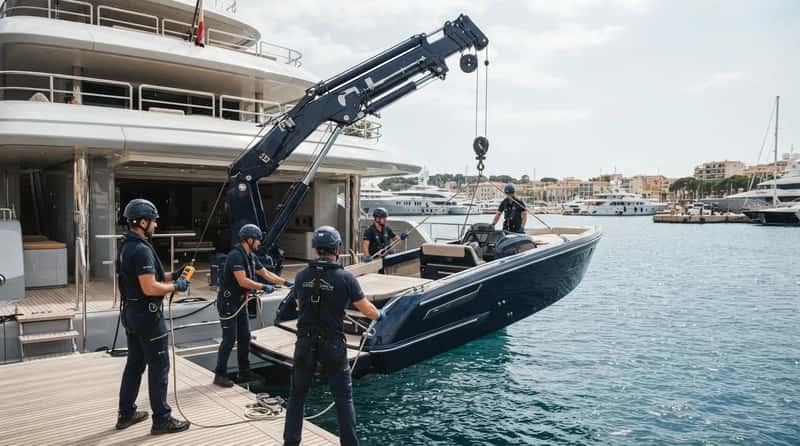
Every launch and retrieval sequence is unique – whether it’s three decks up or from a waterline garage. Crew retrain fresh every time, no matter how many tenders they’ve launched on other vessels.
No two yachts, garages, or crane setups are identical. That’s why a dry run is required before any charter begins.
Harbour teams that skip the pre-charter rehearsal are the ones that end up with bent cranes and damaged hulls. It’s not tradition – it’s risk management.
Tenders and the cranes that lift them keep getting bigger and heavier, which only raises the stakes of getting this step wrong. Launching one is always a delicate process with real potential for mishap.
But that’s nothing compared to what we found about #16…
#16 – The Lifting Gear Gets Inspected Every Single Time
Guests board the tender. What they don’t see is what happened in the ten minutes before.
Crew inspect the lifting points, harness, crane, and boom for wear before every single lift. Skipping that step – even once – is how catastrophic drops happen.
A single drop of hydraulic fluid on the crane deck can ground an entire charter day. Any fluid on deck or unusual sound is treated as an immediate red flag, and operations stop for a full re-inspection.
Painter lines must be attached at both stern and bow, and no crew member stands near the tender’s underside during the lift. That rule sounds obvious – until you’ve seen a swing happen in open water.
But that’s nothing compared to what we found about #15…
#15 – Slow Is a Professional Standard, Not a Failing
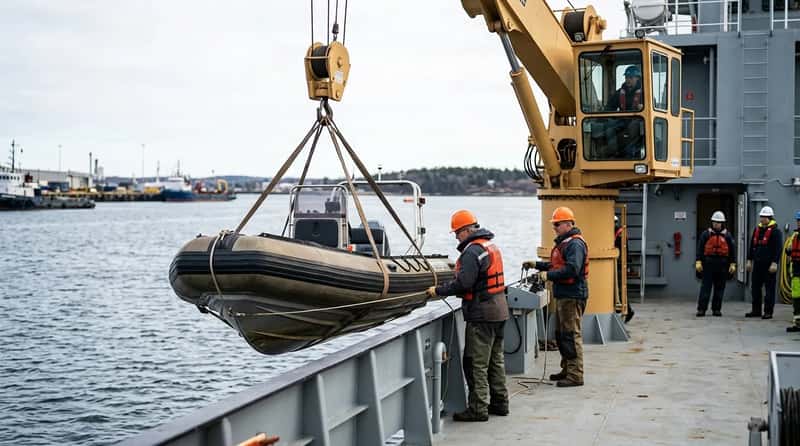
New deckhands get impatient during crane operations. Veterans know the phrase by heart: slow is pro.
Crew watch for sudden movement the moment the crane takes the tender’s weight, and the same vigilance applies to the operator at the controls. Speed during a lift is where expensive mistakes compound fast.
A launch quietly affects vessel stability, crew positioning, and safety cover all at once. That’s why decks are cleared, lifejackets go on, and every department gets notified before a single line moves.
Harbour teams that rush tender ops to impress guests are the ones running the highest risk. The calm, deliberate crew is the skilled one.
But that’s nothing compared to what we found about #14…
#14 – Harbour Teams Run Covert Provisioning Runs
Guest transfers are the visible side of tender operations. The invisible side is what actually keeps the yacht running.
Tenders shuttle guests, run beach-club picnics, tow waterskiers, carry dive gear, and handle the daily provisioning that keeps the yacht stocked without a marina berth. Most of that happens while guests are asleep or occupied elsewhere.
Provisioning runs often start before dawn to beat harbour traffic and get first pick at the fish market. Harbour teams schedule these movements separately from the guest itinerary – and keep them off it on purpose.
Multiple tenders can be running entirely different missions at the same time. Managing that traffic without guests ever noticing is its own quiet skill.
But that’s nothing compared to what we found about #13…
#13 – Not All Tenders Are Created Equal (And the Guest Never Knows Which One They’re Getting)
Most guests assume one tender equals one purpose. The reality is a carefully managed fleet hierarchy.
A dedicated watersports RIB comes with high-performance engines built for towing, while a VIP shuttle needs weather protection, a retractable canopy, and sometimes full climate control inside an enclosed cabin. A 40-50 metre yacht typically runs a 6-9 metre primary tender plus a smaller jet RIB.
Yachts above 60 metres often carry a 10-metre-plus limousine tender, a second open boat, and sometimes a beachlander. Which tender a guest boards is a deliberate operational decision – not random.
Harbour teams quietly weigh sea state, guest profile, and destination before picking the vessel. Guests just think they “got in the boat.”
Quick Compare
- Watersports RIB: high-performance engines built for towing
- VIP shuttle: weather protection, retractable canopy, sometimes full climate control
- 40-50m yacht fleet: 6-9m primary tender plus a smaller jet RIB
- 60m+ yacht fleet: 10m+ limousine tender, second open boat, sometimes a beachlander
But that’s nothing compared to what we found about #12…
#12 – The Kill Cord Rule Is Non-Negotiable (And Often Ignored)
Every tender operator knows the kill cord rule. Far fewer actually follow it on every single run.
If the driver gets thrown clear of the helm, the cord kills the engine instantly – stopping a runaway vessel before it reaches a crowded anchorage. A runaway tender in a busy harbour isn’t a minor incident – it’s a potential fatality.
Professional teams treat the kill cord as a cultural standard, not a line on a checklist. Crews who skip it on “short runs” are usually the ones who learn why it exists the hard way.
Every tender risk assessment – covering safety, environment, and the people on board – puts the kill cord at its centre. It’s the cheapest insurance policy on the boat.
But that’s nothing compared to what we found about #11…
#11 – VHF Radio Is the Lifeline Nobody Talks About
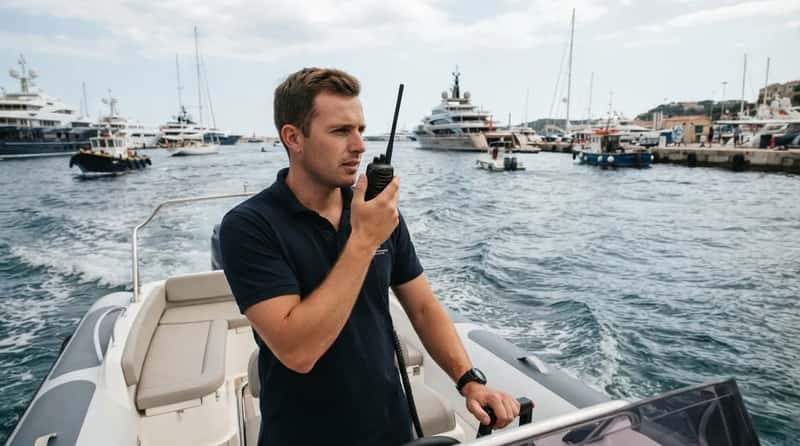
Guests see the polished handoff at the dock. They don’t see the radio traffic running behind every movement.
Tenders cross fairways, work close alongside ships, and sometimes assist with towing – so crews keep a listening watch on VHF at all times. Radio silence during a run is a red flag, not a sign of confidence.
Experienced harbour teams keep continuous two-way contact between the tender, the mothership, and the dock – even on a five-minute run. A lot can happen on the water in five minutes.
Teams that rely on mobile phones alone are operating below professional standard. VHF is the standard because it still works when the phone network doesn’t.
But that’s nothing compared to what we found about #10…
#10 – Passenger Loading Is Strictly Managed (Even When Guests Push Back)
Boarding is where harbour teams face the most social pressure – and where they have to hold their ground. Overloading a tender is one of the most common and most dangerous mistakes in harbour operations.
Guests who insist on “just one more person” are pushing against a stability calculation that already accounts for sea state, fuel load, and gear on board. On superyachts, passengers are often escorted by at least two crew members for exactly this reason.
The working capacity of a tender is always lower than its maximum printed capacity – harbour teams know this, and they enforce it. A polite but firm refusal at the boarding point is a sign of a well-run operation.
A team that always says yes to one more passenger is the one that ends up in an incident report. Elite teams would rather disappoint a guest for thirty seconds than risk a capsize.
But that’s nothing compared to what we found about #9…
#9 – Night Runs Have a Completely Different Protocol
Daytime tender ops are demanding enough. After dark, the entire risk profile changes.
Pre-launch checks expand to include a quick ignition test, a battery voltage check, and confirmation every navigation light is working – because guests might want a late-night run ashore. That readiness has to be maintained from the moment the tender is last recovered.
Harbours that look completely clear during the day become obstacle courses after dark – unlit mooring buoys, anchored boats without anchor lights, and dinghy traffic that never shows up on AIS. Operators carry a torch as standard kit for exactly this reason.
Experienced teams slow right down at night and navigate visually instead of by assumption. Crews who run night tenders at day speeds are the ones filing hull damage reports the next morning.
Worth Knowing
- Pre-launch night checks add ignition tests, battery voltage checks, and nav-light confirmation
- Unlit mooring buoys and boats without anchor lights are common after-dark hazards
- Dinghy traffic often never shows up on AIS at all
- A torch is considered standard kit for every night operator
But that’s nothing compared to what we found about #8…
#8 – The Safety Management System Is a Living Document
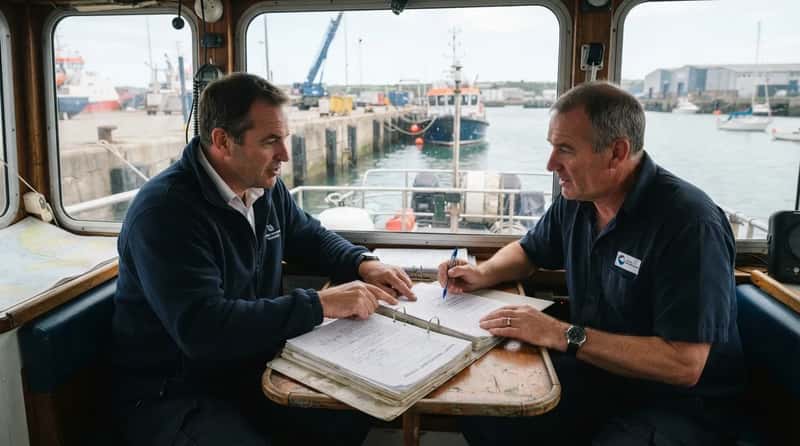
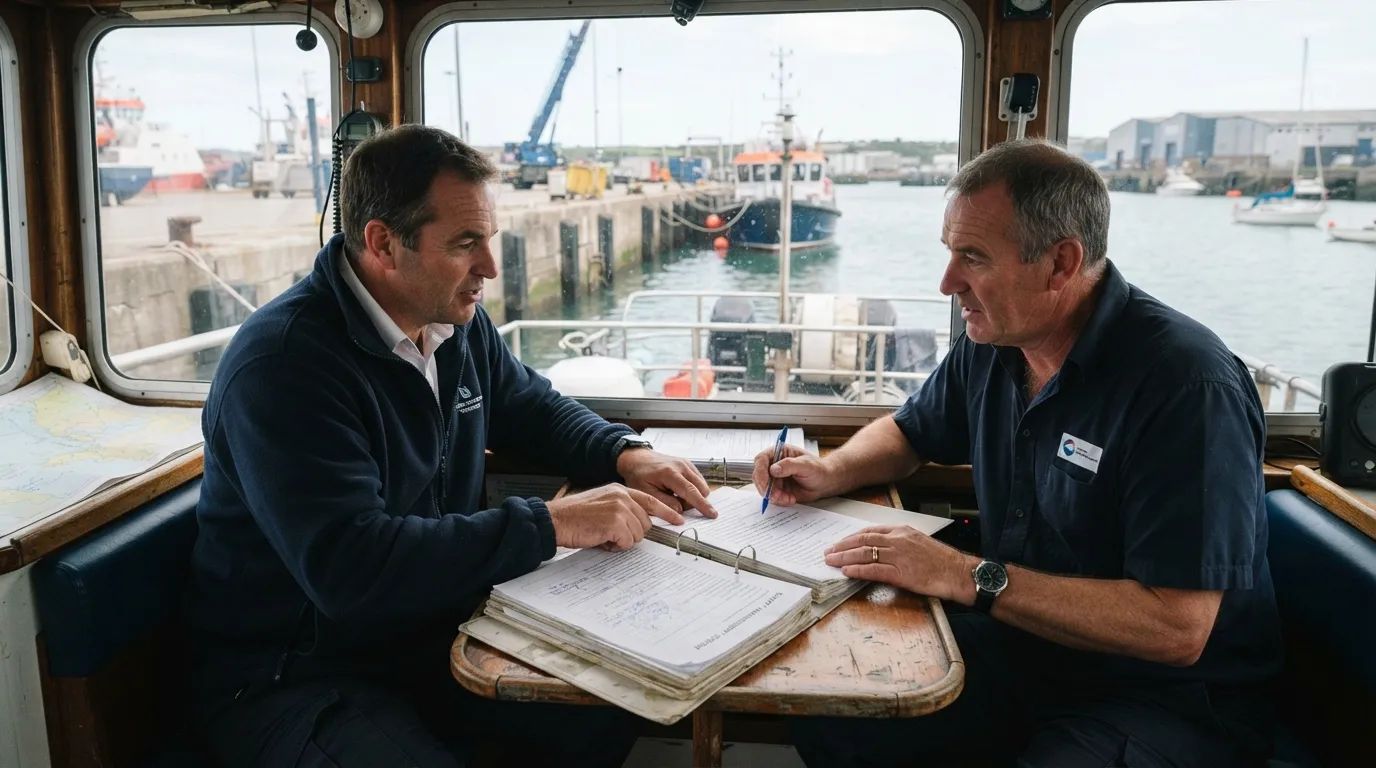
Behind every professional harbour tender team is paperwork most outsiders never see. Any tender classified as a domestic commercial vessel requires a full Safety Management System covering risk assessments, crew training, pre-op checks, maintenance, and incident records.
The SMS is not a file that sits in a drawer – experienced teams update it after every significant event, near-miss, or change in conditions. It functions as the operation’s institutional memory.
Formal training covers launching, recovery, boat handling, collision avoidance, navigation, and emergency procedures – and every one of those topics feeds straight back into the document. Teams without an active SMS are, in effect, operating without a safety net.
But that’s nothing compared to what we found about #7…
#7 – Harbour Teams Know the Local Traffic Pattern Better Than the Charts
Charts show hazards. Harbour teams know the human patterns that no chart can capture.
Tenders cross fairways, work close to ships, and sometimes assist with towing – so knowing when other vessels move matters as much as knowing where hazards are marked. The best operators memorise the morning ferry crossing, the afternoon fishing fleet return, and the evening water taxi peak.
That knowledge dictates safe departure timing, and it’s almost never written down. It lives in the crew’s heads and gets passed on verbally, hand to hand.
New crew who skip the local traffic brief on day one are the ones who get caught in a ferry wake mid-transfer. Every experienced harbour hand has a story about that exact moment.
But that’s nothing compared to what we found about #6…
#6 – Tender Operator Certification Gaps Are More Common Than the Industry Admits
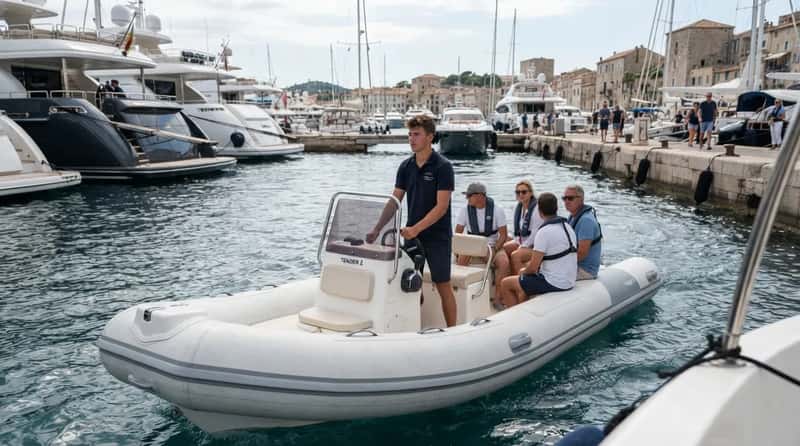
Here’s the uncomfortable truth most charter brochures leave out: not every crew member running a tender is fully certified for that specific vessel and route.
The RYA Tender Operator Course builds advanced boat handling, close-quarters manoeuvring, and passenger management – it’s a specialist qualification, not a basic powerboat licence. A powerboat certificate is a good starting point, but real competence comes from actual drive time.
The gap between holding a certificate and being genuinely competent in a real harbour environment is where most tender incidents happen. Reputable teams insist on both the paperwork and the mentored seat time.
Teams that treat one as a substitute for the other are running an elevated risk on every single trip. It just doesn’t show up until something goes wrong.
At a Glance
- RYA Tender Operator Course: a specialist two-day course built on Powerboat Level 2 skills
- Focus areas: short-handed operations, passenger safety, and night pilotage
- Prerequisite: competence to RYA Powerboat Level 2 (coastal) standard
- Real competence: only comes from logged seat time, not the certificate alone
But that’s nothing compared to what we found about #5…
#5 – The Yacht’s Garage Door Size Controls Everything
Owners pick their dream tender. Then reality hits – it doesn’t fit.
The garage door, beam crane, or swim-platform load rating sets the hard upper limit on tender size, no matter what the owner prefers. Physics doesn’t negotiate on what can actually be stored and launched safely.
This is why experienced harbour teams get consulted during a yacht’s design phase – not after the tender has already been ordered. A mismatch between tender size and garage capacity is one of the most expensive, avoidable mistakes in superyacht operations.
A tender’s service life runs through four stages: acquire, create, move, operate. The garage constraint sits right at the top of “acquire” – and it shapes everything that follows.
But that’s nothing compared to what we found about #4…
#4 – SOLAS Compliance Is Non-Negotiable – and Often Misunderstood
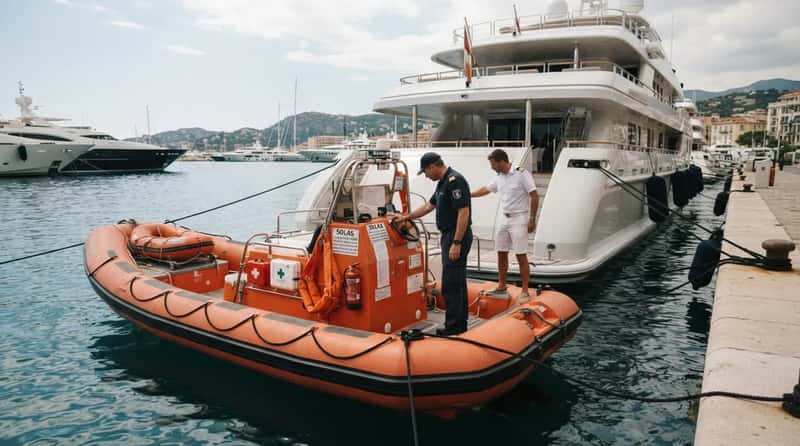
Most yacht owners know SOLAS exists. Far fewer understand exactly what it demands from their tender fleet.
Any yacht over 500GT must carry a SOLAS-compliant rescue tender – Safety of Life At Sea – and that’s not satisfied by just any boat that hasn’t been specifically certified. Many owners assume their primary limousine tender doubles as a rescue vessel – it doesn’t, unless it meets strict SOLAS standards for freeboard, buoyancy, and emergency equipment.
Harbour teams who know their exact compliance position sail through port authority inspections. The ones who don’t are the ones paying anchor fines and sitting through detentions.
Crew running passenger transfers must hold a Proficiency in Survival Craft and Rescue Boats certificate. That certificate is the actual gateway into SOLAS compliance.
Fast Facts
- SOLAS rescue tender rules apply to yachts over 500 gross tonnes (GT)
- A compliant rescue tender must be able to self-right if capsized
- Transfer crew need a Proficiency in Survival Craft and Rescue Boats certificate
- Not every polished limousine tender meets SOLAS freeboard and buoyancy standards
But that’s nothing compared to what we found about #3…
#3 – Wash and Wake Are the Most Under-Respected Hazard in Any Harbour
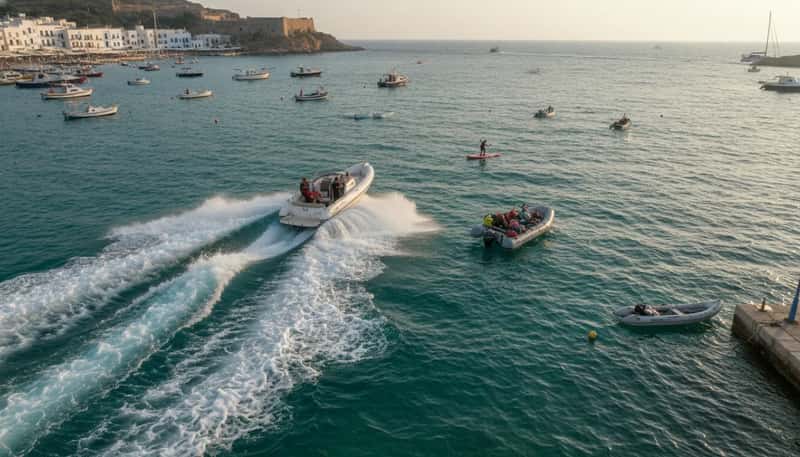
Tender teams worry about weather, gear, and passengers. The hazard they rarely brief guests on is wash – and it causes more damage than most crews will admit.
A fast-moving tender in a crowded anchorage creates a wake that rocks smaller dinghies, destabilises boarding platforms, and has capsized poorly loaded inflatables. Harbour authorities in busy anchorages – especially in the Mediterranean during peak season – now actively fine vessels for excessive wake inside restricted zones.
Professional operators cut speed well before they’re legally required to. They stay aware of every vessel sitting in their wake, not just the ones in front of them.
Wake management isn’t an afterthought – it’s part of proper harbour coordination, and it starts with the operator’s throttle hand. Most guests never even notice it’s happening.
But that’s nothing compared to what we found about #2…
#2 – Incident Reporting Is the Secret That Separates Elite Teams From the Rest
When something goes wrong – a scrape, a near-miss, a harder-than-expected berthing – the temptation is to say nothing and move on. Elite harbour teams do the exact opposite.
A proper Safety Management System exists to record every incident, and that record isn’t bureaucracy – it’s the data that stops the same mistake from happening twice. The most professional harbour teams hold a brief debrief after every notable event, no matter how minor it seems.
That culture of reporting is what separates clean incident histories from teams who collect the same problems on a loop. A near-miss that’s reported and discussed is worth more than a hundred perfect runs nobody ever examined.
It starts at the handover – every shift change requires a signature and verification. That single habit is where accountability actually lives.
But that’s nothing compared to what we found at #1…
#1 – The Pre-Charter Rehearsal Is the Single Most Important Thing Guests Never See
Every experienced harbour professional will tell you the same thing: a charter’s success gets decided before the guests ever step aboard. Rehearsing the launch and retrieval sequence isn’t a suggestion – it’s a prerequisite.
The teams who deliver the smoothest, most effortless-looking guest experience are the ones who ran the exact same sequence in silence the day before – checking crane loads, timing the launch, testing radio channels, walking the boarding sequence step by step. The “effortless” guests see is manufactured through repetition.
Every pre-operating check, emergency plan, and maintenance item required by the SMS gets verified in that rehearsal, not just signed off on paper. It’s where the paperwork becomes muscle memory.
Guests board and think the crew makes it look easy. The crew knows exactly why it looks easy – and they’d never tell you.
The Bottom Line
Harbour tender operations are one of the most technically demanding, safety-critical, and quietly professional disciplines in the marine world. The teams who do it best run on layered knowledge – certification, local intelligence, rigorous pre-checks, and a culture of honest debrief.
The effortless guest experience is the product of invisible work – weather monitoring, load calculations, kill cord discipline, and late-night readiness checks that happen without applause. Most guests will never know any of this happened.
Now you do. Which of these eighteen surprised you most – or have you seen a harbour team in action and caught something we missed?
Bonus: The One Habit That Beats All 18 Secrets
Every professional harbour team quietly follows one habit that never makes it into the guest-facing briefing: the written float plan.
Before any tender leaves the yacht – even for a five-minute shuttle – the crew logs it with the bridge or duty officer.
- Destination and route
- Exact passenger count, and names if possible
- Planned departure time and expected return time
- A fixed “overdue” trigger point – the exact minute the bridge starts calling on VHF if the tender hasn’t checked in
If the tender isn’t back by that trigger time, the mothership starts calling immediately – no guessing, no waiting “a bit longer to see.”
It takes less than sixty seconds to file, but it’s the fastest way any harbour team turns a vague “something feels wrong” into knowing exactly where to look, and exactly when to start looking.