For nearly 19 years, travelers in standard security lanes took their shoes off at the checkpoint, and that rule is gone. Your outfit still decides whether you glide through screening or hold up the line, and whether you shiver for the next four hours.
These 19 outfits run from quick checkpoint fixes to choices that touch your comfort and your health. Hold on for #1, the one outfit where clothing may matter to your circulation, and it comes with a question for your doctor. But first, the shoes.
#19 – Slip-On Sneakers With Soft Knit Layers
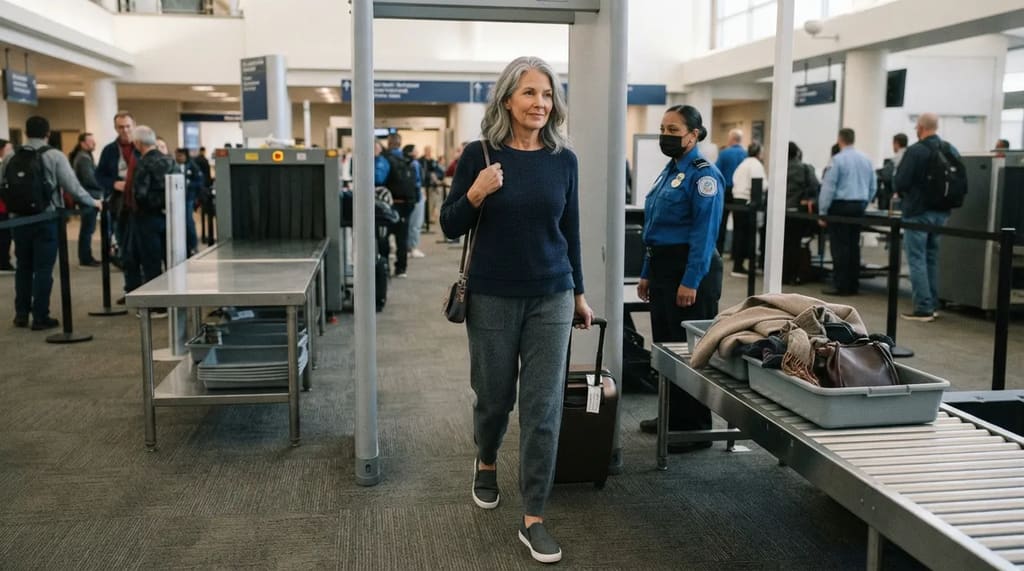
The shoes-off rule is gone for routine screening, which tempts you to lace up your sturdiest walking shoes. TSA ended the requirement in July 2025.1 2
Don’t count on it every time, though. An officer can still ask you to remove your shoes if you set off an alarm or are picked for additional screening.2
So build the outfit around a shoe you can step out of while standing. Loafers, no-tie sneakers and slip-on boots all save time at the belt, paired with soft leggings or straight pants and a knit top.
Choose shoes you can remove and replace without sitting down or untying anything.
Your shoes can stay on, but one bulky piece of your winter outfit still goes into a gray bin in a standard lane.
#18 – Open Cardigan That Comes Off in One Motion
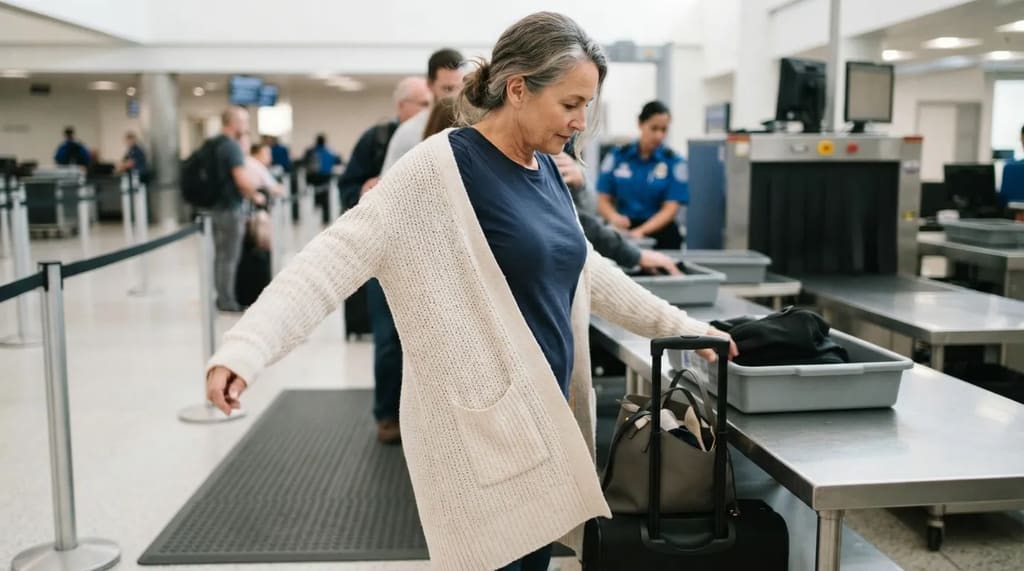
In a standard lane, your outer layer is going into the bin. Jackets come off for screening unless you’re 75 or older, so most women reading this will be shedding theirs in front of a line.
That makes a long open cardigan or a zip jacket a smarter first layer than a belted coat with a row of buttons. A cardigan slides off both shoulders in seconds, while a hoodie means dragging fabric over your head with a bag on your arm.
Wear a plain shirt underneath. If you choose a sweatshirt, add a shirt beneath it, since the top layer may be off before you’ve found a place to put your bag.
Quick Compare: Standard Lane vs. PreCheck
- Shoes: Since TSA’s July 8, 2025 change, they usually stay on in both lanes, unless an alarm or extra screening says otherwise.
- Standard lane: Plan on taking off your belt and light jacket.
- PreCheck lane: Shoes, belts and light jackets typically stay on.3
Whatever goes on top should come off in a single move.
With the jacket in the bin, your hands are full, and the right pockets decide where the phone, keys and boarding pass go.
#17 – Pocketed Leggings and a Long Tunic
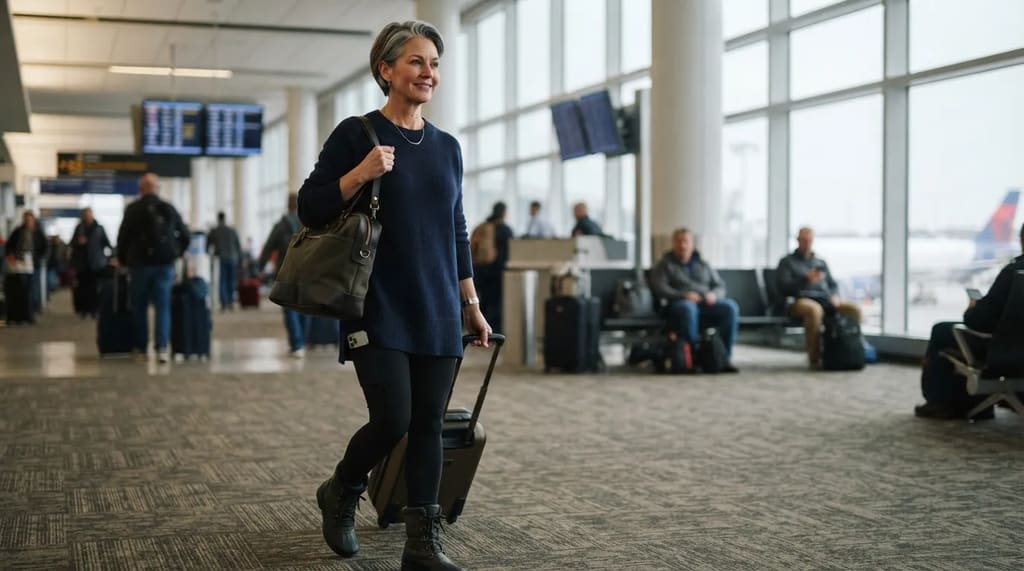
Pockets earn their keep before and after the checkpoint, never at the belt. They keep your essentials close on the walk from the curb to the line.
At the belt, empty them. Everything goes into your bag before you approach, because a forgotten item the scanner picks up can lead to a pat-down.
Add a tunic-length sweater that covers your hips, which is warmer than a short top and more forgiving after hours in a seat. Leggings with a wide, soft waistband also take pressure off your middle when you’re belted in.
Move everything from your pockets into your carry-on before you reach the belt.
Pants bring a different problem than leggings, and one of the two usual suspects, denim or a belt, is less trouble than it looks.
#16 – Stretch Jeans With No Metal Belt
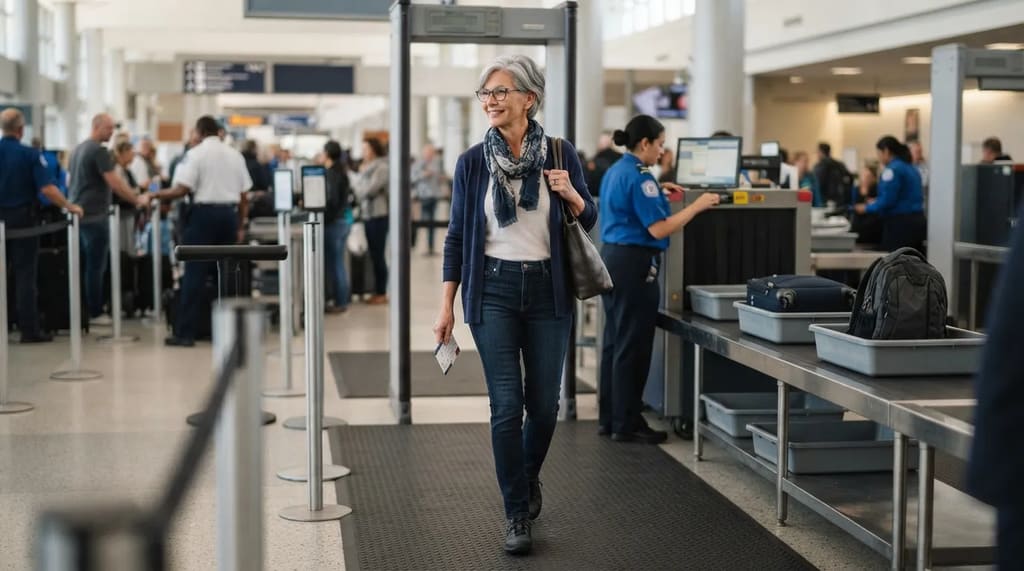
Jeans are the outfit people avoid for the wrong reason. The small metal buttons and zips are unlikely to cause trouble at airport security.
The belt is where trouble starts. A big metal buckle can trigger the scanner, and in standard lanes you’ll typically be asked to take your belt off anyway.
So pick stretch denim that stays up without one, and pack the belt in your bag to wear after security. Stiff, high-rise denim is a poor travel pant, however good it looks, because a rigid waistband and a seat belt make a long flight feel longer.
Leave the belt in your carry-on and wear the jeans.
Jeans pass, but some garments underneath your sweater carry a piece of metal that can mean extra screening.
#15 – Wireless Bra Under Your Softest Sweater
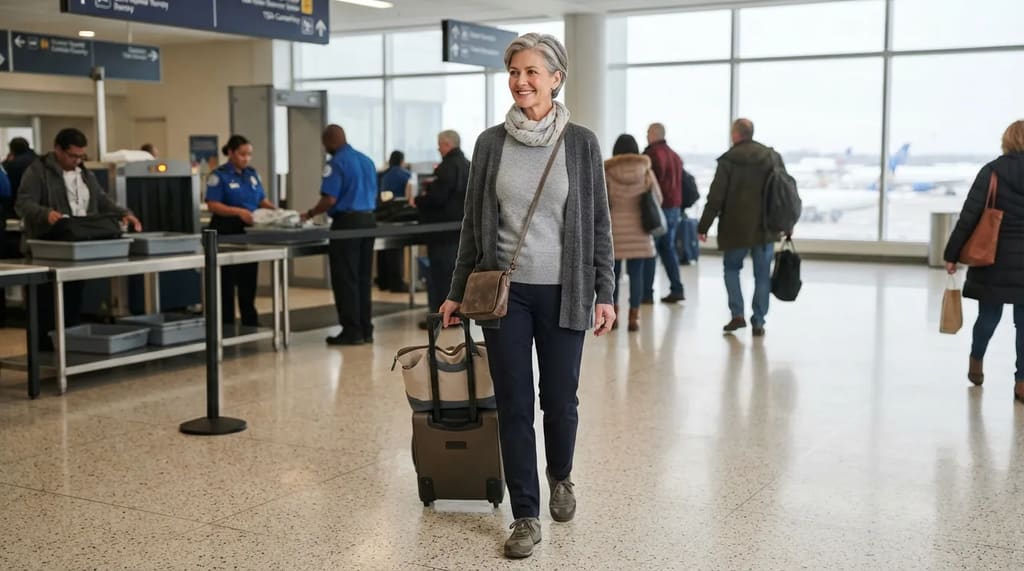
The one garment you can’t hand over at the belt is the one with metal sewn into it. Bras with plastic underwire, or no wire at all, are the safer bet at airport security.
An alert at the checkpoint means a conversation and possibly a pat-down you could have avoided. A wireless style also suits a long day in a seat, when a stiff band digs in at hour five.
Put a fine-gauge crewneck or V-neck sweater over it. Thin knits sit smoothly under a cardigan, so the whole outfit stays slim enough to peel off in the line.
Switch to a wireless or plastic-wire bra on every travel day.
Your neck and wrists are the next place a standard lane asks questions.
#14 – Simple Jewelry and a Plain Watch
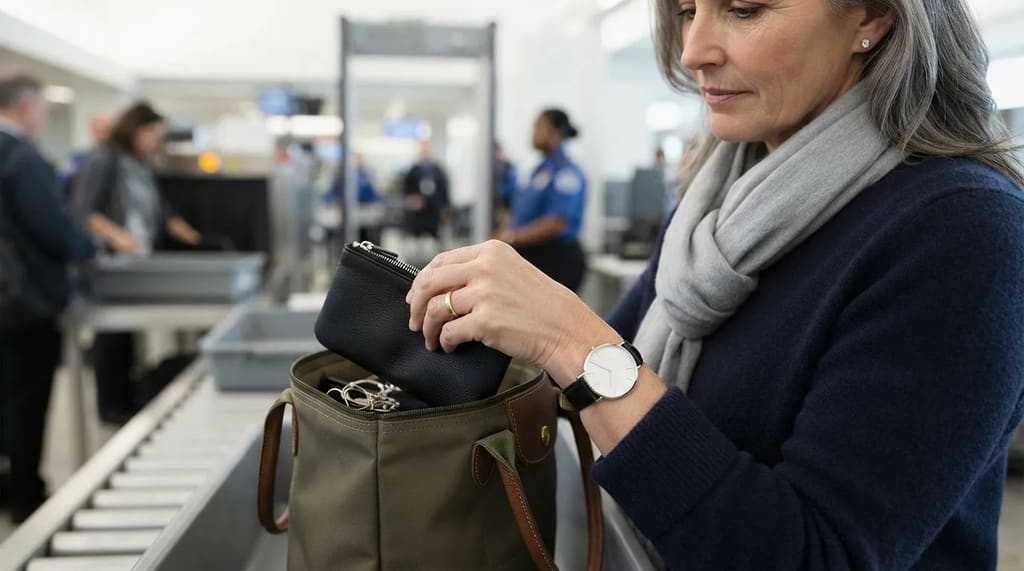
Standard lanes treat your wrists and neck as a checkpoint of their own. Bulky bracelets, watches and large metal pieces can set off the detector, while a wedding band and small studs usually pass without a second look.
PreCheck loosens the rules on shoes, belts and light jackets, but it doesn’t make a heavy metal bracelet invisible. That’s one more reason the stack-of-bangles outfit works better at the party than at the gate.
Choose small studs and a ring you never take off. Slip everything else into a zippered pouch inside your bag until you’re past the checkpoint.
Wear only the jewelry you’re content to leave on through the scanner.
#13 – Flat Pull-On Boots for Snowy Curbs
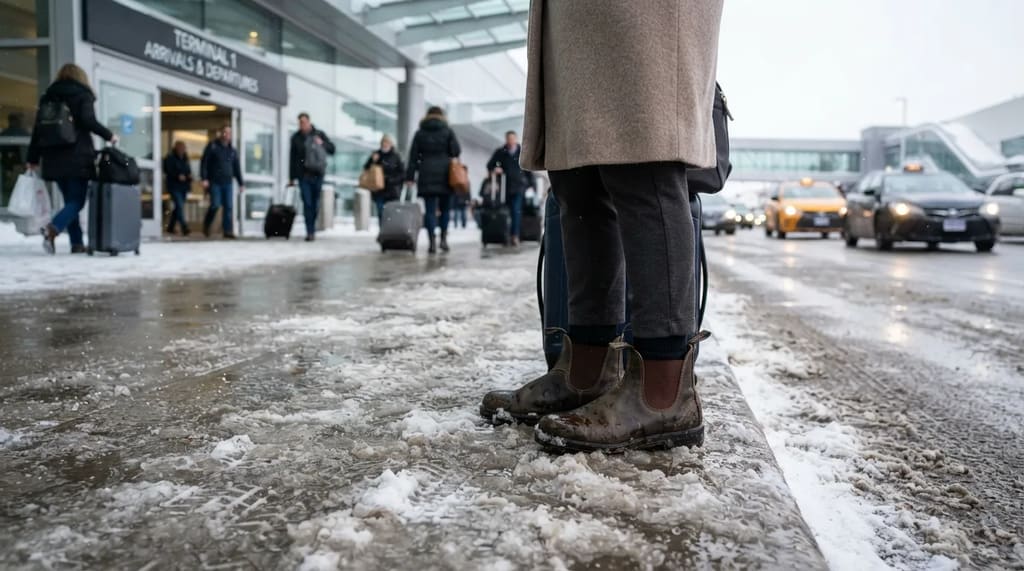
Heels with metal shanks can alert the metal detector, and winter makes the boot question harder than the shoe question. The answer is a flat sole and a shaft that goes on with a tug.
Skip the boot with three buckles and a zipper. Slip-on boots save time at the belt, and they stay on better than a loose slipper when the walkway is wet.
If your trip calls for sturdy boots and you’re checking a bag, pack them in your checked luggage and wear comfortable travel shoes through the airport. That also spares your feet on long terminal walks.
A flat sole and a pull-on shaft beat any boot with buckles.
Boots cope with the curb, yet your waistband has a job they can’t do once you’re in the air.
#12 – Elastic-Waist Wide-Leg Pants
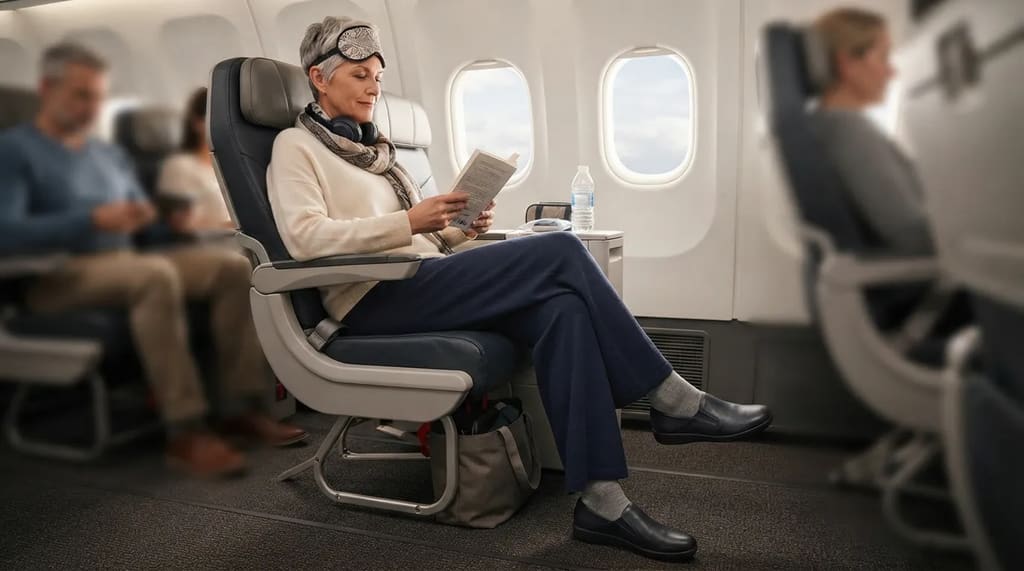
Cabin air pressure at cruising altitude is equivalent to an elevation of 6,000 to 8,000 feet, which can make your body swell slightly.4 Your waistline and ankles notice first.
Pull-on pants with an elastic waist leave room for that. Elastic-waist pants or leggings work well as the base of a flight outfit, and a wide leg leaves space for socks and air.
Compare them with the stretch jeans from earlier: denim is fine at the checkpoint, but after hours seated the pull-on pant wins. Sit in a pair at home for an hour before you commit.
Pick a waistband that still feels comfortable after hours of sitting.
Soft pants are half of a good flight outfit, because the fabric against your skin faces air drier than most deserts.
#11 – Natural-Fiber Base Layer Under Everything
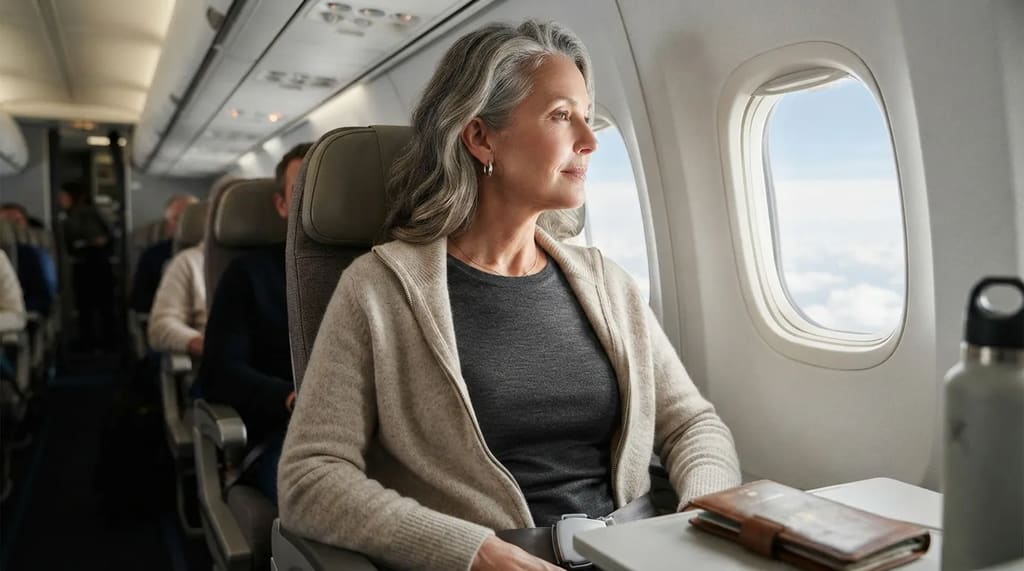
Cabin air typically sits at 10 to 20 percent relative humidity, against a comfortable 30 to 60 percent at home.5 That dryness is why the fabric against your skin matters more than the sweater on top.
Pure polyester feels plasticky and clammy fast in that air. Cotton has a different flaw, because it absorbs moisture but releases it slowly, so a shirt damp from hurrying through security stays damp.
A thin merino or wool-blend long-sleeve handles both problems. Merino is often considered the best option because it regulates temperature and wicks moisture.
The cotton sweatshirt many of us grab for flying is overrated, since it’s heavy, slow to dry and hard to peel. Put a thin wool or wool-blend layer next to your skin.
Even the best base layer needs partners, and the order you wear them decides whether you shiver at hour three or sweat at boarding.
#10 – Three Layers Built for the Coldest Hour
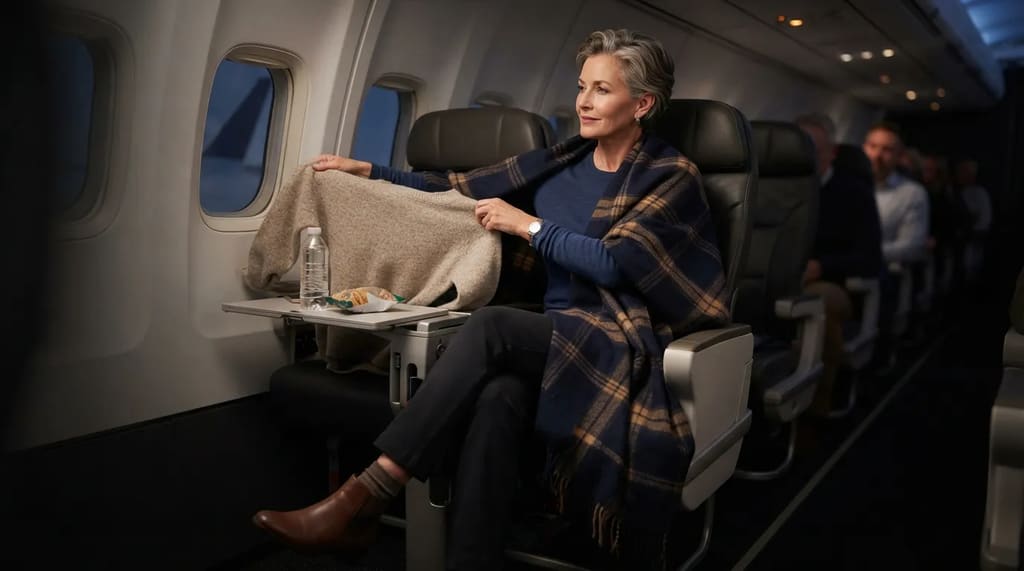
Plan the outfit around the coldest hour of the flight, not around how warm the gate area feels. That one rule beats any single outfit.
Three layers do the job: a breathable base, a warm mid layer, and a large scarf or shawl that doubles as a blanket. You add and shed them as the cabin changes.
Boarding often runs warm. Take the sweater off before you sit, fold it into the seat pocket, and pull it back on two or three hours in, once the cabin has cooled.
At a Glance: The Three-Layer Plan
- Base: a thin merino or wool-blend long-sleeve.
- Middle: a sweater you can shed at boarding.
- Top: a big scarf or shawl that doubles as a blanket.
- Timing: dress for the coldest hour, not the gate.
Take the middle layer off at boarding and put it back on once the cabin cools.
Some seats need one more layer, because the cold can come from the wall beside you.
#9 – Packable Puffer Vest for the Window Seat
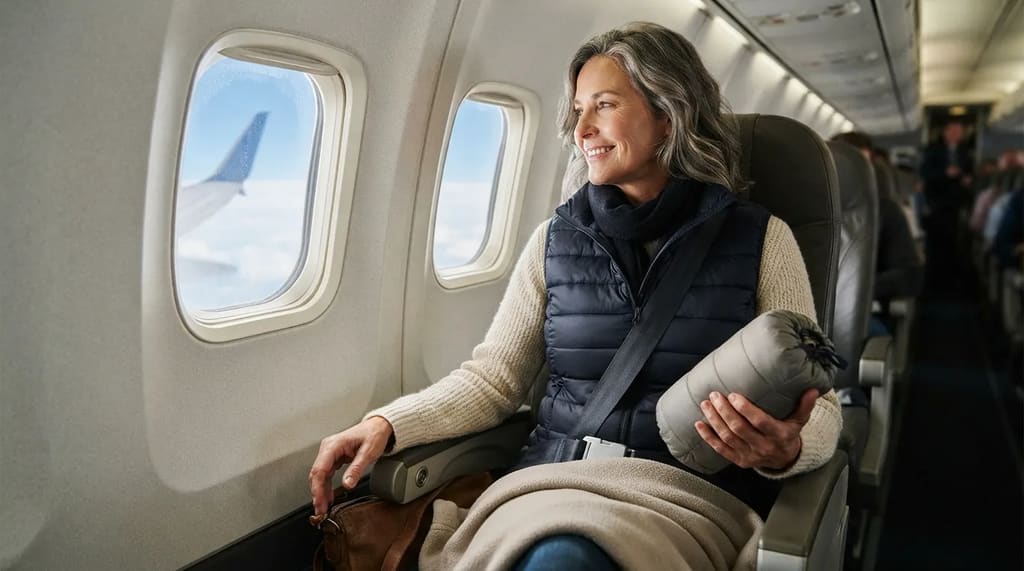
The window seat can feel colder than the middle seat, and the reason is the wall beside you. The window seat may feel cold from the fuselage, while the middle seat is warm from body heat.
If you picked the window, a packable down jacket or vest is the answer. A lightweight cardigan or zip-up hoodie also works if you’d rather not carry a puffer.
A vest keeps your arms free, and it goes over the sweater from the three-layer outfit without bunching at the elbows. It also rolls small enough to live in your personal item, so you can reach it in flight.
Keep your extra warm layer under the seat, not in the overhead bin.
#8 – Peel-Off Outfit From Snow to Sunshine
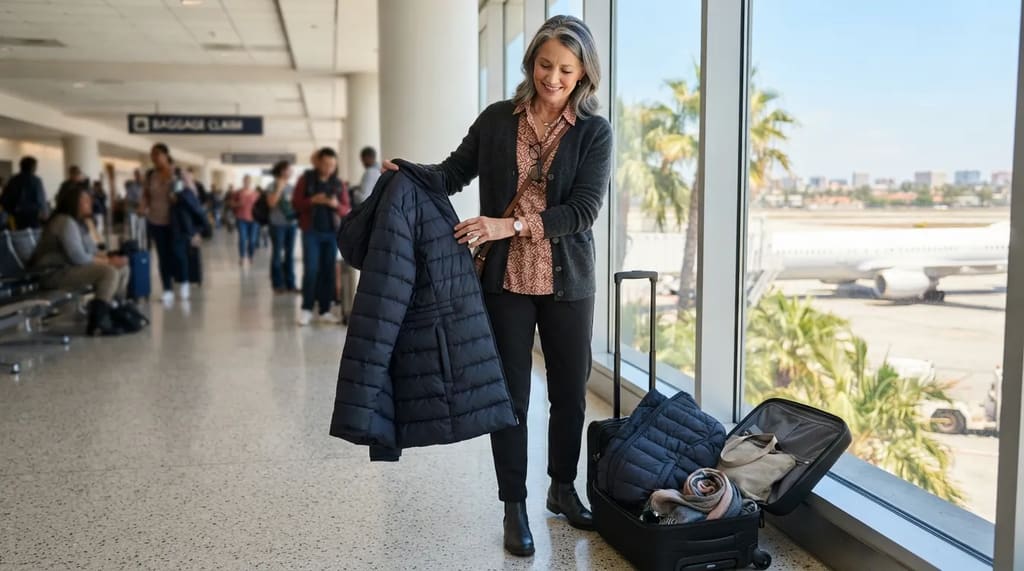
Wearing your bulkiest jacket and boots on the plane frees up suitcase space and keeps you warm in a chilly cabin. If the trip ends somewhere warm, it also leaves you overdressed and sweating on arrival.
For winter-to-warm trips, the heaviest-coat rule is overrated, because you’ll haul that coat through a sticky terminal. Dress for the cabin and for the arrival, with layers that fit in your bag.
Build it so it comes apart: a light base, a sweater and a coat that folds into your carry-on. Peel off layers as you approach your destination, and stow the warm ones before deplaning.
Make sure every winter layer can fit in your carry-on.
Layers fix the temperature problem, but a tight connection tests your feet more than the cabin tests your sweater.
#7 – Cushioned Walking Shoes for Long Terminals
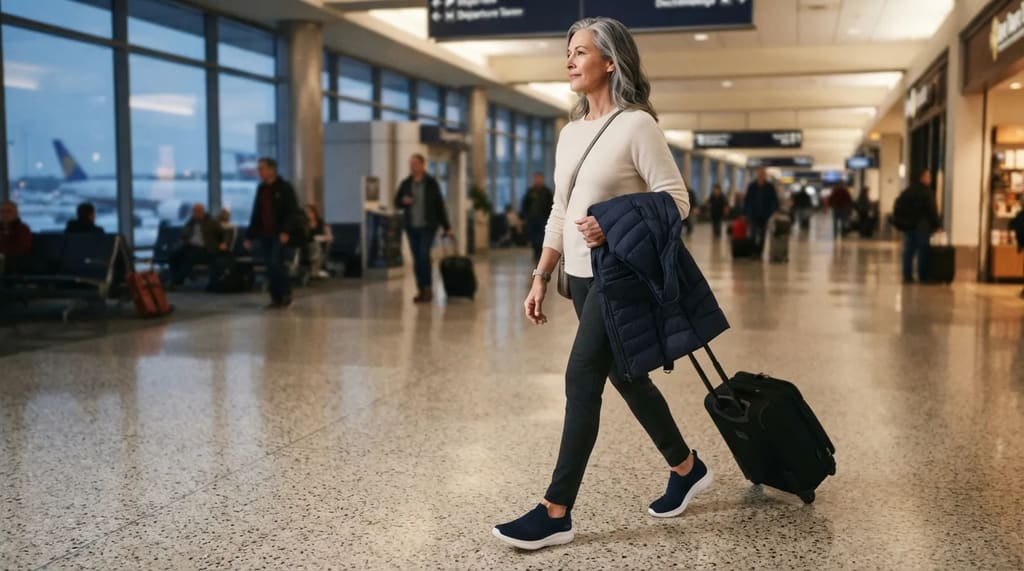
Winter trips often include a connection, and a long terminal walk with a coat over your arm is a different test from the security line. A shoe that slips off easily is a gift at the belt and a nuisance at a brisk pace.
Choose a cushioned sole with a secure heel, such as a slip-on walking sneaker with a stretch upper. Feet swell in flight, so the shoe needs room.
Test them first. Wear the pair around the house for an hour or two before the trip, because a new shoe that rubs on the kitchen floor will blister in the terminal.
Break in your travel shoes for a few days before you fly.
Walking shoes handle the floor, while your hands still need a plan for the coat, the phone and the boarding pass.
#6 – Hands-Free Crossbody Bag With a Zip Pocket
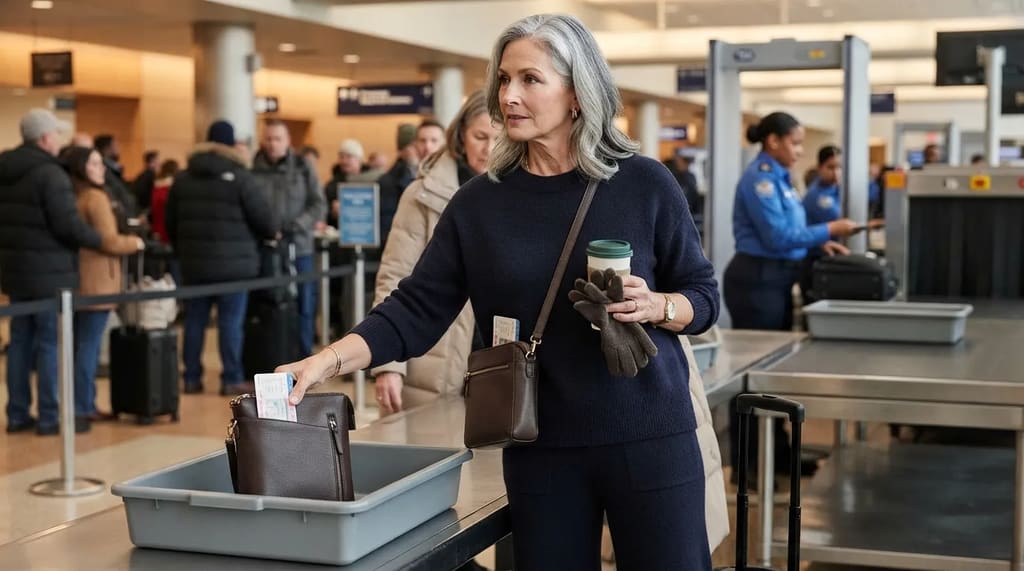
You’ll show your ID and boarding pass more than once between the curb and the gate. A crossbody bag with one zip pocket keeps both within reach without a fumble.
In winter your hands are busy with gloves, a coffee and a coat. A bag that sits across your body leaves both hands free and survives a shove through a crowded gate area.
Keep the ID and boarding pass in the outer pocket and nothing else. At the belt, the whole bag goes into the bin in one motion, and you pick it up the same way.
Give your ID and boarding pass one fixed pocket and never move them.
The bag covers the paperwork, but a favorite lounge set can bring a different problem: trim that makes officers look twice.
#5 – Matching Knit Set With No Bulky Trim
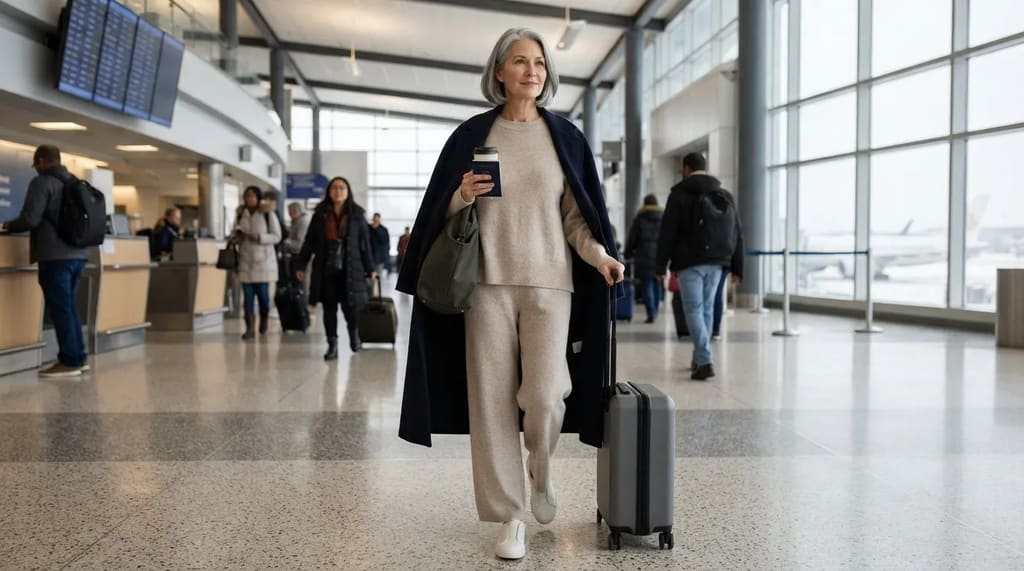
A matching soft set looks put together and feels like loungewear, which is why it’s popular for winter flights. Trim is the catch, because excessive fur, volume or unusual materials may set off the scanner or require a search.
Pick a set with plain ribbing and a smooth surface. Skip pom-poms, faux-fur collars and metal hardware, since zippers, studs and metal embellishments all raise the odds of an alert.
The payoff is an outfit that looks like you made an effort and feels like you didn’t. Choose a neutral color and it mixes with every layer you’ve already read about.
Plain, smooth and soft beats anything with hardware.
A two-piece set is easy, but the next outfit takes the idea further, especially once you’re standing in an airplane lavatory.
Related Stories From Travelbinger

#4 – Sweater Dress Over Fleece-Lined Leggings
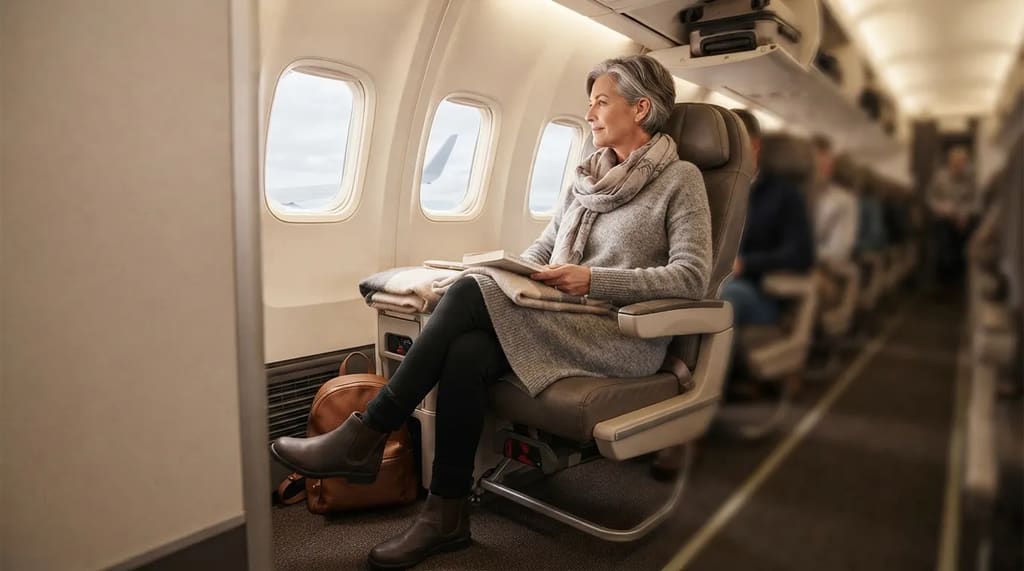
An airplane lavatory is barely wider than your shoulders, and nobody enjoys wrestling a tucked-in top and a waistband in there. A knit sweater dress solves it with one garment and nothing to tuck.
Choose a knee-length or midi hem in a wool blend, so it stays warm and doesn’t ride up when you sit. A soft, stretchy neckline matters too, because you may doze in it.
Fleece-lined leggings underneath cover your legs against the draft from the floor and keep things modest when you reach into the overhead bin. Add slip-on boots or sneakers and the checkpoint takes care of itself.
Why It Stands Out
- One garment, with nothing to tuck or re-button.
- A knee-length or midi hem stays put when you sit.
- Fleece-lined leggings block the draft from the floor.
- Slip-on footwear keeps the checkpoint quick.
Pick one soft piece you won’t have to adjust every time you stand.
The dress handles the cabin, but the walk outside is a different fight: wind, slush and a curb where your ride never quite stops.
#3 – Water-Resistant Hooded Coat for the Curb and the Jet Bridge
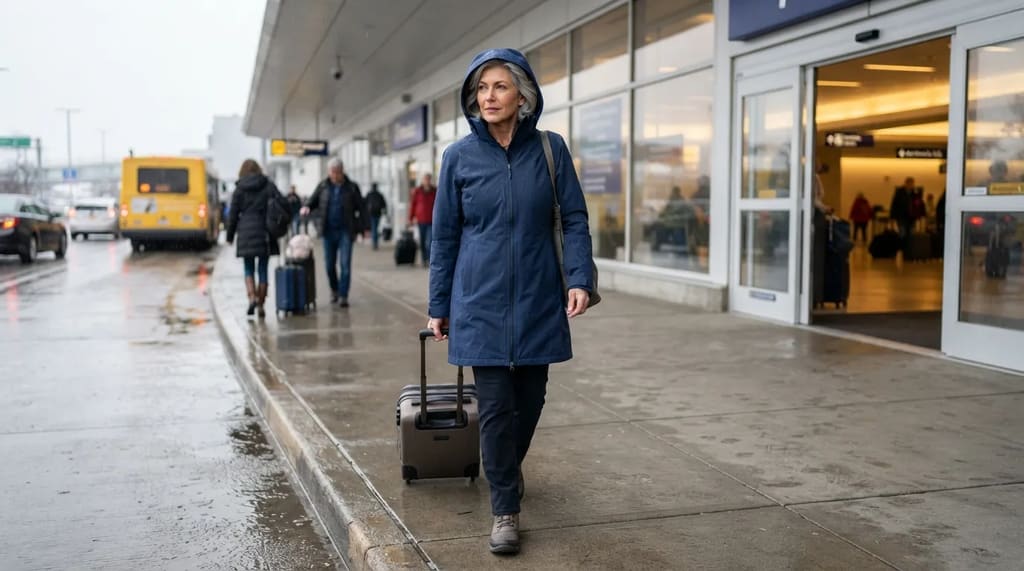
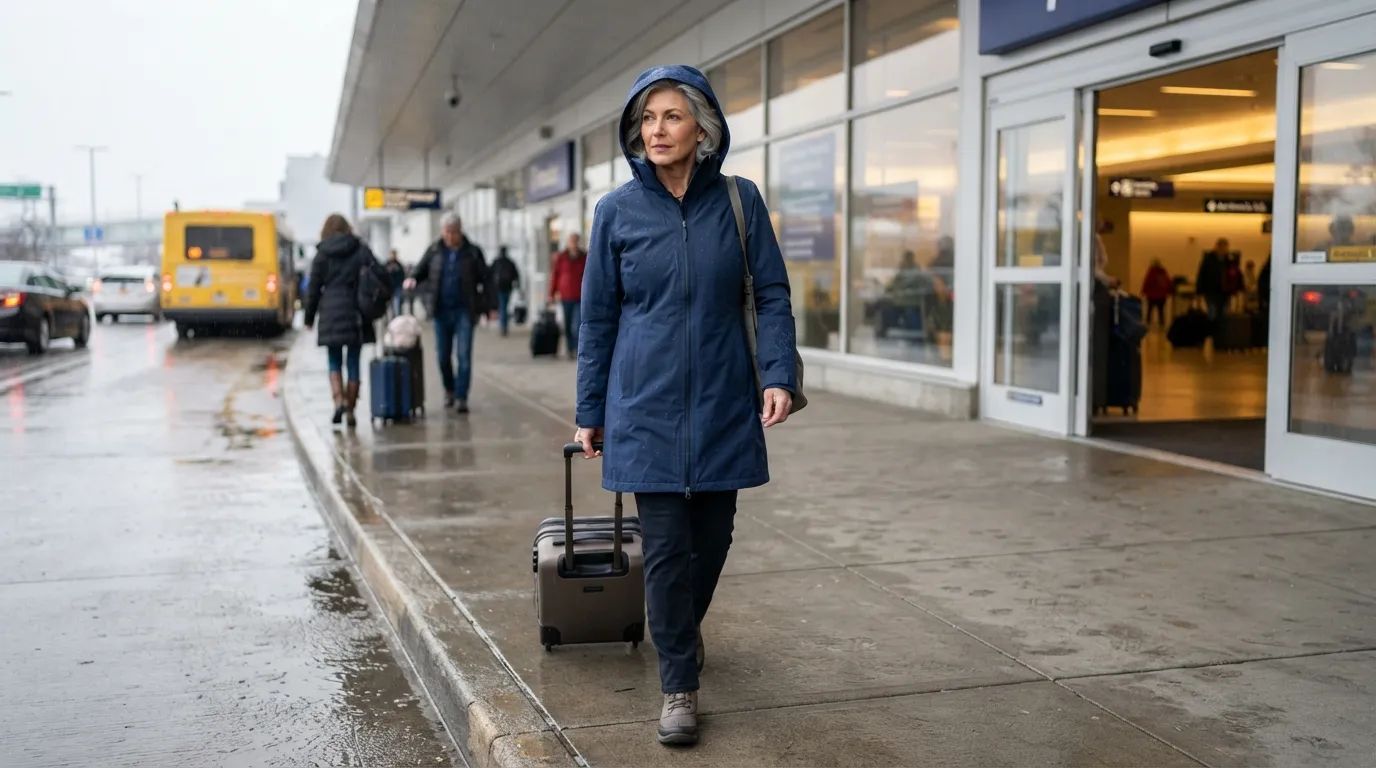
Airports are warm inside and miserable at the edges. The curb, the shuttle stop and the walk across a wet parking lot are where winter gets to you.
A water-resistant coat with a hood keeps you dry when the weather turns, and dry matters more than thick. Damp fabric, especially cotton, stays cold against your skin long after you’ve stepped inside.
Pick a hip-length coat with a single front zipper rather than a row of buckles, because in a standard lane it’s heading for the bin. A coat you can shrug off in one motion is worth more than one with six pockets.
Choose a coat that sheds water and comes off in one smooth move.
Even the best coat stays in your bag or the overhead bin once you board, so the next piece has to earn its place on your lap.
#2 – Oversized Wool Wrap You Already Own
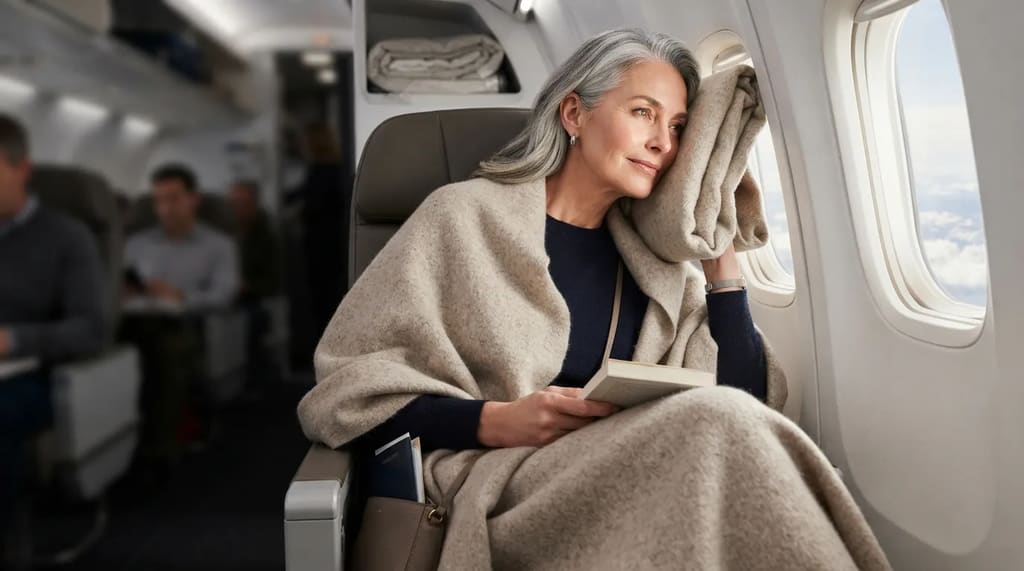
The most useful travel accessory on this list isn’t a gadget. It’s a big wool or cashmere-blend wrap that works as a scarf at the curb, a blanket in the cabin and a cushion against the window.
Blankets aren’t guaranteed on every flight, and a thin airline one rarely stretches to your shoulders. A wrap you chose yourself drapes over your arms and tucks around your knees without a fight.
Go for a solid neutral that matches everything in your suitcase. Fold it into your personal item, so it’s there the minute the vents turn cold.
Pack one large wrap that can serve as scarf, blanket and pillow.
Every outfit so far has chased the same goal: staying warm. The last one chases something different, and it starts at your ankles.
#1 – Compression Socks Under Wide-Leg Pants
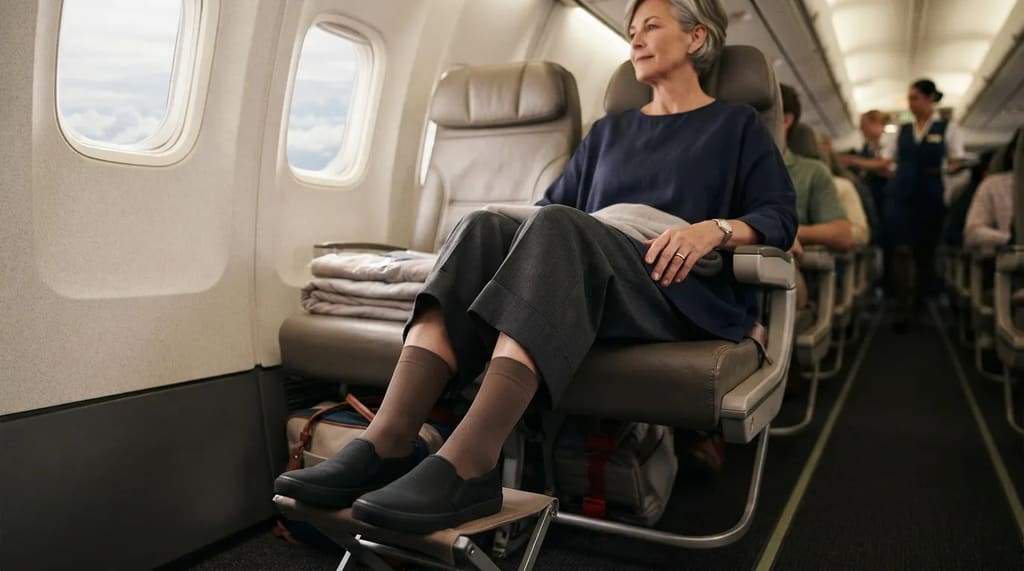
Long flights ask your legs to do something they hate, which is stay still. The CDC notes that travel lasting four hours or more can raise the risk of blood clots in the legs.
Several things raise that risk further, and age is one of them, which is why this belongs in an article for women over 50.
Fast Facts: Long-Flight Leg Health
- The trigger: travel lasting four hours or more.
- Added risk: older age, a previous clot, recent surgery or injury, hormone therapy and limited movement.
- CDC-style habits: move your legs often and walk the aisle when you can.
- Clothing: loose, comfortable fabric, plus graduated compression stockings if your doctor agrees.
The outfit follows from that: knee-high compression socks under the wide-leg pants from #12, with the roomy slip-on shoes from #19 and #7.
Here’s the question to take to your doctor: “Are compression socks right for me on a long flight, and what strength and size should I wear?” Some circulation conditions make them a poor fit, so this is a conversation, not a guess.6
Before your next long flight, ask your doctor whether compression socks belong in your outfit.
Nineteen outfits, and the pattern is easy to spot: layers that come off fast, fabric that moves with you, and nothing that makes a checkpoint officer look twice. Pick the looks that fit your route, and check TSA’s current rules the week you fly.
The quietest piece on this list, the one at your ankles, may be the one that matters most. A warm sweater is lovely, but the best travel outfit is the one that gets you off the plane feeling like yourself.
- CBS News Shoe Rule: https://www.cbsnews.com/news/tsa-shoes-rule-expires/
- Fox News Shoes-Off Ended: https://noticias.foxnews.com/travel/nearly-20-year-shoe-off-airport-security-policy-put-end-trump-administration.print
- UpgradedPoints TSA FAQ: https://upgradedpoints.com/travel/airports/tsa-airport-security-faq/
- ALPA Cabin Pressure Article: https://www.alpa.org/articles/2025/08/humid-conditions-may-impact-aircraft-performance
- Popular Science Cabin Humidity: https://www.popsci.com/science/why-planes-are-cold/
- American Heart Association Compression Socks: https://www.heart.org/en/news/2024/06/05/do-you-really-need-compression-socks-on-long-flights