Here’s the strange part: a whole pie can sail through the checkpoint, while a jar of gravy over 3.4 ounces gets stopped cold. That one oddity turns a December airport line into a small drama. A dish is surrendered at the belt, someone sprints back to the check-in counter, or a gift gets unwrapped in front of forty strangers.
The item at the top of this list looks even more solid than the pie. It holds its shape on the plate, and security still treats it like a spread. Twelve other snags come first, and they start with something far less dramatic: the ice pack in the cooler bag.
#13 – The Ice Pack That Melted Before the Belt
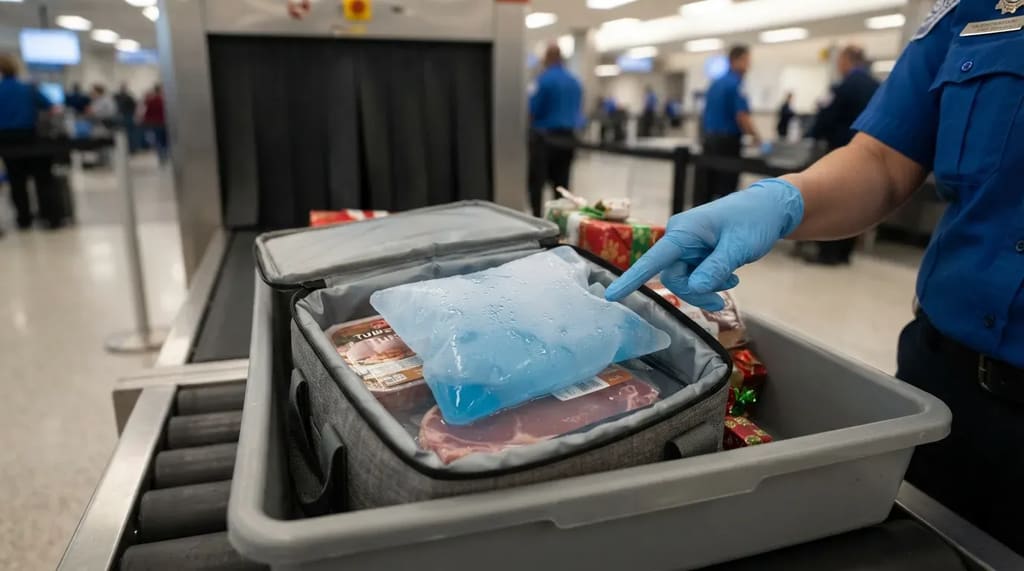
TSA allows ice packs for keeping holiday food cold, but they must be frozen solid when they go through screening.1 A pack that has started to go slushy doesn’t meet that rule. It’s a small thing that can sink a whole cooler.
The meat itself is rarely the problem. TSA lists turkey, chicken, ham and steak as fine in carry-ons, whether frozen, cooked or uncooked. The pack that softened on the ride to the airport is what gets flagged.
The same standard covers frozen liquids. They pass only if they are not partially melted, slushy, or sitting in liquid at the bottom of the container.1 Once a frozen drink or sauce thaws, it goes back to being a liquid in the eyes of security.
Cold food isn’t the only thing that clutters an X-ray image. A flat gift box can do the same.
#12 – The Advent Calendar That Hides a Chocolate Mystery
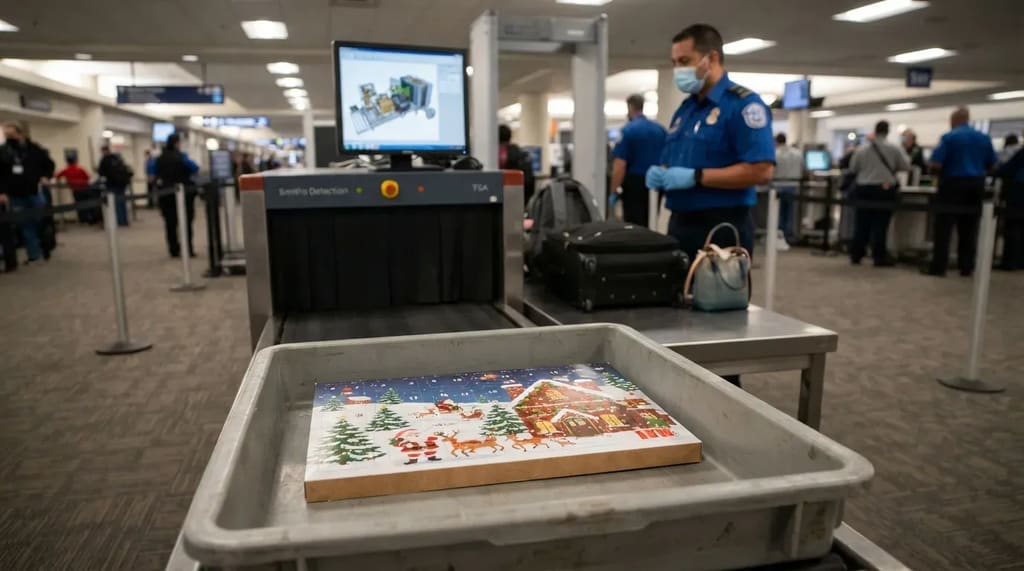
Most Advent calendars can travel in carry-on luggage. The chocolate behind the little doors isn’t the issue. The problem is a dense, flat cardboard slab that shows up on the scanner as one confusing rectangle.
TSA advises separating items that clutter bags and make it hard to get a clear X-ray image. Setting the calendar in its own bin gives the officer a clean look, so you aren’t standing there while someone digs through your bag.
#11 – The Charcuterie Board With a Spreadable Problem
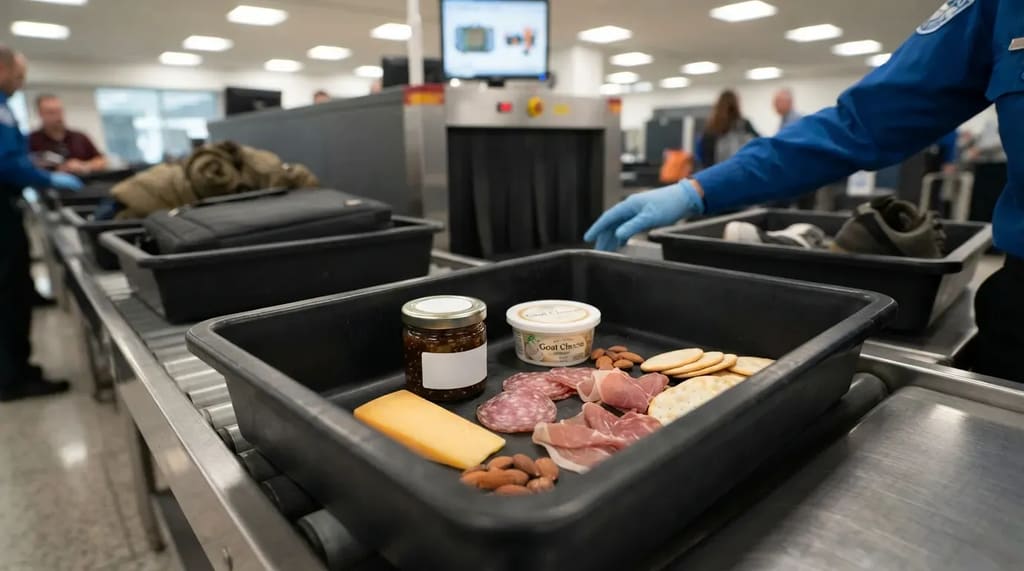
A charcuterie board is a perfect test of how TSA sorts food. Solid foods are fine in carry-ons, and soft, spreadable ones are not. A hard wedge of cheese passes, and a tub of something creamy does not.
The line is the same 3.4 ounces that governs shampoo. Creamy cheese is allowed in a carry-on only in containers that small. The jar of fig spread or mustard sitting beside it falls under the same limit.
The easiest plan is to carry the solid parts and buy the spreadable ones near where you’re staying. Crackers, cured meats and nuts travel without any argument. The jar of spread is the one piece that turns a simple pack into a negotiation.
Quick Compare
- Rides up front: hard cheese wedges, crackers, cured meats and nuts
- Quart bag only: creamy cheese, fig spread and mustard, each in 3.4 ounces or less
- Best move: pack the solids and buy the spreads at your destination
Even the solid parts can draw a second look when they arrive wrapped in foil or paper.
#10 – The Pie Wrapped Too Tightly to Inspect
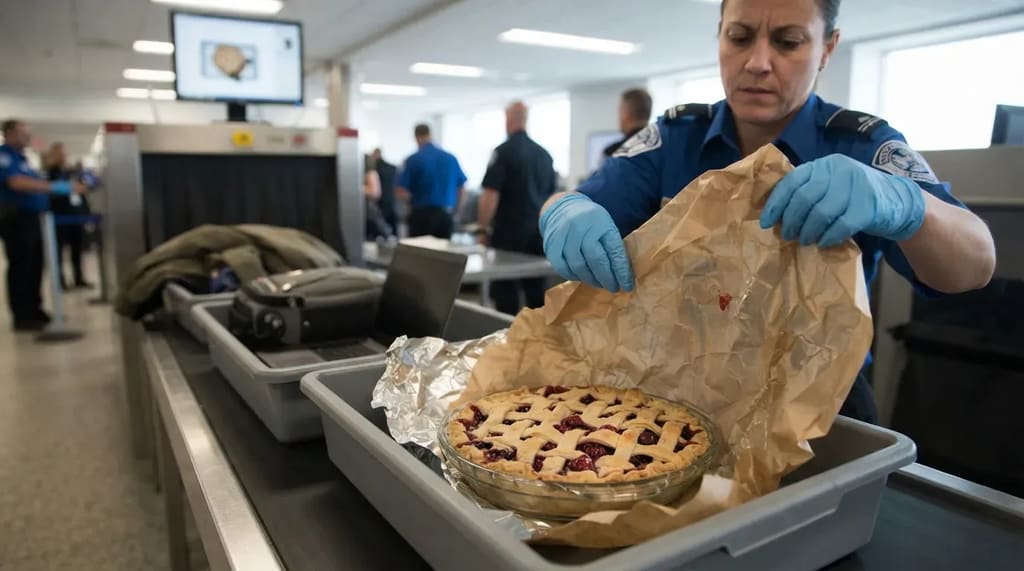
Pie is allowed. TSA says homemade and store-bought pies, cakes, cookies and brownies can all go through a checkpoint.2 The trouble is how the pie is packed.
Pies can get extra screening, and anything wrapped in paper or foil may be unwrapped if the scanner image leaves a question.3 An officer may also ask you to take the pie out for a closer look. Nobody wants to watch a lattice crust get poked in public.
A clear container with firm sides is the smarter choice. The officer can see what’s inside, and the crust survives the trip to the bin and the overhead compartment.
A pie passes because it holds its shape. Its neighbors on the holiday table don’t always meet that test.
#9 – Mashed Potatoes, Dips and Canned Fruit From the Potluck
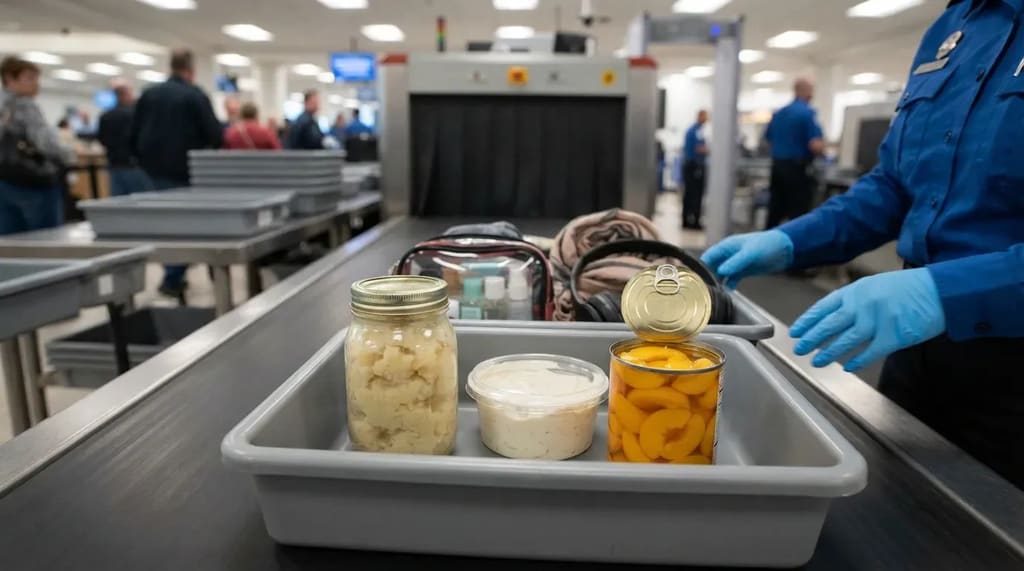
The dishes that sit between solid and liquid are the ones that get stopped. Mashed potatoes, dips, pumpkin butter, pickles and apple cider all fall into that gray zone unless they are frozen completely solid when they reach the belt.
Canned goods are simpler. Canned fruits and vegetables have liquid in the cans, so TSA says to pack them in a checked bag.2 A can that looks like a solid block of peaches is still judged by what’s inside it.
Casseroles get a conditional pass. If one contains soups, sauces or gravy, those parts must meet the 3-1-1 liquids rule. A casserole that holds its shape in the pan is the safe kind.
For mashed potatoes, skip the argument altogether. Raw potatoes are on TSA’s list of foods allowed in carry-on bags, so you can bring the potatoes and mash them after you land.
#8 – A Bottle of Real Maple Syrup That Looks Like a Perfect Gift
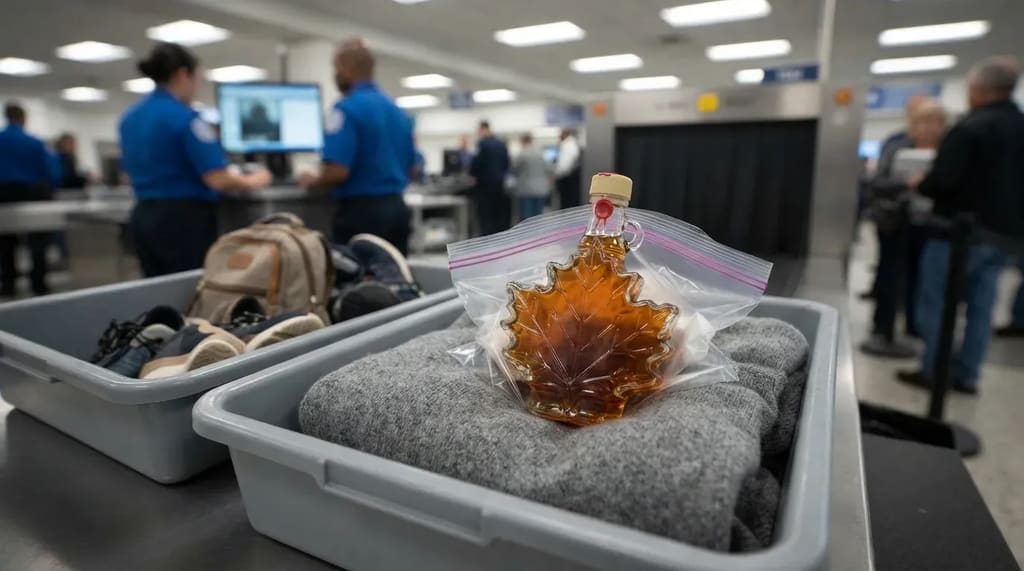
Maple syrup is a popular holiday gift, and it appears on TSA’s list of items that must go in checked bags or risk being surrendered at the checkpoint. Its sweet, sticky reputation doesn’t earn it any exceptions.
The size of the bottle decides it. A small bottle of 3.4 ounces or less can ride in your quart-size bag. A pint or a quart jug cannot.
If the syrup goes in a suitcase, pack it like a leak waiting to happen. Seal the cap, put the bottle in a zip-top bag, and wrap it in a sweater so the glass is cushioned. That’s cheap insurance for a gift that’s hard to replace on arrival.
Syrup shares its checked-bag status with the jam that usually rides beside it in a gift basket.
#7 – Grandma’s Homemade Jam in a Glass Jar
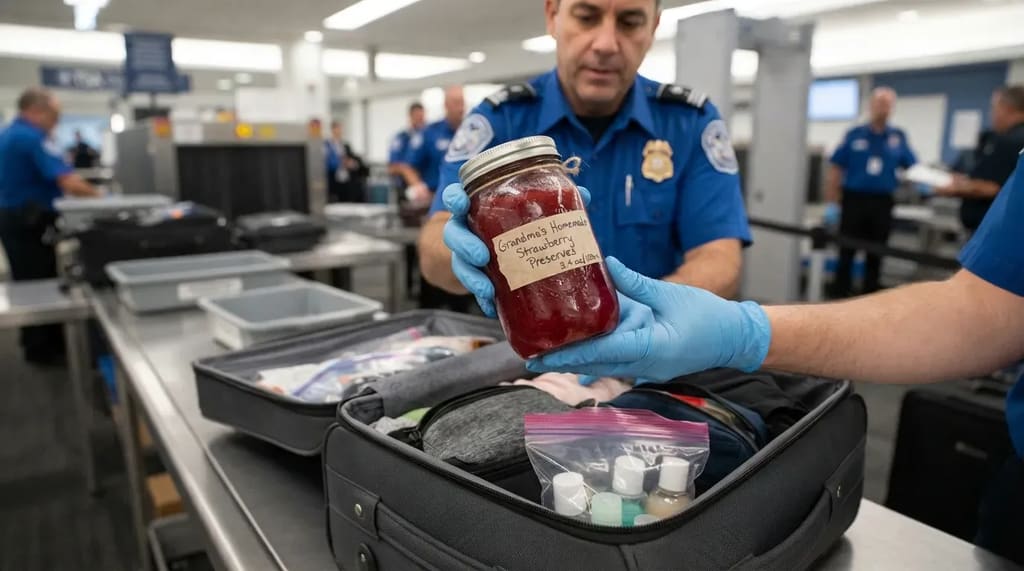
Jam is spreadable, and TSA says so plainly. Preserves, jams and jellies belong in checked bags.2 A homemade jar gets no break for being homemade, even when the label is in your grandmother’s handwriting.
Many travelers assume a half-empty jar slips under the limit. It doesn’t. The container’s size is what counts, so a pint jar with two spoonfuls left is still a pint jar.
For a gift, the checked bag is the sensible route unless you’re making mini jars. A jar of 3.4 ounces or less fits in the quart bag with your other liquids. Anything larger needs a tight seal, a zip-top bag, and some padding from your clothes.
At a Glance
- Jam and jelly: 3.4 ounces or less in the quart bag, anything bigger in checked luggage
- Maple syrup: the same size rule applies
- Cranberry sauce: spreadable, so it gets checked
- Half-empty jars: still judged by the container’s size
Jars are bad enough, but a carton of something drinkable runs into the same limit.
#6 – Eggnog and Sparkling Cider Cartons That Can’t Fly Carry-On
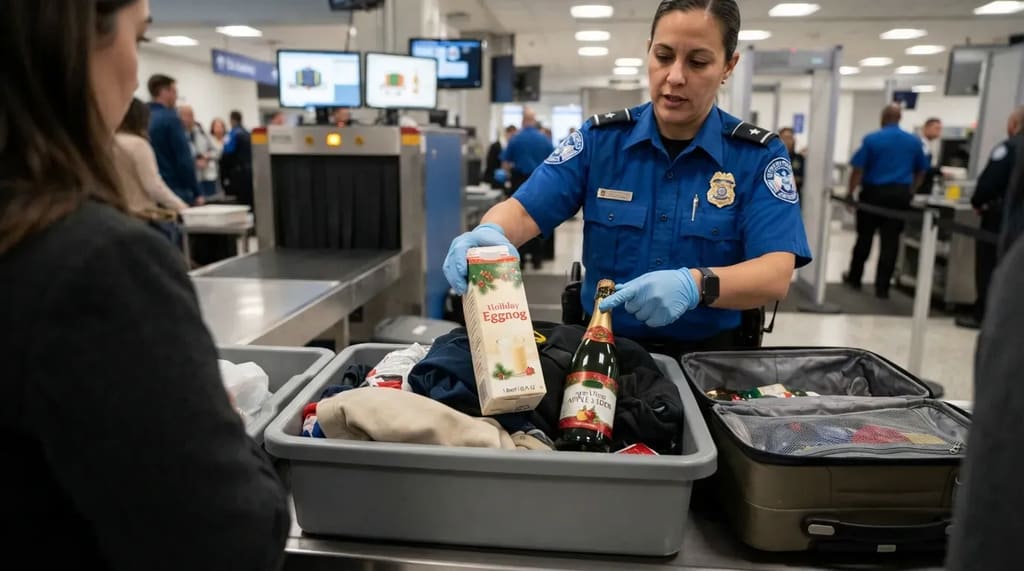
TSA’s checked-bag list includes wine, champagne and sparkling cider.2 Cider has no alcohol, but alcohol isn’t what the rule is about. A liquid is a liquid.
Eggnog follows suit. TSA’s holiday guidance says eggnog, champagne, wine and sparkling apple cider should be securely packed and checked. A carton is bigger than 3.4 ounces by a wide margin, so it goes in checked luggage or stays behind.
Cartons leak easily, so double-bag one if it goes in a suitcase. For a short trip, it’s easier to buy it at a grocery store near your destination than to carry a perishable drink through the airport at all.
#5 – The Snow Globe That Looked Too Big
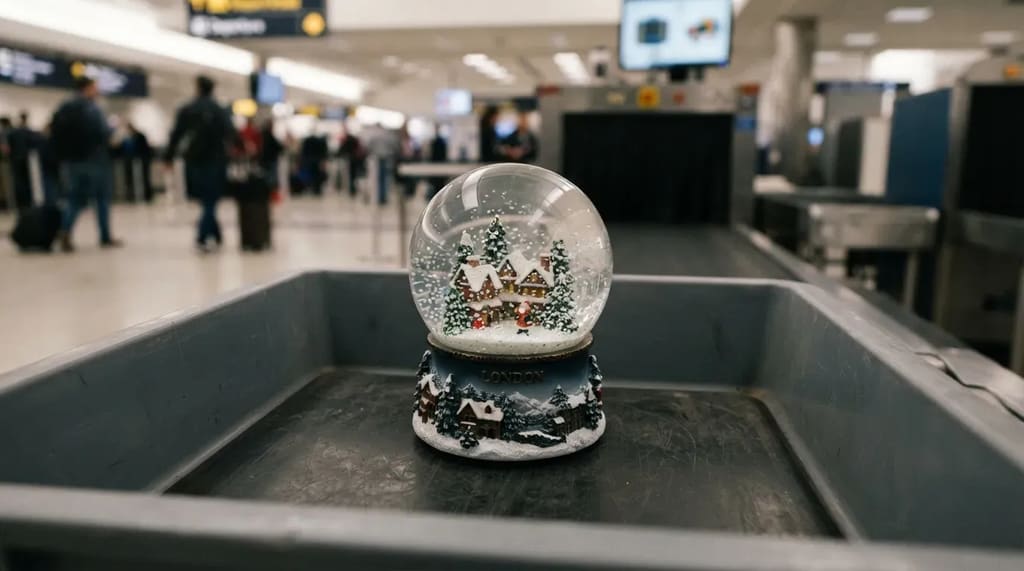
Snow globes are on TSA’s list of holiday trouble spots because of the liquid inside. A small one that holds less than 3.4 ounces, about the size of a tennis ball, can go in a carry-on if the whole globe fits in a quart-size bag.
Larger globes belong in checked bags. The base counts toward the size, which is where many nice globes fail. A souvenir that looks small on the shelf can look huge once it’s sitting in a bin.
A snow globe is glass and water, so the checked bag carries its own risk. For a big or sentimental one, mailing it ahead is the safer choice.
A snow globe hides its liquid inside glass, whereas the next gift on this list names its contents right on the label.
#4 – The Bottle of Wine You Meant to Hand the Host
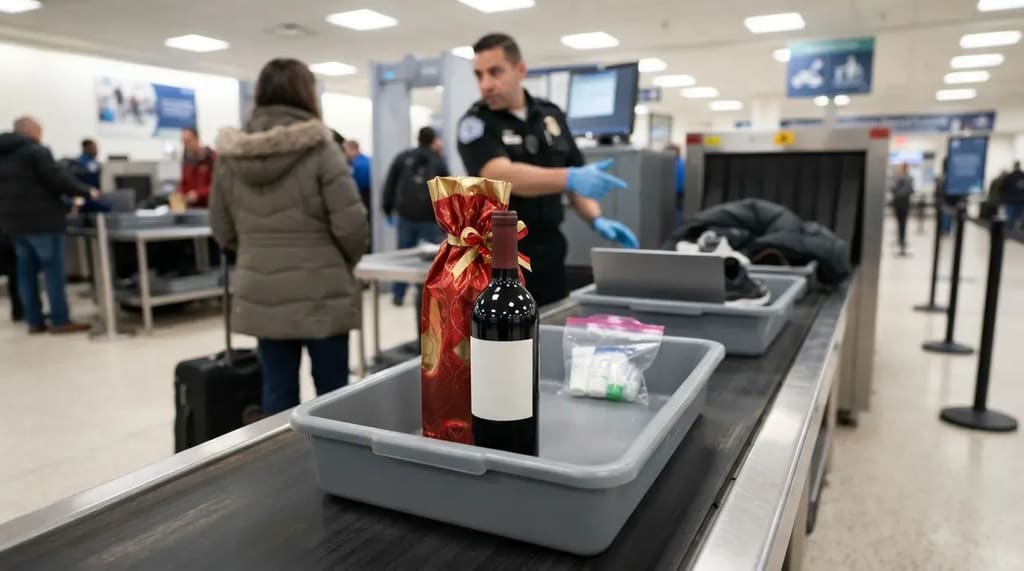
A standard bottle of wine is a checked-bag item. Only a mini bottle of 3.4 ounces or less fits in the quart-size liquids bag. That includes champagne, so the celebratory bottle can’t ride up front with you.
Alcohol has limits of its own. Anything over 140 proof is prohibited. Stronger drinks between 24 and 70 percent alcohol by volume are capped at five liters per passenger in checked luggage.4
There is one way around the carry-on rule. A bottle bought after you pass security, such as in an airport shop, can usually go on the plane with you on a domestic flight. That helps with a gift you pick up on the way, but it does nothing for a bottle already sitting at home.
For a host gift, buy the bottle near where you’re staying. A bottle can break in a checked bag, and a stop at a local shop costs very little time.
Worth Knowing
- Standard bottle: wine and champagne go in checked luggage
- Mini bottle: 3.4 ounces or less fits in the quart bag
- Proof ceiling: anything over 140 proof is prohibited
- Checked limit: drinks between 24 and 70 percent ABV are capped at five liters per passenger
The 3.4-ounce line that keeps wine out of the cabin also governs the gravy boat.
#3 – The Family Gravy in a Mason Jar
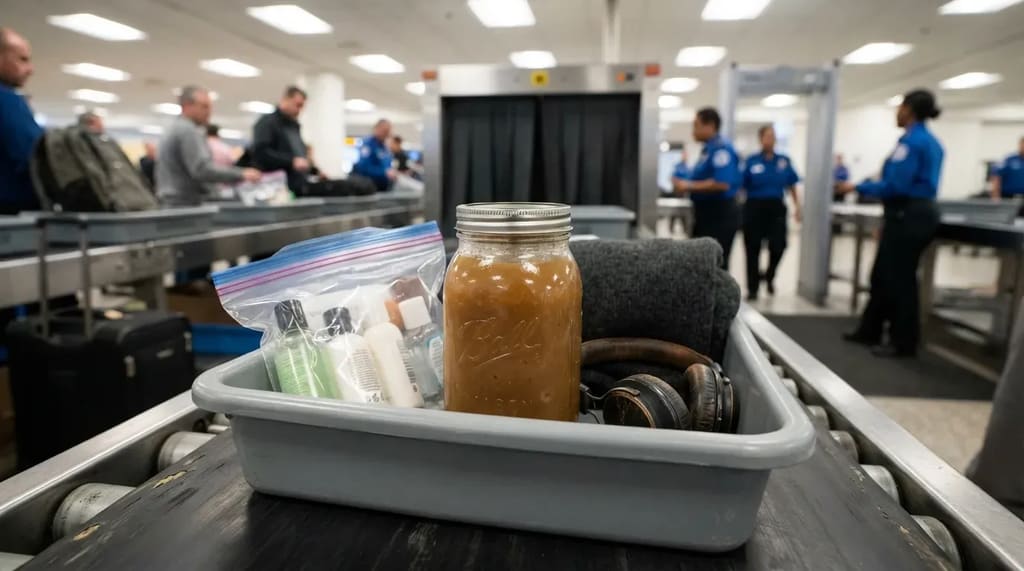
Gravy is the clearest case of a pourable food. TSA counts it whether it’s homemade or from a jar or can, and treats it no differently than a bottle of water or shampoo.
That leaves two choices. A container of 3.4 ounces or less goes in your quart bag, and anything larger goes in a checked bag. Double-bag it there to prevent a messy surprise at baggage claim.
Unless the recipe is one nobody else can make, leave the gravy at home. Making it after you arrive is often easier than transporting it, and a packet or a pan of drippings at the destination solves the whole problem.
Gravy gets stopped because its liquid is obvious, but some gifts get opened because an officer can’t see what’s inside them.
Related Stories From Travelbinger

#2 – The Wrapped Present Under Your Arm
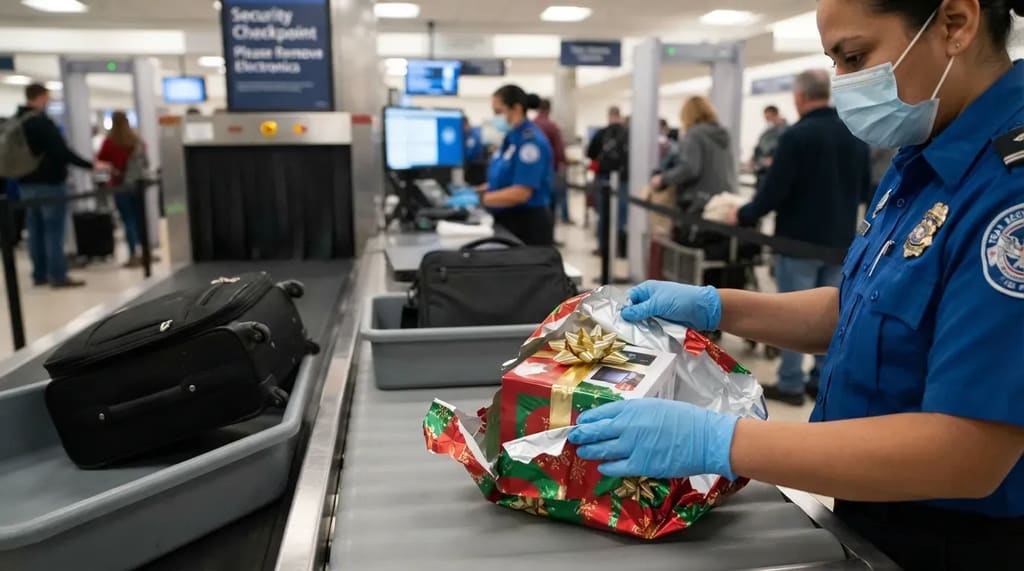
TSA doesn’t ban wrapped gifts. Its holiday guidance simply warns that if a bag raises an alarm, officers may have to unwrap the present to check it.3 5 The paper is the part that gets torn.
TSA recommends waiting to wrap until after the flight, or putting the item in a gift bag so it can be inspected without ripping anything. A box with a lid that lifts off works too.
The warning applies to checked bags as well. A wrapped present in a checked bag can trigger an alarm behind the scenes, and nobody will be there to rewrap it. If you can, ship the gifts to your destination instead.
Wrapping at home often isn’t worth the effort for a flight. Hours of crisp corners are gone the moment an officer opens the box, and a gift bag with tissue paper looks just as festive.
A torn gift can be rewrapped at your destination, while a surrendered can of food stays at the checkpoint for good.
#1 – The Can of Cranberry Sauce That Holds Its Shape
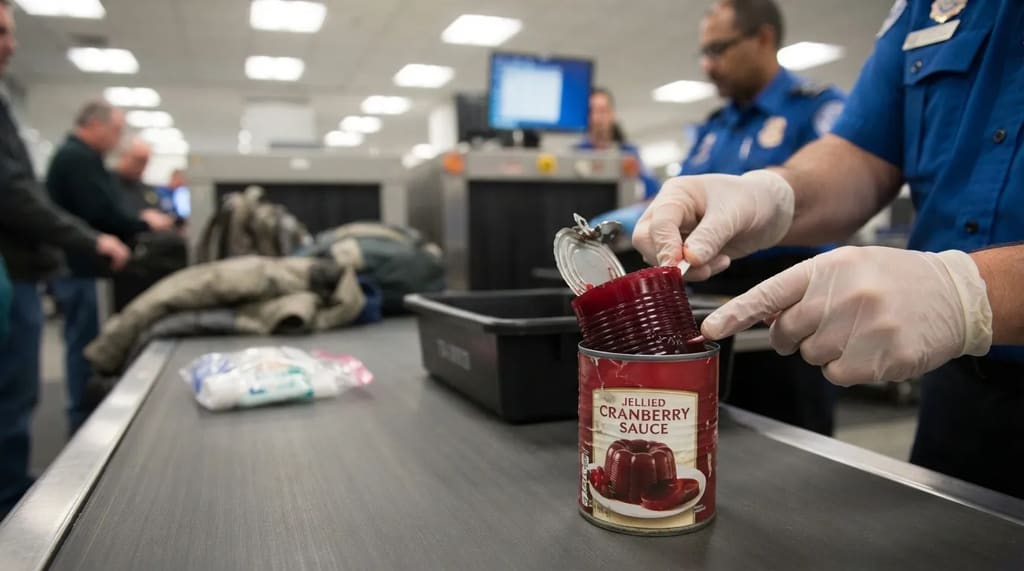
Fresh cranberries are fine in a carry-on. TSA lists raw produce such as cranberries, green beans and potatoes among the solid foods allowed. The sauce made from them is another matter.
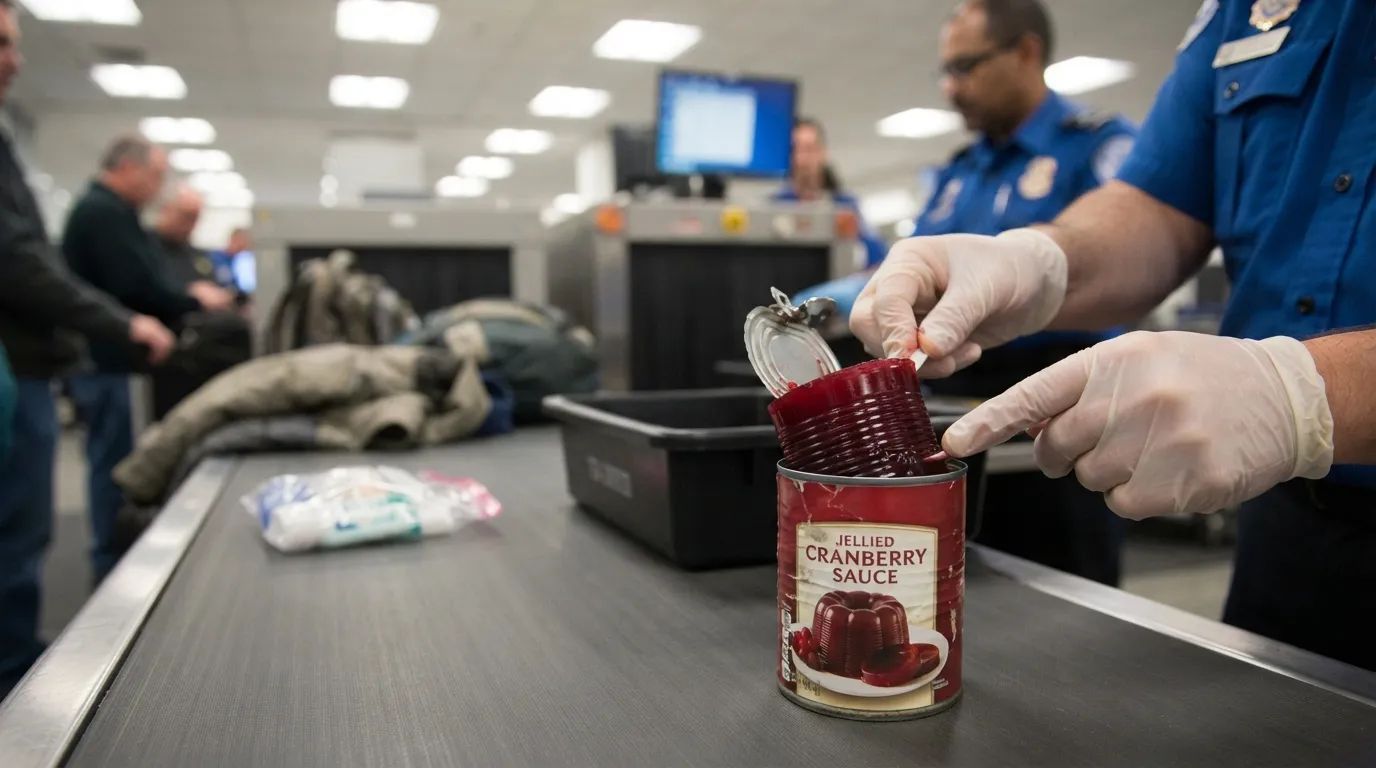
TSA’s holiday guidance says homemade or canned cranberry sauce is spreadable, so it gets checked.2 That includes the jellied kind that slides out of the can in one wobbly, ridged piece. It looks solid, but TSA still treats it as a spread.
That makes it a classic checkpoint surprise. A can sitting upright on the table looks like any other solid food, and the officer at the belt sees it as something you could spread.
You can carry it on only in a container of 3.4 ounces or less, inside your quart bag. A full can goes in the checked suitcase, sealed and wrapped in clothes. Or bring the fresh berries and make the sauce when you arrive.
The pie and the can sit side by side on the holiday table, yet one passes and the other doesn’t. The difference is the question TSA asks of every food: can you spill, spray, spread, pump or pour it? A can that holds its shape on the plate can still be a spread in the eyes of security.
Before you pack a holiday dish, tilt the container and see whether it moves. If it flows, spreads or pours, plan on checking it or making it at the other end. If it holds its shape, it will likely ride along in a bin at the checkpoint.
Why It Stands Out
- The shape fools the eye: jellied sauce looks like a solid but counts as a spread
- The pie passes: its sturdy slice holds together and screens as a solid food
- The berries pass too: raw cranberries ride in a carry-on without trouble
For a specific item, the MyTSA app has a “What Can I Bring?” tool where you type in the item and see whether it goes in a carry-on or a checked bag. A minute with it can spare a dish.
Which dish from your family’s holiday table would be hardest to recreate at the other end of a flight?
- TSA Complete What Can I Bring List: https://www.tsa.gov/travel/security-screening/whatcanibring/all-list
- GMA TSA Thanksgiving Food Rules: https://www.goodmorningamerica.com/travel/story/thanksgiving-travel-dont-wrap-gifts-tsa-tips-115562186
- Travel Off Path Holiday Items: https://www.traveloffpath.com/5-holiday-items-tsa-officers-pull-out-of-carry-on-bags-every-winter-for-inspection/
- Tasting Table High-Proof Liquor: https://www.tastingtable.com/1768247/high-proof-rum-tsa-not-allowed/
- 6abc TSA Holiday Rules: https://6abc.com/post/are-flying-thanksgiving-heres-what-can-cant-get-tsa/15565250/