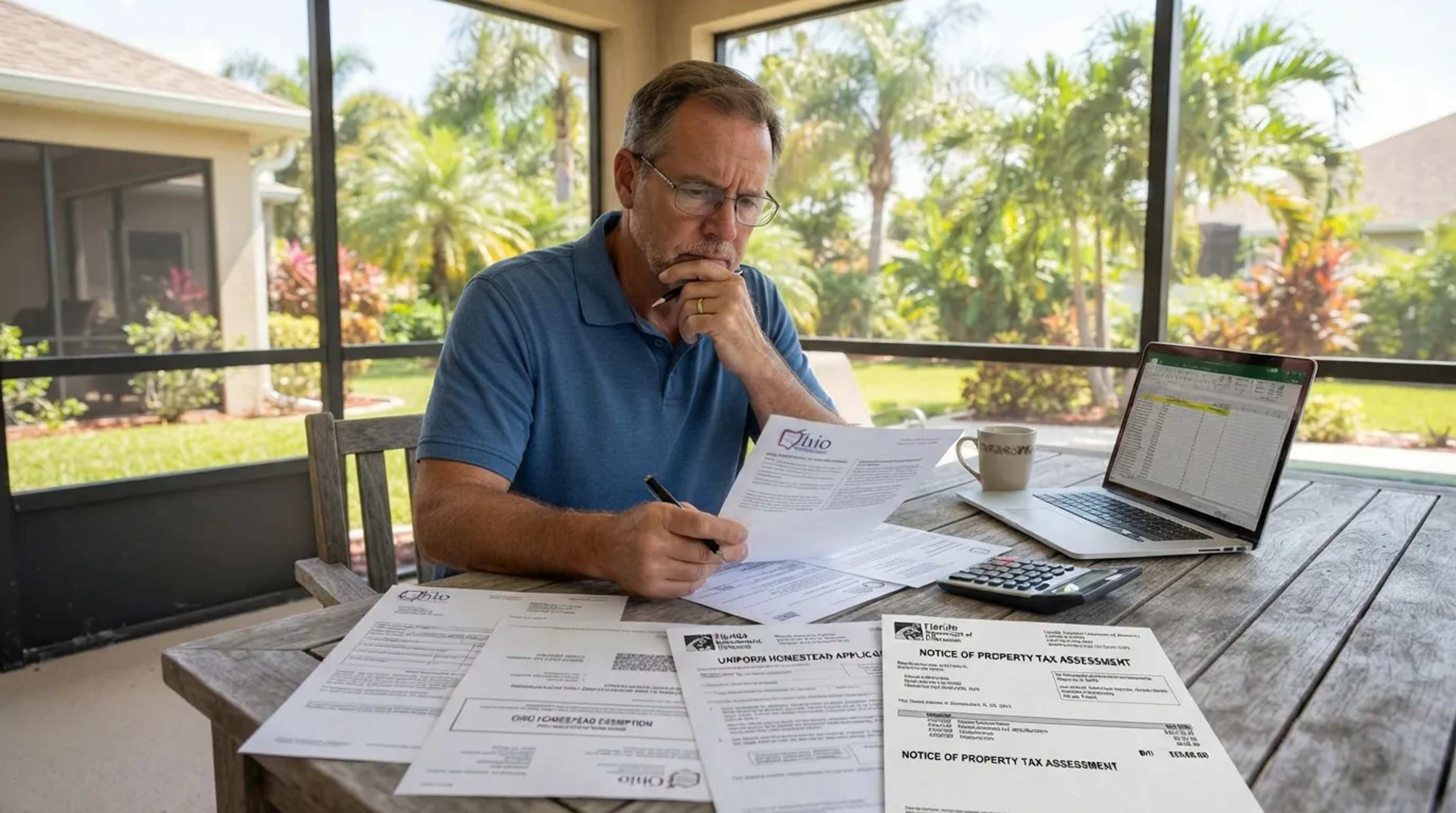
A car that arrives in Florida on December 1 passes the 90-day mark around March 1, and the count includes every day it sat parked in the driveway. That one number decides whether your plates, your insurance and your paperwork still fit the state you’re driving in.
Most rules on this list are cheap to follow once you know them. The last one is the only deadline you can’t fix after a crash, so stay for all twelve, and start with the rule that’s good news for visitors.
#12 – Your Home License Still Works Here
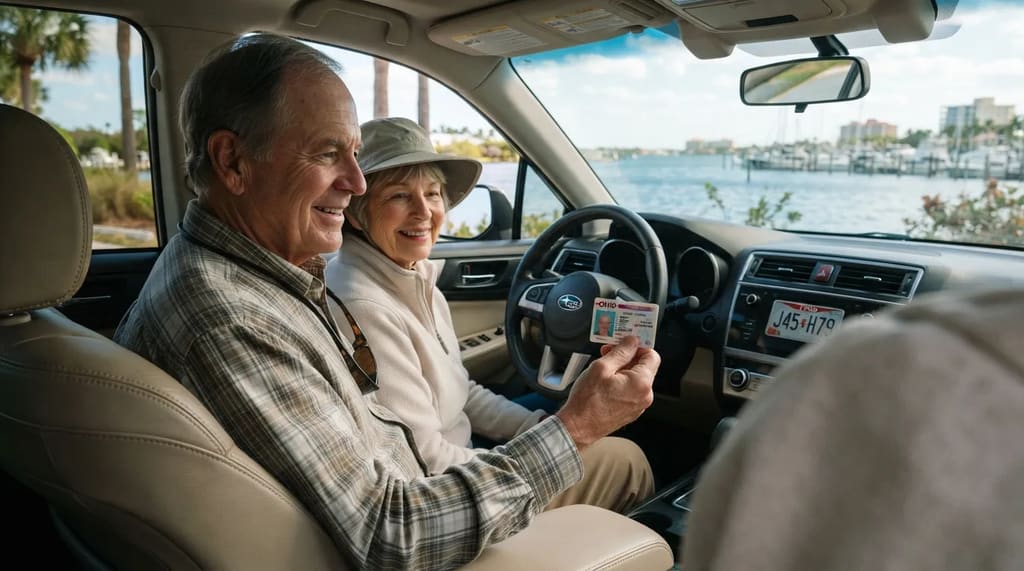
Your license from home is legal in Florida all winter. You can drive here on an out-of-state license for as long as you don’t become a resident.
Florida’s highway safety agency, FLHSMV, starts the 30-day license deadline when you establish residency, and arriving for the winter doesn’t do that. The 30-day license swap is a deadline for new residents, not winter visitors.
That makes the “just to be safe” trip to a Florida licensing office a mistake for a visitor. You’d surrender the license you came with, and you’d be telling Florida you live here, which starts other clocks later in this list.
The one condition is that your license has to be current. Check the expiration date before you pack, and if it falls between November and April, ask your home licensing office whether you can renew by mail or online from out of state, since the rules vary by state.
A license is only the first document on the road. The next one is on your bumper, and a Florida law that took effect this fall changed what can sit around it.
#11 – The Plate Frame Law Changed in October
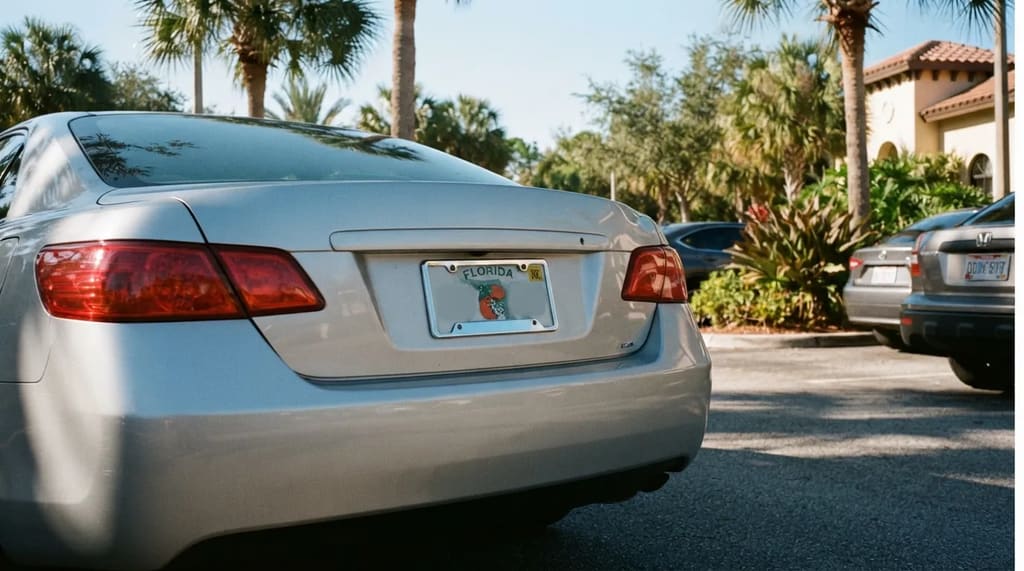
The dealership frame that came with your car has stopped being a worry. Among the laws that took effect on October 1, 2026, one clarifies that decorative license plate frames are legal as long as they don’t obscure registration decals or plate numbers.1
That wording matters for out-of-state cars, because your plate carries your home state’s numbers and stickers. A frame is fine unless it covers the plate numbers or a registration decal.
Here’s the verdict: unscrewing every frame before a Florida trip is a chore that can wait. Fixing a frame that clips a digit or a corner sticker is the one that can’t, since that’s the situation the law still addresses.
Compare that with the earlier items. A five-minute look at your plate costs far less effort than a license swap, and it’s the only legal housekeeping some cars will need.
Frames and stickers matter when the pavement is dry. When a Florida downpour arrives, your windshield wipers trigger a different rule.
#10 – Wipers On Means Headlights On
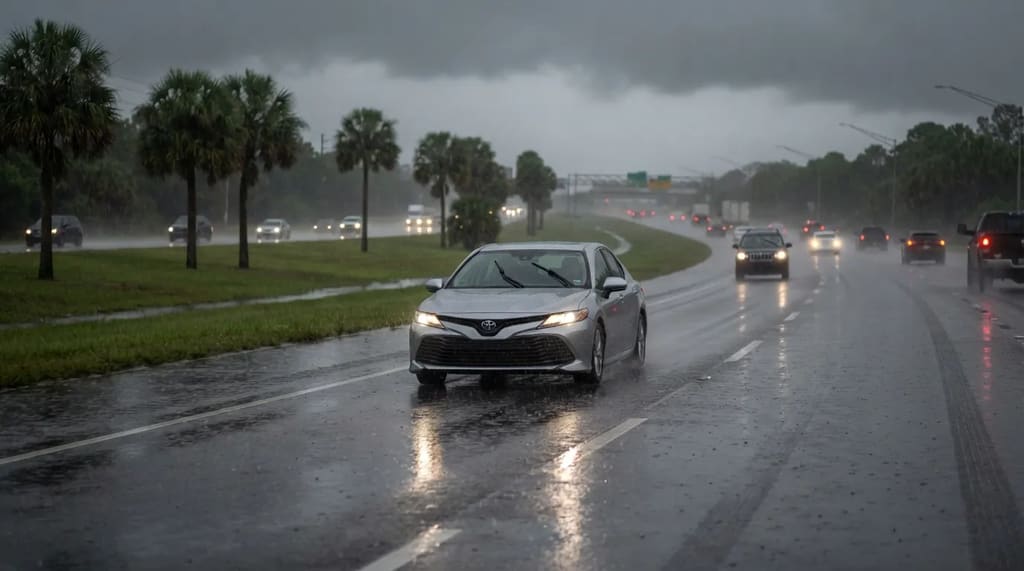
In a Florida rainstorm, your wipers are also a legal switch. Florida requires headlights whenever your windshield wipers are in use because of rain, smoke or fog, in addition to the hours between sunset and sunrise.2
Wipers on, headlights on, any time of day. It sounds like etiquette, but it’s a rule, and a dim afternoon shower can bring a ticket as easily as a night drive does.
If your car has daytime running lights, check what they light. On many cars they illuminate only the front, so the taillights stay dark in the one weather when the driver behind you needs them most.
Switching the headlight dial to on, or setting it to auto, lights both ends of the car. It’s a two-second habit, and it’s the cheapest rule on this list to follow.
Headlights keep you visible, but your hands matter just as much as your lamps. Two kinds of Florida zones add a stricter phone rule than the one that applies everywhere else.
#9 – Two Zones Where Your Phone Is Off Limits
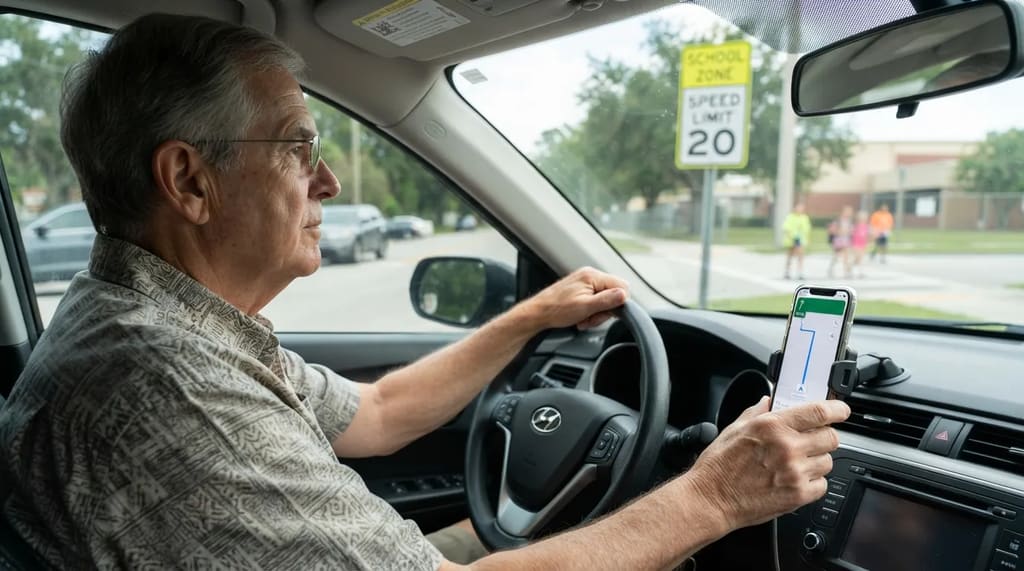
Florida treats texting behind the wheel as a primary offense, so an officer can stop you for it alone. In two kinds of zones the rule goes further.
In school zones and in work zones where workers are present, holding a phone while driving is banned. In those zones, drive hands-free or leave the phone alone.
Visitors are more exposed than locals here, because you’re reading unfamiliar signs and following a navigation voice. The fix is to enter every address before you shift out of park, and to pull over if the route changes.
A phone in a dash mount, with the route already set, keeps you on the right side of the rule. A phone held in your lap while you glance at a map does not.
School zones belong to children, and so does the next rule. It involves a flashing yellow bus, and whether you stop depends on what’s painted or built down the middle of the road.
#8 – School Bus Stops Depend on the Median
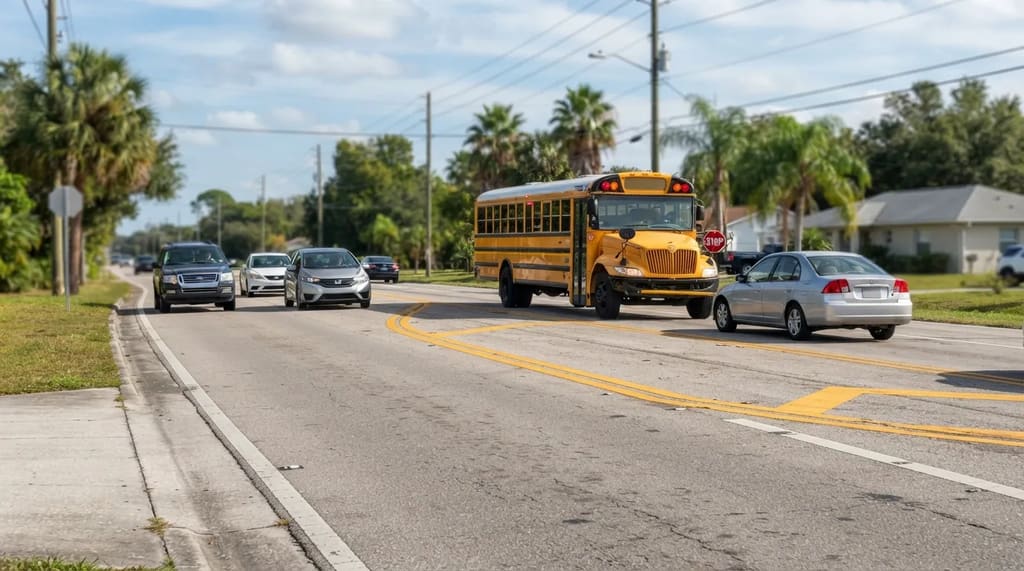
On a road with a painted center turn lane, a school bus with flashing red lights stops traffic in both directions. A paved turn lane isn’t a barrier, so drivers coming toward the bus have to stop too.3
On a divided highway with a raised median or physical barrier, only traffic traveling behind the bus has to stop. Stop for a bus with red lights flashing unless a physical barrier separates you.
Quick Compare
- Painted center turn lane: traffic in both directions stops.
- Raised median or physical barrier: only traffic behind the bus stops.
- Either way: stay put until the lights stop flashing and the stop arm folds in.
This matters in winter because Florida schools run through the season, apart from holiday breaks. A retirement community can feel far from school routes until a bus pulls out of a side street.
Wait until the lights stop flashing and the stop arm folds in before you move. If you’re not sure whether the road counts as divided, stopping costs you a minute and a guess costs a lot more.
#7 – Move Over Isn’t Only for Police Cars
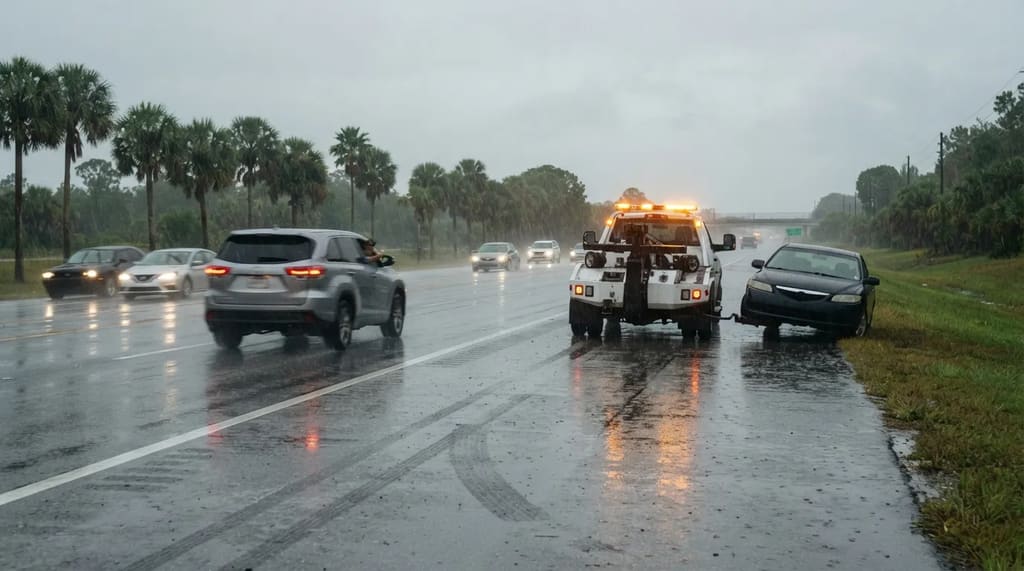
Florida asks you to change lanes for a stopped vehicle with flashing lights, and the slowdown rule covers the times you can’t. The duty starts the moment you see the lights ahead.
If a lane change isn’t safe because of traffic, you’re expected to slow down instead. Move over if you safely can; otherwise slow to 20 mph below the limit.4
That 20-mph cut applies on roads posted 25 mph or higher. On roads posted 20 mph or less, the required speed is 5 mph, so ease off early either way.4
The slowdown matters most in rain, the same weather that triggers the headlight rule above. Spray hides a stopped tow truck until you’re close, and lights flashing in a downpour are easy to read too late.
Slowing for a tow truck is one rule. The next concerns the minutes after a fender-bender, and a dollar figure that quadrupled this October.
#6 – The Crash Reporting Line Is Now $2,000
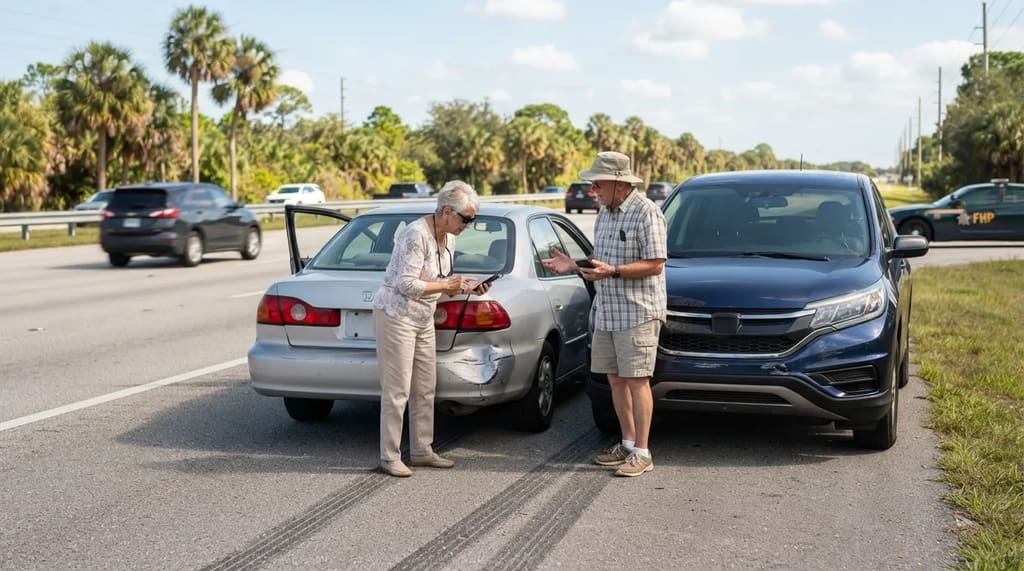
Florida just raised the damage line that triggers a police report. Starting October 1, the property-damage threshold for notifying law enforcement after a crash rose from $500 to $2,000.1
The requirement to report a crash involving injury or death didn’t change. Report injuries always, and property damage of $2,000 or more.
At a Glance
- Effective date: October 1, 2026
- Property damage: report at $2,000 or more, up from $500
- Injury or death: always reportable, no dollar minimum
- At the scene: take photos no matter what the damage looks like
My verdict: treat the new figure as a legal floor, not a reason to skip photos. At the scene, you can’t know what a body shop will say, and a bumper that looks fine may cross $2,000 once the sensors behind it are checked.
Take pictures of both cars, the plates, the road and the other driver’s insurance card regardless of the number. Your home state’s reporting rules and your insurer’s requirements still apply to a Florida crash.
Everything so far applies to any driver over 65. The next rule switches on at one specific birthday, and it reaches visitors only if they cross a certain line first.
#5 – The Vision Test Waiting at 80
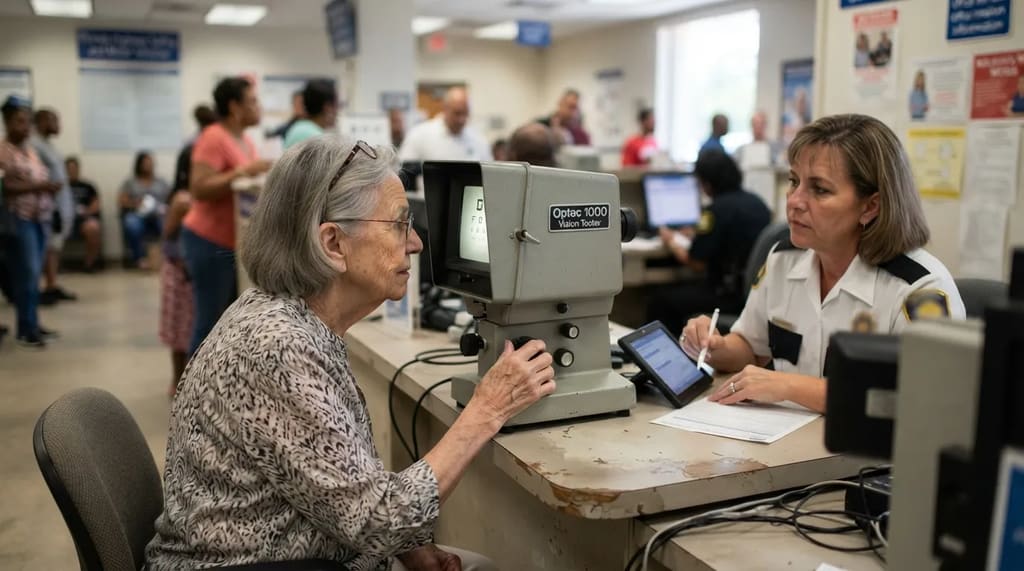
At 80, a Florida license renews every six years instead of eight. Drivers 80 and older must also pass a vision test at every renewal.5
Visitors on home-state licenses follow their own state’s rules, so this lands on residents. Snowbirds who become Florida residents at 80 or older meet the vision requirement at their first Florida renewal.
That’s the hidden cost of the “just to be safe” license swap from the start of this list. At 80, a Florida license adds a vision test to every renewal.
The test is free at a license service center, and your eye doctor can supply the results instead. Florida doesn’t require a road retest based on age alone.5
A Florida license also changes how the state reaches you. One new channel doesn’t wait for you to open it.
#4 – The Clock That Starts at Residency
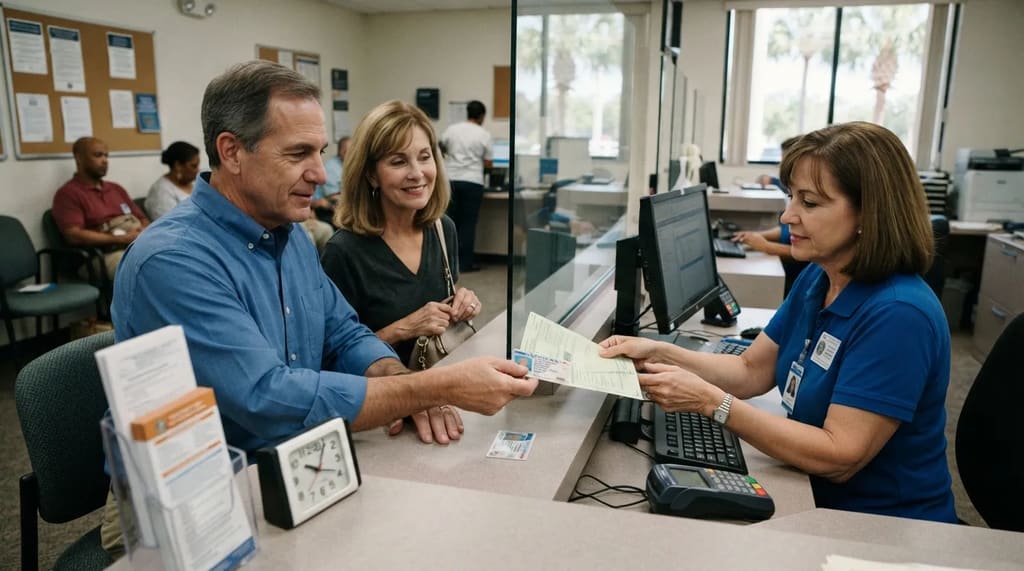
Florida doesn’t count how long you’ve visited. It counts what you’ve set up here, and a job, a lease or enrolling children in school can establish residency.
Once you’re a resident, the license swap is due within 30 days. The vehicle deadline is tighter: one guide puts it at 10 days after starting a job, or 30 days from residency. The 30-day license clock starts at residency, not at your arrival date.
Other guides give 10 days for all new residents, so confirm the exact deadline with your county tax collector’s office. Don’t wait for a reminder, because the clock runs whether you know about it or not.
If you do end up with a Florida license, there’s a modern wrinkle. Since October 1, 2026, FLHSMV can send notice of a license suspension, cancellation or revocation by email if you’ve authorized it.1
Failing to receive or open the notice doesn’t delay the effective date of the order. Keep your email address current.
Once Florida sees a resident or a long-stay owner, registration paperwork follows. It asks for a document your northern insurance card can’t provide.
#3 – Registration Wants a Florida Insurance Policy
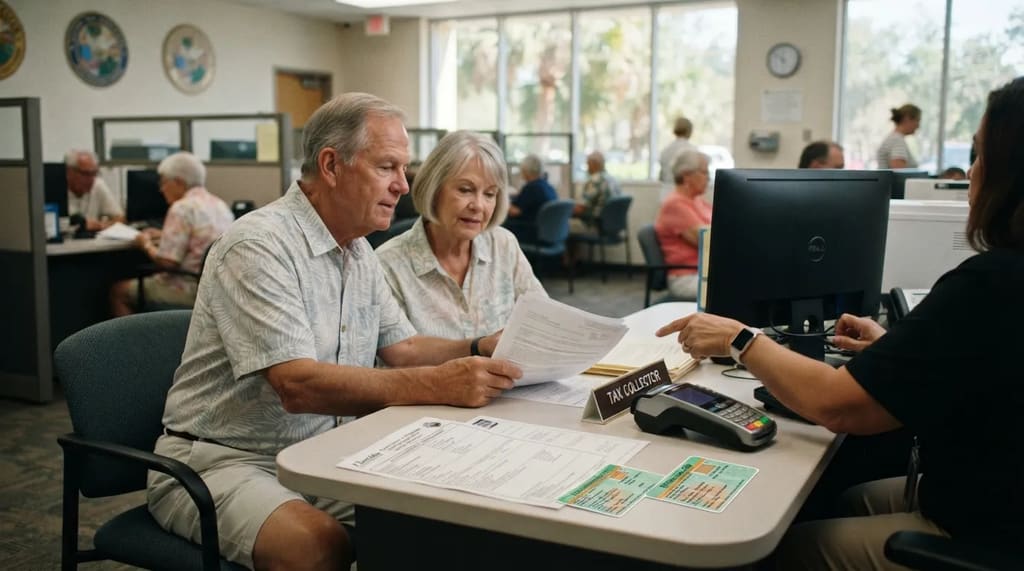
Your northern insurance card won’t register a car in Florida. Out-of-state policies aren’t accepted.
For a car titled elsewhere, plan to bring these items to the tax collector’s office:
- A valid out-of-state title
- Proof of your Florida address and Florida auto insurance
- A VIN verification on Florida form 82042
- Payment for the registration fees
Florida registration requires a Florida policy, with at least $10,000 each in PIP and property damage liability. Those are the usual minimums the agency expects on a Florida-registered vehicle.
My advice is to ask your current agent in the fall, not at the counter in March. Buying a Florida policy can affect the policy you keep at home, and each insurer handles that differently.
Related Stories From Travelbinger



#2 – Your Out-of-State Coverage Clause Has Limits
Your northern policy may carry a clause that extends coverage to other states. Whether that clause pays Florida’s no-fault benefits is a separate question, and the answer depends on the exact wording.
Florida’s PIP is the state’s no-fault injury coverage, and the numbers behind it are specific.
Worth Knowing
- Medical and disability: up to $10,000 in PIP benefits
- Death benefit: $5,000
- Nonresident duty: PIP is required only after 90 of the last 365 days6
- Your clause: its exact wording decides whether it pays Florida benefits
That gap has caused real disputes. A Florida appeals court found that a Georgia policy didn’t provide Florida PIP, because its clause applied only where a state requires nonresidents to carry insurance whenever they use a vehicle. An out-of-state clause may not trigger Florida PIP benefits at all.
Don’t count on the clause. Ask your agent a single question, and ask for the answer in writing: does this policy pay Florida PIP benefits for a visitor injured in a crash?
All of it hangs on one number, 90. The way Florida counts to it isn’t the way a snowbird’s calendar does.
#1 – The 90-Day Count Includes Parked Days
Florida’s statute covers a nonresident owner of a vehicle that, whether operated or not, has been in the state more than 90 days during the preceding 365 days. That owner has to keep security in effect continuously while the vehicle stays here.7
More than 90 days in the preceding 365 triggers Florida’s insurance rule. The days don’t have to be back to back, and a car kept here more than 90 days in a year must be registered even if you remain a legal resident elsewhere.
Some guides describe the count as a calendar year, but the statute’s wording is a rolling 365 days. Say your car stayed December 1 through March 1 last winter and returns in mid-November. The earlier days still sit in the window, so you start the new trip already at or near the line.
This is the rule that ties the list together. The coverage clause in #2, the policy in #3 and the residency clock in #4 all lean on this count, and no sign on the highway mentions it.
Here’s my verdict: if you’re within a few weeks of the line, treat yourself as already over it. Insurance can’t be bought after a crash to cover the crash, and Florida doesn’t count a parked car as absent.
Count the Days, Not Just the Miles
The rules that cost the most on this list are the ones nobody posts on a sign. A speeding ticket announces itself, while a day count slips by while you’re sitting by a pool.
Handle the dates the way you’d handle the trip itself: write them down before you leave, next to your drive-home day. Ask your agent the PIP question early, and check your plate before the first drive.
Fast Facts
- 90 days: the insurance trigger within a rolling 365, parked days included
- $2,000: the new property-damage line for a crash report
- Age 80: six-year renewals and a vision test for Florida license holders
- Wipers on: headlights on, rain or shine
How many days did your car spend in Florida last winter, and did you know that number before reading this?
Bonus: The Insider Move Nobody Tells You About

Don’t just learn the 90-day rule. Build a paper trail that proves you followed it, and do it before you leave home.
- Find your “day 91” date. Print a 12-month calendar, mark every day your car was in Florida in the past year, then count forward from your planned arrival. The day you pass 90 is the date that matters, so circle it.
- Email your agent now, not in March. Give your exact arrival and departure dates and your circled date. Ask: “Does this policy pay Florida PIP benefits for a visitor, and what do I need to change before that date?”
- Save the reply. Keep the written answer on your phone and a printed copy in the glove box with your registration. Vague replies like “you should be fine” are not an answer, so ask again until the reply is specific.
- Set a reminder two weeks before your circled date. That gives you time to change coverage or registration without scrambling.
If you can’t tell whether your coverage meets Florida’s requirements, ask your agent or the county tax collector’s office, and get the answer in writing. A saved email costs nothing, and it’s the cheapest protection on this list.
- Fox 13 New Florida Laws: https://www.fox13news.com/news/new-florida-laws-begin-oct-1-what-you-need-know
- NHTSA Florida Headlamp Interpretation: https://www.nhtsa.gov/interpretations/nht74-135
- Florida School Bus Stop Law: https://www.ddlawtampa.com/blog/florida-school-bus-stop-law/
- FLHSMV Move Over Florida: https://www.flhsmv.gov/safety-center/driving-safety/move-over/
- Florida Senior Drivers Renewal: https://www.dmvusa.com/fl/florida-senior-drivers/
- Florida Nonresident PIP Rule: https://regulations.justia.com/states/florida/69/69o/chapter-69o-176/section-69o-176-008
- Florida Statute 627.733 (2004): https://www.flsenate.gov/Laws/Statutes/2004/627.733