
Most people assume group trips implode over bad luck, clashing personalities, or a destination that turns out to be a dud. The real data says otherwise: according to Kayak, 84% of travelers have watched a group trip stall out at the planning stage, stuck in group-chat limbo for months at a time.
A 2024 Away Travel survey found something even more telling: 62% of people say a group vacation strained a friendship, and rarely because of one dramatic blowup. It’s death by a thousand tiny frictions – the kind a handful of deliberate habits can stop before they start, and the further down this list you go, the sharper those habits get.
#21 – They Pick a Decision-Maker Before the First Booking

Every veteran group traveller knows that democracy is the enemy of momentum.
Most groups default to a collective vote on every single decision, which is how you end up with 200 messages and zero confirmed reservations. According to Kayak, 84% of group trips stall in the planning phase, and 90% of those travellers blame that one friend who won’t commit.
Seasoned travellers short-circuit this immediately by naming a single trip coordinator – not a dictator, but someone with final-call authority when consensus stalls. This person should be organised, responsive, and comfortable dealing with booking departments, and their contact details should go to every group member so there’s no confusion about who to reach.
The role doesn’t mean doing everything alone. It means owning the decision-making lane, while delegating other tasks – accommodation, meals, transport – so the load gets shared instead of dumped on one person. Without someone holding the thread, the trip exists only in a chat that everyone eventually mutes.
But naming a leader is just the start – next comes the conversation nobody wants to have.
#20 – They Talk About Money Before Anything Else

Skipping the budget conversation is the single most reliable way to poison a group trip before it even begins.
Avoiding talking about money is a big mistake. With a group, you’ll have people who have different spending styles or budgets.
Wendy Diep, group travel expert
Most first-time group organisers treat the budget chat as awkward and optional. Veterans treat it as the very first agenda item.
Once you’ve collected everyone’s budget range, share the results without names attached and plan for the lower-middle range of the group. People with bigger budgets can always upgrade their own room or order the expensive wine, but people with smaller budgets should never feel priced out of the core experience.
One of the best pieces of group travel advice is keeping everyone in similar economic brackets – nothing kills the vibe faster than half the group wanting to splurge while the other half counts every penny.
Get the money talk right, and everything else becomes negotiable. Next up: what to do once the budget is actually set.
#19 – They Set Up a Shared Expense Tracker Before Day One

Talking about the budget is step one. Tracking real spending in real time is step two – and most groups skip it entirely.
Seasoned travellers set up a shared expense tracker like Splitwise or Tricount before the trip even starts. Every shared cost gets logged the moment it happens, not reconstructed from memory a week later.
Reconstructing from memory is where friendships fracture. Settling up at the end of the trip instead of tracking as you go creates arguments that no one wins.
Two apps dominate this space, and they serve slightly different needs.
Quick Compare
- Splitwise: receipt scanning, currency conversion, requires an account for every member – best for friend groups who travel together repeatedly.
- Tricount: no account needed, simpler layout – best suited to a one-off trip.
Expenses managed – now the question is whether you’re booking early enough to get the deals that make the budget work.
#18 – They Book Group Accommodation Directly, Not Through an OTA

Here’s something most casual group travellers never figure out: the best group hotel rates almost never appear online.
Accommodation eats up a huge chunk of the group budget, but many hotels offer unpublished group rates that never show up on third-party booking sites at all – contacting the hotel directly is how you access them. Online travel agencies take a commission cut; a hotel’s group sales desk doesn’t, and it passes that saving straight to you.
Experienced organisers book directly with hotel group sales rather than through an OTA, confirm common space before paying a deposit – private dining rooms, meeting areas, reserved terraces – and pre-arrange group meals with set menus.
The standard process is: confirm you actually need 10 or more rooms, start three to twelve months early depending on your travel dates, and contact a Group Sales Manager directly instead of using an online booking engine.
Know exactly when to start that process, because timing matters far more than most groups realise.
#17 – They Start Planning Months Earlier Than They Think They Need To

The single most consistent mistake made by first-time group organisers? Starting too late and watching the good options disappear.
Summer trips, holiday weeks, and spring break destinations need six to twelve months of lead time. Wait until three months out and the good rates and best room configurations will already be gone.
One of the biggest mistakes in group travel is waiting too long to book transportation, which often leads to limited vehicle options, higher prices, or logistical problems like not having enough space.
Major events, holidays, and high seasons all push costs up and crowds in, so experienced group travellers aim for quieter periods when possible. Many operators also offer discounts at specific times of year – signing up to their newsletters prevents missing out.
Getting ahead on the calendar also buys flexibility to shift travel dates – which is the next move veterans always make.
#16 – They Negotiate With Date Flexibility as a Bargaining Chip

Most groups pick their dates first and then try to get a good price. Seasoned group travellers do it the other way around.
When negotiating group rates with airlines, highlighting flexibility with travel dates can help secure not just lower fares but perks like reduced change fees or complimentary seat assignments. Carriers value predictable, committed group bookings and will trade extras for the certainty of filled seats.
Adjusting travel dates to avoid school holidays, long weekends, and local public holidays at the destination can cut costs by up to 20% compared to peak-period booking – a meaningful saving when multiplied across an entire group’s flight spend.
Sunday check-ins typically run cheaper than Saturday check-ins because business travel demand drops at the start of the week – a small shift most groups never consider, but one experienced organisers use as a standard lever.
Flexible dates give you price power. But there’s another piece of the cost puzzle experienced travellers always interrogate: what’s actually included in that group rate.
#15 – They Read the Cancellation and Attrition Clauses Carefully

Group contracts contain fine print that can turn a good deal into an expensive trap – and first-time organisers almost never read it closely enough.
Group flight bookings typically follow a two-stage payment structure that differs from individual ticketing, and understanding those terms upfront prevents costly surprises later. Hotels work similarly, with attrition clauses that charge you for rooms the group ultimately doesn’t fill.
The attrition clause is the most dangerous line in any group hotel contract. It specifies a minimum percentage of your room block you must actually use – typically 80 to 90% – and charges you for unused rooms even if people cancel. Experienced group travellers negotiate that percentage down before signing and always build a buffer into the block.
When you’re planning for one or two people, the risk is low. When you’re planning for ten, the odds that someone gets sick, has a family emergency, or cancels outright climb fast, and seasoned organisers price that inevitability into the contract, not into wishful thinking.
Managing the contract is one thing. Managing the expectations of the people filling those rooms is an entirely different discipline.
#14 – They Discuss Travel Styles Before Confirming the Destination

A great destination chosen for the wrong group is worse than a mediocre destination chosen for the right one.
A common mistake made when planning a group trip is not discussing expectations. There are many important aspects that people don’t discuss before booking that really worsen the experience.
Tonia Hope, travel guide
That covers not just budget and dietary restrictions, but also what type of traveller each person actually is. Some like to relax and take it slow, others want to hit the ground running from sunrise.
If you’re inviting others on a trip, be clear about what the itinerary entails so people can opt in or out – not find out the hard way after they’ve already arrived. Just because someone is a good friend doesn’t mean your travel preferences are aligned.
Veterans ask directly: resort lounger or neighbourhood wanderer? Early riser or slow-morning person? Museum crawler or outdoor adventurer? Knowing travel styles shapes the destination – the itinerary, though, requires its own careful architecture.
#13 – They Build an Itinerary With Built-In White Space

The overcrowded itinerary is one of the most common ways an enthusiastic organiser accidentally ruins a trip.
A itinerary that reads like a military operation – every hour accounted for, every transition timed to the minute – leaves zero margin for the unpredictable, and the unpredictable always shows up.
Seasoned group travellers deliberately leave 20 to 30% of each day unscheduled. That white space isn’t wasted time; it’s the pressure valve that keeps the group from cracking under a packed schedule.
It’s also where the best moments of any trip tend to happen – the side-street discovery, the three-hour lunch nobody planned. Structure provides the skeleton; white space provides the life inside it.
The itinerary is built. But how it gets shared – and who has access to it – is where a lot of groups quietly lose control.
#12 – They Use a Single, Shared Itinerary Document Everyone Can Access

A great itinerary that lives only in the organiser’s inbox is a liability, not an asset.
One of the most common reasons group trips go off track is lack of communication. When plans are scattered across text chains and emails, details get missed – which is why experienced travellers use one shared channel instead.
Apps like TripIt let the whole group share flights, car rentals, and hotel confirmations in one place, so everyone stays current on any changes in real time. Google Docs serves the same function for custom itineraries – the key is that one version exists and everyone knows where it lives.
A shared document also cuts down the flood of individual questions the coordinator has to field, freeing them to solve real problems instead of answering the same thing fourteen times in the group chat.
Everyone has the plan. Now someone needs to make sure everyone actually reads it – and shows up on time to use it.
#11 – They Establish a “Group Time” Rule Early
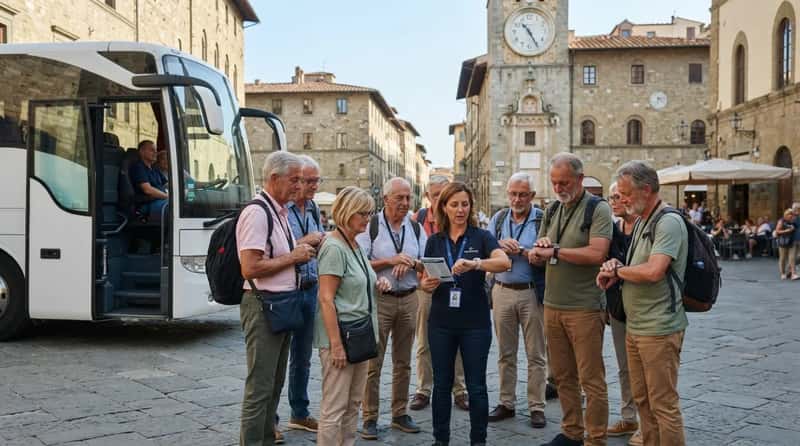
Late arrivals in a group don’t just inconvenience one person – they tax everyone’s patience and compress the whole day’s schedule.
The dirtiest secret of group travel is that one chronically late member can steal hours from every other person on the trip. Experienced travellers address this directly and early, not passive-aggressively after the third missed departure.
They set a group norm: the bus, the tour, the table – it leaves on time, and late members catch up. Reading the daily itinerary and arriving a few minutes early becomes second nature, so nobody’s ever rushing.
Some organisers use the “meet time vs. leave time” trick: the stated meeting time is ten minutes before the actual departure. It sounds patronising until the first time it saves the group from missing a ferry.
Punctuality handled – next, the smart move that determines how smoothly the group moves through airports and borders.
#10 – They Sort Out Travel Documents as a Group, Not Individually
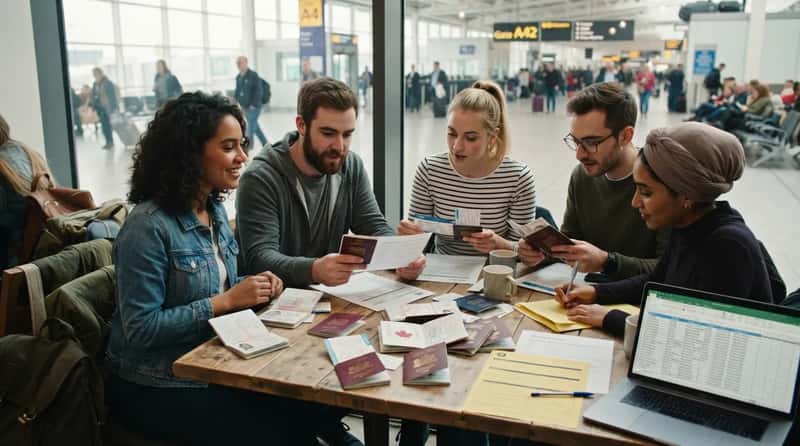
The passport that expires two weeks before departure. The visa nobody realised was required. The name mismatch on a flight booking. These are the disasters that derail group trips, and they’re entirely preventable.
Booking flights for a group is a different proposition from booking for one or two people. The more passengers involved, the more moving parts – managing everyone’s documents, coordinating payment deadlines, keeping seats together.
Seasoned organisers collect every traveller’s passport details, expiry dates, and visa requirements into a single shared document weeks – sometimes months – before departure. They confirm passport validity meets the destination’s entry rules, which often demand six months beyond the travel dates, not just validity at the time of travel.
Fast Facts
- Many destinations require passports valid at least six months beyond the return date, not just the travel dates.
- A single shared document tracking every passport number and expiry date prevents last-minute scrambles.
- Name mismatches between bookings and passports are far cheaper to fix before departure than at the check-in desk.
The fix is simple: whoever spots a mismatch first flags it directly with the airline weeks before departure, not at the gate.
Documents in order. Now for the financial safety net that first-timers almost always skip.
#9 – They All Buy Travel Insurance – and Verify It Actually Covers the Trip
Travel insurance is one of those things that feels unnecessary until the exact moment it becomes the most important thing you ever bought.
When you’re planning for one or two people, the risk of cancellation or disruption is low. When you’re planning for ten, the odds that someone gets sick, has a family emergency, or hits a serious problem climb fast, and experienced travellers treat insurance as a core budget line, not an optional extra.
The critical move first-timers miss is actually reading the policy, not just buying it. Group-specific risks – like a trip cancelled because of one member’s medical emergency – require specific coverage, and standard policies often don’t cover “cancel for any reason” or pre-existing conditions unless upgraded.
Seasoned travellers also verify the policy covers the specific activities planned. Adventure sports, water activities, and high-altitude trekking are frequently excluded from basic policies – and finding that out before departure costs nothing, while finding it out in a foreign emergency room costs everything.
Protected financially – now for the strategy that keeps the group’s energy intact once travel actually begins.
#8 – They Plan for Independent Time Within the Group Trip

Counter-intuitively, the thing that holds a group together best is deliberately scheduling time apart.
Every experienced group traveller knows the phenomenon: by day three, even the best of friends need an hour away from the group. Suppressing that need doesn’t make it go away – it just converts it into short tempers and passive friction nobody can name but everyone feels.
Experienced organisers build “free afternoons” directly into the itinerary as intentional structure, not filler. Some nap, some explore solo, some pair off in smaller combinations, and the group reunites for dinner feeling recharged instead of depleted.
Staying in local neighbourhoods beyond the city centre, taking leisurely walks, and leaving some days with nothing set in stone is what it actually means to live like a local while travelling. That breathing room is impossible in a relentlessly scheduled group itinerary.
Personal space managed – and the next habit ensures the group stays physically together when it matters most.
#7 – They Choose Accommodation That Keeps the Group in One Place

Splitting a group across two hotels sounds like a minor inconvenience. In practice, it splinters the group’s social dynamic for the entire trip.
Smaller groups of 6 to 12 people usually do best in a shared villa with a pool rather than a formal hotel room block – a setup that keeps communal energy alive instead of scattering it across floors or separate properties.
Experienced organisers confirm common spaces before signing any contract at all: private dining rooms, meeting areas, reserved terraces, group meals with set menus, even the activities calendar briefed at booking rather than left for arrival.
The private villa for mid-sized groups is genuinely underrated. A single property with a shared kitchen, living areas, and outdoor space costs less per head than equivalent hotel rooms while delivering shared meals, shared mornings – the texture of actually being somewhere together rather than just sleeping near each other.
Accommodation sorted – but how the group actually moves around on the ground is where a lot of trips quietly fall apart next.
#6 – They Pre-Book Group Transportation Instead of Figuring It Out on Arrival

The group of twelve standing outside an airport at midnight, arguing about how many taxis they need, is a tableau as old as group travel itself – and entirely avoidable.
One of the biggest mistakes in group travel is waiting too long to book transportation. This leads to limited vehicle options, higher prices, or logistical headaches like not having enough space, so experienced travellers lock in transfers at the same time as flights and hotels.
Giving a transport provider a complete itinerary helps them plan the most efficient route and keep the day on track. Even the best plan falls apart if passengers don’t know where to be, so making sure everyone has the information is non-negotiable.
For larger groups, a dedicated charter vehicle is almost always cheaper per head than the equivalent in taxis or ride-shares, and it keeps the group together – which has its own logistical and social value. Every time the group splits into multiple vehicles, the odds of someone getting lost, delayed, or separated go up.
Ground transport locked in – now for the booking strategy that determines how much the whole trip actually costs per person.
#5 – They Actively Pursue Group Rates Rather Than Assuming They Don’t Qualify

Most travellers assume group rates are only for corporate events or tour operators with hundreds of people. That assumption is costing them real money.
Group rates for accommodation, transportation, and activities can reduce individual expenses by 20 to 40% – a range wide enough to meaningfully change what a trip costs or includes. But those rates don’t appear automatically; you have to ask.
Worth Knowing
- Airline group bookings typically require at least 10 passengers and can be secured up to 11 months in advance.
- Locked-in group fares protect against price spikes but don’t benefit from later sale pricing.
- Group discounts on accommodation and activities commonly run 20 to 40% below individual rates.
- Blocks under 10 rooms sometimes cost more than what solo travellers can find through loyalty points or flash sales.
Knowing that crossover point – when a group rate stops being the better deal – separates experienced organisers from everyone else.
Costs optimised – now for the habit that keeps the group’s social fabric intact when the trip is under stress.
#4 – They Maintain a Positive, Flexible Mindset as a Non-Negotiable Group Norm
Logistics can be planned. Flexibility has to be actively cultivated.
Regardless of who you’re travelling with, some open-mindedness is essential for a good group trip, and so is a positive mindset. Seasoned travellers know something will go wrong on every trip – a delayed flight, a closed attraction, a restaurant that can’t seat twelve – the variable isn’t whether disruption happens, but whether the group can absorb it.
It helps to introduce yourself to fellow travellers on day one and stay flexible when small changes pop up – that mindset turns hiccups into shared stories instead of shared grievances.
Veteran group travellers often talk about the strangers-turned-friends effect: the people they never expected to click with becoming genuine travel companions, some of whom they still keep in touch with years later, even trading destination ideas long after the original trip ended.
The mindset is set. The next habit is the one most first-time organisers dismiss as unnecessary – until the moment it saves the entire trip.
#3 – They Hold a Pre-Trip Meeting to Align Everyone Before Departure

The single most underused tool in group travel has nothing to do with apps or booking platforms. It’s a one-hour conversation before anyone boards a plane.
Seasoned travellers consistently recommend starting with a pre-trip meeting to get everyone on the same page early, using a shared document covering everything from the itinerary to packing lists, and staying flexible but firm – compromise is key, but the trip shouldn’t become a free-for-all.
The pre-trip meeting is where the ground rules get set without the pressure of being mid-trip. Budget expectations, daily pace, communication norms, how decisions get made when the group disagrees – all of it lands better in a living room or a video call than at 8 PM outside a restaurant where nobody can agree on where to eat.
As noted earlier, most bad group-trip experiences aren’t really about the group itself – they stem from poor planning, missed communication, and expectations nobody bothered to say out loud.
The meeting happens. Expectations are set. But the next habit is the one that actually protects the trip when something goes seriously wrong.
#2 – They Assign Roles and Distribute Responsibility Across the Group

The group trip that puts all the planning weight on one person is the group trip that ends with that person never organising a group trip again.
Experienced travellers delegate tasks early and assign roles for accommodation, meals, and transportation. When everyone has a part to play, the planning gets easier and the emotional labour – the part that actually exhausts organisers – gets shared too.
The most effective role structures divide responsibilities by domain rather than by task.
At a Glance
- Flights lead – tracks fares, seat assignments, and schedule changes.
- Accommodation lead – manages the booking, deposit, and room block details.
- Food and activities lead – handles restaurant research and reservations.
- Communications lead – keeps the shared itinerary current and answers group questions.
Nobody does everything, nobody does nothing, and the organiser’s job shifts from execution to coordination.
Group travel can either create lifelong memories or turn into a stressful nightmare, and the difference usually comes down to proper planning and clear communication. Distributing responsibility is how both of those actually work at scale.
Roles distributed. The stage is set. And the single most powerful habit that experienced group travellers never skip? It’s the one that holds everything else together – and it’s next.
#1 – They Do a Post-Trip Debrief – and Use It to Make Every Future Trip Better

Here’s the habit that separates people who occasionally travel in groups from people who do it well, repeatedly, over years: they debrief after every trip.
Most groups dissolve back into normal life the moment they land. The feedback that would make the next trip dramatically better – the restaurant booking that was chaos, the morning schedule nobody could keep, the activity half the group secretly hated – goes unvoiced, and the same mistakes repeat with the same people.
Seasoned group travellers schedule a debrief within a week of returning, while memories are still sharp. It doesn’t need to be formal – a group message thread works – but it needs to be specific: what worked, what didn’t, what to change next time.
Group trips can create lifelong memories or lifelong grudges, and the difference almost always comes down to the same predictable mistakes groups keep making trip after trip. The debrief is the mechanism that finally breaks that cycle.
The groups that build this habit end up with something rare: a repeatable system for great travel together. They’re not lucky. They’re deliberate.
The Bottom Line

Group travel doesn’t fail because of bad destinations or impossible personalities. It usually stems from poor planning, lack of communication, and unmet expectations.
The 21 habits above share a single through-line: anticipate friction before it becomes conflict. Name a decision-maker. Talk about money first. Track expenses in real time. Book early, read contracts carefully, build white space into every day. Distribute responsibility. Hold a pre-trip meeting. Debrief afterward.
None of it is complicated. All of it requires intention. Group travel bookings have climbed 50% since 2021, which means more people are attempting this and learning these lessons the hard way, trip by trip, friendship by friendship.
The travellers who keep coming back for more haven’t found some secret destination. They’ve just stopped leaving these twenty-one things to chance.
#22 – The Bonus Tip Nobody Shares

Most groups treat the number of rooms in their hotel block as fixed the moment the contract is signed. Seasoned organizers treat it as a moving target they can shrink without penalty.
The trick is to negotiate a room block with free cancellation up to about 5-7 days before arrival, plus a separate “release date” roughly 30-45 days out where you’re allowed to cut the block size with no attrition fee at all.
- Ask for the initial hold slightly above your expected headcount, not below it, so nobody gets left without a room.
- Get the release date written directly into the contract – many hotel sales managers will agree to 45-60 days out if you simply ask before signing.
- Send the whole group a hard RSVP deadline about 10 days before that release date so you’re adjusting the block based on real numbers, not guesses.
- Only the rooms still on the books after the release date count toward the attrition penalty – everything trimmed before it is free.
This single negotiating point can save a group real money the moment three or four people inevitably drop out, and it costs nothing to ask for – most first-time organizers simply never know it’s on the table.