Most people assume the toughest part of a cruise dining room shift is hauling heavy trays or memorizing a menu that changes every night. Crew members who have spoken openly about the job say the real strain sits right across the table.
Picture a packed main dining room, with a handful of waiters moving between dozens of tables while tracking allergies, birthdays, and drink orders. Some of what they put up with is small and some is jaw-dropping, and the one at the very top is not what most passengers would guess.
#22 – Showing Up in Swimwear
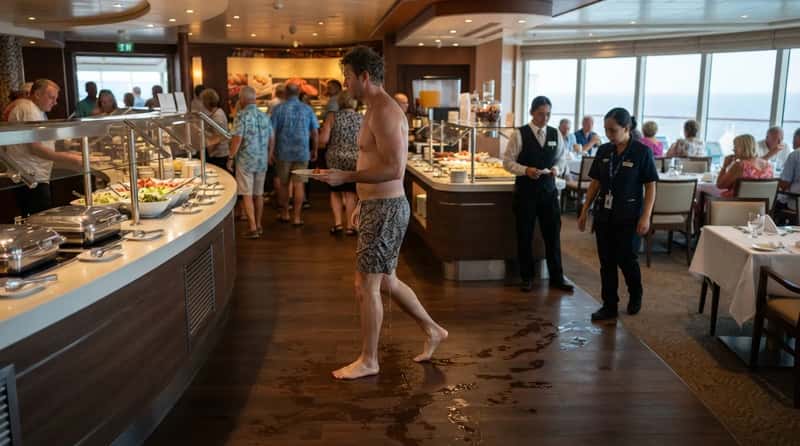
Cruise dining rooms are not extensions of the pool deck, and staff know it the moment a guest walks in still damp from the waterslide. The trouble starts with the floor.
One cruiser described watching a passenger go straight from the pool into the buffet line, dripping wet and shirtless. Wet footprints next to the pasta station mean somebody ends up quietly mopping while the room still needs to be served on schedule.
Most lines expect cover-ups, shirts, and shoes in the buffet hall, café, and specialty restaurants. Arriving in a bathrobe or strolling around barefoot lands in the same category.
That one is easy to spot from across the room. #21 is much sneakier, and it happens right at the table.
#21 – Snapping a Napkin to Shake Off Crumbs
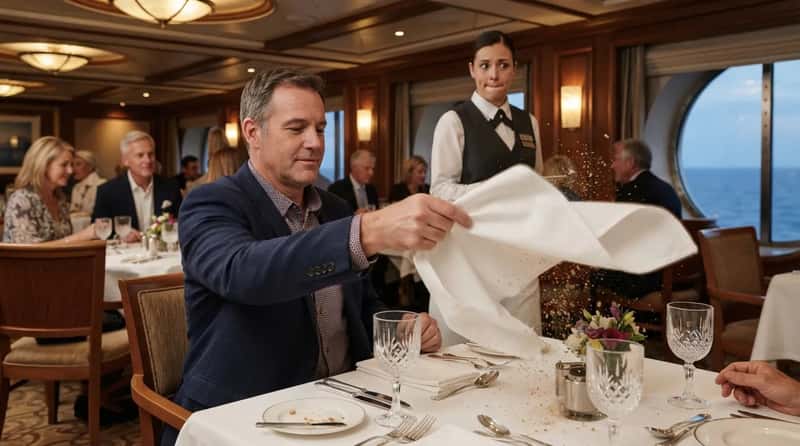
It seems like a trivial habit, but dining room staff notice it immediately and have to bite their tongues. Snapping a napkin open sends crumbs flying, and nobody wants a stranger’s crumbs near their food.
Basic etiquette says to unfold it gently and lay it on your lap. The napkin is there to protect your clothes, not to be whipped around like a towel in a locker room.
Waiters almost never say anything, because correcting a paying guest mid-meal feels awkward for everyone. Staff who see it night after night from the same guest say it tests their composure every time.
Crumbs are the small stuff. #20 involves something guests think is actually helpful.
#20 – Stacking Plates “to Help”
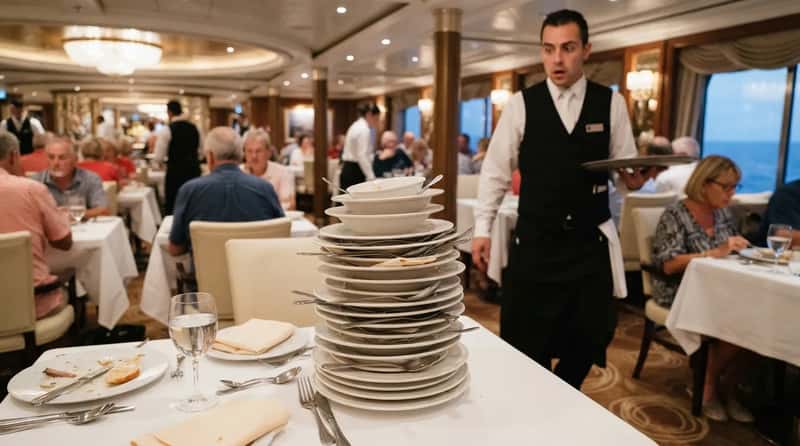
Passengers who stack their own dishes before the server arrives genuinely believe they’re being considerate. Dining room staff say it often backfires.
Crew are trained to clear plates, glasses, and cutlery in a specific way so everything travels safely. A guest’s tidy tower often has to be taken apart first, which costs precious seconds.
In a busy main dining room, those seconds add up across dozens of tables. Servers also answer to supervisors about how tables get cleared, so a disrupted routine can land on them.
Speaking of workflow, #19 is the behavior that can knock an entire section off schedule.
#19 – Arriving Significantly Late to Assigned Seating
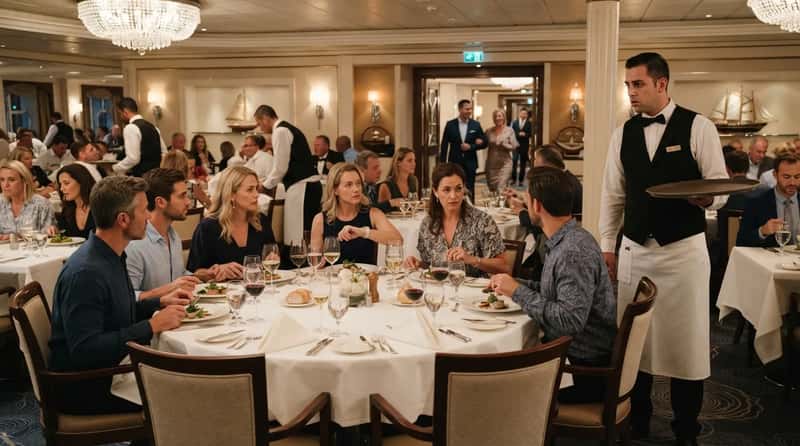
Assigned dining times exist for a reason. A late arrival doesn’t just inconvenience one table, it sends a ripple through the whole wait team.
Picture a table of eight where everyone is seated on time except one couple. The waiter holds the orders, the punctual guests sit hungry, and the server’s timeline slides backward.
When the latecomers finally arrive, that same waiter may have to rush them through their courses to stay on schedule. Nobody enjoys a hurried dinner, least of all the people who caused it without meaning to.
Late arrivals are frustrating, but #18 changes the mood of the whole dining room.
#18 – Running Speakerphone Video Calls at the Table
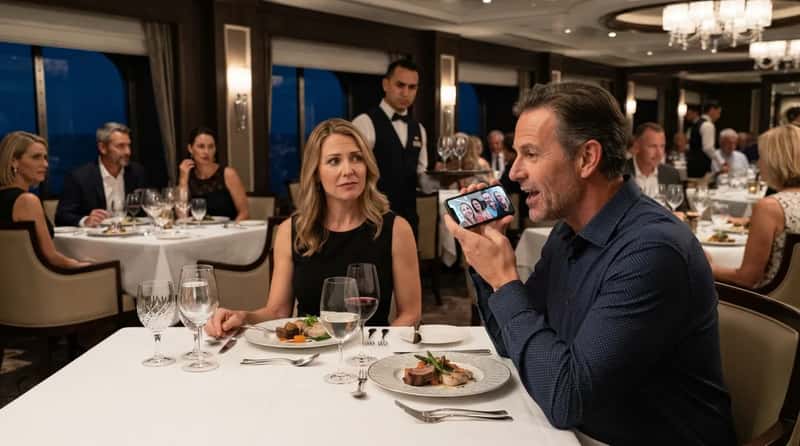
A quick call home sounds harmless. A full speakerphone video call between courses is another story.
Servers say phones at the table can turn a quiet dinner into an impromptu conference room, complete with ringtones and echoing voices. It isn’t the call itself that bothers them, it’s the volume that carries across five neighboring tables.
Those neighbors are trying to have their own anniversary dinners, after all. Stepping away for a few minutes, or using headphones, solves the problem every time.
Quick Compare
- Speakerphone at the table: voices carry to neighboring tables and interrupt their evening.
- Headphones at the table: the call stays private, though it still pulls you out of your own meal.
- Stepping away to take it: the easiest option on everyone nearby, and it takes only a few minutes.
That’s manageable compared with what #17 does to the people serving your food.
#17 – Snapping Fingers or Waving to Get Attention
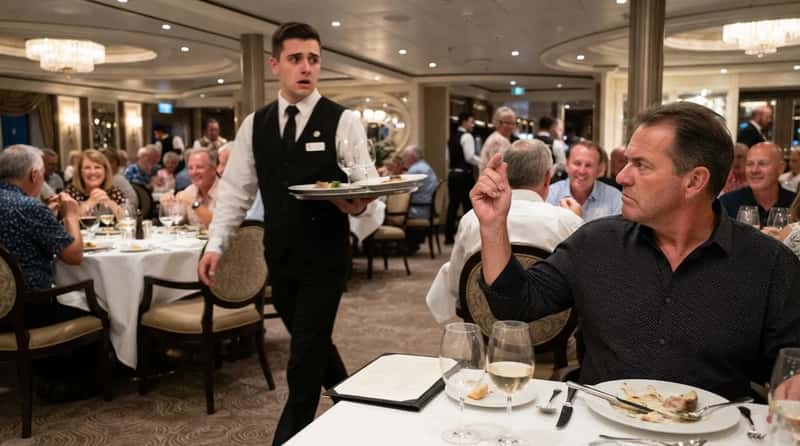
Snapping fingers or waving an arm overhead is one of the habits service workers most often describe as demeaning. It turns a professional into a prop.
By dinnertime, a server has often been on their feet for hours, tracking dozens of orders, names, and allergies at once. A finger snap ignores all of that in half a second.
Most servers will respond calmly and without comment, but the message lands. Eye contact or a simple raised hand gets attention just as fast and keeps the mood friendly.
Uncomfortable, yes. But #16 is where a single guest can sour the mood for several tables at once.
#16 – Complaining Loudly Across the Room
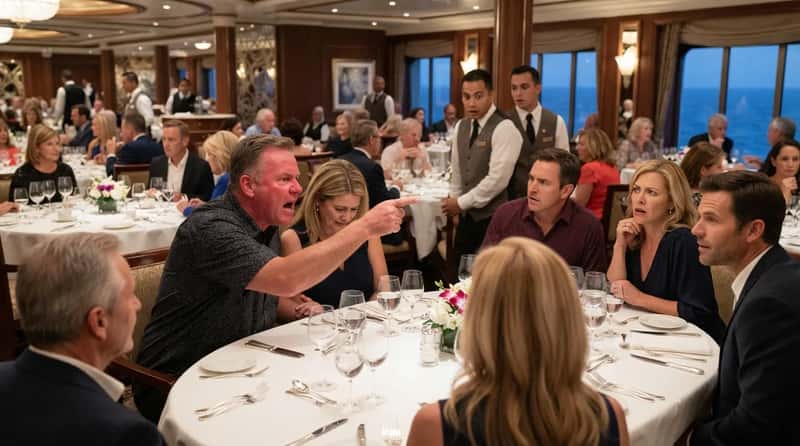
Having a problem with your meal is completely normal. How you raise it can turn one bad moment into everyone’s bad evening.
The best route is a calm word with your server or the maître d’. A loud complaint across the room lands on diners who had nothing to do with it.
Word travels fast on a ship, and a sour mood can spread from one table to three. If the problem is bigger than dinner, Guest Services is the right place to take it, and a polite tone tends to get the best results.
And if loud complaints are rough, #15 makes staff uncomfortable in a very different way.
#15 – Asking Staff Deeply Personal Questions
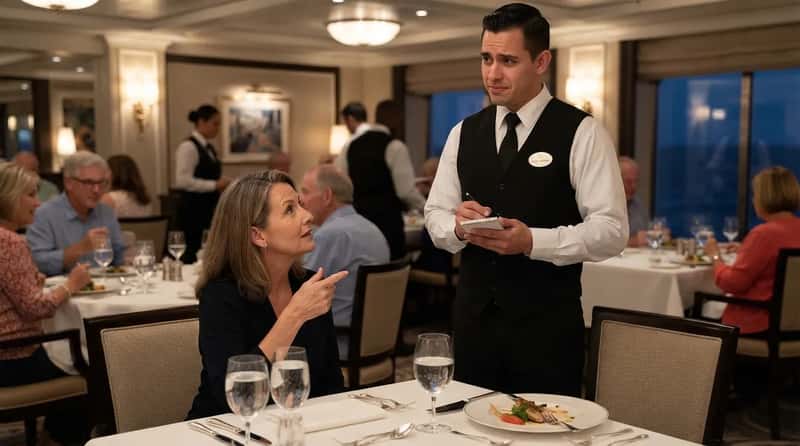
Cruise dining staff are trained to be warm and personable. Some passengers take that warmth as an open invitation to probe into private matters.
Questions about salary, whether they miss their family, or when their contract ends put staff in an impossible spot. They can’t answer honestly without risking sounding unprofessional, and they can’t dodge without seeming rude.
Many crew members work long contracts with very few days off and go months without seeing their families. Poking at exactly that reality doesn’t show empathy, it puts someone on the spot at work.
Overly personal questions are still gentler than what happens in #14.
#14 – Mocking a Waiter’s Accent
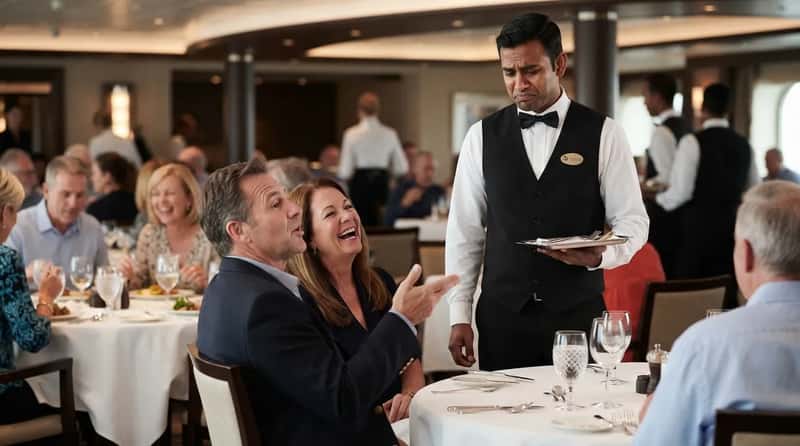
Cruise dining rooms are staffed by crew from all over the world, and this behavior crosses a line many passengers don’t realize they’re approaching.
Imitating a waiter’s accent is often disguised as a joke between courses. For many crew members, English is a second or third language, so it stings.
They have worked hard to communicate in a language that isn’t their own, and mimicry mocks that effort. No matter how friendly the intent, crew rarely find it funny.
That’s hard to watch. But #13 carries a different kind of sting, the kind that hits staff in the wallet.
#13 – Threatening to Remove Tips Over Minor Issues
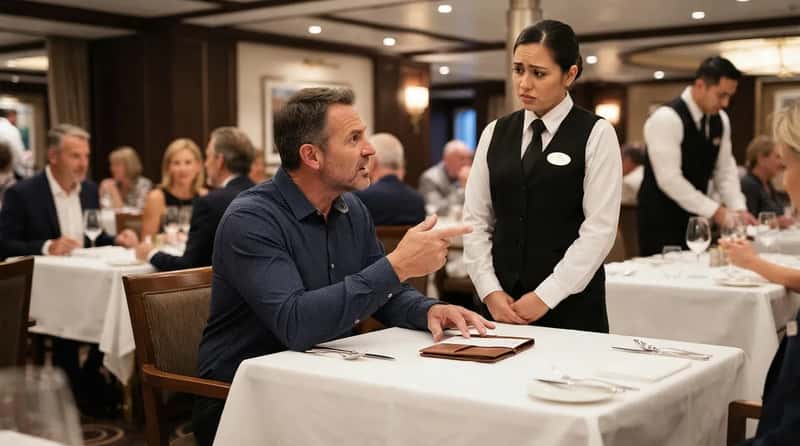
The threat to pull gratuities is one of the most common leverage plays on board, and dining staff know exactly what it signals. It often shows up over something small.
Etiquette can slip on vacation, and some passengers demand that all their tips be removed over one perceived shortcoming from one waiter or steward. But gratuities are typically shared across the service team.
That means one guest’s complaint can hit people who never met them at all. Staff who overhear the threat say the mood at that table changes for the rest of the voyage.
That one hurts. #12 causes real logistical chaos behind the scenes.
#12 – Claiming Allergies That Aren’t Real

Cruise dining staff take dietary restrictions and true food allergies extremely seriously, which is exactly why faking one is so disruptive.
When a passenger flags a severe allergy, the kitchen changes how that dish is prepared, with separate utensils, separate surfaces, and extra communication up the chain. Then the same guest happily eats the supposed allergen.
Staff have to rethink everything they assumed about that table. Real allergies deserve the full attention that fake ones drain away, which is why telling the line about genuine restrictions before sailing helps everyone.
Worth Knowing
- Tell the cruise line about genuine restrictions before you sail, not at the table.
- Repeat the details to your server on the first night so the whole team is in the loop.
- Be specific about what you can’t eat instead of using a vague label.
- If it’s a preference rather than an allergy, call it a preference. Staff are happy to work with that too.
Now #11 might surprise you, because it involves something passengers feel entitled to.
#11 – Ordering Off-Menu as If It’s Standard Practice
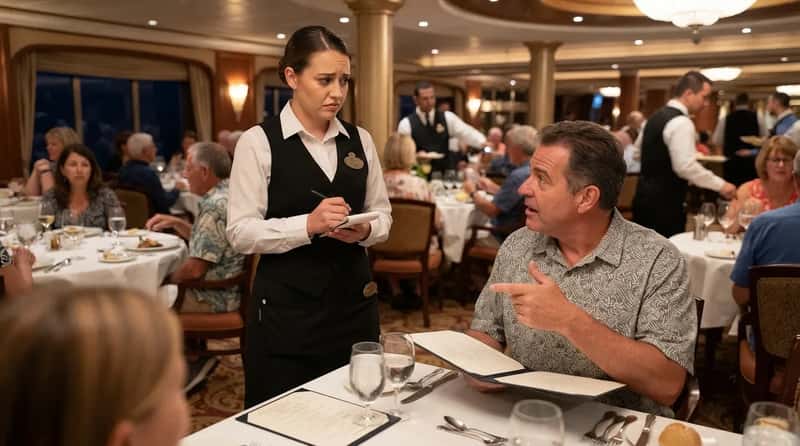
The main dining room menu changes nightly, and cruise kitchens are impressive operations. But treating the galley like a personal short-order cook is a real friction point.
There’s a big difference between a reasonable swap, like dressing on the side or a different vegetable, and demanding an entirely custom dish. The second requires extra back-and-forth with a kitchen that is already running flat out.
Waiters actually want guests to explore that menu, yet plenty stick to the same three safe dishes all week. The kindest move, staff say, is to read the menu before ordering.
That’s frustrating behind the scenes. #10 plays out right in front of the whole room.
#10 – Yelling or Cursing at Dining Staff
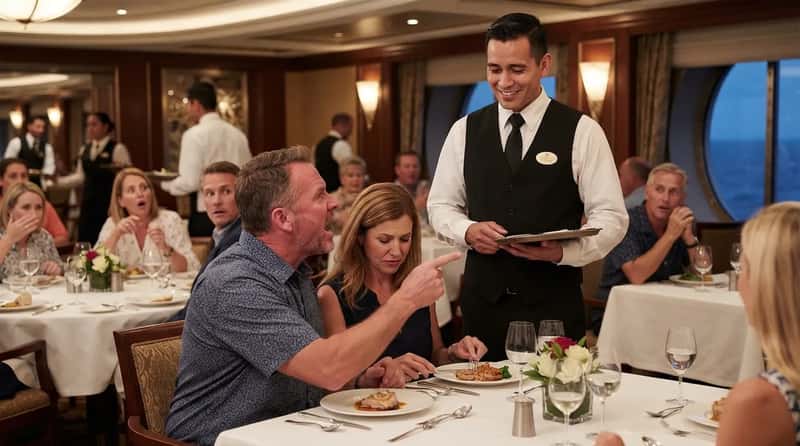
This should go without saying, but it doesn’t. Staff describe it as one of the hardest things to endure with a smile.
Passengers being rude or yelling at crew is a frequent complaint in the cruise community, even from fellow passengers. For the person on the receiving end, staying professional while being berated in public is brutal.
Staff are trained to de-escalate, smile, and move on. That doesn’t mean it doesn’t leave a mark on the rest of their shift, and on how they see that table for the rest of the voyage.
#9 involves no raised voices at all, and somehow it’s harder for staff to handle.
#9 – Ignoring the Dress Code on Formal Nights
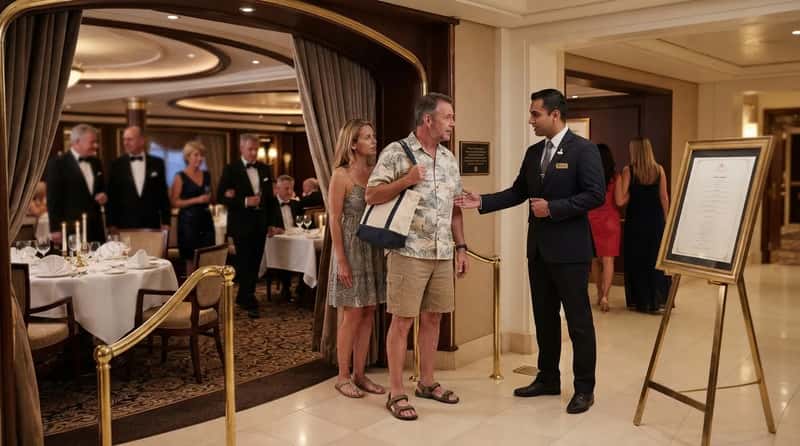
Formal nights are an event for the kitchen, the décor team, and the waitstaff who dress up too. Passengers who walk in wearing beach shorts send a message, whether they mean to or not.
Some people love dressing up for dinner, while others would rather walk the plank than put on a suit or cocktail dress. Whatever your stance, flagrantly ignoring a stated dress code lands badly in the room.
The staff have polished the silverware, adjusted the lighting, and set the mood. Where the code is enforced, it often happens at the door, which creates its own awkward standoffs.
#8 is more brazen, and staff say it turns up sailing after sailing.
#8 – Taking Dining Room Items as Souvenirs
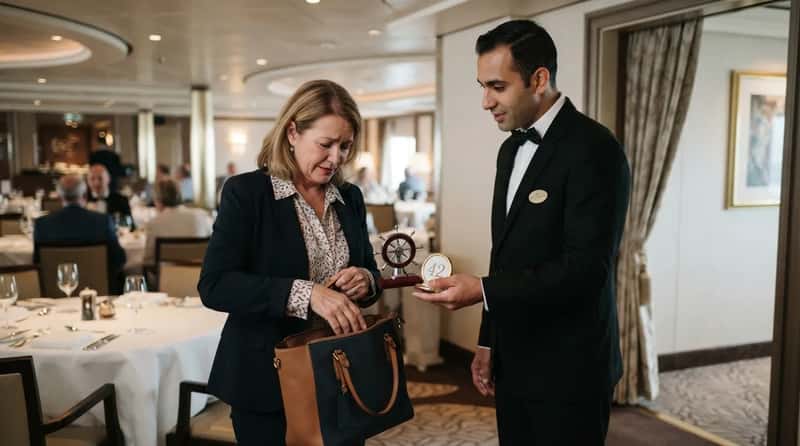
Small items have a way of quietly vanishing from dining rooms by the end of a cruise. The staff who notice are stuck in an awkward spot.
One cruiser described a guest being stopped near the exit after a maître d’ noticed something odd in her bag. He politely asked her to return the table ornament and the table number sign that had ended up in her purse.
Everything from salt shakers to decorative centerpieces can go missing. Confronting a paying guest is uncomfortable, so the usual approach is a quiet word at the exit, away from other diners.
That’s awkward enough. #7 happens in plain sight, right at the serving line.
#7 – Using the Buffet Without Hand Hygiene
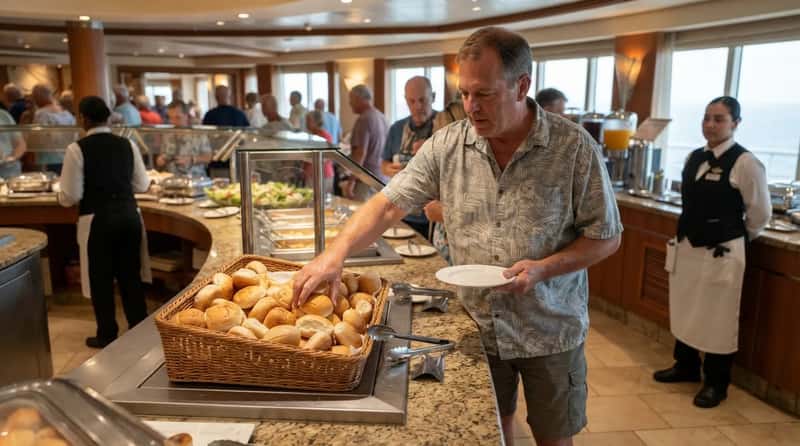
Buffet staff watch this happen constantly, and their discomfort is equal parts professional and personal. Skipping hand washing or sanitizer before eating is one of the most commonly flagged etiquette failures on ships.
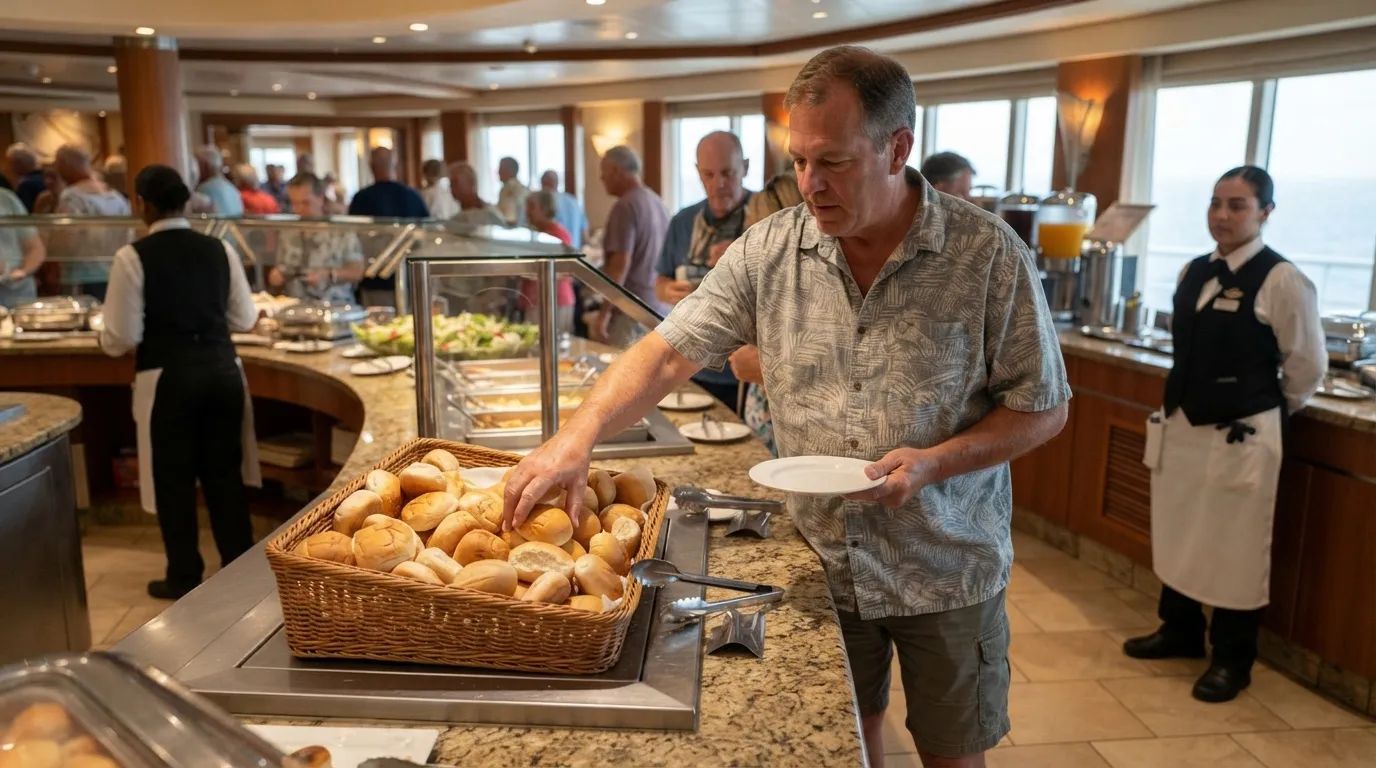
Grabbing rolls, bread, or breakfast items with bare hands instead of the provided tongs is another frequent offender. Fellow passengers are often the ones who call it out.
Staff at the stations see the full picture: the same hands that touched elevator buttons and stair rails reaching straight into shared food. They can’t always intervene without causing a scene, so they replace items, swap serving tools, and say nothing.
#6 feels completely normal to the passenger doing it, and quietly exhausting to the team behind it.
#6 – Lingering Well Past Closing Time
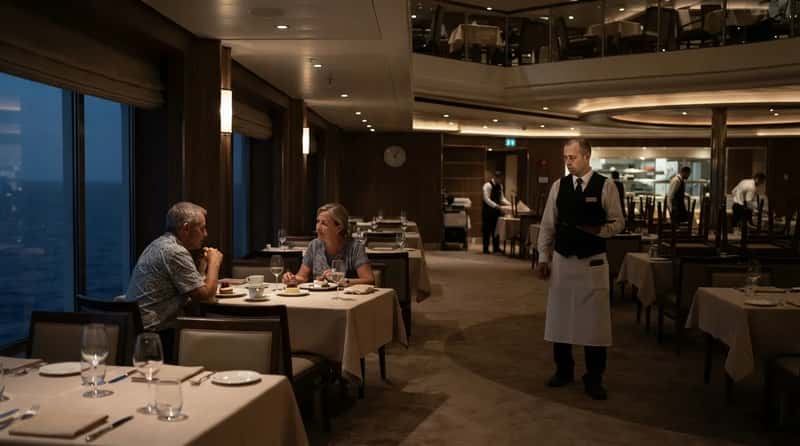
Cruise dining rooms run on tight windows, and a fresh seating or a full reset often begins the moment the previous service ends. Staff can’t clock out until the room is done.
The ‘one more coffee, one more dessert’ request at closing time is one of the habits servers find hardest to manage without showing frustration. Each extra round pushes back everything else on their list.
Guests who treat the room like a private lounge extend the working day of everyone on that floor. They rarely realize it, because the staff keep smiling.
Nearly there. #5 through #1 are the behaviors staff find hardest of all to watch, so brace yourself.
#5 – Overloading a Plate and Leaving Most of It
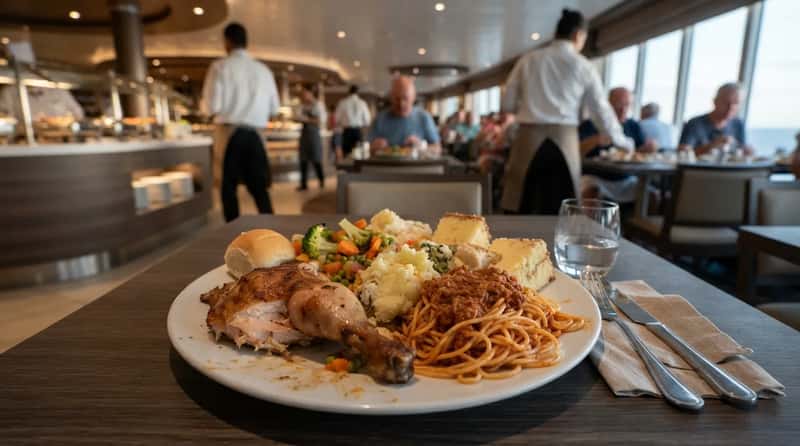
All-inclusive dining is a genuine luxury. Piling a plate high and then leaving most of it untouched is something staff see far too often.
Some passengers treat all-you-can-eat like a challenge to build the Leaning Tower of Pisa. Loading more than you can finish is wasteful, and it can leave other guests waiting for a refill.
Staff replenishing the stations have to guess how fast trays will empty. And the mountains of leftovers end up in the hands of the servers who clear them.
At a Glance
- Start with small portions. Second trips are part of the deal.
- Sample unfamiliar dishes in a bite or two before committing.
- Take only what you plan to finish, so the next guest finds a full tray.
- Grab a clean plate for each trip.
The waste stings, but #4 is the one that worries food safety teams.
#4 – Reusing a Plate at the Buffet
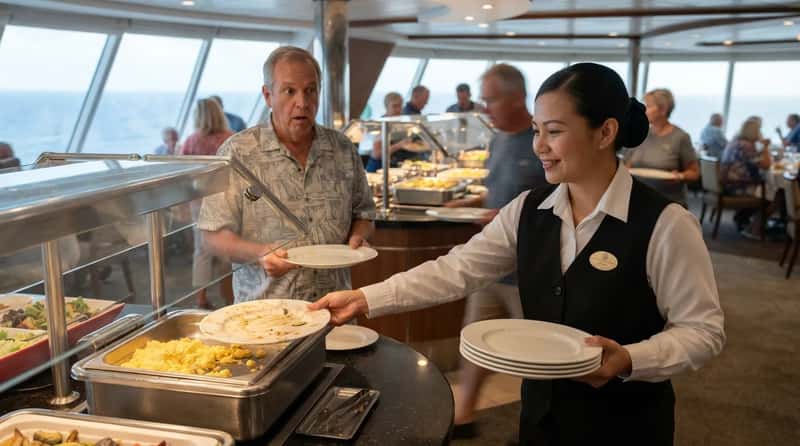
It looks like a minor shortcut. To staff protecting food safety on a ship with thousands of guests, it’s a real hygiene concern.
A used plate carries residue and bacteria, and taking it back to a shared food line risks cross-contamination. That’s why guests are expected to grab a fresh plate every trip.
Buffet staff who spot it face a choice between an awkward moment and a bypassed protocol. Most smile and quietly hand over a clean plate.
Three to go, and these are the ones that stick with staff long after the ship has docked.
#3 – Skipping Out on Tips on the Final Night
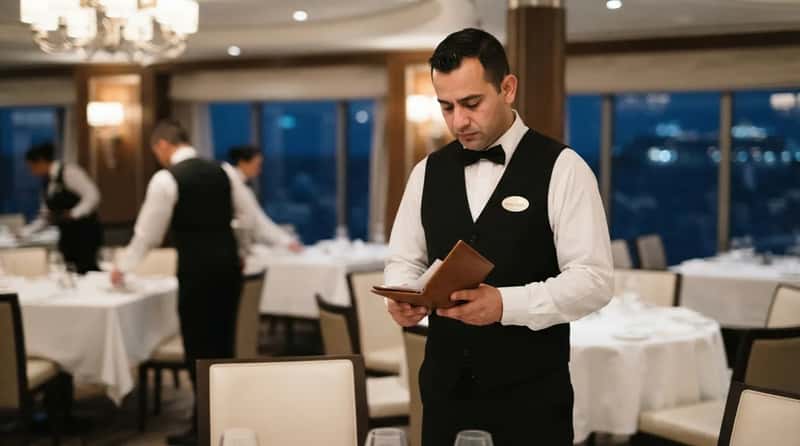
This one comes with a well-known tactic, and dining staff have seen versions of it many times. Cruisers have talked online about ordering room service on the final night to sidestep tipping in the dining room.
It lands directly on the workers who spent a whole voyage learning a guest’s preferences and going out of their way to meet them. On many modern ships, automatic gratuity charges make this harder to pull off.
Passengers who go to the front desk on the final day to remove those charges send an even clearer message. Staff who delivered a week of personal service feel it plainly.
Only two left. #2 is the one staff are least likely to forget.
#2 – Using the Cloth Napkin as a Tissue
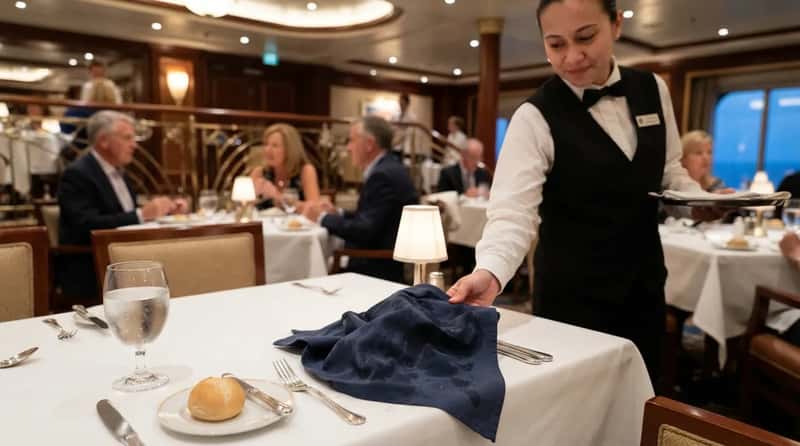
This one earns its spot near the top for a reason, and it’s exactly as unpleasant as it sounds. Staff have to handle the aftermath without drawing any attention to it.
Blowing your nose in a cloth napkin is a clear breach of etiquette, and it spreads germs. The napkin then travels from table to server to laundry, a chain of contact that starts with one thoughtless moment.
Removing it without letting the guest or neighboring tables notice is one of the quietly demanding skills of the job. A quick request for a tissue would spare everyone.
And now the behavior at the top: no raised voice, no broken rule, and somehow the hardest of all to watch.
#1 – Treating Dining Staff as Invisible
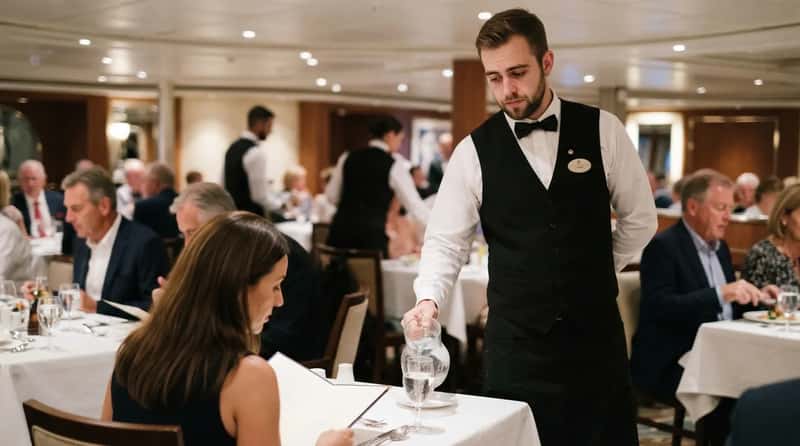
No raised voice, no broken rule. Just a sustained refusal to acknowledge that the person refilling your water, clearing your plate, and remembering your preferences every night is a human being.
Crew members are often far from home for months at a time. The small human exchange at the table can be one of the few warm moments in a very long shift.
Passengers are often asked how their day is going, and returning the favor can make a real difference. Ask about their day, whether they got off in port, or where they’re from.
Guests who never return that basic exchange across a full sailing are the ones dining staff remember longest, and not fondly.
The Bottom Line
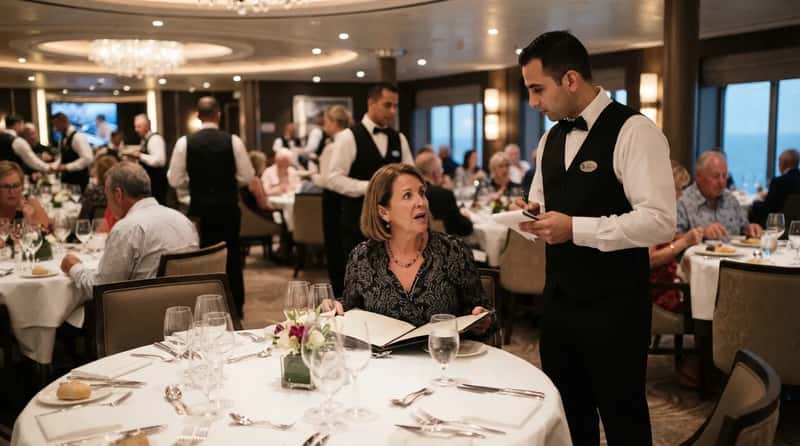
Most passengers assume the drama on a cruise lives at the pool or in the buffet line. The real friction sits at the table, where harmless-looking habits can quietly wreck a server’s whole rotation.
Fast Facts
- 22 behaviors made the list, from swimwear at the door to the invisible-guest problem at #1.
- Four are about noise or getting attention: #18, #17, #16, and #10.
- Three are about hygiene: #7, #4, and #2.
- Two are about tipping: #13 and #3.
From finger snaps and dress code dodging to the quiet offense of treating staff like background furniture, these 22 behaviors share one thread. Most guests have no idea they’re doing them.
The fix is almost always simple: slow down, look up, and treat the person serving your dinner like the professional they are. Learn a name on night one, and the next six dinners feel different for both sides of the tray.
Bonus: The Night-One Reset Dining Crews Wish Every Guest Knew
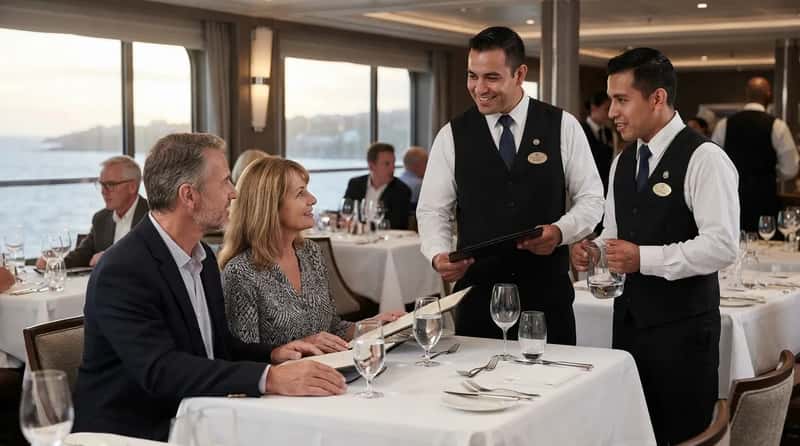
The single best move happens before you order a thing on the first night. Spend about two minutes setting the tone with your table team, and the rest of the voyage runs smoother for everyone.
- Read the name tags. Greet both your waiter and your assistant waiter by name, since both work your table all week.
- Give one useful preference. Mention how you like your drinks, your pace of dinner, or a dietary need, so they can plan instead of guess.
- Ask one easy question. Try “What’s the dish the kitchen does best tonight?” It invites them to share their expertise, and it usually leads you to a better meal than the safe choice.
If you have a real problem with your table, such as noise, timing, or seating, speak to the maître d’ early on embarkation day or the first evening. Fixes are far easier before the dining room settles into its routine, and a calm, polite request gets the best response.
Then close the loop at the end of the cruise. Many lines let you name crew members you appreciated on a comment card or survey, and a specific thank-you with a name attached means more than a generic score.