Most guests think a hotel breakfast runs on eggs, coffee, and a good waffle iron. Behind the counter, it runs on something else: a quiet mental list of guest habits that make the staff wince. Some cost real money, some collide with food-safety rules, and a few are just brutal at 6:45 a.m.
This list draws on food-safety guidance and the complaints hospitality workers repeat again and again. A few entries will make you laugh. One or two may change how you walk up to the buffet, and the habit at #1 has nothing to do with manners.
#23 – The Plate Piled High and Abandoned
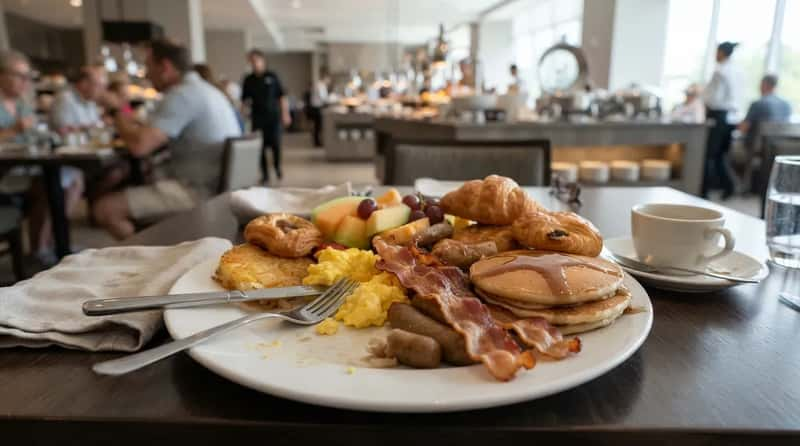
The most common buffet habit is also the quietest: a heaping plate that comes back nearly untouched. The USDA estimates that 30 to 40 percent of the U.S. food supply goes uneaten, and a buffet is where that number becomes visible. Eyes get bigger than stomachs when everything is within arm’s reach.
Once food lands on a guest’s plate, it can never return to the line. It goes straight into the bin. Staff watch those full plates arrive at the dish room and do the math on everything being thrown out.
That’s the quiet waste. The next habit is far more brazen, and it involves a bag…
#22 – The Pocket Picnic That Staff Spot From Across the Room
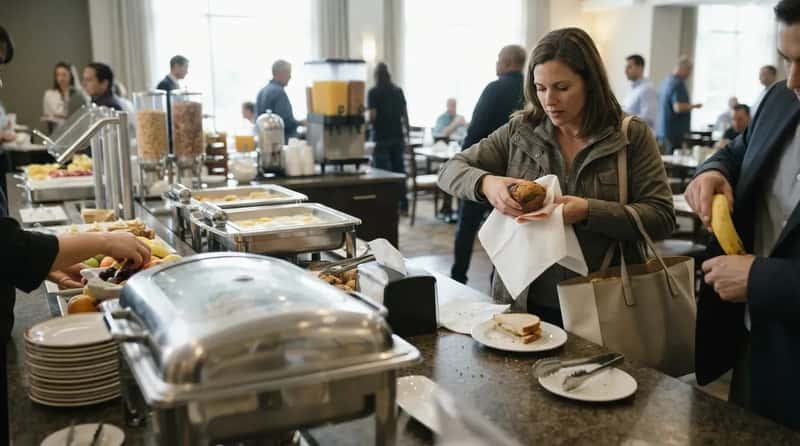
Some guests treat the buffet like a free grocery run. Staff notice the napkin-wrapped muffins, the three bananas “for later,” and the sandwich quietly assembled from the cold cuts. It looks far more obvious from behind the counter than it feels from the line.
Policies vary by property. Many hotels shrug at one piece of fruit or a coffee for the road. A full takeaway lunch is where the goodwill ends, and some properties respond by moving items behind a staffed counter or switching to pre-portioned servings. That slower, more controlled setup is often the direct result of a few guests pushing their luck.
Quick Compare
- Usually fine: one piece of fruit or a coffee for the road
- Pushing it: a stash of muffins wrapped in napkins
- Where goodwill ends: a lunch built from the cold cuts
Now move down the line, because the next station has a hygiene problem…
#21 – Bare Fingers on the Pastry Tray
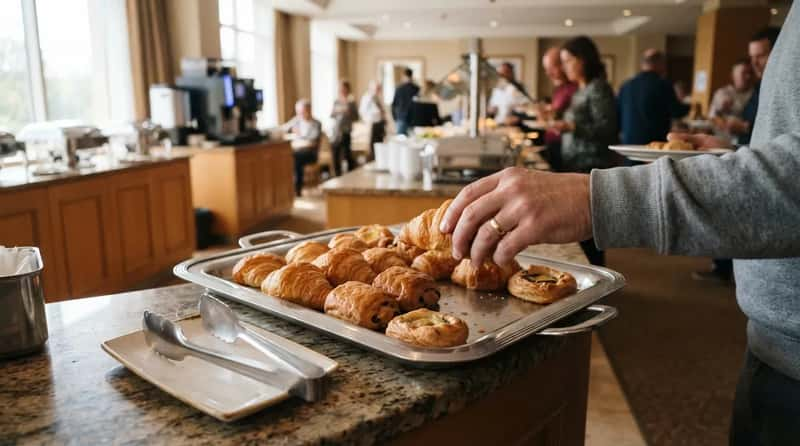
Tongs sit right there, and plenty of guests still reach in with their hands. Food-safety experts stress that ready-to-eat items like pastries and fruit are exactly where germs travel. Food workers are trained to avoid bare-hand contact, and guests are expected to use the utensils provided.
The CDC lists norovirus as a leading cause of foodborne illness in the U.S., and it spreads easily on contaminated hands and surfaces. One poke at a croissant can mean the whole tray gets pulled. Staff then have to explain to the next guest why the pile suddenly looks so small.
Tongs are one thing. The utensil crime at #20 is worse…
#20 – The Taste Test Straight From the Serving Spoon
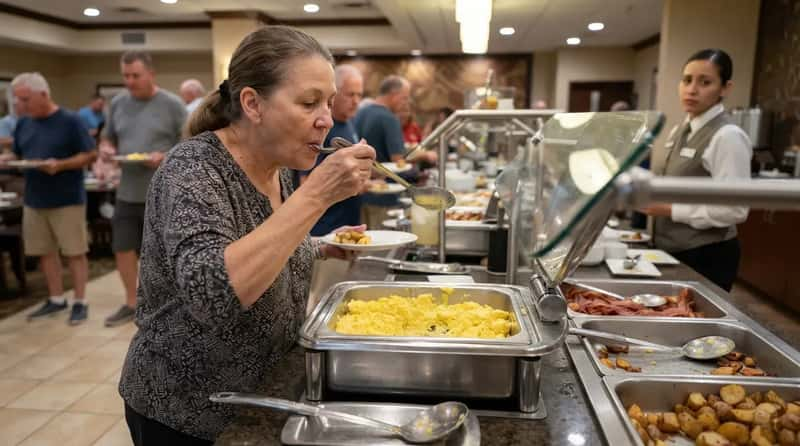
A quick lick of the serving spoon feels harmless in the moment. Then the spoon goes right back into the pan everyone else is eating from. Servers describe watching this happen in real time, with no polite way to stop it.
Sneeze guards and long-handled utensils exist because shared food is a shared risk. Staff are trained to swap out any utensil that touches a mouth, a plate rim, or the floor. That means more trips to the dish room and more trays lost mid-rush.
The next habit is one almost every guest has done at least once…
#19 – Going Back for Seconds With the Same Dirty Plate
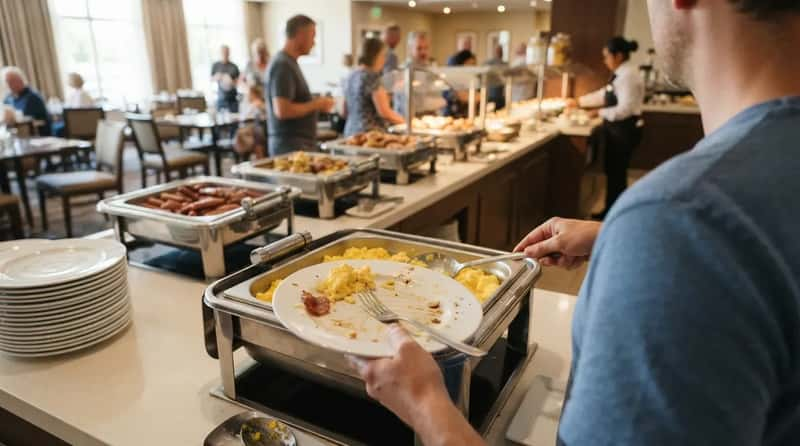
A guest finishes round one, then walks straight back to the line with the same plate. Health departments in many places expect a clean plate for each trip, which is why you’ll often see a small sign asking for one.
Leftover eggs, sauces, and fork-touched bites end up inches from shared spoons and tongs. A used plate is one of the easiest ways for a guest’s germs to hitch a ride onto the serving line. The fix is free, since clean plates are stacked right at the start.
From here, the friction moves off the buffet line and into the room itself…
#18 – The Group That Builds Its Own Banquet Hall
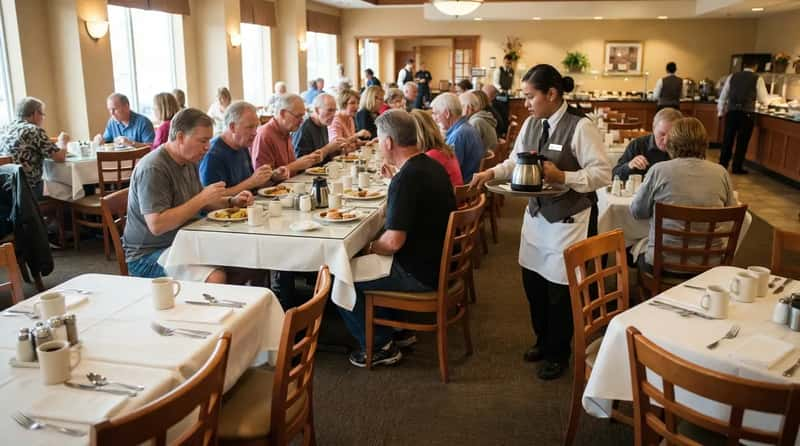
Eleven people arrive, and suddenly four tables are pushed together across a walkway. It feels like a small thing. Hotel dining teams planned that room carefully, down to where a server can carry a hot coffee pot without a collision.
ADA standards generally call for accessible routes at least 36 inches wide, and a shoved-together table can shrink that fast. Guests using wheelchairs, walkers, or strollers are the ones who get blocked. Staff end up resetting the whole room after the group leaves.
Worth Knowing
- The usual minimum clear width for an accessible route is 36 inches.
- Narrower pinch points of 32 inches are allowed only for short stretches.
- Pushed-together tables can eat that space in seconds.
- Servers carrying hot coffee need a clear lane too.
The next scene sounds minor, but it can bring a whole line to a halt…
#17 – The 14-Ingredient Omelet Order During the Rush
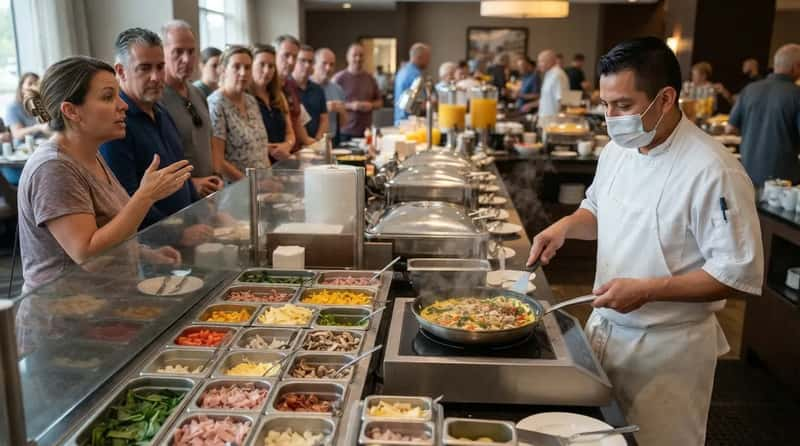
Here’s an opinion that gets cooks nodding: the omelet station is one of the most overrated parts of the whole buffet. Ask any cook and they’ll tell you it’s the slowest item on the line. One guest asking for egg whites, no cheese, extra spinach, and everything else on the side holds up fifteen people behind them.
A line of hungry guests can stretch past the station in minutes, and the cook can only work one pan at a time. Everyone behind that order watches their coffee cool. Those guests don’t blame the person with the 14 requests. They blame the hotel.
Speaking of stations, the next one has a sizzling problem…
#16 – Walking Off From the Waffle Iron
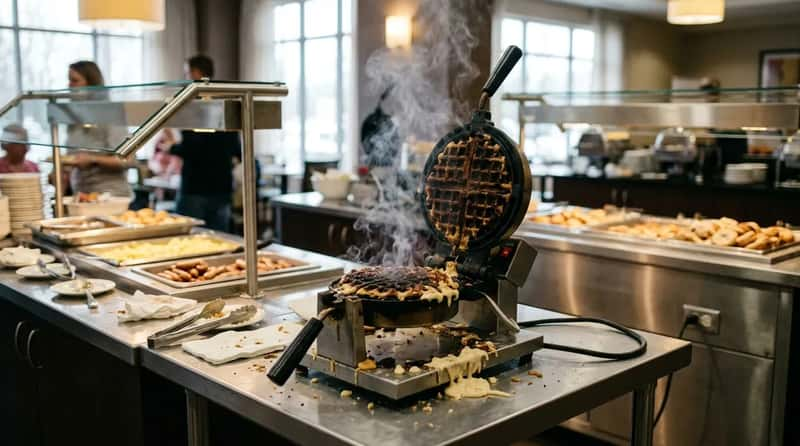
The waffle maker is the star of many buffets. It’s also the item guests abandon most often mid-cook. Batter overflows, sugar caramelizes, and the next guest inherits a sticky, burnt mess.
Burnt toast has long been a classic smoke-alarm trigger, and a scorched waffle can do the same. A forgotten waffle can clear a corner of the room with smoke. Staff then scrape the iron clean and reset the whole station.
The next offender is far more caffeinated…
#15 – Filling Three Travel Mugs Off the Coffee Urn
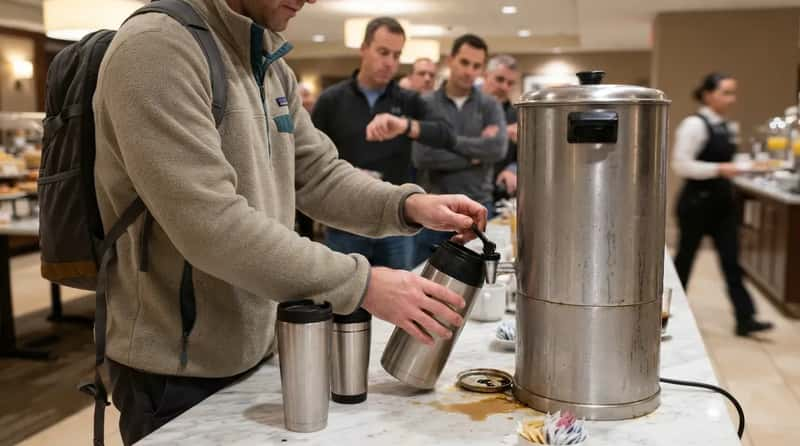
Hotels expect guests to grab a coffee for the car. Some guests arrive with a thermos, two tumblers, and a plan to fill them all. When the urn runs dry at peak hour, staff have to rebrew while a line of caffeine-starved guests glares at the counter.
It’s a safety issue too. A hot urn is no place for a rushed, overfilled cup. Burns and spills are exactly what staff try to prevent at a crowded station.
The clock matters at breakfast, and the next habit is all about timing…
#14 – Strolling In Five Minutes Before Close
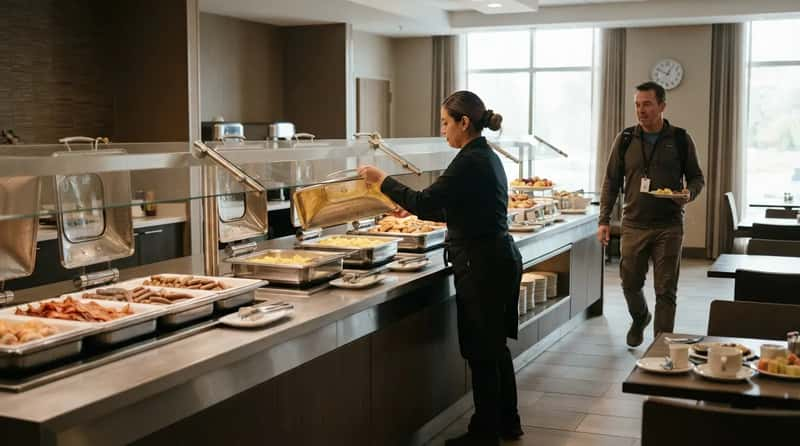
Breakfast ends at 10:00 a.m., and guests walk in at 9:55 expecting the full spread. Staff have already started pulling trays. The line looks stocked, but a lot of that food is on a countdown.
The USDA says perishable food shouldn’t sit out for more than two hours, or one hour above 90°F. A tray that’s been out too long has to be tossed, no matter how full it looks. That’s why a thinning buffet isn’t the staff being lazy.
Fast Facts
- 2 hours: the USDA’s limit for perishable food left out at room temperature
- 1 hour: the limit once it’s above 90°F
- 135°F: the FDA Food Code minimum for holding hot food
- 41°F: the FDA Food Code maximum for holding cold food
And there’s another habit that quietly puts people at risk, especially one group of guests…
#13 – Swapping Serving Spoons Between Dishes
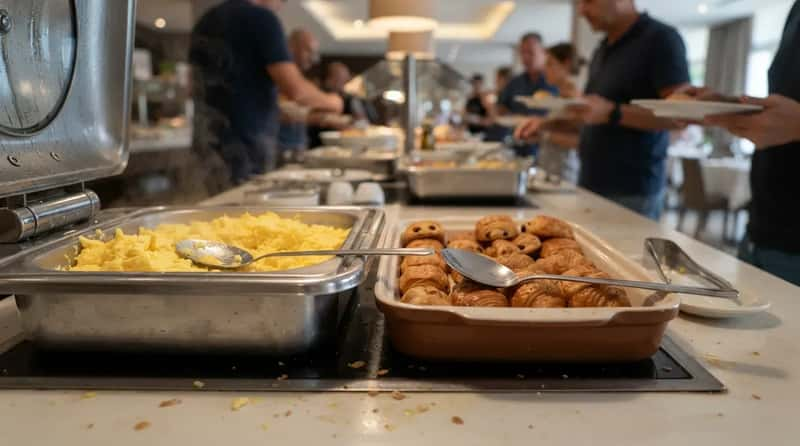
It’s easy to grab the nearest spoon and use it on the next tray. That’s a bigger deal than it looks. Sesame became the ninth major U.S. food allergen as of 2023, and FARE says more than 33 million Americans live with food allergies.
A spoon that moves from the scrambled eggs to the pastry tray can carry trace allergens with it. Cross-contact is one of the biggest invisible hazards on a shared buffet line. Staff try to keep one utensil per dish, but a busy morning makes that nearly impossible to enforce.
Next up is a scene that gives staff a very different kind of stress…
#12 – Sending Small Kids Down the Buffet Alone
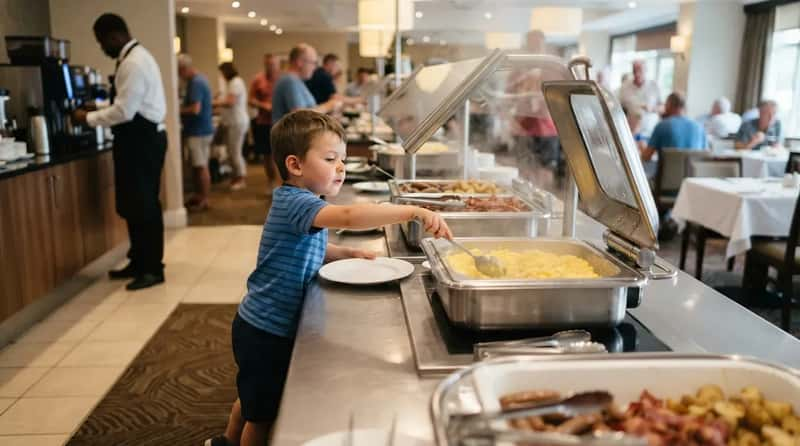
A seven-year-old at a hot buffet is a different story from a seven-year-old at home. There are steam trays, hot waffle irons, slippery floors, and a long reach for a high shelf. Staff see near-misses nearly every weekend.
It’s not about blaming kids. Hot surfaces and fast-moving carts are a bad mix for children without an adult nearby. Dining teams would gladly trade their “no kids at the stations” signs for a little shared supervision.
The next habit starts a debate that gets heated fast…
#11 – Skipping the Tip Because “It’s a Buffet”
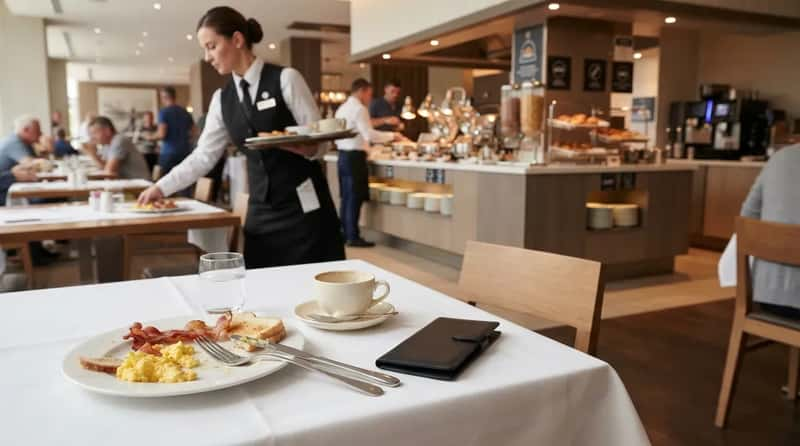
Here’s a debate sure to start an argument at any table. Many guests assume a buffet means no service, so no tip. Etiquette guides often suggest a smaller gratuity, commonly cited around 10 percent, since staff still clear plates and refill drinks.
Others argue the hotel should pay for service already. Both views have a point. The federal minimum cash wage for tipped workers has been stuck at $2.13 an hour since 1991. Whether a given breakfast server falls into that group depends on the job.
Money is also behind the next myth, and it’s a big one…
#10 – Believing the “Free” Breakfast Is Actually Free
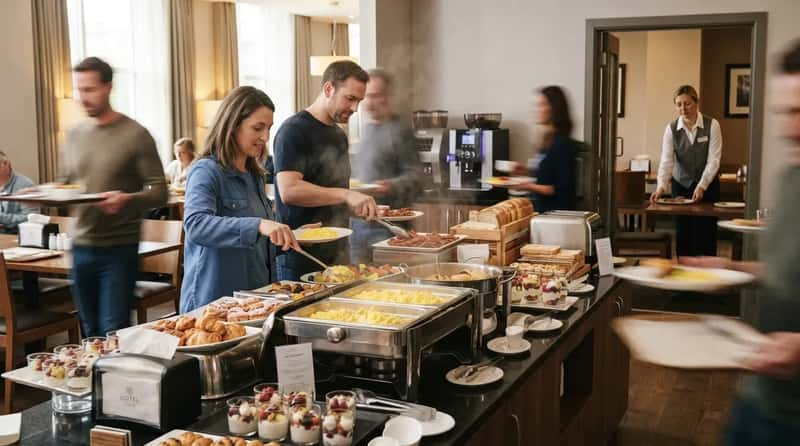
Hotel pricing experts point out that included breakfast is almost always baked into the room rate. It’s a perk with a cost behind it. When guests treat it as unlimited, it’s the staff who absorb the frustration.
The price is built in somewhere, whether in the nightly rate or a bundled fee. A federal rule on hidden fees took effect in May 2025 and covers short-term lodging, which has put total pricing under the spotlight. Free usually means “already paid for.”
The next habit is one that insiders say sneaks up on them…
#9 – Sneaking Extra Friends Into the Breakfast Room

A guest checks in, then brings along three relatives who don’t have a room. They slide into the dining area, grab plates, and nobody asks questions. Until somebody does.
Many hotels check room numbers or wristbands for a reason: included breakfast is priced for registered guests, not walk-ins. Staff have to either confront the uninvited, which is awkward, or eat the cost. Neither outcome makes the morning smoother.
Now for what staff find once the guests have gone…
#8 – Trash Hidden in Napkins, Teacups, and Saucers
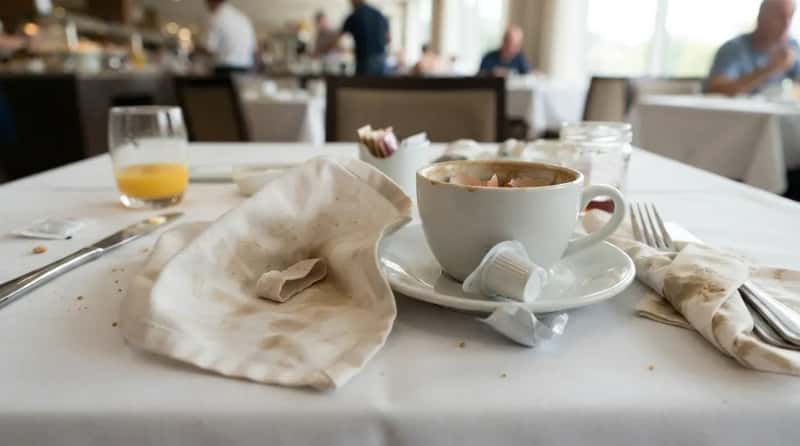
Staff clear tables and find eggshells inside coffee cups. They find used creamer packets tucked under plates and gum wrapped in a napkin. The shock isn’t the mess, it’s how creative the hiding spots get.
Wrapped-up silverware is a familiar hospitality headache. Cutlery tossed out with the napkin can vanish into the garbage bag. Replacing it adds up over a busy season.
The next scene is one almost nobody expects to see at a breakfast table…
#7 – Showing Up Barefoot or Dripping From the Pool

A guest strolls in with a wet swimsuit and bare feet straight from the pool. It’s a quick breakfast, they figure. Meanwhile the floor under the omelet station turns into a slip hazard.
“No shirt, no shoes” is typically a house policy, not a federal law. Wet floors are one of the most common causes of falls in any dining room. Staff would happily skip the sign if guests simply dried off first.
Wet floors are one thing. The next habit involves a whole camera crew of one…
#6 – Staging a Photo Shoot Mid-Line
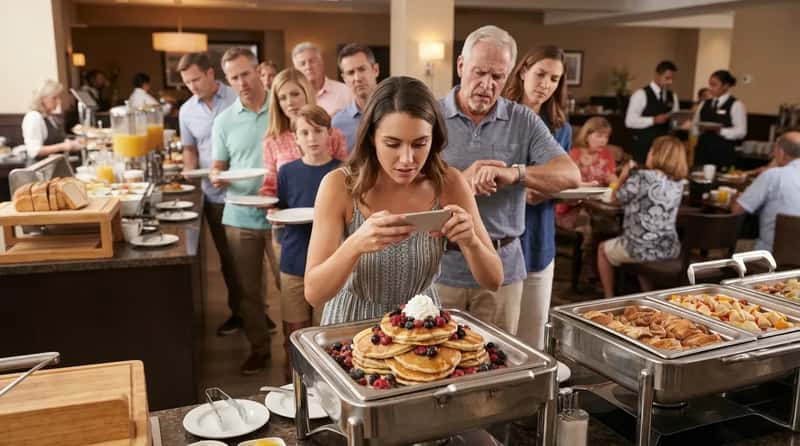
Hotels love a tagged breakfast post. They don’t love the person stopped in front of the pancake tower for a ninth angle. Meanwhile ten guests wait behind them with their plates going cold.
It’s a small habit with a visible effect on the room. One person’s photo session can freeze an entire line. Staff would gladly pose the food themselves if guests simply stepped aside for the shot.
The next habit is the one that makes food-safety people cringe…
#5 – Leaving the Chafing Dish Lids Wide Open
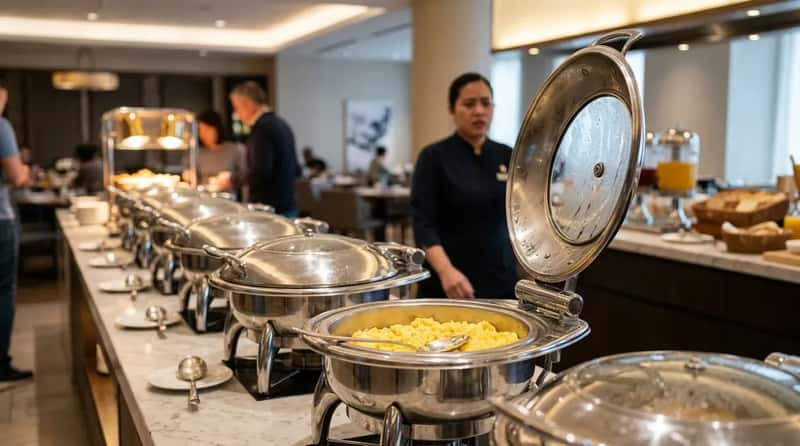
A guest lifts a lid, takes a scoop, and leaves it tilted. Then the next guest does the same. Before long, the whole tray is losing heat.
The FDA Food Code says hot food should be held at 135°F or above. A lid left open can turn a safe tray into a lukewarm one. Staff have to monitor temperatures constantly, and an open lid makes that job harder.
Only four left, and the next one may be the biggest tray-killer of all…
#4 – Putting Food Back After Touching It
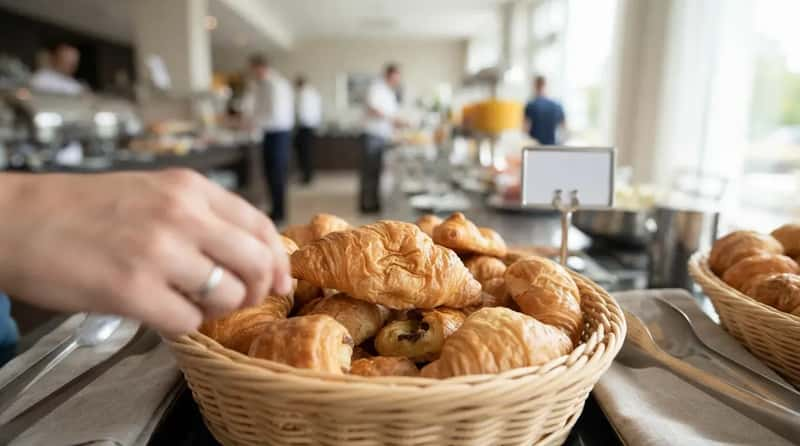
A guest picks up a croissant, squeezes it, then sets it back down. It looks small. It’s one of the biggest no-nos in any buffet kitchen.
Under the FDA Food Code, food that has been served to a customer generally can’t be offered to anyone else. Staff may have to discard the entire pile if they see it happen. That’s why they watch the pastry basket like hawks.
Why It Stands Out
- Pastries are ready to eat, so no cooking step cancels out a touch.
- Staff can’t tell whose hands were clean.
- Nobody can tell which croissant got squeezed, so the whole pile may go.
- One moment of curiosity can empty a full basket.
The next one isn’t about food at all, but it stings…
#3 – Skipping the Fix and Going Straight to the One-Star Review
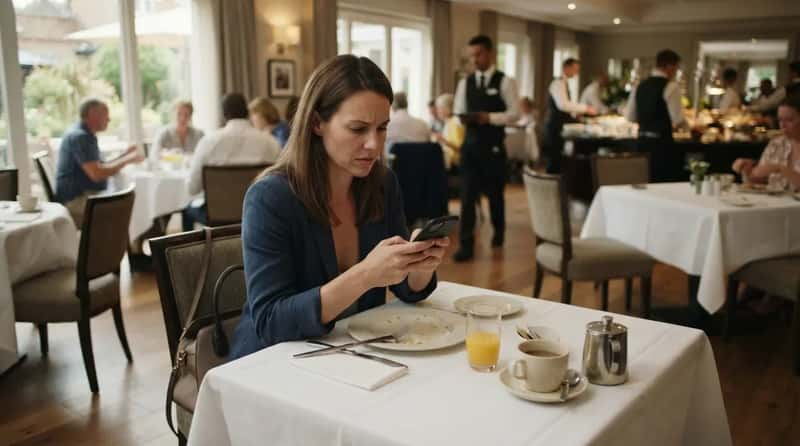
A four-minute problem becomes a permanent review. The coffee is cold, the eggs ran out, a table wasn’t cleared. The guest says nothing at the time and posts online an hour later.
Reviews matter, and staff know it. The manager on duty can often solve a cold-coffee problem before the toast pops. Dining teams say they’d much rather hear “excuse me” than read about it later.
The next entry is the one hospitality workers say they carry home with them…
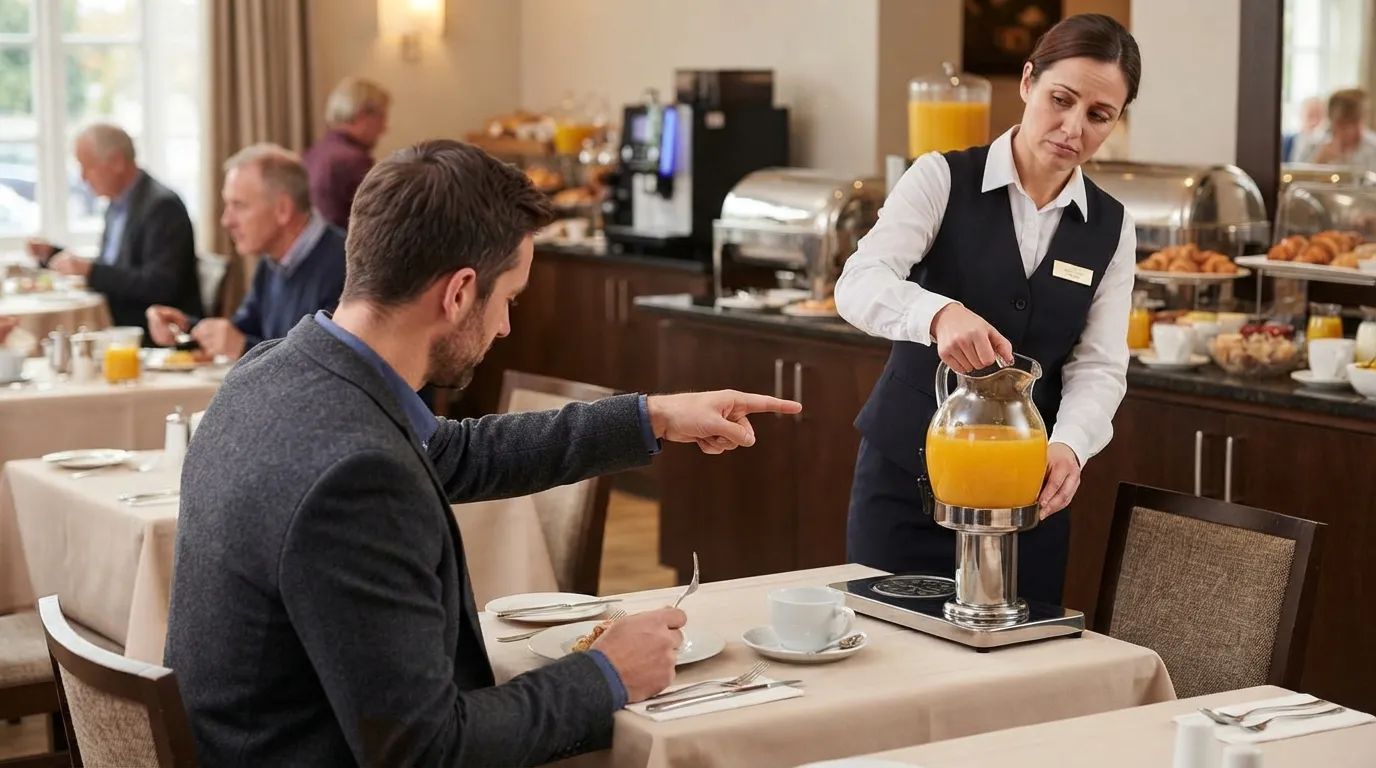
#2 – Treating the Staff Like Furniture
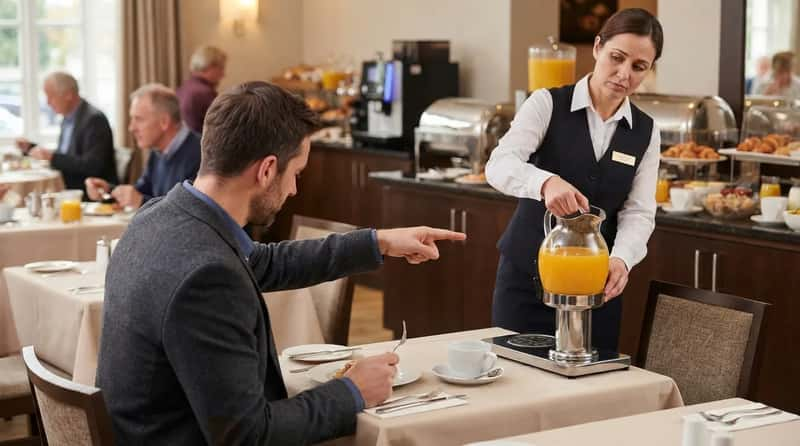
Snapping fingers. Talking over someone mid-sentence. Pointing at an empty cup without looking up. Hospitality workers say this is the habit that sticks with them the longest.
Breakfast shifts often start before most guests are even awake. The people refilling the juice dispenser have usually been on their feet for hours. A quick “thanks” costs nothing and can change the whole morning.
And the habit at the top of the list is the one that can actually make people sick…
#1 – Handling Shared Utensils While Visibly Sick
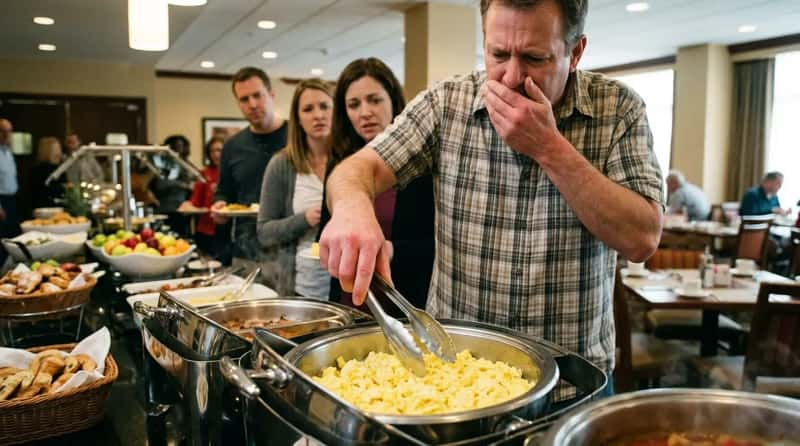
A guest coughs into a hand, then reaches for the tongs. Another sniffles through the line, touching everything on the way. It’s the habit that worries dining teams most, because the consequences don’t stay at the buffet.
Here’s the part many people get wrong: hand sanitizer isn’t a reliable defense against norovirus, and soap and water is. The CDC recommends washing hands for at least 20 seconds. Hotels can wipe down every surface, but they can’t see who skipped the sink.
If you’re unwell, the kindest thing you can do for everyone else at the buffet is a quiet breakfast in the room.
Most of these habits aren’t malicious. They’re automatic, which is exactly why staff would end them first. The biggest ones aren’t really about manners: food safety, allergen cross-contact, and a sick guest at the tongs carry real consequences, while a forgotten waffle and a skipped thank-you cost far less.
The next time you walk into a hotel breakfast room, look at it the way the staff do. It’s less a free spread than a shared kitchen with fifty strangers in it, and the best mornings are the ones where nobody notices the people keeping it running.