
Before Instagram, before Amazon Prime, before you could order a city’s entire aesthetic delivered to your door in two days, the only way to prove you’d actually been somewhere was to drag proof home with you. And in the 1980s, proof came in a very specific form – a snow globe stuffed in a duffel bag, a pennant tacked to a basement wall, a hotel ashtray that somehow ended up on the kitchen counter. Travelers in that decade had a souvenir culture so rich and specific it feels almost mythological today. Most of it is gone now, killed off by digital photos, airport security, and the slow death of the gift shop as a social institution.
The truly wild part isn’t just that these items disappeared – it’s that they were purchased with total sincerity, displayed with pride, and considered a completely normal way to say “I was there.” Some of them are now fetching surprising money on eBay. Others have vanished so completely that even longtime collectors struggle to find them. A few of the ones toward the end of this list are the ones nobody talks about – and those are the ones that sting the most.
#29 – The Souvenir Felt Pennant
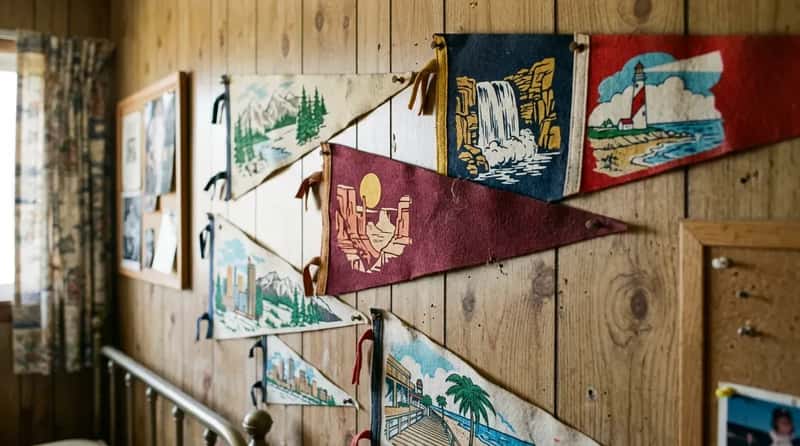
Long before anyone pinned a destination on a digital map, they pinned a felt pennant on the bedroom wall. These triangular banners – stiff, slightly scratchy, printed with city names in bold block letters – were the unofficial scorecards of 1980s family road trips. Hit six states in one summer? You’d better have six pennants to prove it. They hung in dens, garages, and teenagers’ rooms from coast to coast, representing places like Niagara Falls, the Grand Canyon, and virtually every boardwalk town on the Eastern Seaboard.
What’s remarkable is how quickly they vanished as a category. By the mid-1990s, the pennant had almost entirely retreated into sports team merchandise, losing its identity as a general travel souvenir. Today you can find them in vintage shops and on Etsy, but the wall of pennants that used to greet visitors in every souvenir shop from Maine to California simply no longer exists. They were the emotional receipt of the American road trip – and now they’re gone.
#28 – Souvenir Collector Spoons
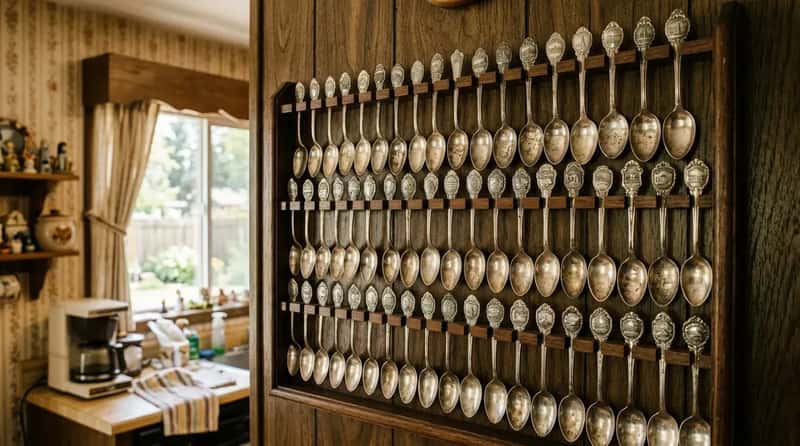
Every kitchen drawer in America in 1985 had at least one of these. Decorative souvenir spoons – tiny, silver-plated, engraved with a state name or landmark – were the go-to gift for the traveler who didn’t know what else to buy. Grandmothers collected them religiously. Display racks sold specifically to hold them lined the walls of gift shops from Washington D.C. to Yellowstone. There was something almost ritualistic about the exchange: you went somewhere, you brought back a spoon, you added it to the rack.
The spoon rack was its own cultural artifact – a serialized record of everywhere a family had ever been. At the height of their popularity, specialty spoon displays were sold in department stores as standalone home décor items, designed to hold up to 36 spoons at a time. Today, those racks collect dust at estate sales, usually still half-full of spoons nobody wants to claim. The spoon-as-souvenir idea feels almost incomprehensible now, which makes it one of the most purely “of its era” items on this entire list.
#27 – Hotel Matchbooks
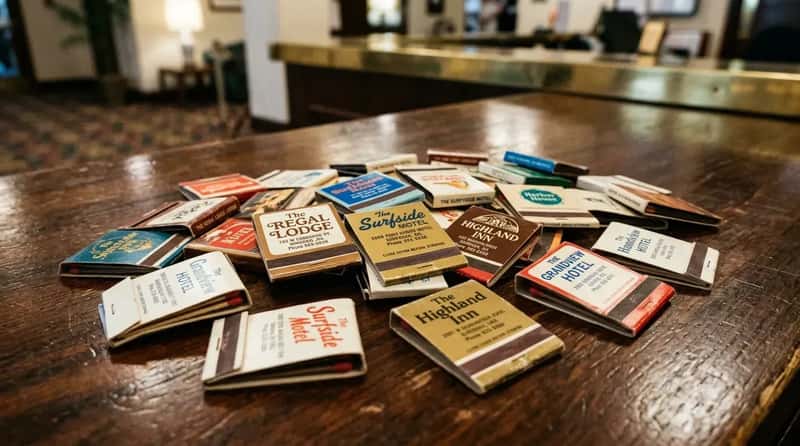
Every hotel worth its name in the 1980s had custom matchbooks sitting on the front desk, in the rooms, and at the bar – free for the taking. Travelers pocketed them without thinking twice. Some collected them intentionally, filling shoeboxes with matchbooks from Holiday Inns, resort hotels, and roadside motor lodges across the country. Small, flat, and free, they were the perfect accidental souvenir – and they happened to capture the branding of hotels exactly as they looked at their peak.
They died on two fronts simultaneously: smoking rates dropped sharply through the late ’80s and ’90s, making matches feel irrelevant, and hotels began stripping out every branded freebie in the name of cost-cutting. By 2000, the hotel matchbook was functionally extinct as a standard room amenity, and the habit of collecting them went with it. Vintage matchbook lots from the 1960s through the 1980s now sell on Etsy for surprisingly decent sums, prized precisely because they captured the look of hotels that no longer exist.
#26 – Ceramic Souvenir Bells
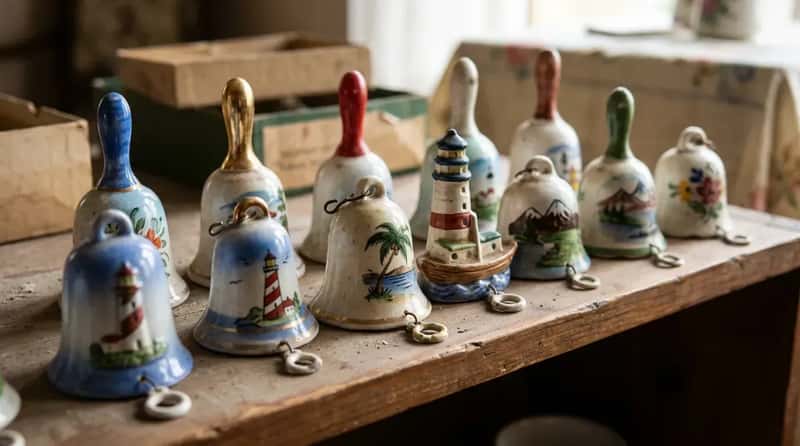
Somewhere between the collector spoon and the snow globe lived the ceramic souvenir bell – a small, hand-painted, ringing trinket sold in every tourist gift shop from San Francisco’s Fisherman’s Wharf to the Florida Keys. They came in endless regional variations: shaped like lobsters, lighthouses, or cowboys, painted with the state flower, or simply stamped with the city name in gold lettering. People gave them to grandmothers. Grandmothers lined them up on shelves. Those shelves are now at estate sales.
The ceramic bell occupied a very specific emotional niche – it was a gift for someone who had everything, because it was essentially nothing but sentiment pressed into glaze. Gift shops often stocked them in dozens of variations, and a single display spinner could hold 40 or 50 different versions. No one makes a specific point of hunting for them today. The souvenir bell’s reign lasted roughly from the 1960s through the early 1990s, and then it vanished as completely as if it had never rung at all.
#25 – Oversized Novelty Postcards
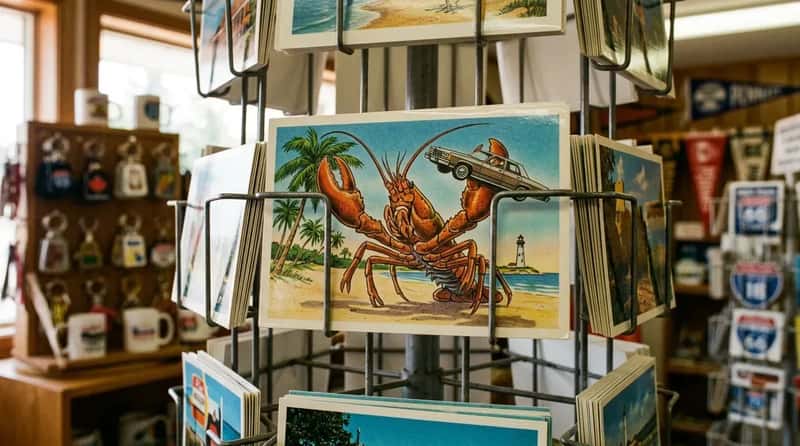
Not the standard postcard – the big one. Jumbo postcards, roughly double or triple the standard size, were a staple of 1980s souvenir shops and highway rest stops. They depicted exaggerated local pride: a giant bass leaping from a small lake, a cowboy so tall he dwarfed a skyscraper, a lobster the size of a car. The images were deliberately absurd, played for laughs, and they sold by the thousands. Finding one in the wire rack at a gas station was a small, reliable joy of the American road trip.
The jumbo novelty postcard was specifically an American artifact – a product of roadside commerce, cheap printing, and a culture that found regional self-deprecation genuinely funny. These oversized cards were sold loose in spinning wire racks at gas stations and rest stops, usually for under a dollar. Digital photography, email, and eventually social media posts replaced the postcard’s core function. But that particular flavor of oversized, gag-style Americana disappeared almost entirely – and even souvenir shops that still sell standard postcards rarely carry the jumbo novelty versions.
#24 – Snow Globes From Specific Landmarks
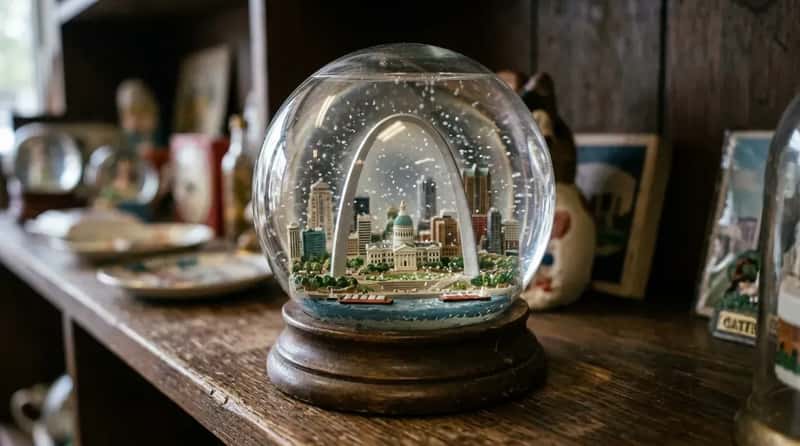
Snow globes didn’t die – but the specific type that dominated 1980s souvenir shops mostly did. Back then, a snow globe was made of glass, heavy in the hand, and depicted an actual local landmark with real specificity: the Gateway Arch in St. Louis, the Space Needle in Seattle, the boardwalk in Atlantic City. They weren’t generic. They were destination-specific objects that told you exactly where someone had been, down to the building.
The modern souvenir snow globe is almost always lightweight plastic, mass-produced overseas, and depicts a generic theme rather than a recognizable local structure. The shift from glass to plastic happened through the 1990s as manufacturers cut costs, and with it went the tactile heft that made the original globes feel like real keepsakes. The heavy glass versions from the 1980s are now legitimately collectible – if you find a good one at a flea market with clear water and an intact landmark inside, it’s worth considerably more than the $4.99 someone paid for it in 1984.
#23 – Souvenir Ashtrays

In the 1980s, ashtrays were not just functional objects – they were considered perfectly acceptable decorative souvenirs. Gift shops at major tourist sites sold ceramic ashtrays stamped with local imagery: the Las Vegas Strip in neon colors, a Hawaiian beach with palm trees, a New York City skyline pressed into the ceramic. They were small, cheap, and durable – the perfect souvenir specs – and they sat on kitchen counters and home bars across America without a second thought.
The ashtray-as-souvenir collapsed in almost perfect synchrony with the public smoking decline of the 1990s. As smoking moved from a normal household activity to a stigmatized one, nobody wanted a decorative reminder of it on their shelf. Hotels quietly removed branded ashtrays from rooms as the decade progressed. The gift shop ashtray was gone from retail by the early 2000s. Today they survive in antique shops and on collector sites, sought specifically for their vintage travel branding rather than any smoking-related purpose.
#22 – Pressed Penny Machines (and the Coin Collections)
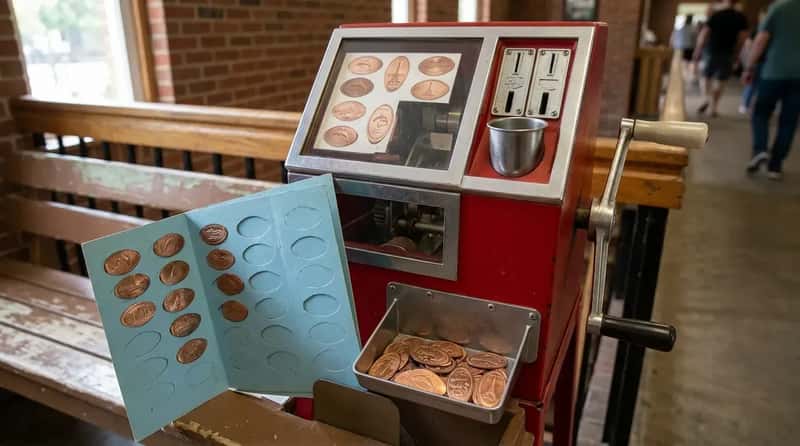
The pressed penny machine – where you’d feed in two quarters and a regular penny, turn a crank, and get back an elongated copper oval stamped with a local image – was everywhere in the 1980s. Theme parks, zoos, national parks, aquariums, and major tourist sites all had them. Families collected them obsessively, storing them in special blue fold-out books designed specifically to hold pressed pennies in labeled slots. Kids considered it the most satisfying souvenir per dollar ever invented.
Here’s what most people don’t realize: the machines themselves never fully disappeared. A network of pressed penny machines still exists at many major attractions today. But the ritualistic collection of them – the little blue books, the deliberate hunting, the family tradition of seeking out every machine at every stop – has almost entirely faded from mainstream tourist culture. In the 1980s, it was a near-universal family travel habit. Now it’s a niche activity practiced mostly by dedicated adult collectors who remember doing it as kids.
#21 – State-Specific Souvenir Plates
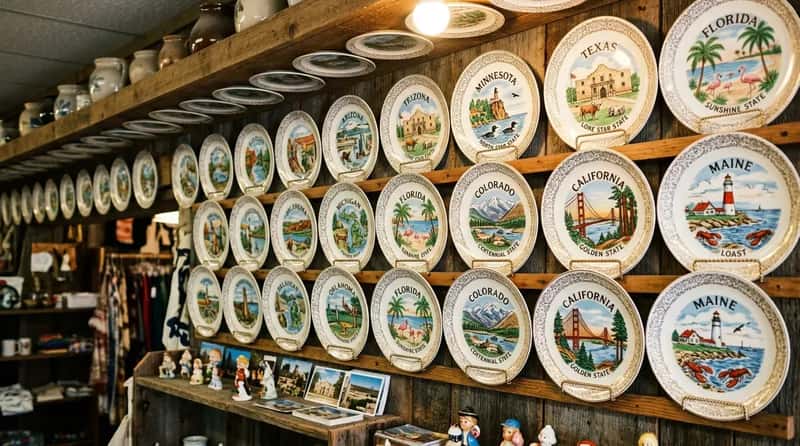
Decorative collector plates depicting state landmarks, wildlife, or scenic vistas were a staple of every roadside gift shop in the 1980s. They came in standardized sizes, usually eight inches across, and featured color illustrations of recognizable local scenes ringed by ornate borders. People hung them on walls, propped them on plate racks, or lined them up along kitchen soffits. Serious collectors had dozens, sometimes acquired over years of family vacations.
The collector plate industry peaked in the 1970s and 1980s and then collapsed with surprising speed in the 1990s as tastes shifted and the items flooded the secondary market, destroying their perceived value. What had seemed like a curated collection started to feel like clutter, and younger generations had zero interest in inheriting them. Today they fill the shelves of every Goodwill and antique mall in America, almost always priced under five dollars, overlooked by shoppers hunting for something with actual resale value.
#20 – Satin Destination Pennants (Not the Sports Kind)
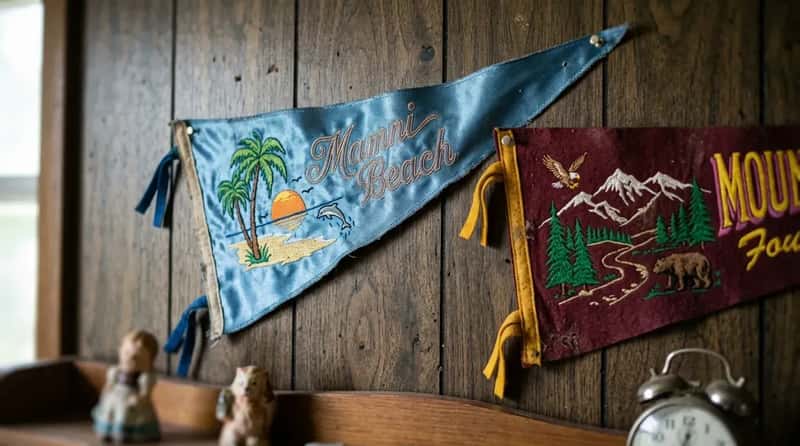
Separate from the felt pennants mentioned earlier, there was a specific subcategory: the tourist-destination pennant that mimicked the look of a sports team pennant but celebrated a place, not a team. “Greetings from Florida.” “Rocky Mountain National Park.” “The Magic of Las Vegas.” These pennants were shiny satin or felt, hung from bedroom walls, and were designed to make a vacation feel as significant as a championship. They were sold in gift shops alongside the felt versions, and together they dominated the wall-hanging souvenir category for the entire decade.
What killed them wasn’t indifference but competition. By the 1990s, the T-shirt had so thoroughly dominated the wearable souvenir market that non-sports pennants lost their retail shelf space entirely. Gift shops couldn’t justify stocking both when T-shirts outsold everything else combined. The destination pennant quietly vanished from gift shop inventory, and with it, one of the most visually distinctive souvenirs of the entire American road-trip era. Finding one today in good condition is genuinely difficult.
#19 – Hotel Soap Bar Collections
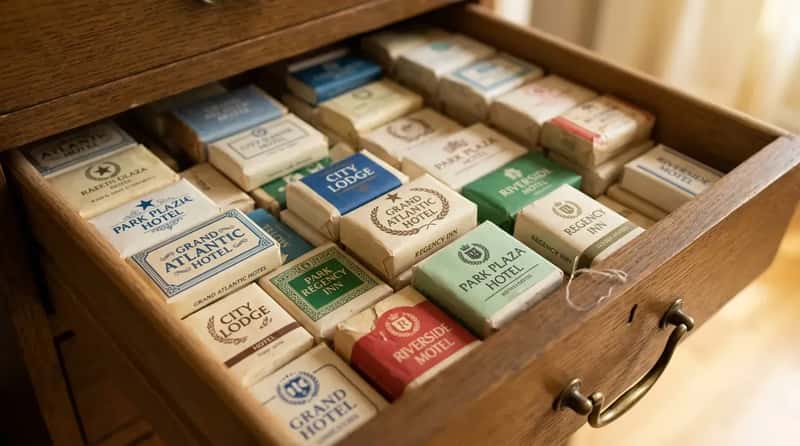
In the 1980s, hotel soap bars were small branded rectangles – embossed with the hotel’s name, wrapped in paper, and considered perfectly respectable to pocket on checkout. Travelers collected them. Some people kept a drawer full of miniature soap bars from every hotel they’d ever stayed in, arranged like a fragrant archive of every trip they’d ever taken. It sounds absurd now, but it made perfect sense in an era when hotels put genuine effort into branded amenities and the bars were distinctive enough to be worth keeping.
The branded hotel soap bar began its decline in the 1990s when environmental concerns prompted many chains to switch to refillable dispensers mounted to shower walls. By the 2010s, most major hotel chains had moved almost entirely away from individual soap bars. The small paper-wrapped bar with the hotel name stamped on it still exists at some independent and luxury properties, but the idea of collecting them as souvenirs has essentially vanished from travel culture – along with the drawer full of tiny bars that used to be a fixture in so many American homes.
#18 – Souvenir Thimbles
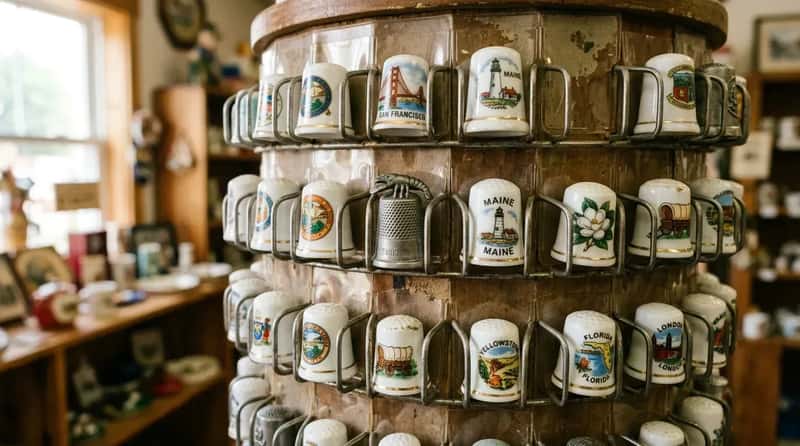
Right next to the souvenir spoons on the spinner rack, you’d find the thimbles. Tiny porcelain or pewter thimbles stamped with state seals, painted with landmarks, or shaped like regional symbols – the lobster, the magnolia, the covered wagon – were collected with the same dedication as the spoons, displayed on special wall-mounted thimble racks, and given as gifts to relatives who sewed. Which, in 1985, was still a significant portion of the American adult population.
Two things killed the souvenir thimble simultaneously: the dramatic decline of home sewing as a mainstream hobby, and the broader collapse of the small-trinket souvenir category in the late 1990s. At their peak, specialized thimble display cabinets were sold in craft stores nationwide, designed to hold 50 or more thimbles in a felt-lined wooden case. Those cases now appear at estate sales still full of their original thimbles, waiting for heirs who genuinely don’t know what to do with them. It’s one of the most complete cultural disappearing acts in American souvenir history.
#17 – The Souvenir Spoon Rack as a Statement Wall Piece
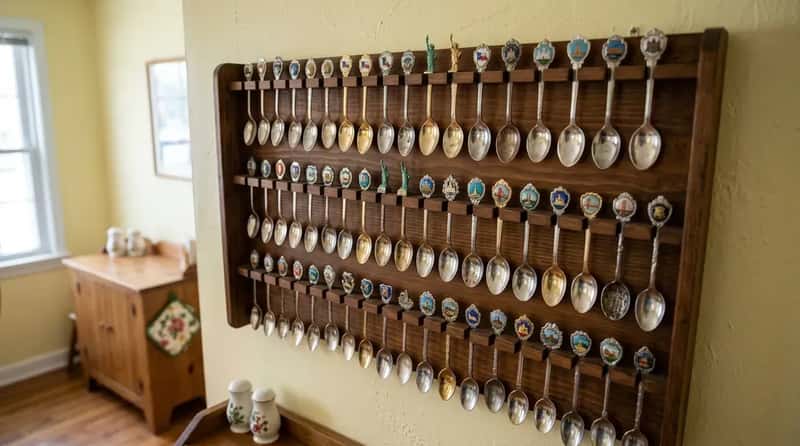
The spoon rack deserves its own entry because it wasn’t just a storage solution – it was a statement piece. Mounted on the kitchen or dining room wall, a fully populated spoon rack was a family’s travel biography made visible. Guests would study it. Kids would count the spoons. Relatives would ask about specific ones. The rack itself was often handmade or hand-painted, and filling it was considered a genuinely meaningful long-term project. Some families spent decades completing theirs.
By the early 2000s, the fully populated souvenir spoon rack had become so strongly associated with a specific older aesthetic that younger homeowners actively avoided it – even if they secretly found it charming. Interior design trends moved hard against the cluttered wall display, and the spoon rack became shorthand for a certain kind of grandmotherly décor that the HGTV generation was actively fleeing. The racks are everywhere at estate sales now, often still mounted to boards, complete with every spoon, waiting to be separated and sold individually to collectors.
#16 – Carousel Slide Projector Shows of the Vacation
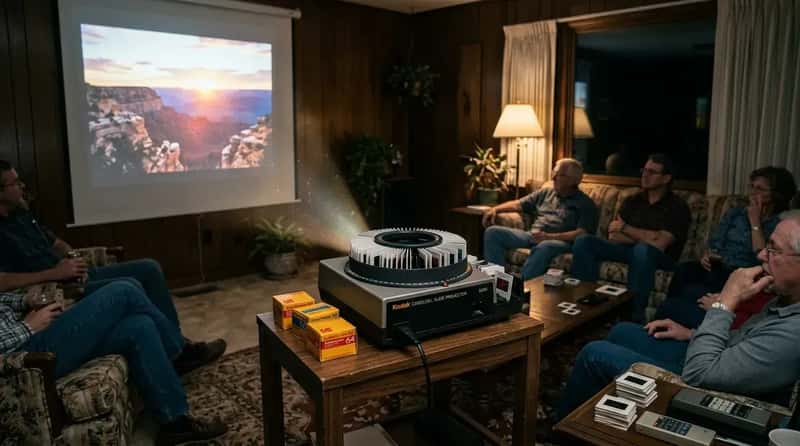
Before digital cameras, every serious 1980s traveler came home with rolls of 35mm film and the profound anxiety of not knowing how the photos turned out until you paid to develop them a week later. But the truly devoted traveler came home with slide film – Kodachrome or Ektachrome transparencies that, when projected through a carousel slide projector, turned the living room wall into a travel documentary. Hosting a slide show for friends and family after a big trip was a genuine social event in the 1980s.
Kodak discontinued its legendary Kodachrome slide film in 2009, effectively ending an era – but the ritual of the projected slide show had already died years earlier, as home video cameras, then digital cameras, then smartphones made the carousel projector feel impossibly slow and labor-intensive. Millions of carousels full of travel slides now sit in basements and attics across America, the images inside them unseen for decades, their colors slowly shifting as the chemistry ages. They are among the most quietly heartbreaking lost artifacts of the 1980s travel era.
#15 – Souvenir Mini License Plates
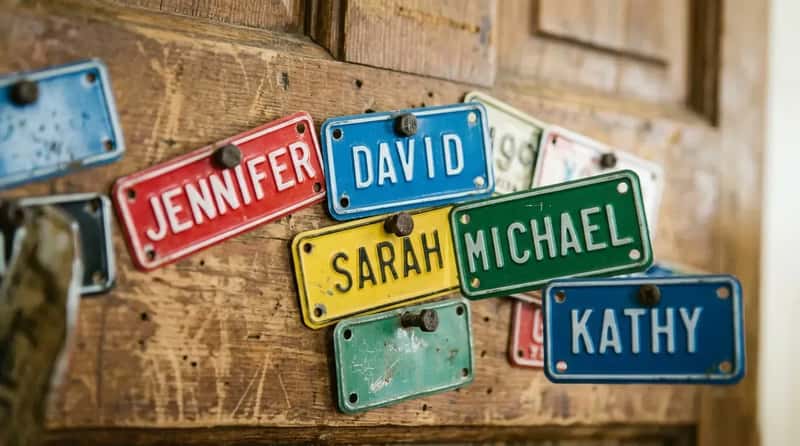
Gift shops at state border crossings, theme parks, and highway rest stops sold miniature license plates by the thousands in the 1980s. They were roughly the size of a playing card, stamped metal, and bore the traveler’s name – or a common name close enough – alongside the state plate design. Kids clipped them to their bicycle handlebars, hung them from bedroom doorknobs, or bolted them to wooden nameplates above their beds. They were genuinely personalized in a way that most souvenirs weren’t.
The mini license plate occupied a specific gap in the souvenir market: cheap enough to be an impulse buy at under two dollars, personalized enough to feel special, and durable enough to last for years. The category still technically exists in some tourist locations, but the spinner racks of 50-plus name variants that used to dominate rest stop gift shops are largely gone. Digital personalization has replaced the pre-stamped metal plate – and with it went the specific, slightly agonizing joy of scanning every slot in the rack hoping your name was in there.
#14 – Travel Agency Destination Posters
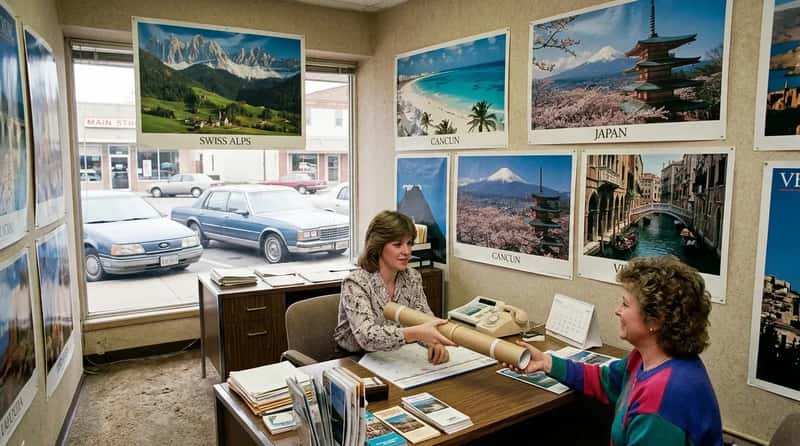
In the 1980s, travel agencies were physical storefronts on main streets in every American town, and their windows were plastered with oversized destination posters: the Swiss Alps, the beaches of Cancún, the temples of Japan, the canals of Venice. These were promotional materials produced by airlines and tourism boards, but travelers often sweet-talked the agents into giving them a rolled-up copy to take home. They were legitimately beautiful – professionally photographed, lithographically printed, and designed to make you ache for the destination.
The travel agency storefront has nearly vanished from American commercial real estate, largely replaced by online booking platforms. With the storefront went the poster, and with the poster went one of the most visually striking free souvenirs of the era. Original airline and tourism board posters from the 1980s now sell at auction for serious money, recognized as the graphic design artifacts they actually were. Most people who had them hanging on their walls never thought to keep them.
#13 – Souvenir Whiskey Decanters
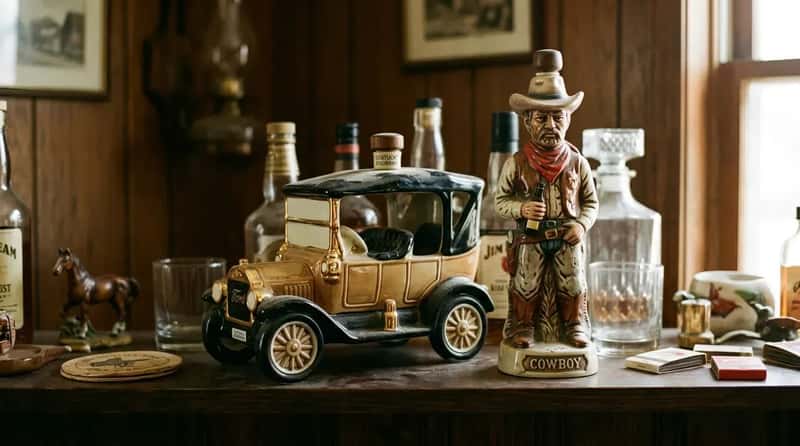
Gift shops in tourist-heavy regions of Kentucky, Tennessee, and the American Southwest sold ceramic souvenir whiskey decanters in the 1980s with remarkable enthusiasm. These were ornate, collectible bottles – shaped like cars, cowboys, eagles, or state landmarks – that came pre-filled with local bourbon or whiskey. Some travelers bought them for the contents; many more bought them for the bottle itself, draining it and displaying the decanter on a home bar shelf as a conversation piece from the trip.
Jim Beam alone produced hundreds of collector decanter designs through the 1960s, ’70s, and ’80s, and the secondary market for these bottles was substantial enough to support dedicated collector clubs and price guides. The category collapsed in the early 1990s as tax structures and changing retail regulations made the filled decorative decanter economically impractical for gift shops. Empty decanters without their original contents now turn up regularly at flea markets – still beautiful, still detailed, still completely representative of a souvenir culture that no longer exists.
#12 – Small Felt Flags on Wooden Sticks
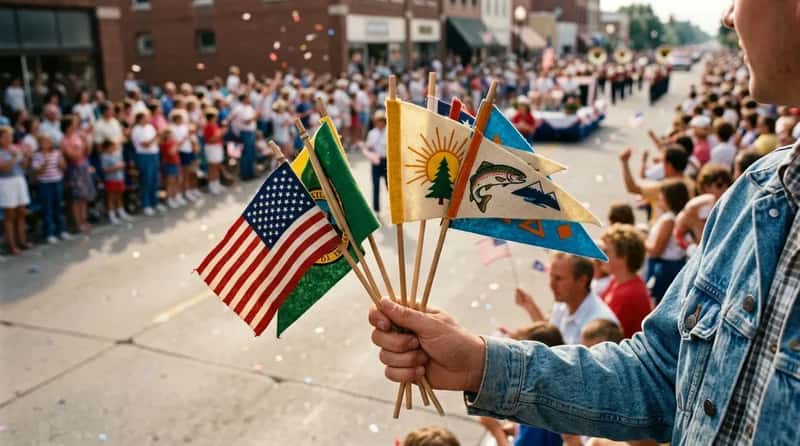
Distinct from the wall-mount pennants, these were smaller felt flags on thin wooden dowels – sold specifically to wave at parades, stuff into a beach bag, or hand to a kid who needed something to do with their hands at a tourist site. They were sold at Fourth of July celebrations, national park entrance areas, amusement parks, and state fairs. Kids loved them because they were essentially toys disguised as souvenirs, and parents loved them because they were cheap enough to buy without guilt.
The hand-flag souvenir category survived into the 1990s but was rapidly colonized by plastic versions with cheaper construction, losing the felt-and-wood quality that made the originals feel worth keeping. Today, the small souvenir flag industry exists primarily for patriotic and sports purposes – the idea of buying a small flag simply to commemorate visiting a place has essentially vanished from American tourist culture. The ones that survive from the 1980s turn up occasionally in antique shops, their dyes slightly faded, still carrying the names of destinations their original owners haven’t visited in 40 years.
#11 – Souvenir Ceramic Coin Banks
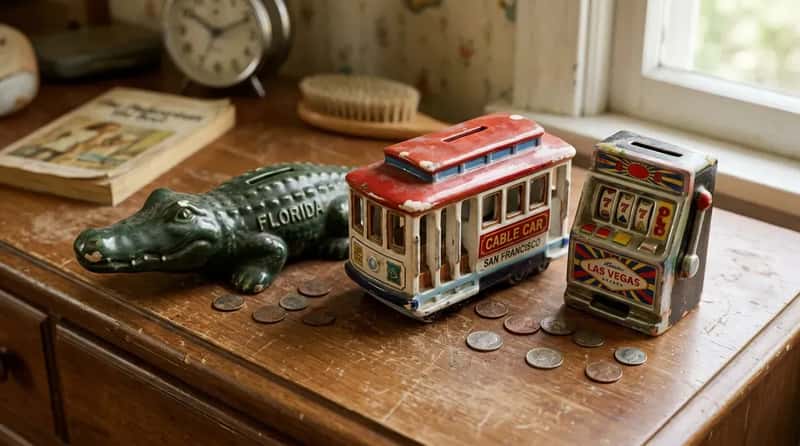
Ceramic coin banks shaped like landmarks, animals, or regional icons were a staple of 1980s souvenir shopping, targeted directly at parents who wanted to give their kids something functional rather than purely decorative. A piggy bank shaped like a Florida alligator, a slot machine bank from Las Vegas, a ceramic cable car bank from San Francisco – these were the kinds of items that lived on kids’ dressers for years, their connection to the original trip growing hazier with every coin dropped in.
The souvenir bank required a certain belief in permanence to make sense as a gift – you had to assume the recipient would keep it long enough to actually use it. As gift culture shifted toward consumables and experiences rather than permanent objects in the 2000s, the coin bank souvenir lost its retail logic entirely. Modern children also have far less reason to handle physical coins regularly, which made the coin bank feel like a relic before the souvenir version of it fully disappeared. You can still find them at flea markets, usually still holding a few old coins inside.
#10 – The Original Heavy-Glass Souvenir Shot Glass
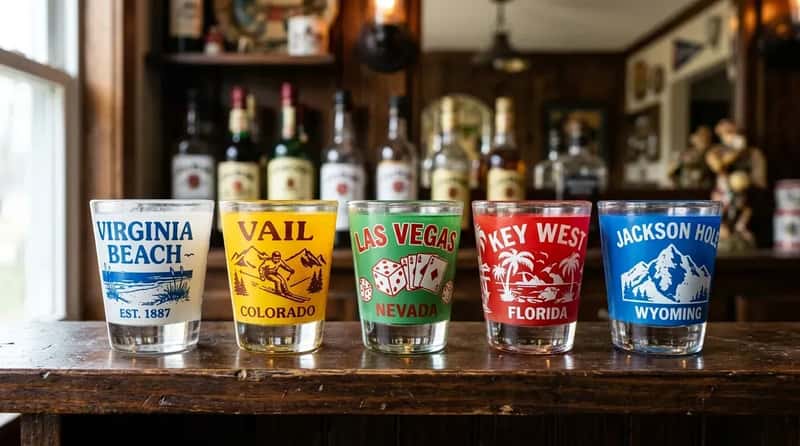
Souvenir shot glasses technically still exist, but the version that dominated the 1980s was categorically different from what you find today. The classic 1980s souvenir shot glass was heavy glass, silk-screened with bright destination text and imagery, and sold in gift shops as a genuinely adult souvenir for people who had traveled somewhere fun. Every beach town, every ski resort, every casino city had its own version. Collectors lined them up on bar shelves the same way others collected spoons.
The original heavy-glass, screen-printed shot glass was gradually replaced by cheaper imported versions – thinner walls, decals instead of silk-screen printing, generic imagery – through the 1990s and 2000s. The category survives, but the quality and specificity of the original versions is gone. If you find a thick, heavy-bottomed shot glass from 1984 with a crisp silk-screened design and the name of a hotel or resort that no longer exists, you’ve found something genuinely irreplaceable. The cheap versions that replaced them are not the same artifact at all.
#9 – Souvenir Bumper Stickers on Real Bumpers
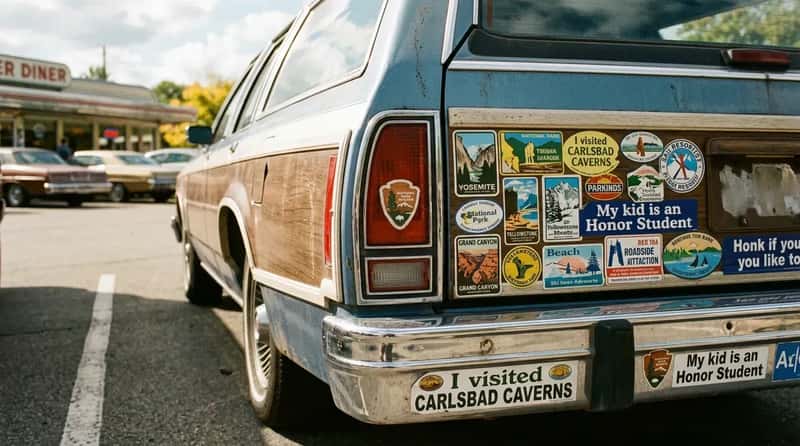
In the 1980s, American cars were rolling travel diaries. Bumper stickers from national parks, beach towns, ski resorts, and roadside attractions accumulated on rear bumpers and station wagon tailgates like rings on a tree. “I Visited Carlsbad Caverns.” “Honk If You Love Jesus.” “My Kid Is an Honor Student at…” Families displayed their travel history on their vehicles without irony, and souvenir shops sold bumper stickers as seriously as they sold anything else in the shop.
The bumper sticker souvenir began its decline when car culture shifted in the 1990s toward leased vehicles – you don’t sticker a car you’ll have to return. Then came the SUV with its smoother surfaces and less sticker-friendly finishes, followed by a broader cultural shift away from permanent vehicle modification. Today, the oval country-code sticker has replaced the narrative bumper sticker for most travelers, and most cars have none at all. The bumper sticker rack – once a centerpiece of every gift shop – has shrunk to a single spinner or disappeared entirely.
#8 – Destination-Specific Souvenir Music Boxes
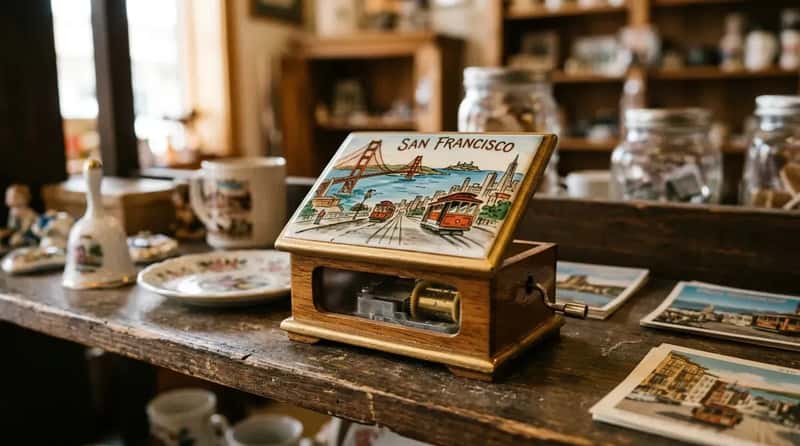
Music boxes as souvenirs – small, delicate, usually porcelain or lacquered wood, playing a recognizable melody associated with the destination – were the premium tier of 1980s gift shop merchandise. A music box from San Francisco might play “I Left My Heart in San Francisco.” One from New Orleans might crank out “When the Saints Go Marching In.” They were expensive by gift shop standards, usually $15 to $30 in 1980s dollars, and they were bought for people you actually cared about impressing.
The souvenir music box required skilled craftsmanship – the mechanism, the case, the painting – which made it vulnerable to cost pressure in a way that cheaper items weren’t. As manufacturing shifted aggressively overseas in the 1990s, quality dropped, and with it the perceived gift-worthiness of the item. By the mid-2000s, the souvenir music box had almost entirely left mainstream gift shops, surviving only in high-end museum stores and specialty boutiques. Original 1980s versions in working condition are genuinely sought after by collectors today.
#7 – Keychains Made With Actual Local Materials
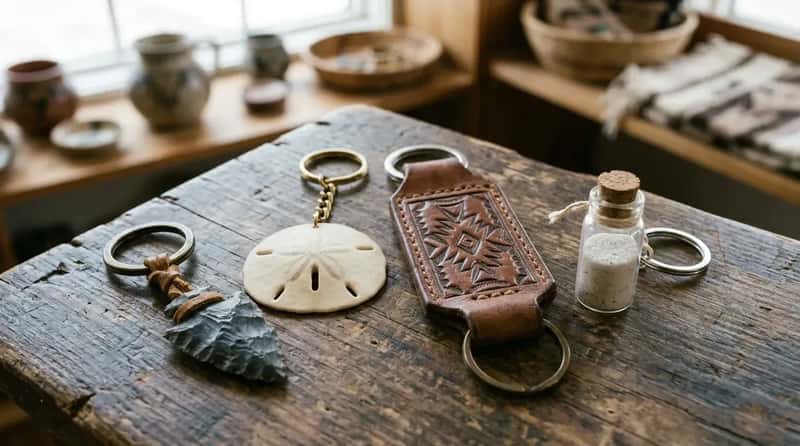
Not the generic plastic keychain with a city name on it – the specific, material-driven ones made with something actually from the place. A genuine arrowhead from New Mexico. A real sand dollar from the Carolina coast. A leather keychain tooled by hand at a working ranch gift shop in Wyoming. A tiny bottle of actual sand from a specific Florida beach. These objects made a specific promise: that the material itself was a piece of the destination, not just a label attached to it.
The authenticity-material keychain required local production, which became economically unsustainable as gift shop inventory increasingly shifted to mass-produced items shipped from overseas suppliers. By the time the internet made it possible for consumers to verify that a “genuine turquoise” keychain was actually dyed howlite, trust in the whole category had already eroded. The hand-tooled leather keychain, the real sand dollar, the genuine arrowhead – these artifacts of honest souvenir-making are almost impossible to find in mainstream tourist shops today, replaced by identical plastic tags sold under dozens of different destination names.
#6 – Souvenir Thermometers on Wooden Plaques

These are almost impossible to explain to anyone under 40 without them laughing – but they were everywhere. A small working thermometer mounted on a wooden plaque or painted ceramic backing, decorated with regional imagery – a bear for the Smokies, a lobster for Maine, a cactus for Arizona – was considered a perfectly legitimate souvenir to buy and display. People hung them on back porches, in garages, and on kitchen walls. They were functional in a way most souvenirs weren’t, which made them feel like a reasonable purchase.
The souvenir thermometer plaque occupied a narrow, specific category: too cheap to be a real gift, too functional to be purely decorative, and too regional to be mass-produced efficiently. When gift shop economics forced buyers to reduce their SKU counts in the late 1990s, souvenir thermometers were among the first items cut. The few that survive are disarmingly charming – tiny working instruments inside kitschy painted frames, still accurately reading the temperature 40 years later, still bearing the name of a place that may or may not still exist in the form the traveler remembered it.
#5 – Annotated Travel Guidebooks With Handwritten Notes
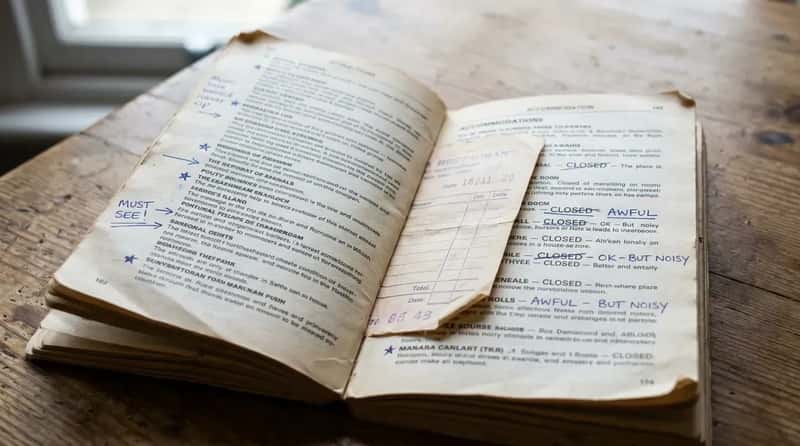
The Fodor’s guide. The Frommer’s. The AAA TripTik booklet assembled by a travel agent and mailed to your house weeks before departure. In the 1980s, travelers relied on paper maps and printed guides to navigate, and those tools came home with the traveler covered in margin notes, underlines, dog-eared pages, and the occasional restaurant receipt tucked inside. The annotated guidebook was a secondary travel journal – unintentional, accidental, and irreplaceable.
The annotated paper guidebook is now one of the rarest artifacts of 1980s travel culture, because almost none of them were kept. People threw them away after the trip, not realizing they’d created a detailed first-person record of exactly where they went, what they thought was worth seeing, and what they’d paid for everything. The ones that survived – still folded to a specific page, still carrying a long-ago traveler’s handwriting in the margins – are extraordinary time capsules. Every one that gets thrown away erases another first-person account of how that world looked.
#4 – Airline Souvenir Wings Pinned to a Kid’s Shirt
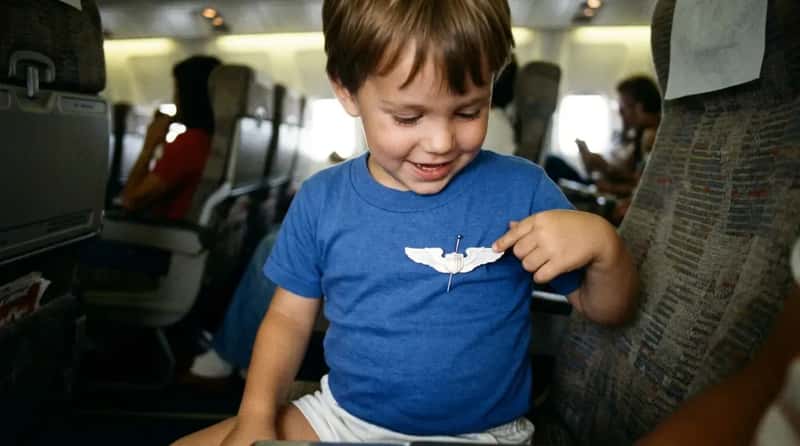
If you flew as a child in the 1980s, a flight attendant almost certainly pinned a small set of plastic or metal pilot’s wings to your shirt. It was standard practice on most major U.S. carriers – Delta, United, American, Eastern, TWA – and kids collected them like badges of honor. Some airlines gave out wing pins, some gave out small cardboard certificates, and some gave out both. They were free, they were charming, and they made the terrifying experience of flight feel like an achievement rather than an ordeal.
The airline souvenir wing for children disappeared in the 1990s and 2000s as carriers eliminated nearly every passenger amenity in pursuit of cost efficiency. The deregulation era that began in 1978 transformed air travel economics so thoroughly that by the mid-2000s, the complimentary meal, the pillow, the blanket, and the children’s wing pin had all essentially vanished from domestic coach travel. Original souvenir wings from defunct carriers – Eastern Air Lines, Pan Am, Braniff International – are now legitimate collector’s items, worth real money to aviation memorabilia enthusiasts who remember pinning them on as kids.
#3 – Souvenir Menus From Iconic Restaurants
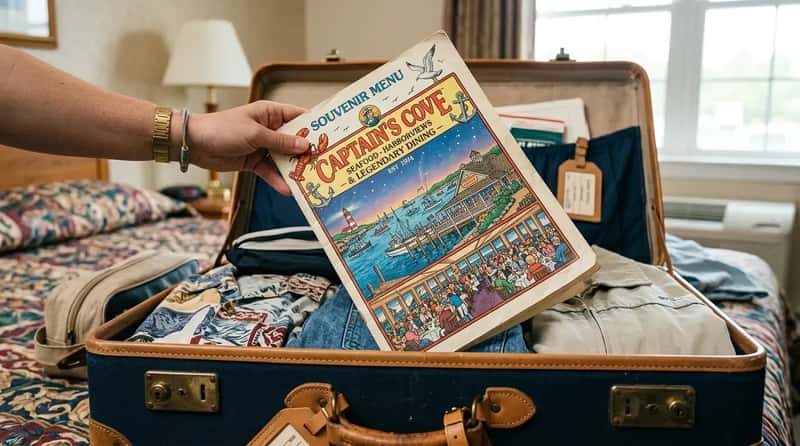
In the 1980s, destination restaurants – famous diners, seafood shacks, hotel dining rooms, landmark steakhouses – printed full-color souvenir menus designed to be taken home. They weren’t just functional ordering documents; they were keepsakes, printed on heavy stock with photographs of the restaurant, local history notes on the back, and sometimes a signed note from the owner. Savvy travelers folded them carefully and tucked them into luggage. A few restaurants actively encouraged the practice.
The souvenir menu required a restaurant to believe its brand was worth commemorating – a very different business philosophy from today’s QR-code-menu culture. Digital menus killed the physical menu in most restaurants, and cost pressures killed the souvenir-grade printing long before that. Today, tracking down an original menu from a beloved 1980s restaurant that has since closed is a legitimate nostalgia quest – the menus survive in attics and scrapbooks, quietly preserving the prices, the offerings, and the design sensibility of a restaurant world that no longer exists.
#2 – Pre-Made Kodachrome Destination Slide Packs
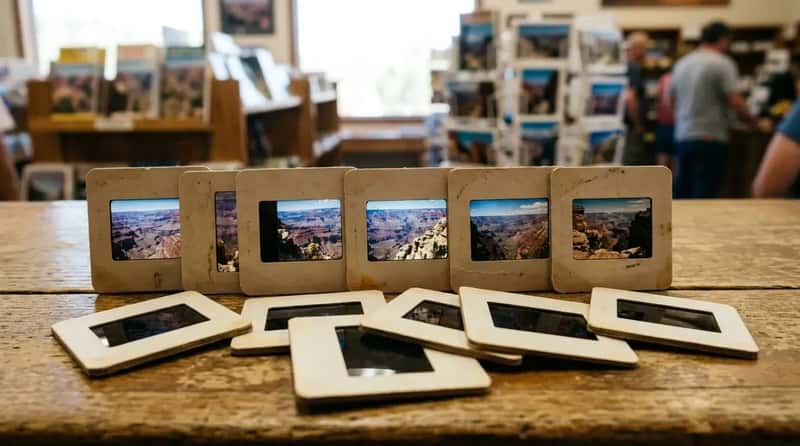
Before the point-and-shoot camera democratized personal photography, tourist sites sold pre-made photographic slide packs of themselves – professional images of the destination that travelers could bring home and project. In the early 1980s, destination slide packs were still widely sold at national park visitor centers and major landmarks: a set of 12 Kodachrome slides of the Grand Canyon, properly composed and labeled, for under five dollars. They were the curated Instagram grid of their era – shareable at home, via a projector, on the living room wall.
The destination slide pack vanished almost overnight once consumer cameras became reliable enough that everyone could take their own photos, and disappeared entirely once those photos could be digitized and shared online. By the early 1990s, the pre-made destination slide set had all but left visitor center shelves. The surviving packs are remarkable artifacts – professional-quality images of destinations as they looked in the late 1970s and early 1980s, before many of them were altered, developed, or demolished. They are primary historical documents that most people threw away.
#1 – The Handwritten Travel Journal Sold at the Gift Shop
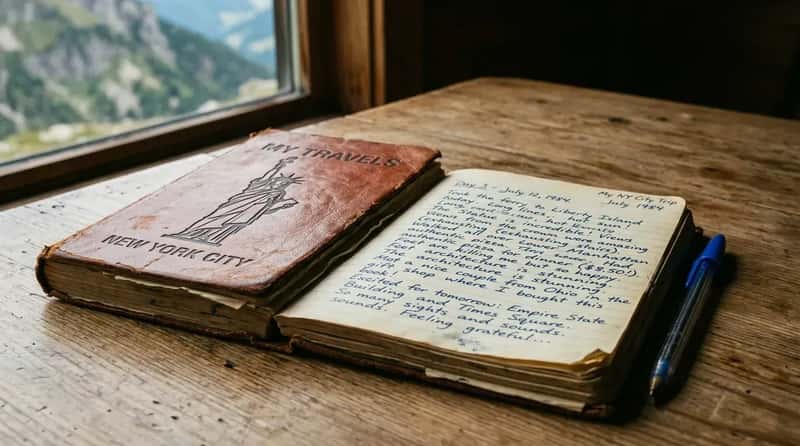
Here’s the one that hurts most to think about. In the 1980s, gift shops at major tourist destinations – national parks, historic sites, iconic landmarks – sold blank travel journals specifically branded to the destination. A leather-bound journal embossed with the Yellowstone bison. A cloth-covered notebook stamped with the Statue of Liberty. A simple composition book with “My Grand Canyon Trip” printed on the cover. They were designed for one purpose: to capture the experience in the traveler’s own words, in real time, without a filter or an algorithm.
What travelers actually wrote in these journals – the prices they paid, the people they met, the arguments they had, the food that surprised them, the moments that hit them sideways – is the most irreplaceable record of what American travel actually felt like in that decade. Most of those journals were thrown away. Some sit in boxes, unread for decades. A small number have been found at estate sales by strangers who read them with the same astonished attention you’d give a primary historical source – because that’s exactly what they are. Every souvenir on this list can be approximated or replicated. The handwritten travel journal, filled by a specific person in a specific moment, cannot.
So many of these souvenirs look silly in retrospect – a thimble, a spoon, a hotel matchbook – but they were doing something serious. They were turning a trip into an object, making the intangible fact of having been somewhere into something you could hold. Modern travel has a thousand ways to document an experience and almost no way to make it feel permanent. Every item on this list was an attempt to solve that problem with whatever materials the gift shop had on hand. Which one did you have? Drop the one you remember most in the comments – or the one you still have hiding somewhere in your house.