It’s easy to assume that formal, legal control over women mostly ended decades ago, tucked away in old statute books next to laws banning certain hat colors on Sundays. Walk into any courtroom in the world’s wealthier democracies and that assumption seems to hold up fine. Yet step outside that narrow lens and a different picture appears: real, enforceable laws that still let a husband, father, or the state itself decide where a woman can go, who she can marry, and what she inherits.
Some of these rules are ancient in origin but current in application, updated or reaffirmed as recently as this year. Others sit quietly in American state codes, rarely discussed outside advocacy circles. Together they show that legal control over women isn’t a relic. It’s a living, if shrinking, feature of the modern world.
1. Male guardianship rules that decide when a woman can travel or work

In several Middle Eastern countries, a woman’s ability to leave the house, cross a border, or take a job still runs through a man’s approval. Fifteen countries in the region still apply personal status or family laws that require women to either “obey” their husbands, live with them, or seek their permission to leave the marital home, work, or travel. Saudi Arabia has loosened some of these rules, but not erased them.
Saudi reforms only apply above a certain age, and even then the protections are thin. As of August 2019, women aged 21 and above gained the right to travel abroad without a guardian’s permission, while women below that age must still obtain approval from a male guardian unless married, on government scholarships, or working for a government organization. In Iran, marriage narrows a woman’s freedom rather than protecting it: married women must show their husband’s permission to obtain a passport and to travel. Some Iranian women have discovered that permission revoked without warning, sometimes at the airport itself.
2. Afghanistan’s mahram rules confining women to their homes
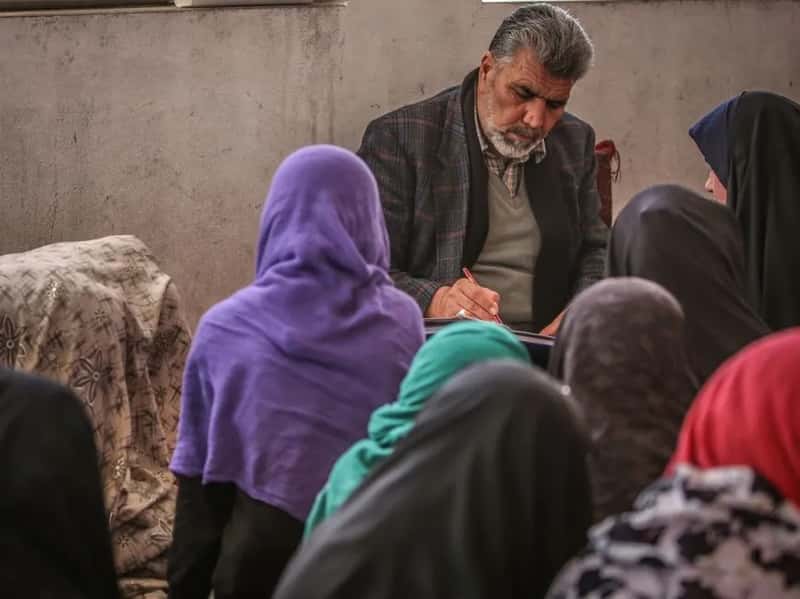
Nowhere is legal control over women’s movement more absolute right now than in Afghanistan. Afghanistan stood as the most extreme example of women’s travel restrictions in 2025, when the Taliban announced a “promotion of virtue and prevention of vice” law that barred women from traveling or using public transportation without a male guardian. The rule isn’t symbolic; it’s enforced daily across the country.
The restrictions extend well beyond long trips abroad, reaching into ordinary daily life. Women are mandated to wear face coverings in public and barred from travelling more than 70 kilometres without a close male relative. Unmarried women face even harsher consequences, since those without a “mahram,” or male guardian, face even tougher restrictions and have been cut off from access to health care, banned from traveling long distances, and pressured to quit their jobs. It’s a legal architecture built entirely around male permission, with almost no exceptions.
her than protecting the wife.
3. Inheritance codes that give sons double a daughter’s share

Family law in several countries still splits an inheritance by gender rather than by need or relationship, and it isn’t a fringe interpretation. In Egypt, the country uses Sharia law, derived from Islam’s holy book and the teachings of the Prophet Muhammad, as the basis of its family legislation, and under that law a daughter can inherit half of what a son receives when a parent dies. Recent survey research found this arrangement has broad public backing rather than fading support.
A 2025 study out of Northeastern University in London surveyed attitudes toward the rule directly. The survey found that seventy percent of respondents would want a son to inherit twice as much as a daughter in the event of a parent’s death. The researcher behind the study grouped Egypt with two other countries where family law leaves little room for equal treatment, noting along with Saudi Arabia and Iran, Egypt has some of the least gender-equal family laws worldwide due to the strong influence of Sharia in family legislation. The financial consequences follow women for life, shaping everything from home ownership to labor force participation.
4. Citizenship laws that treat mothers as second-class parents

In roughly two dozen countries, a woman married to a foreigner cannot pass her own nationality to her children the way a man automatically can. In 24 countries, women still cannot pass on their nationality to their children on an equal basis as men, while over 45 countries prevent women from conferring citizenship to their spouses on equal terms. The consequence isn’t abstract paperwork. It can mean a child grows up with no legal nationality at all.
The Gulf states illustrate the problem sharply, since the rule there leaves almost no room for exception. Qatar, Kuwait, Brunei, Lebanon, Somalia and Eswatini do not let mothers confer nationality on their children, or only with rare exceptions. One Kuwaiti mother described the arrangement plainly, saying she had three children who are all stateless because Kuwaiti women do not have the right to pass their nationality to their children, a right reserved for Kuwaiti men. The law effectively ties a child’s legal identity to the father’s nationality alone, regardless of where the mother is from or how long the family has lived there.
5. American state laws that still permit marriage before adulthood

It’s tempting to treat legal control over women as something that only happens elsewhere, but American statute books tell a more complicated story. Thirty four states still permit child marriage through legal exceptions, and California, Mississippi, New Mexico, and Oklahoma set no absolute minimum age at all, allowing a minor of any age to marry with parental or judicial approval. Oklahoma has since closed its loophole, but the pattern across the rest of the country remains largely unchanged.
The scale of this isn’t small or historical. Between 2000 and 2021, over 314,000 children were legally married in the United States, some as young as 10, and the vast majority of them girls. Once married, a minor typically loses the practical tools to leave. As one legal analysis put it, a minor who marries often cannot file for divorce, hire an attorney, or access a domestic violence shelter without an adult’s involvement. That last detail matters most: the same laws that treat a fourteen year old as too young to sign a phone contract still, in a handful of states, treat her as old enough to enter a legally binding marriage.