An unexpected flower set into the mountain: this is how I like to describe the Valadier Temple, a marvel for which the label hidden gem could not be more appropriate. An improbable convergence of geology, faith, and architectural vision, the temple—a Catholic church commissioned directly by the pope at the time of its construction—would astonish anyone for the stark contrast between an entirely natural landscape and quintessential architectural forms.
Reaching it is a fundamental part of the experience, a true ascent—both physical and mental—that prepares you for the surreal sight awaiting at the end: a structure that feels as if it were placed there by the hand of God, or as if it had always been protected by the very heart of the mountain.

The Ascent: Walking the Via Crucis into the Mountain
The Valadier Temple is located in the municipality of Genga, in Italy’s Marche region, within the Parco Naturale Regionale della Gola della Rossa e di Frasassi, home to the extraordinary caves that rank among the country’s most famous natural landmarks. It may well be the proximity to this overwhelming natural wonder that explains why the Valadier Temple has never quite achieved the level of recognition it deserves.
The parking area from which the climb begins lies deep within the fluvial valley of the Sentino River, enclosed by vertical rock walls and dense vegetation that offer no preview of what lies above. From here, the ascent continues exclusively on foot along a path marked by the twelve Stations of the Via Crucis, set directly into the rocky cliffside. Technically, the walk is not difficult, but the incline is steady and naturally encourages a slow pace, subtly echoing the deliberate, laborious progression of Christ carrying the cross. After about thirty minutes, the Valadier Temple appears like an unbelievable, almost unreal vision. The clean lines typical of Italian Neoclassicism brush against the rough, irregular rock of a huge cave, creating a contrast that is both startling and deeply memorable.
An Experience of Contrasts
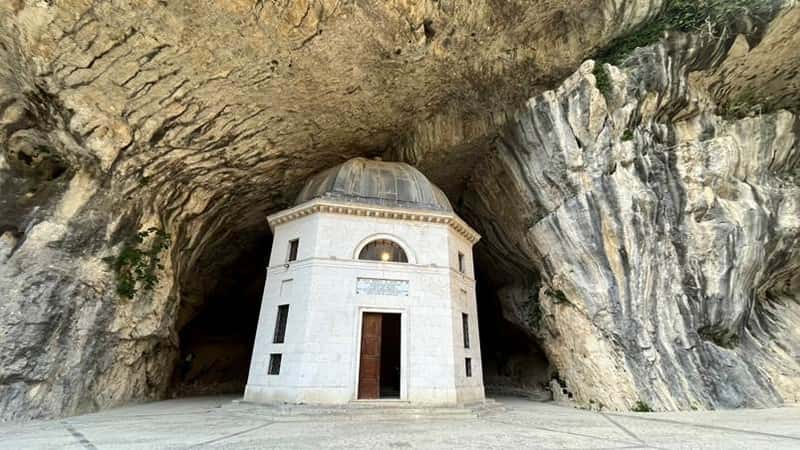
The cave is immense, rugged, and irregular; the temple is precise, linear, and perfectly calibrated to the space available; the nearby hermitage (which I will describe later) is small and rough. And yet, within this visual and geological variety—constantly shifting and layered—everything feels suspended in time, held in a rare and delicate balance. I walked back and forth through the interior and exterior of the cave, observing the juxtapositions of materials and styles from different angles. The most dramatic viewpoint is from inside the cave itself, where the temple’s imposing silhouette, backlit, stands in perfect equilibrium with the greenery and rock of the opposite side of the valley.
Seeing it sparked a cascade of questions: why here, of all places? How many years did it take to build such a striking structure? What was the architect’s guiding idea? Once the initial sense of wonder settled, the answers began to surface, one by one.
The Valadier Temple: Human Order Within Natural Chaos

The temple was designed in 1828 by architect Giuseppe Valadier, the same figure behind the redesign of Rome’s Piazza del Popolo, and was completed in a relatively short time precisely because it was conceived as an essential, almost archetypal structure. The building is octagonal, built in travertine, and crowned by a restrained dome. It was commissioned by Pope Leo XII as a protected place of worship and a safe refuge for the faithful, in a symbolic location that combined isolation with the ideals of order and rationality. Placing a Neoclassical temple in such a harsh and seemingly inhospitable environment was a powerful statement: faith could exist anywhere, even where it appeared to have no space at all—within landscapes, and souls, that might seem unwelcoming.
According to historical sources, Valadier conceived the project with the intention of not competing with the mountain, but of respecting it. He wrote that architecture should “submit to nature without offending its majesty.” And that is exactly what happens here. The temple does not dominate its surroundings, but settles into them with composure. Light filters from above, reflects off the limestone walls of the cave, and creates an atmosphere that feels suspended, contemplative, and quietly solemn.
The Hermitage of Santa Maria Infra Saxa

Right next to the temple stands the Hermitage of Santa Maria Infra Saxa, often mistaken for a simple secondary chapel. In reality, this small structure has much older origins, dating back at least to the 9th century, and is quite literally built infra saxa, within the rock itself. Early records describe it as a cloistered female monastery inhabited by Benedictine nuns.
The hermitage is reduced to its essentials. The façade is simple, the interior austere, with faint traces of medieval frescoes still visible. It forms a perfect counterpoint to the Neoclassical temple. Where Valadier represents design and order, the hermitage speaks of adaptation and renunciation. Together, they illustrate two opposing yet complementary ways of inhabiting the mountain.
Practical Information

Reaching the Valadier Temple requires a car or other private transportation. The town of Genga lies roughly halfway between Ancona and Perugia, at the edge of the Marche and Umbria regions. From the parking area, access is exclusively on foot via an uphill walk of about 30 minutes. Comfortable walking shoes are essential. At the beginning of the trail, there is a small fountain where visitors can refill water bottles—an important detail during the warmer months.
For meals, it’s worth stopping in or around Genga or Serra San Quirico, where simple, authentic trattorias serve traditional Marche cuisine, including handmade pasta, grilled meats, and local wines. For overnight stays, agriturismi and small local hotels offer ideal options for travelers seeking quiet and immersion in nature, often at far more reasonable prices than more heavily trafficked destinations.