Bangkok is a city that overwhelms and fascinates at the same time: golden temples, constant traffic, street food aromas, and an energy that never seems to slow down. In the historic heart of the Thai capital stands Wat Pho, one of the city’s most significant and revered temples, right by the Grand Palace. Visiting this place is not only an encounter with Thai spirituality, but also an immersion into a cultural landscape where religion, knowledge, and care for the body have been deeply intertwined for centuries.
I am not a big fan of massages by default. I enjoy them, of course, but only when they have a story to tell and they go beyond simple muscle relaxation. And that is exactly what I found in Bangkok, where massage is the expression of an ancient tradition, a disciplined practice, and a spiritual connection between body and mind. Follow my story to learn everything you need to know about experiencing what might just be the best massage of your life – I know that I one I got there was mine.
The Grand Palace of Bangkok: History and Significance
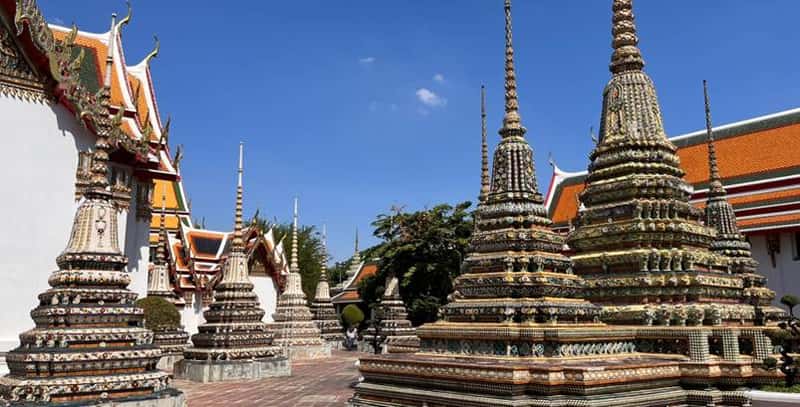
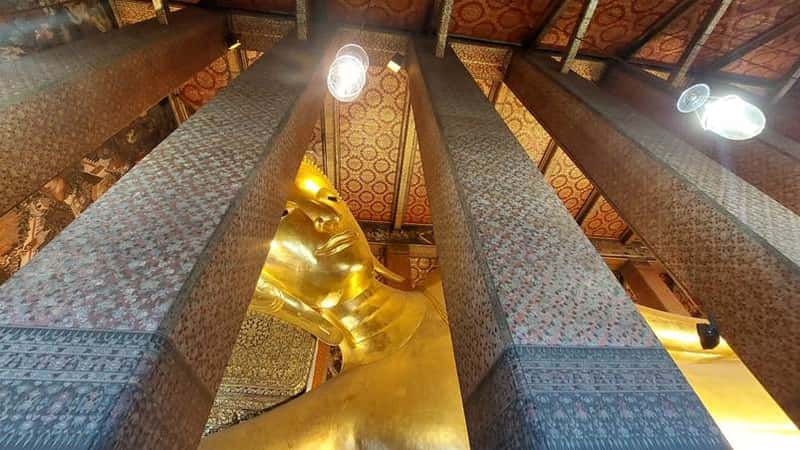
Let’s start from the place where everything began. Founded in the late 17th century and extensively rebuilt by King Rama I at the end of the 18th century, Wat Pho is one of Bangkok’s oldest and largest temple complexes. Often referred to as the Temple of the Reclining Buddha, it is best known for its monumental 46-meter-long Buddha statue, covered in gold leaf and depicting the moment of the Buddha’s entry into Nirvana. But Wat Pho is far more than a single iconic image. The temple complex spreads across a vast area filled with courtyards, chedis, cloisters, and richly decorated pavilions, where marble floors, intricate mosaics, and serene Buddha images create an atmosphere that feels both majestic and deeply contemplative.
Historically, Wat Pho functioned not only as a religious center but also as a place of learning: inscriptions carved on stone slabs preserved knowledge on medicine, massage, astronomy, and literature, making the temple one of Thailand’s earliest public centers of education. Walking through Wat Pho today means moving through layers of history, where spiritual practice, scholarship, and daily life have coexisted for centuries.
Wat Pho: The Birthplace of Thai Massage

Wat Pho is widely recognized as the birthplace of traditional Thai massage and home to the Wat Pho Thai Traditional Medical and Massage School, the oldest and most respected institution for Thai medicine and massage in the country. The massages offered within the temple complex are not improvised tourist services, but part of a structured, codified tradition passed down through generations.
Traditional Thai massage (Nuad Thai) combines deep pressure, stretching, and work along energy lines, without the use of oils. You remain fully clothed, lying on a floor mat, while the practitioner uses hands, elbows, knees, and even feet to release tension and restore balance.
The Massage Experience After Visiting the Site

A visit to the Wat Pho grounds is visually stunning but also physically demanding. Heat, humidity, and crowds can take their toll, especially after hours spent walking among courtyards, chedis, and galleries. This is precisely why the idea of indulging in a traditional Thai massage feels so natural here—not as an extra, but as a continuation of the experience. Entering the massage area at Wat Pho feels like stepping into another dimension. The transition is immediate and striking. Outside, the city pulses; inside, everything slows down. There is no music, no chatter, no unnecessary movement. You wait quietly in line, in order of arrival, until your name is called. Silence is absolute.
The massage takes place in a single large room, softly lit, wrapped in deep penumbra. Therapists move calmly from one futon to the next, working with precision and focus. The air carries a subtle scent of essential oils and talcum powder. The atmosphere is deeply meditative—so much so that, despite the physical nature of the treatment, you risk drifting into sleep, carried by a sense of profound well-being. Nothing here feels rushed or performative. Everything invites stillness. All therapists are trained at the official Wat Pho school, and the quality is consistently high. This is not a gentle spa treatment designed purely for relaxation. Traditional Thai massage can be intense, especially if your body is tired or holding tension. But it is precisely this depth that makes it effective, particularly after a long, hot day of sightseeing.
Understanding Your Body Through Massage
One of the most fascinating aspects of receiving a massage at Wat Pho is that it is not just relaxing—it is revealing. Through pressure points, stretches, and your body’s responses, the therapist can sense areas of tension, fatigue, and accumulated stress. Without many words, the massage becomes a form of dialogue, helping you understand how your body is really doing.
You begin to realize where stress has settled, where energy feels blocked, and how imbalance manifests physically. In this context, massage is not only about relief, but about awareness—a way to reconnect body and mind through touch and movement. In my case, at the end of the session, the therapist looked at me, smiled, and said: “Come back tomorrow—for double the time.” It was half a joke, half a diagnosis. And honestly, it felt accurate.
Practical Information: Tickets and Hours
Wat Pho is open daily from 8:00 AM to 6:30 PM, making it easy to fit into a full day of sightseeing. The entrance ticket costs around $5–6 USD, and it also grants access to the temple complex, including the Reclining Buddha. Massage treatments are offered inside the temple grounds, and prices vary depending on duration. As a general reference, a traditional Thai massage costs approximately $7–8 USD for 30 minutes and $10–12 USD for a 60-minute session, making it an accessible experience even by Bangkok standards.
A smart way to organize your visit is to explore the temple earlier in the day, when temperatures are slightly more bearable, and save the massage for early afternoon. That is usually when the heat and humidity peak—and when your body will appreciate the treatment the most.
How to Get There and Getting Around
Reaching Wat Pho is relatively straightforward, especially if you plan ahead. One of the most convenient and scenic options is to take a Chao Phraya River boat, which avoids Bangkok’s often congested traffic. Public boats stop at Tha Tien Pier, just a short walk from the temple entrance, making this a popular choice for both locals and visitors.
Taxis and ride-hailing services such as Grab are also widely available and convenient, although travel times can vary significantly depending on traffic. For those looking for a more traditional experience, tuk-tuks are plentiful in the area, but it’s important to agree on the fare before getting in.
Once you arrive, the historic district around Wat Pho is best explored on foot. Many major landmarks are within walking distance, and moving slowly through the area allows you to appreciate the rhythm of daily life around the temples, rather than rushing from one stop to another.
Dress Code: What to Wear
As a functioning Buddhist temple, Wat Pho has a strict dress code that visitors are expected to respect. Shoulders must be covered, and both men and women are required to wear pants or skirts that fall below the knee. Tank tops, short skirts, short shorts, and beachwear are not permitted, and flip-flops are discouraged inside the temple grounds.
If you arrive unprepared, don’t worry too much: appropriate clothing can be rented or purchased near the entrance for a small fee. Still, coming dressed correctly will save time and make the visit more comfortable.
For the massage itself, no special attire is needed. Comfortable clothing is provided by the massage school, allowing you to relax fully without having to change beforehand.
Culture, History, and Well-Being in One Experience
Getting a traditional Thai massage at Wat Pho is special because this is where the practice was born and refined. Experiencing it here means engaging with the massage in its original cultural and philosophical context, not just as a physical treatment. More than anywhere else in the world, Wat Pho allows you to understand the true essence of traditional Thai massage—its focus on balance, awareness, and the connection between body and mind.