I’ve never felt particularly drawn to caves—despite the fact that, in Zelda: Tears of the Kingdom, they’re easily my favorite biome. Maybe it was the idea of darkness, cold, and humidity; I’m not entirely sure. What I do know is that stepping into the Grotte di Frasassi made me realize I had been missing something important—and that caves would no longer be something I automatically crossed off my future itineraries.
Located in Italy’s Marche region, the Grotte di Frasassi form a hidden system that has been patiently shaping itself beneath the surface for millions of years. Set near the small town of Genga, Frasassi is one of the largest and most spectacular karst cave complexes in Europe. But size alone doesn’t explain its impact. What makes these caves extraordinary is their clarity: scale, structure, and time are immediately legible, even to visitors with no geological background. You don’t need to understand the science to feel the immensity.
A Cathedral Carved by Water
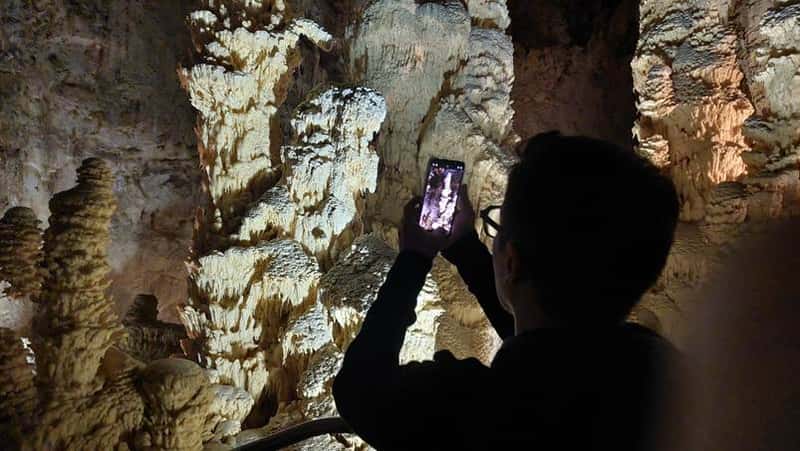
The visit begins almost abruptly. One moment you’re in the green Apennine foothills, the next you’re stepping into an underground space so vast it challenges perception. The Abisso Ancona, the largest chamber in the complex, is often compared to a cathedral—and the comparison is not rhetorical. Its volume is so vast that it could comfortably contain St. Patrick’s Cathedral in New York, yet the space is entirely natural, carved by water and chemical processes over roughly 190 million years.
Stalactites and stalagmites rise and descend with a precision that feels architectural. Some are massive and blunt, others thin and translucent, all extremely fragile. The lighting—carefully designed and unobtrusive—helps read the space without turning it into spectacle. What strikes you most is not decoration, but proportion. Everything feels calibrated by time.
Moving Through Deep Time

The guided path through the caves unfolds as a sequence of chambers, each with its own atmosphere. Narrow passages open suddenly into enormous voids; low ceilings give way to vertiginous heights. The temperature remains constant year-round, around 57°F, and the air feels clean, slightly humid, and still.
What Frasassi does exceptionally well is pacing. The walk is long enough to feel immersive but never rushed. You begin to understand how water, drop by drop, has shaped every surface. Flowstone formations ripple like frozen waterfalls; mineral deposits create subtle color variations—ivory, amber, soft gray—that change depending on light and angle. It’s a reminder that geological processes operate on scales we rarely consider, yet their results are immediately tangible.
The Single Attractions Inside the Cave
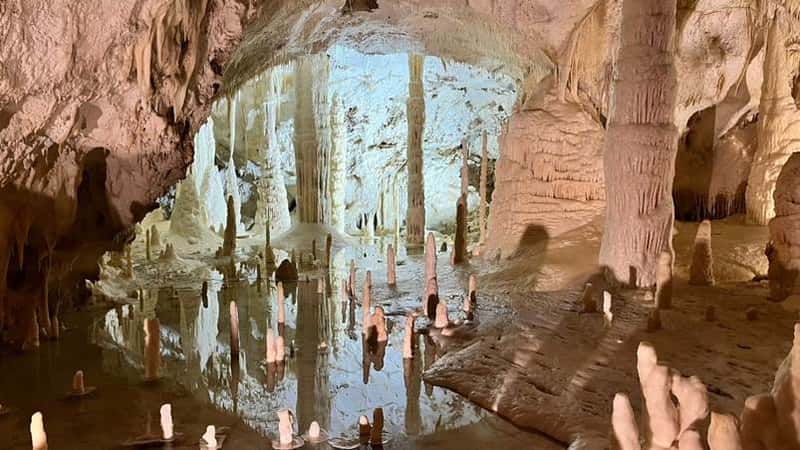
Beyond the Abisso Ancona, the Frasassi complex unfolds through a sequence of distinct chambers, each with its own identity, named after the recognizable shapes and formations found within them. The Sala delle Candeline is filled with delicate, slender stalagmites that resemble wax drippings. The Sala dell’Orso, named after prehistoric bear remains once found here, introduces a more intimate scale, while the Sala dell’Infinito opens again into a vast, luminous space dominated by massive formations that feel almost sculptural. The Sala delle Spade, where long, blade-like stalactites descend from the ceiling at sharp angles, creating a sense of suspended movement. Throughout the route, underground streams, flowstone curtains, and mineral basins appear and disappear, reinforcing the idea that Frasassi is not a static monument but a living geological system, constantly reshaped by water and time.
Not Just a Cave, but a System
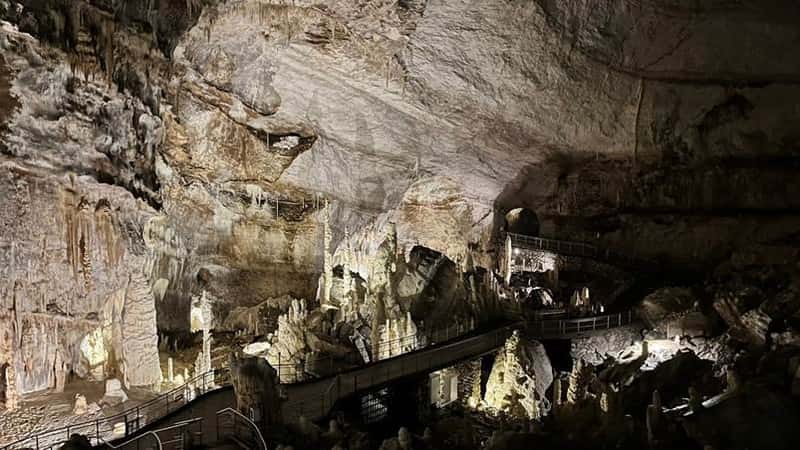
Frasassi is not a single cavern but a complex network, still active and evolving. Underground rivers continue to flow, and new formations are constantly in the making, though imperceptibly slow. This sense of ongoing change gives the visit a strange immediacy: you’re not looking at something finished, but at something in progress.
There’s also an unexpected sense of calm. Despite the scale, the caves don’t feel oppressive. Instead, they invite a kind of focused attention. Sound is absorbed, movement slows, and conversations naturally drop in volume. It’s an environment that encourages quiet observation rather than explanation.
Practical Information: Visiting Frasassi
The Grotte di Frasassi are open year-round, though hours vary by season. Entry is only possible with a guided tour, which is included in the ticket and conducted in Italian; audio guides or printed materials in other languages are usually available. The full visit takes about 75 minutes, and booking in advance is recommended, especially on weekends and during summer.
The caves are located about 60 miles northeast of Rome and can be reached by car in roughly 1.5 to 2 hours. There is also a train station at Genga–San Vittore Terme, followed by a short shuttle or taxi ride to the entrance. Parking is available on site.
Wear sturdy shoes with good grip and bring a light jacket—the constant cool temperature can feel chilly after a while. Photography is allowed in most areas, but tripods and flash are typically prohibited.
For food, options near the caves are limited to casual cafés and restaurants. For a more relaxed meal, consider driving to nearby towns in the Marche countryside, where traditional trattorias offer simple, satisfying local cuisine.
A Different Kind of Italian Wonder
Frasassi doesn’t fit the classic Italian travel narrative of art cities and layered urban history. Instead, it offers something rarer: a confrontation with the physical structure of the planet itself. There are no frescoes here, no ruins, no piazzas—yet the experience is just as memorable. It’s also surprisingly accessible. Paths are well maintained, stairs are manageable, and the visit doesn’t require special equipment beyond comfortable shoes. This balance between accessibility and awe is one of Frasassi’s greatest strengths.