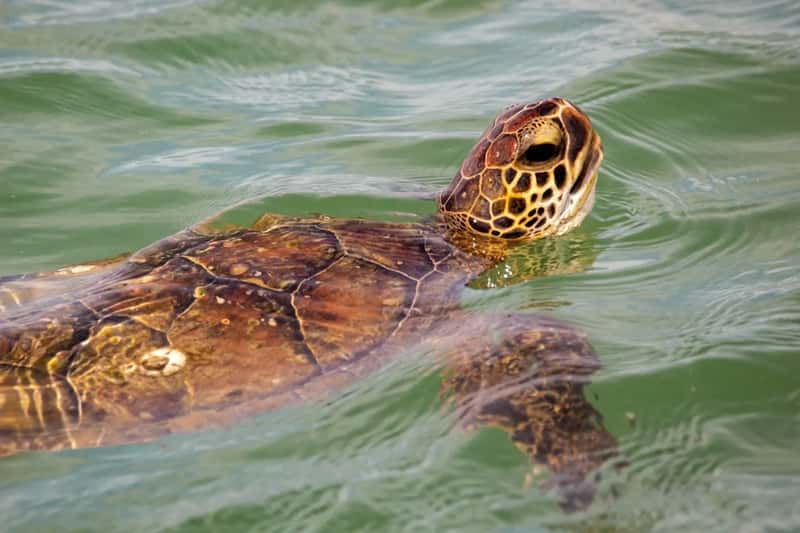
There’s a turtle smaller than a dinner plate that has become one of the most closely watched conservation stories along the Gulf Coast. The Kemp’s ridley sea turtle holds the unfortunate distinction of being the smallest sea turtle in the world, and for decades it also carried the label of being the world’s rarest. Yet something remarkable has been happening on the beaches of Texas and Mexico, and in the cold waters off Cape Cod, that suggests this pint sized reptile might just have a future after all.
What makes the Kemp’s ridley story so compelling isn’t just the numbers, though those are dramatic enough. It’s the sheer scale of coordinated effort, spanning two countries, dozens of agencies, hundreds of volunteers, and decades of unglamorous fieldwork, that has kept this species from disappearing entirely. The turtle’s recovery has never been a straight line upward, but the persistence behind it tells its own story.
A Species Pushed to the Brink
The scale of the Kemp’s ridley’s decline is almost hard to fathom. The estimated number of nesting females in 1947 was 89,000, but shrank to an estimated 7,702 by 1985. Other estimates put the collapse even more starkly, noting the population fell from 40,000 nesting females in the 1940s to about 200 by 1985. Either way, the trajectory was catastrophic, and it happened within a single human lifetime.
The causes were varied but preventable. For decades, their eggs were harvested en masse for sale or consumption, and adult turtles were routinely caught and killed in shrimp trawlers in the Gulf of Mexico. Egg poaching alone could wipe out nearly an entire generation in a single season, since Kemp’s ridleys concentrate their nesting on a small handful of beaches. That vulnerability, having almost the whole species reliant on one narrow stretch of coastline, is precisely what made the crash so swift and so severe.
The World’s Rarest Sea Turtle
Even today, the Kemp’s ridley carries a heavy title. L. kempii is the rarest species of sea turtle and is the world’s most endangered species of sea turtle as well as the smallest. The species gets its name from an unlikely source, too. The species is named after Richard M. Kemp, a fisherman from Key West, Florida, who first submitted the species for identification in 1906.
Geographically, the turtle is something of a homebody compared to its wide ranging cousins. They are primarily found in the Gulf of America (formerly Gulf of Mexico), but juveniles are also found in the Atlantic Ocean as far north as Nova Scotia and sometimes even occur in the eastern North Atlantic Ocean. That narrow home range is a double edged sword. It makes the population easier to monitor and protect in a concentrated area, but it also means there’s no backup population elsewhere to fall back on if something goes wrong in the Gulf.
Turtle Excluder Devices Changed Everything
If there’s one single innovation that turned the tide for Kemp’s ridleys, it’s the turtle excluder device, commonly known as a TED. These simple metal grids fit into shrimp trawl nets and let turtles escape before they drown, while still letting shrimp pass through to be caught. Bycatch in commercial and recreational fishing gear continues to be the biggest threat facing Kemp’s ridley sea turtles, and NOAA Fisheries and partners are dedicated to protecting and recovering the species using a variety of innovative techniques to study, protect, and recover it.
Beyond gear modifications, regulators have also leaned on smarter fishery management. Bycatch of ridley turtles is being reduced by fishing gear modifications such as the use of TEDs, changes to fishing practices, and closures of certain areas to fishing during nesting and hatching seasons. None of this happened overnight. It took years of pushback from parts of the shrimping industry before TEDs became standard practice, but the payoff in reduced turtle deaths has been significant.
Mexico’s Beaches and the Bi-National Partnership
The heart of the Kemp’s ridley’s recovery story actually lies south of the U.S. border, at a beach called Rancho Nuevo in Tamaulipas, Mexico. Kemp’s ridleys were once abundant in the Gulf with tens of thousands of females nesting at Rancho Nuevo, before the population crashed in the mid-20th century to a low of only several hundred females nesting in the 1980s, prompting intensive conservation actions on nesting beaches and through fisheries management.
What’s remarkable is how long this cross border collaboration has lasted. Bi-national protection efforts between the US and Mexico have been sustained for over 50 years, longer than almost any international wildlife conservation partnership. Mexican conservationists guard nests around the clock during the arribada, the synchronized mass nesting event where females emerge together to nest in mass arribadas.