The gate agent calls your row.
You already know where you’re sitting.
You booked it three weeks ago. You checked it twice.
Not because of the view. Not exactly.
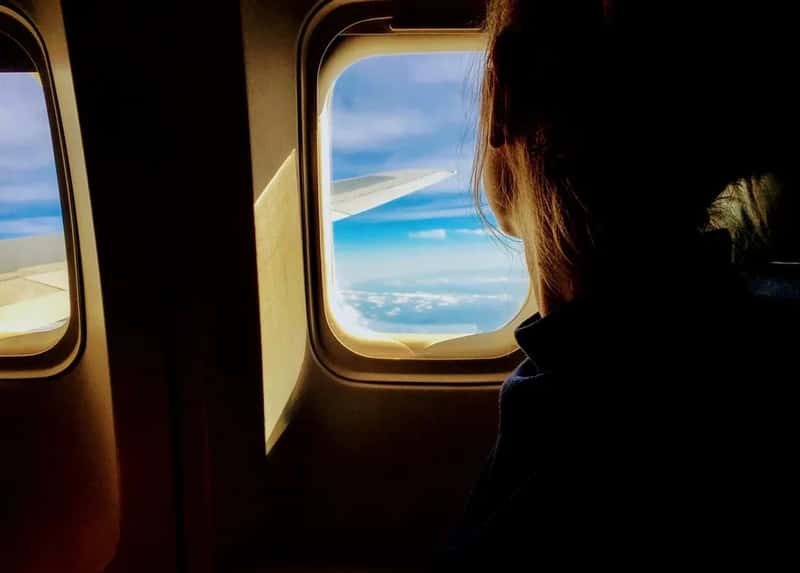
There is something that happens the moment you slide into that corner. The fuselage presses against your left shoulder. The oval window glazes the light. The aisle – and everyone in it – becomes a problem that belongs to someone else. You exhale. You didn’t know you were holding your breath until just now.
This is the gap between the version of yourself that navigates open-plan offices, dinner parties, and group chats – and the version that quietly, fiercely needs a wall on one side just to feel like a person. We move through the world performing accessibility. We smile at strangers. We leave the door ajar. But put us at 35,000 feet in a pressurized aluminum tube with 200 people we will never see again, and the mask slips. We reach for the corner. We reach for the edge. We reach for the wall.
The Control Ritual
You open the seat map the moment booking becomes available.
You don’t scroll. You go directly to the window.
This is not coincidence. Performance psychology specialist Sam Wones says this kind of behavior runs deeper than seat preference – it reflects a need for control in environments where individuals feel they lack it, and ritualistic actions like seat-map checking can reduce anxiety about the unknown. Think about what that means. The plane hasn’t taken off. You haven’t even packed your bag. But your nervous system is already negotiating. It is already scanning the environment for the one variable it can still manage.
The window seat is that variable.
According to psychologist and University of Washington professor Jonathan Bricker, Ph.D., seat selection is “a rare opportunity to have some control over your environment when traveling” – and that is very significant for the traveler.
This isn’t anxiety. This is intelligence. The body knows what it needs before the mind admits it.
You are not being rigid. You are being precise.
The Insulation Instinct
There is a wall on your left side. A stranger is on your right.
This is the entire architecture of your peace.
When you choose the window, there’s a wall on one side – and for the most part, you’re insulated enough that you won’t be affected by other people’s behavior. You won’t have your seatmate asking you to move so he can go to the bathroom. Read that again slowly. That simple physical fact – one side sealed, one side open – is the entire difference between a bearable flight and three hours of low-grade social dread.
The wall is not about coldness. It is about calibration.
When on the ground in a large group of people, introverts often feel physically uncomfortable and prefer to stay on the periphery – so it makes sense that it’s the same in the air. They just don’t like to be surrounded by people or objects on all sides.
The periphery is not the margins. The periphery is where you can finally breathe.
The wall is the architecture of a private self in a very public world.
The Nesting Reflex
Within ninety seconds of sitting down, you have already arranged your space.
Phone in the seat pocket. Earbuds in. Jacket folded, wedged against the fuselage.
You are building something.
Dr. Becky Spelman, chief psychologist at Harley Street’s Private Therapy Clinic, notes that window seat passengers like to be in control and “like to ‘nest’ and prefer to exist in their own bubble.” The word “nest” is worth sitting with. A nest is not a luxury. A nest is a survival structure. It is the thing an animal builds specifically so the world cannot get in.
As Bricker puts it, “You can create your own little own space by the window.” The spot feels cozier, and you can rest a pillow against the wall for more comfy naps. “You can create a little bit of a home,” he says.
Home. On an airplane. At altitude. Between cities.
This is what the window seat person is actually doing: locating themselves in space when everything else is between places.
The Bubble Psychology
The bubble is not metaphor. It is neurological fact.
Personal space isn’t just social preference – your brain actively regulates it. The amygdala, your threat-detection center, fires when that bubble is compressed without consent. Every stranger who brushes your armrest, every knee that drifts into your zone, every unwanted conversation – these are minor activations of a system designed to keep you safe from predators. The body does not distinguish between a saber-toothed tiger and a chatty seat neighbor in 24B.
People higher in anxiety or introversion typically prefer more distance, while extroverts tend to be comfortable standing closer.
The window seat is the most defensible position in economy class.
Your personal space is a territory that, like all territories, you defend to maintain your autonomy and comfort. Whether it’s a seat in a public space or your own room, territorial behaviors show how we project our need for space and control into the world around us.
You are not antisocial. You are simply awake to your own perimeter.
The Inner World Premium
Let me be honest with you for a moment.
I have paid extra for this. Not a little. Genuinely more money than was reasonable, for a slightly better window seat on a medium-haul flight. And I did not feel foolish about it. I felt relieved. Because what I was actually purchasing wasn’t a seat. It was a few hours of being unreachable. A few hours of pressing my forehead against cold Plexiglas and watching the cloud ceiling break open over the Atlantic, and not having to explain myself to a single person while I did it. The wall on my left was worth every dollar.
Passengers who opt for a window seat tend to place a higher emotional value on the entire travel experience, as a simple look at the horizon seems to alter their mindset while onboard.
There’s something about staring out at clouds that invites deep thought. Research shows that people who regularly engage in self-reflection tend to have greater self-awareness and emotional intelligence.
The inner world is not an escape. It is a destination.
The Introversion Signal
It is not shyness. Get that out of the way immediately.
Introversion is a basic personality style characterized by a preference for the inner life of the mind over the outer world of other people. One of the Big Five dimensions that define all personalities, introversion sits on a continuum at the opposite end of which is extroversion. Compared to extroverts, introverts enjoy subdued and solitary experiences.
Those who prefer window seats often score high on the introversion scale. They cherish their solitude and often use the flight time to recharge their batteries. This doesn’t mean they’re antisocial or shy.
It means the noise costs something.
Psychologists confirm that introverts gravitate toward window seats for privacy and control, while extroverts prefer aisle seats for mobility and easier interaction.
One group is managing energy. The other is generating it.
The window seat is where the energy debt gets paid back, quietly, at altitude, with the world locked safely on the other side of the glass.
The Territorial Identity
You claimed this seat before you arrived.
That act is more significant than it appears.
One of the most basic forms of territorial behavior is simply using the same space repeatedly. When you sit at the same desk in a library day after day, or always choose the same corner of the couch at home, you are engaging in habitual occupation. This repeated use strengthens the psychological bond between you and the space, making it feel like yours even if you share it with others.
Window seat people are not choosing a view. They are choosing a position in the world.
Psychologist Julian Edney outlined seven key dimensions of territoriality: physical space, possession, defense, exclusiveness of use, markers, personalization, and identity.
Identity. There it is.
The seat is a declaration. A small, quiet, non-negotiable declaration of exactly who you are when no one is asking you to be anything else.
The Exit That Never Comes
Here is the dark irony of the window seat: you are the most trapped person on the plane.
You cannot leave without permission. You cannot stretch without politics. You cannot get up at 2 AM without waking the stranger beside you, which means you simply don’t get up, which means you sit there, sealed in, for hours – and you chose this.
You chose the beautiful prison.
Window seat lovers often have a desire for control – the ability to regulate their engagement with others on the flight, the opportunity to decide when to stare out at the clouds or when to shut the world out. That paradox is the whole thing in a sentence. You accept physical confinement in exchange for psychological freedom. You trade mobility for sovereignty. You cannot leave. But nothing can come in.
The window seat gives you power. You control the shade. You decide if it’s bright or dark. You’re not at the mercy of someone else’s preferences.
In a world that is constantly demanding your attention, the shade is yours to open or close. That is not a small thing.
The Horizon Gaze
At some point during the flight, you stop looking inward and start looking out.
The clouds below are not scenery. They are evidence.
Evidence that you are, for the moment, between things. Between who you were at the departure gate and whoever is meeting you at the other end. Between obligations. Between performances. Between versions of yourself.
It’s as though a sense of adventure or a more open mindset is somehow linked to seeing what’s outside the aircraft. This idea of “horizon gazing” – and the feeling of being “on a journey” – enhances comfort levels, perhaps making long flights more bearable for some.
Introverts tend to be introspective and drawn to solitary activities – like staring out of an airplane window. They’re comfortable being alone with their thoughts, and a plane journey offers the perfect opportunity for some quiet reflection.
The horizon is not a destination. It is permission. Permission to be nobody for a while. Permission to think thoughts that belong only to you.
The wall is there. The world is outside it. And for once, that is exactly where you want it.
The Boundary as Identity Architecture
You did not choose the window seat because you are difficult.
You chose it because you know, with some precision, what you need to remain yourself.
The concept of personal boundaries reflects deeper psychological needs for self-protection and identity formation amid today’s fast-paced world. And the window seat is one of the last places where a boundary can be established cleanly, architecturally, without a single conversation. The wall does the work. You don’t have to explain.
Next time you’re booking a flight and instinctively click on that window seat, you’re not just choosing where to sit – you’re honoring something essential about who you are. You’re someone who values internal reflection over external noise. Who needs boundaries and isn’t afraid to create them.
The choice between a window and an aisle seat is not just about where one sits; it’s a reflection of personal needs, psychological comfort, and even one’s personality. But it goes further than that. It is a reflection of the private architecture of the self. The self that doesn’t live in your Instagram bio or your job title or the person you become after the second drink at the work function. The self that exists quietly, continuously, in the small decisions no one else notices you making.
You chose the wall.
You chose it on the first flight you can remember, and you’ve chosen it every time since, and you’ve never really had to think about why. It just felt right. It felt like the only position in the entire plane where you could be still inside, even while the jet stream was carrying you somewhere new at 500 miles per hour.
That stillness is not passivity. It is the most sophisticated form of self-knowledge there is.
Somewhere above the clouds, pressed between aluminum and sky, one hand resting on the cool curve of the fuselage – you are more yourself than you will be at the destination.